Spot Bitcoin ETFs record $450M inflows in ‘early positioning’ push

cointelegraphPublished on 2025-12-18Last updated on 2025-12-18

Abstract

Spot Bitcoin ETFs recorded $457 million in net inflows on Wednesday, the highest single-day intake in over a month. Fidelity’s FBTC led with $391 million, followed by BlackRock’s IBIT with $111 million. Cumulative net inflows now exceed $57 billion, with total assets surpassing $112 billion. Analysts suggest the rebound reflects early macro positioning amid expectations of lower interest rates, as signaled by potential Federal Reserve policy shifts. However, Bitcoin faces resistance due to a large supply cluster between $93,000–$120,000, with 6.7 million BTC currently held at a loss. Market demand remains fragile, and price stability may depend on absorbing sellers above $95,000 or new liquidity entering the market.

Spot Bitcoin exchange-traded funds (ETFs) recorded $457 million in net inflows on Wednesday, marking their strongest single-day intake in more than a month as institutional demand showed signs of re-acceleration.

Fidelity’s Wise Origin Bitcoin Fund (FBTC) led the inflows, recording the largest daily intake at roughly $391 million, accounting for the majority of the day’s net inflows. BlackRock’s iShares Bitcoin Trust (IBIT) followed with around $111 million, according to data from Farside Investors.

The inflows lifted cumulative net inflows for US spot Bitcoin (BTC) ETFs to more than $57 billion, while total net assets climbed above $112 billion, equivalent to around 6.5% of Bitcoin’s total market capitalization.

The rebound followed a choppy stretch in November and early December, when flows alternated between modest inflows and sharp outflows. Spot Bitcoin ETFs last saw inflows above $450 million on Nov. 11, when funds pulled in roughly $524 million in a single day.
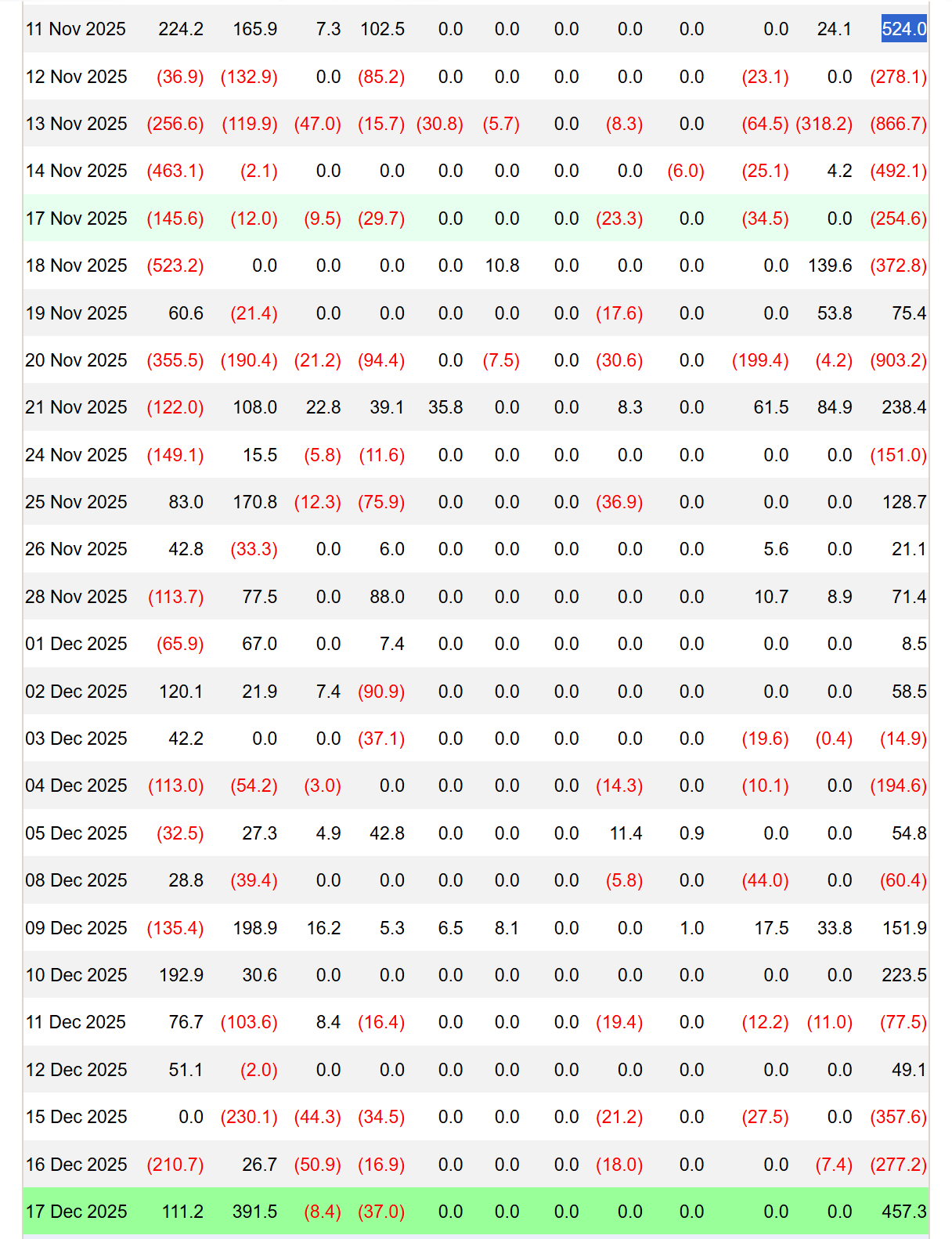
Last time spot Bitcoin ETFs saw inflows of over $450 million was on Nov. 11. Source: Farside Investors

Related: Crypto ETPs to enter ‘cheesecake factory’ era in 2026: Bitwise

Bitcoin ETF inflows show early macro positioning

Vincent Liu, chief investment officer at Kronos Research, said the renewed interest appears to reflect early positioning rather than late-cycle enthusiasm. “ETF inflows feel like early positioning,” Liu said. “As rate expectations soften, BTC becomes a clean liquidity trade again. Politics sets the mood, but capital moves on macro.”

However, Liu cautioned that while momentum could continue, it is unlikely to be smooth. “Momentum likely holds, but expect it to be uneven,” he said. “Flows will track liquidity and price action. As long as BTC remains a clean macro expression, ETFs stay the path of least resistance.”

On Wednesday, US President Donald Trump said he plans to appoint a new Federal Reserve chair who strongly supports cutting interest rates. Speaking during a national address marking the first year of his second term, Trump said he would announce a successor to current Fed Chair Jerome Powell early next year, adding that all known finalists favor lower rates than current levels. Lower rates are usually considered bullish for risk assets like crypto.

Related: Spot Bitcoin ETFs see $358M outflow: Are investors really abandoning BTC?

Around 6.7 million BTC sitting at a loss

Bitcoin has returned to price levels last seen nearly a year ago, leaving behind a dense supply cluster between $93,000 and $120,000 that continues to cap recovery attempts. This top-heavy structure has pushed the amount of Bitcoin held at a loss to 6.7 million BTC, the highest level of the current cycle, according to Glassnode.

The report said demand remains fragile across both spot and derivatives markets. Spot buying has been selective and short-lived, corporate treasury flows episodic, and futures positioning continues to de-risk rather than rebuild conviction. Until sellers are absorbed above $95,000 or fresh liquidity enters the market, Bitcoin is likely to remain caught between structural support near $81,000, per Glassnode.

Magazine: 2026 is the year of pragmatic privacy in crypto — Canton, Zcash and more

Trending Cryptos

Related Reads

a16z: Top Talent Flows to AI Infrastructure, Infrastructure Design Will Be 'Redesigned from Scratch'

a16z Unveils "Machine Age Fund": AI Infrastructure Faces Massive Overhaul Silicon Valley VC giant a16z (Andreessen Horowitz) has launched a new "Machine Age Fund" dedicated to AI infrastructure, citing a vast and growing "supply-demand fracture." Key takeaways: * **Unlimited Demand vs. Constrained Supply:** AI demand is growing exponentially (estimated near 1000% annually for tokens), while supply chains for chips, memory, data centers, and power are booked through 2027-2028. GPU prices are rising against historical trends. * **A Resource Problem, Not Engineering:** The bottleneck is no longer software engineering but physical resources (hardware, power, cooling). Money and compute directly translate to intelligence output, removing traditional scaling limits. * **Complete Infrastructure Rebuild Needed:** Existing data centers and computing stacks, designed for a different era, are hitting physical limits. Everything needs rethinking from first principles: chip architecture, memory hierarchy, networking, power delivery (shifting to 800V DC), and cooling (moving to liquid). * **Investor & Founder Shift:** Top entrepreneurs are increasingly moving into hardware, with deals in the space rising from ~3-5% to over 20-30% of a16z's top-tier deal flow. Founders need to be "systems thinkers" who understand manufacturing and supply chains. * **Massive Economic Scale:** Training a frontier model now costs $3-5B. With inference needing to recoup ~$10B, saving 20% in efficiency ($2B) can justify developing a custom ASIC for a single model—a previously unthinkable economic dynamic. * **Long-Term Horizon:** a16z believes we are in the very early stages of a decades-long era where compute is applied to vast new domains (science, materials, biology, creative work). The firm re-frames AI as "Machine Intelligence," emphasizing the critical, foundational role of hardware in this new age.

marsbit26m ago

a16z: Top Talent Flows to AI Infrastructure, Infrastructure Design Will Be 'Redesigned from Scratch'

marsbit26m ago

Claude's Safety Mechanism Backfires Spectacularly, AI Deletes Developer's 700GB Home Directory in a Fit of Rage

Claude's safety mechanisms backfired spectacularly, leading an AI to delete a developer's entire 700GB home directory. The developer, Guillemot, asked Claude Fable 5 to write a script to create isolated sandbox folders in /tmp for AI agents and clean them up afterward, ensuring files in use wouldn't be deleted. Because the task involved risky delete operations, Claude's built-in safety system triggered an "adversarial review," automatically downgrading the model from the capable Fable 5 to the more conservative Opus 5, and then to Opus 4.8, to perform a security check. The Opus 4.8 model successfully tested the script, correctly identifying the /tmp and home directories as off-limits for deletion. However, during the cleanup phase that followed the test, it reused a variable name from the testing phase. This variable contained the path to the user's home directory. Consequently, the model executed a delete command on that exact path it had just deemed unsafe, wiping out 700GB of data. The intended /tmp directory remained untouched. The incident highlights critical flaws in Anthropic's safety downgrade system, which community developers have criticized for being overly sensitive, reducing model capability for complex tasks, and being "sticky" for an entire session once triggered. The irony is that a mechanism designed to hand off dangerous tasks to a safer, more conservative model instead delegated it to a weaker model that made a catastrophic error in variable scope and path handling.

marsbit48m ago

Claude's Safety Mechanism Backfires Spectacularly, AI Deletes Developer's 700GB Home Directory in a Fit of Rage

marsbit48m ago

Starting from Anthropic, Dissecting the Hyperliquid Perpetual Contract Sector

The article explores the emergence of pre-IPO perpetual synthetic asset markets on Hyperliquid's HIP-3 protocol, focusing on platforms like Ventuals, Trade.xyz, and Entropy. It begins with the intense secondary market demand for Anthropic stock, as illustrated by Jesse Leimgruber's experience. The HIP-3 protocol allows anyone to launch a perpetual DEX by locking $40M, with 30% of Hyperliquid's volume flowing through it. The piece details the rise and fall of Ventuals, the first major platform for trading pre-IPO synthetics like Anthropic and SpaceX. Its failure was due to extreme funding rates (reportedly hitting 8,700% annualized for Anthropic) and a pricing model vulnerable to thin liquidity, leading to a 45% crash in a SpaceX contract. Trade.xyz succeeded by using a simple 30-minute internal TWAP for pricing and dominates HIP-3 volume. Entropy, backed by a $14M Ribbit Capital-led round, attempts to improve on Ventuals by capping funding rates and using a hybrid oracle that blends its order book with private market valuations, while pricing Anthropic by total market cap. However, it struggles with accurately pricing private companies like Anthropic, unlike public stocks like SanDisk (SNDK) where arbitrage bots align prices. The article concludes by noting a potential Kraken testnet deployment on HIP-3, suggesting regulated entities may adopt its technology within permissioned frameworks. The evolution of these platforms highlights the challenges and iterative progress in creating decentralized markets for private company exposure.

marsbit1h ago

Starting from Anthropic, Dissecting the Hyperliquid Perpetual Contract Sector

marsbit1h ago

Trading

Spot

Hot Articles

What is DOGE M

Doge Matrix ($doge m): The New Breed of Community-Driven Cryptocurrency Introduction In the ever-evolving landscape of cryptocurrency, new projects constantly emerge, each aiming to capture the interest of investors and enthusiasts alike. One of the latest entrants to this domain is Doge Matrix, represented by the ticker symbol $doge m. This project has attracted attention thanks to its roots in the popular meme culture surrounding Dogecoin, establishing its place within the web3 space. This article aims to provide a comprehensive analysis of Doge Matrix, covering its overview, creator, investors, functionality, timeline, and notable aspects. What is Doge Matrix ($doge m)? Doge Matrix is a community-driven cryptocurrency project that seemingly builds upon the widespread appeal of Dogecoin, a digital currency known for its Shiba Inu mascot and its meme origins. While the overarching objectives of Doge Matrix are not extensively defined, it is characterized by a commitment to harnessing community involvement and support. Unlike traditional cryptocurrencies that often emphasize utility or intrinsic value through underlying technologies, Doge Matrix positions itself within a space that embraces the cultural phenomenon of cryptocurrencies, particularly appealing to those who resonate with the ethos of meme-based assets. Drawing on the strengths of the Dogecoin community, Doge Matrix operates as part of a broader ecosystem, inviting participation and engagement from users who share an interest in cryptocurrency and the digital landscape. Who is the Creator of Doge Matrix ($doge m)? The identity of the creator of Doge Matrix remains unknown. This lack of transparency is not an uncommon occurrence in the cryptocurrency space, where some projects are launched without revealing the identities of their founders. The absence of information regarding the founding team can raise questions among potential investors about the project’s accountability and direction. Who are the Investors of Doge Matrix ($doge m)? As it stands, there is no publicly available information detailing the investors or investment foundations that back Doge Matrix. The project appears to rely primarily on community support rather than institutional investment. This model aligns with the community-driven nature of the initiative, fostering an environment where the direction of the project is shaped by its participants rather than being dictated by a select few financial backers. How Does Doge Matrix ($doge m) Work? The specifics regarding the operational mechanisms of Doge Matrix are somewhat vague, reflecting a broader trend of projects in the meme coin space where innovative functionalities are not always clearly articulated. Nonetheless, Doge Matrix seems designed to tap into the existing cryptocurrency ecosystem by encouraging user participation while tapping into the familiar cultural references associated with Dogecoin. Its potentially unique characteristics derive from community interactions rather than technological advancements, emphasizing shared experiences and collaboration among token holders. While the exact innovations have not been explicitly outlined, the project appears to create a space where community members can engage, share ideas, and propel the project's potential forward. Timeline of Doge Matrix ($doge m) Reflecting on the project’s timeline reveals notable events that have defined its journey thus far: November 25, 2024: Doge Matrix reached its all-time high value, marking a significant milestone in its early history. January 1, 2025: Conversely, Doge Matrix hit its all-time low value, illustrating the volatility often associated with cryptocurrencies, especially in the early stages of a project's lifecycle. Ongoing: The project continues to be actively traded and supported by its community, although specific future milestones or objectives have yet to be disclosed. Key Points About Doge Matrix ($doge m) Community Focus At the heart of Doge Matrix is a commitment to community engagement. The project thrives on the premise of collaboration and shared objectives among its members, emphasizing the importance of collective effort. Unlike centralized projects that often have a defined leadership structure, Doge Matrix at present showcases a more fluid approach to governance, where every community member's voice matters. Volatility The cryptocurrency market is notorious for its volatility, and Doge Matrix is no exception. Its price history reflects significant fluctuations between high and low values, which is typical of many new cryptocurrencies but underscores the risks associated with investment in emerging tokens. Lack of Detailed Information One of the most striking features about Doge Matrix is the scarcity of detailed information regarding its technological underpinnings and operational mechanisms. This ambiguity necessitates that potential investors conduct thorough due diligence before engaging with the project. Conclusion In summary, Doge Matrix ($doge m) illustrates a new wave of cryptocurrency projects that lean heavily on community engagement and cultural relevance. While lacking in certain specifics—such as clear leadership, defined objectives, and detailed functionality—the project has managed to generate interest within the crypto community, leveraging the established appeal of meme culture. As with any investment in the cryptocurrency space, understanding the inherent risks and conducting comprehensive research is essential for potential participants. Doge Matrix stands as a reminder of the dynamic, sometimes unpredictable nature of the crypto industry, marked by constant evolution and enthusiasm for community-driven initiatives.

4.5k Total ViewsPublished 2025.02.03Updated 2025.02.03

What is DOGE M

What is $M

Understanding Mantis ($M): A New Era in Cross-Chain Interoperability In the continually evolving landscape of Web3 and cryptocurrency, new projects strive to offer innovative solutions aimed at enhancing the user experience and expanding functional possibilities within the decentralized financial ecosystem. One such project garnering attention is Mantis ($M), a pioneering protocol founded on the principles of cross-chain interoperability and intent-based settlements. This article delves into the essential aspects of Mantis, including its core functionality, creators, investment backing, innovative features, and critical milestones. What is Mantis ($M)? Mantis is described as a multi-domain intent settlement protocol that simplifies cross-chain interactions, enabling users to execute complex financial transactions across various blockchain platforms seamlessly. The protocol operates through three primary layers: Intent Expression: Users can articulate their transaction goals using natural language facilitated by the DISE LLM, an advanced AI language model. For instance, a user might express a desire to swap Ethereum (ETH) for Solana (SOL) with a specific slippage tolerance of 1%. Execution: This layer employs a network of solvers that compete to fulfill user intents. Transactions are executed using mechanisms such as Coincidence of Wants (CoWs) and Order Flow Auctions (OFAs), which ensure that user demands are met optimally. Settlement: Leveraging the Inter-Blockchain Communication (IBC) protocol, Mantis enables atomic cross-chain transactions, allowing users to operate across various supported chains, including Ethereum, Solana, and Cosmos. Mantis is engineered to introduce native yield generation for idle assets, employing cryptographic proofs to maintain the integrity of transactions throughout the entire process. Creators & Development Team Mantis was conceived by the Composable Foundation, a research-driven organization notable for its emphasis on blockchain interoperability solutions. This foundation collaborates with esteemed academic institutions, including Harvard University and the University of Lisbon, contributing to extensive research and development efforts that inform Mantis's architecture and functionality. The Composable Foundation’s commitment to fostering innovation in the blockchain space positions Mantis as a robust solution for the growing demand for interoperability among multiple blockchain networks. Investors & Backing While specific details about individual investors have not been publicly disclosed, Mantis enjoys substantial backing from various entities, including: Ecosystem grants from IBC-enabled chains, which support the protocol's growth and integration within decentralized finance ecosystems. Strategic partnerships with infrastructure providers that enhance Mantis's network capabilities and deployment strategies. Funding through the Composable Foundation's treasury, ensuring sustained financial support for ongoing development and operational costs. These collaborative efforts reflect a consensus among stakeholders about the importance of enhancing cross-chain functionality and the potential utility of Mantis's infrastructural innovations. Key Innovations Mantis sets itself apart through several pioneering innovations that enhance its functionality and utility: Chain-Agnostic Intents: Users can initiate transactions from any supported chain while settling on another. This flexibility empowers users, driving increased interaction among different platforms. AI-Powered Interface: The integration of DISE LLM allows users to conduct complex DeFi operations using natural language, thereby simplifying interactions and making blockchain technology accessible to a broader audience. Cross-Domain MEV Capture: Mantis creates an internal market for maximal extractable value (MEV) through competitions among solvers. This innovative approach allows for greater efficiency and value extraction in complex transactions. Modular Settlement Layer: The protocol supports various verification methods, including zero-knowledge proofs and optimistic rollups, providing a versatile framework that can adapt to emerging blockchain technologies. Historical Timeline Mantis's development is marked by several critical milestones that chart its trajectory and growth: | Year | Milestone | |————|————————————————————————-| | 2022 | Initial concept development within the Composable Foundation's research division. | | Q3 2024 | Launch of the testnet with bridging capabilities between Solana and Ethereum. | | Q1 2025 | Anticipated Token Generation Event (TGE) alongside the mainnet launch. | | Q2 2025 | Expected integration of DISE LLM and expansion of cross-chain capabilities. | | 2025 H2 | Planned support for over 15 chains through further IBC upgrades. | This timeline outlines Mantis's evolution, from conceptual discussions to active implementation and future growth phases. Ecosystem Growth Strategy Mantis's strategy for ecosystem growth includes several initiatives designed to encourage user participation and developer engagement: Credits System: Users can earn protocol credits by providing liquidity and engaging in referral programs. These credits are redeemable for incentives in the future, fostering a robust user community. Modular Software Development Kit (SDK): This toolkit empowers developers to create applications based on intent-driven models utilizing Mantis's infrastructure, thus promoting innovation within its ecosystem. Governance Model: As the protocol matures, $M token holders will have a voice in protocol governance, allowing them to vote on proposed upgrades and changes, thereby enhancing community engagement and decentralization. Mantis represents a significant advancement in the realm of cross-chain architecture. By seamlessly integrating advanced AI algorithms with a robust settlement framework, Mantis seeks to tackle the problems of fragmentation within multi-chain ecosystems. Its innovative approach prioritizes improved user experiences while adhering to the foundational principles of decentralization and security, setting a new standard for the future interoperability of blockchain technologies. As Mantis continues its journey of growth and implementation, it promises to be a project to watch closely in the competitive landscape of Web3 and decentralized finance. With its focus on crossing boundaries and elevating user engagement, Mantis is poised to be an integral part of the future developments in the cryptocurrency space.

927 Total ViewsPublished 2025.03.18Updated 2025.03.18

What is $M

How to Buy M

Welcome to HTX.com! We've made purchasing MemeCore (M) simple and convenient. Follow our step-by-step guide to embark on your crypto journey.Step 1: Create Your HTX AccountUse your email or phone number to sign up for a free account on HTX. Experience a hassle-free registration journey and unlock all features.Get My AccountStep 2: Go to Buy Crypto and Choose Your Payment MethodCredit/Debit Card: Use your Visa or Mastercard to buy MemeCore (M) instantly.Balance: Use funds from your HTX account balance to trade seamlessly.Third Parties: We've added popular payment methods such as Google Pay and Apple Pay to enhance convenience.P2P: Trade directly with other users on HTX.Over-the-Counter (OTC): We offer tailor-made services and competitive exchange rates for traders.Step 3: Store Your MemeCore (M)After purchasing your MemeCore (M), store it in your HTX account. Alternatively, you can send it elsewhere via blockchain transfer or use it to trade other cryptocurrencies.Step 4: Trade MemeCore (M)Easily trade MemeCore (M) on HTX's spot market. Simply access your account, select your trading pair, execute your trades, and monitor in real-time. We offer a user-friendly experience for both beginners and seasoned traders.

9.5k Total ViewsPublished 2025.07.02Updated 2026.06.02

How to Buy M

Discussions

Welcome to the HTX Community. Here, you can stay informed about the latest platform developments and gain access to professional market insights. Users' opinions on the price of M (M) are presented below.

活动图片