Key Signals
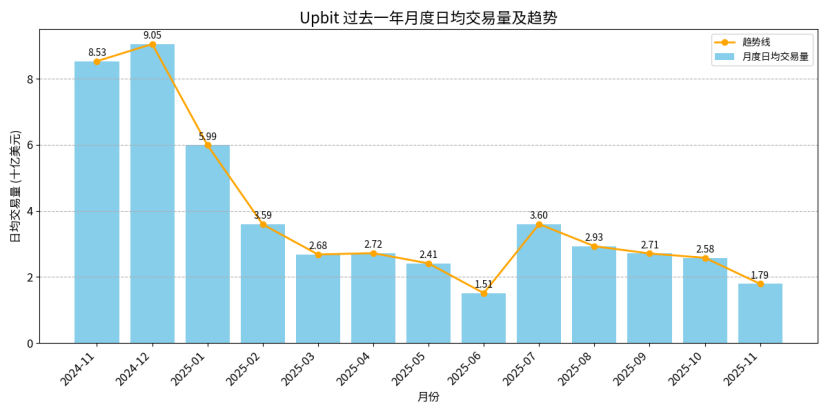
- The South Korean digital asset market is undergoing one of the most significant structural resets in its history. Upbit's average daily trading volume fell from $9 billion in December 2024 to $1.78 billion in November 2025, a drop of approximately 80%. This occurred against a backdrop where the total number of new listings on Korean exchanges in 2025 actually increased by 141% year-on-year. Meanwhile, retail capital is fiercely rotating, flooding into the soaring stock market. Led by the AI chip sector, spearheaded by Samsung Electronics and SK hynix, the KOSPI index rose by about 70%.
- The "Kimchi Premium," once seen as a hallmark phenomenon of the Korean market, historically maintained at around 10%, has now compressed to about 1.75%. This is not a massive capital flight, but a normalization process squeezing out speculative bubbles.
- The Kimchi Premium refers to the price difference where cryptocurrencies like Bitcoin trade at a higher price on local Korean exchanges (e.g., Upbit, Bithumb) compared to global exchanges (e.g., Binance, Coinbase).
- The core question is: Has Korea's crypto era ended, or is this a system reset before the next structural wave?
2. Behind the Freeze: Deconstructing the Slowdown in Korea's Crypto Market
This is not a short-term correction but a structural readjustment driven by a combination of regulation, capital controls, and investor fatigue.
2.1 Regulatory Delays and Uncertainty
- The stablecoin bill, a core pillar for the future of digital assets in Korea, has been stalled for 7 months due to disputes over whether the "issuing entity should be a bank or a non-bank institution." There are currently 6 different proposals under review, and the Financial Services Commission (FSC) plans to consolidate them into a unified bill by the end of 2025.
- This regulatory vacuum has slowed the pace of innovation on the institutional side and made Web2 companies exploring tokenization and settlement layer innovations more cautious, with the overall environment clearly shifting towards risk aversion.
2.2 Capital Outflow and Liquidity Trap
- Korea's strict foreign exchange controls block overseas market makers and institutions from injecting liquidity, leading to a long-term trend of one-way capital outflow.
- The Foreign Exchange Transactions Act (FETA): Non-residents cannot freely hold or flexibly use the Korean Won (KRW). The vast majority of large foreign exchange and capital movements require mandatory reporting or prior approval, significantly limiting the ability of overseas institutions to operate smoothly in the Korean market.
- The Financial Supervisory Service's (FSS) "Foreign Exchange Business Processing Guidelines": Local banks face strict intraday position caps and are essentially prohibited from providing KRW liquidity to non-resident institutions, making it difficult for overseas market makers to establish KRW positions and provide truly bilateral liquidity services.
- Although it is predicted that the revenue scale of Korea's digital asset market will reach $635 million by 2030, liquidity constraints remain prominent in the short term.
- Interestingly, the Korean market is highly reliant on leveraged trading. Once a new catalyst emerges, such as regulatory clarity or a new global Bitcoin rally, the market could rebound extremely rapidly.
2.3 Constructive Correction, Not a True Crash
- Rather than viewing the market cooling as a recession, it's better understood as a return to normalcy. Korea's cycle is aligning with global trends: shifting from speculation-driven extensive growth to a phase more focused on utility value. The focus of market participants is gradually moving from short-term trading to infrastructure, custody, compliance, and real-world application layers. Although painful, this phase is a necessary process to support sustainable future expansion.
3. Crypto Giants Land in Seoul Collectively
- Even though local retail participation has significantly declined, global crypto giants are still actively increasing their bets on the Korean market. This counter-cyclical expansion precisely indicates that external players remain highly optimistic about Korea's population's technological literacy and the long-term potential of the institutional market.
3.1 Key Moves
- In October 2025, Binance re-entered the Korean market in a major way by acquiring Gopax, ending a four-year absence. This was partly facilitated by the relaxation of foreign ownership restrictions in Korea and also releases a signal that Korea is willing to open up further to global crypto companies.
- This acquisition lays the groundwork for more intense market competition, smoother liquidity channels, and more sophisticated product offerings, significantly upgrading the products and services available to local users.
- Core Performance Indicator Matrix
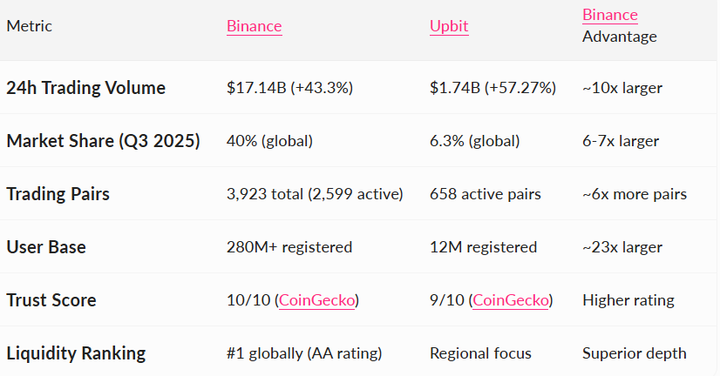
Source: Surf AI, 2025
3.2 Why Now?
This timing can be understood through three strategic factors:
- High Crypto Literacy and Extremely Fast Technology Adoption Rate
- Korea remains one of the fastest markets globally in accepting and implementing emerging technologies, including AI and digital assets.
- Stablecoin Integration Prospects
- Local banks, fintech companies, and internet giants like Kakao and Naver are exploring stablecoin pilots, potentially bridging the local financial system with the on-chain world.
- Sustained Institutional Demand
- Korean institutional investors are increasingly interested in custody, asset tokenization, and legal, compliant digital asset allocation, laying the foundation for sustained long-term capital inflows.
4. Outlook
- The current downturn is not an end, but a structural reset pushing the Korean market from pure speculative behavior towards utility value orientation, better aligned with institutional demand. Stablecoin legislation, institutional custody infrastructure, and a potential Bitcoin ETF are highly likely to become key pillars of the next growth phase. Korea is entering a new stage driven by real product value, user education, and compliant innovation.
4.1 Market Forecast
- The Korean crypto market is expected to grow slowly at a compound annual growth rate (CAGR) of 2.94%, but the real inflection point is likely to come from a Bitcoin ETF potentially approved in 2026. This topic has been frequently discussed and rumored among Korean policymakers.
- Once approved, potential changes include:
- Formal participation by Korean pension and asset management institutions
- Large-scale entry of overseas market makers
- Higher quality price discovery and tighter bid-ask spreads
This could also potentially re-establish Korea's status as a regional "net inflow hub" for capital.
4.2 Korea's Web2 and Web3 Convergence
- Korean large enterprise groups are delving deeper into the practical application layer of blockchain:
- Banks, fintech companies, and large tech firms are testing stablecoin pilots and exploring payment and settlement rails related to the digital Korean Won.
- Upbit and Bithumb have launched or expanded institutional custody services, enabling local institutions and overseas capital to re-enter the market in a compliant manner.
- This signals a shift from speculation-dominated usage to an application model centered on infrastructure and practical use.
4.3 Global Comparison
- Korea's regulatory direction is increasingly resembling Japan's: strict yet relatively predictable. If Korea can achieve similar regulatory clarity on key issues like stablecoins, asset tokenization, and digital asset ETFs, it has every opportunity to become one of Asia's most balanced crypto hubs, attracting both institutional builders and global liquidity.
4.4 From a Web3 Marketing Perspective: Why Korea Places Extra Importance on Product Usability
- An important but often underestimated structural driver in Korea's next cycle is the increasing market demand for genuine product usability.
- Korea is one of the few markets where exchanges and users actively test, verify, and deeply understand a project before truly accepting it. This trend is becoming more pronounced as the market transitions to a utility-driven phase.
- For example:
- Upbit's Quiz Events: Treating education as market infrastructure
- Upbit often conducts quiz-based educational activities when listing new coins, requiring users to answer questions about:
- The project's technical architecture
- Token economic model
- Use cases and real-world functions
- Roadmap and risk profile
- This is fundamentally different from the airdrop farming models common in other regions. The signal it sends is that Korean exchanges value verification, understanding, and user education more, and require projects to clearly and deeply explain their value.
- Upbit X Surf Product Practical Usage Event
- In 2025, Upbit and Surf collaborated on a product hands-on event, encouraging users to directly use the project's product, experience its functions, and produce meaningful usage results.
- This clearly demonstrates a shift:
- Korean exchanges are increasingly prioritizing validation based on actual usage experience, rather than superficial exposure marketing.
- In Korea, a product being usable and user-friendly is itself the strongest marketing.
- Narrative without execution cannot survive here long-term.
4.5 Investor Playbook
To position effectively during this reset phase, investors need to:
- Continuously monitor key catalytic events, such as: FSC bill integration progress, Bitcoin ETF-related discussions, and upcoming stablecoin legislation.
- Prioritize allocating to projects with long-term utility value, rather than tokens relying purely on sentiment and speculation.
- Focus closely on macroeconomic indicators in the fourth quarter, as historically Korean retail investors have often re-entered the market en masse during risk-on recovery cycles.
- Diversify allocations to reduce single holdings dependent entirely on political and regulatory timing for thematic narratives.
Furthermore, investors should focus on international ecosystems that are proactively establishing local presence and capabilities in Korea. A key trend shaping Korea's next cycle is the rapid formation of partnerships between global public chain ecosystems and Korean large enterprises. This预示着 Korea is transitioning from a market primarily focused on trading and consumption to a hub role of "co-development and deep infrastructure integration."
Case 1: Sui x t’order
- Local Partner: t’order (Korea's dominant tableside ordering and POS network)
- Integration Method: Supports KRW-pegged stablecoin payments,配合 QR code and facial recognition payment, zero fees for merchants, real-time settlement
Case 2: Solana x Shinhan Securities
- Local Partner: Shinhan Securities (one of Korea's top securities firms)
- Cooperation Method: Signed a strategic Memorandum of Understanding (MOU) to jointly support Web3 entrepreneurs, developers, and the Solana ecosystem in Korea, led by Superteam Korea
Case 3: Arbitrum x Lotte Group
- Local Partner: Lotte Group (one of Korea's largest conglomerates)
- Integration Method: Arbitrum provided significant developer grants to Caliverse (Lotte's metaverse platform) for integrating the Arbitrum blockchain
5. Korea's Crypto Winter is a Reset, Not a Retreat – And a Strategic Entry Window for Builders
Despite the current market contraction, Korea remains one of the world's most dynamic crypto markets. Stablecoins are helping Web2 large enterprises explore on-chain settlement and infrastructure tokenization; leading exchanges continue to expand custody and institutional services; and the possibility of a Bitcoin ETF approval significantly increases the probability of overseas liquidity flowing back to Korea.
Korea's crypto ecosystem is not coming to an end; it is maturing rapidly.
This reset means: Korea is transitioning from a hype-driven retail playground to a digital asset economic system with structural design, institutional support, and institutional participation as its core fulcrum.