Solana’s Network User Base Expands With Rapid Rise in Returning Participants

bitcoinistPublished on 2026-06-08Last updated on 2026-06-08

Abstract

Despite a prolonged price decline that tested the $60 level, the Solana network shows no signs of slowing down. Recent data reveals significant growth in its user base, driven by a rapid increase in returning participants. Over 1.7 million users are returning to the network daily, reaching the highest level since February, which is seen as a key indicator of long-term health and user confidence. Furthermore, Solana is outperforming Ethereum in key metrics. Over the past week, Solana processed nearly double the perpetual futures volume and more than double the DEX aggregator volume compared to Ethereum. This growing disparity leads some analysts to believe Solana could lead the next wave in finance. Currently, SOL is trading around $65, showing a slight price increase.

Even after a lengthy period of downward price action, bringing Solana’s value to retest the $60 level, the network does not seem to be slowing down in any way. During this highly negative phase, the SOL network has persistently seen positive activity across its ecosystem, with some activity reaching unprecedented levels.

Returning Users Fuel Solana’s Network Growth

Solana network continues to demonstrate robust strength in the face of heightened volatility across the altcoin and the broader cryptocurrency market. Recent data shows that Solana is witnessing a significant growth in its network user base as the number of returning participants increases at an accelerated rate.

Zensei unveiled this network growth on the X platform, which has notably captured the attention of the community, with many expressing optimism toward the altcoin. The development suggests that current users are also becoming more active throughout its expanding array of services and applications, in addition to continuing to interact with the ecosystem.

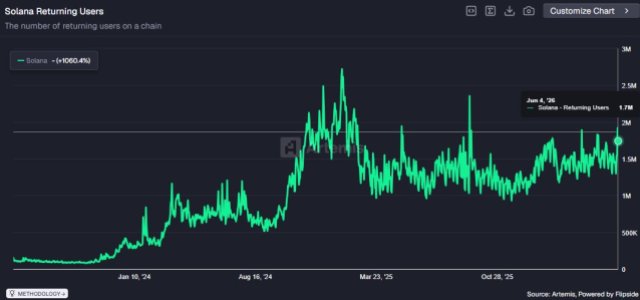
In the midst of criticism, SOL is steadily recording more than 1.7 million users, who are returning to the network every day. Such a strong rise in returning users is often seen as a crucial indicator of the network’s health, indicating long-term interest rather than short-term speculation.

Source: Chart from Zensei on X

As seen on the Solana Returning Users chart, these players recently surged to their highest level since February this year. Zensei has referenced this growth to continued confidence among these users because more people are sticking around instead of just trying to exit the network.

Furthermore, the expert has highlighted SOL network’s superiority against other major chains across the crypto sector. In his view, there is nowhere else in the crypto sector where millions of users keep showing up every day as Solana does on a daily basis.

Why SOL Could Lead The Next Wave Of Finance Ahead Of Ethereum

In another X post, Zensei revealed that the gap between Solana and Ethereum keeps getting wider, with SOL dominating Ethereum in several key areas. Data shared by the expert shows that SOL has surpassed Ethereum in both Perp volume and Decentralized Exchange (DEX) aggregator volume over the past week.

During the period, SOL processed over $19.0 billion in perp volume compared to Ethereum, which saw about $10.1 billion, representing a lead of nearly 89%. On the DEX aggregator side, SOL captured approximately $10.2 billion in volume compared to the $4.8 billion of Ethereum, indicating a lead of roughly 115%.

After this robust disparity in growth between the two leading networks, the expert is confident that Solana will lead the future wave of finance ahead of Ethereum. This noteworthy SOL performance demonstrates the network’s growing usefulness and capacity to handle rising activity levels.

CoinMarketMap’s data is showing that the SOL price is trading at $65, demonstrating a nearly 2% increase in the last 24 hours. However, trading volume is moving in a different direction, dropping by more than 3% over the past day.

SOL trading at $66 on the 1D chart | Source: SOLUSDT on Tradingview.com

Related Questions

QAccording to the article, what key metric is highlighted to show Solana's network health despite recent price volatility?

AThe significant growth in returning users, with over 1.7 million returning daily, is highlighted as a key indicator of the network's long-term health and interest.

QWhat data does Zensei present to argue that Solana could lead the next wave of finance ahead of Ethereum?

AZensei presents data showing Solana dominating Ethereum in Perp volume (approx. $19.0B vs $10.1B) and DEX aggregator volume (approx. $10.2B vs $4.8B) over a recent one-week period.

QWhat does the chart from Zensei show about the level of Solana's returning users recently?

AThe chart shows that the number of Solana's returning users recently surged to its highest level since February of this year.

QAccording to the expert cited, what does the sustained high number of returning users suggest about user behavior?

AThe expert suggests it indicates continued confidence among users, with more people sticking around and engaging with the ecosystem's services rather than just trying to exit the network.

QWhat are the current price and 24-hour trading volume trend for SOL as mentioned at the end of the article?

AThe SOL price is mentioned as trading at $65, with a nearly 2% increase in the last 24 hours, while its trading volume decreased by more than 3% over the same period.

Related Reads

Huang Renxun Dramatically 'Saves' South Korean Stock Market

In early June, South Korea's stock market experienced a sharp decline, with the KOSPI index dropping over 5% and triggering a trading halt. Amid this volatility, NVIDIA CEO Jensen Huang's visit to Seoul provided a dramatic boost to market sentiment. During his trip, Huang held a dinner meeting with SK Group Chairman Chey Tae-won and SK Hynix CEO Kwak Noh-Jung. He announced that NVIDIA's new Vera CPU would utilize SK Hynix DRAM and confirmed a multi-year technical collaboration between the two companies. This partnership aims to co-develop next-generation memory for NVIDIA's AI infrastructure roadmap, covering products from data center supercomputers to personal AI devices. Huang also publicly commented that AI company stocks were attractively priced. A key announcement was that NVIDIA's upcoming Vera Rubin AI supercomputer systems will use HBM4 memory, with supply qualifications granted to all three major suppliers: SK Hynix, Samsung Electronics, and Micron Technology. Despite this multi-sourcing strategy, Huang warned that the industry-wide chip shortage, affecting everything from wafers to packaging, is expected to persist for several years due to relentless demand from global AI factory construction. The collaboration extends beyond memory supply. SK Hynix will employ NVIDIA's AI platforms and Omniverse digital twin technology to enhance its own semiconductor design, simulation, and manufacturing processes, aiming for more autonomous factory operations. This visit builds upon a prior October 2025 agreement for SK Group to build a large-scale AI data center using over 50,000 NVIDIA GPUs. Huang's itinerary also included meetings with other Korean giants like Hyundai, LG, and Samsung, indicating NVIDIA's broader strategy to deepen ties with South Korea's tech industry.

链捕手8h ago

Huang Renxun Dramatically 'Saves' South Korean Stock Market

链捕手8h ago

Trading

Spot
Futures

Hot Articles

Discussions

Welcome to the HTX Community. Here, you can stay informed about the latest platform developments and gain access to professional market insights. Users' opinions on the price of S (S) are presented below.

活动图片