Solana Strengthens RWA Presence With Explosive Growth In Value

bitcoinistPublished on 2026-05-20Last updated on 2026-05-20

Abstract

Despite a recent price pullback to around $85, the Solana network is experiencing significant growth, particularly in its Real-World Asset (RWA) ecosystem. The total value of tokenized assets on Solana has surged to a new all-time high of over $2.8 billion, driven by its fast transaction speeds and low costs. This reflects growing institutional interest in bringing traditional financial assets onto the blockchain. Simultaneously, Solana's perpetual futures (perp) volume has reached record levels, hitting approximately $20 billion in total volume, second only to Hyperliquid. A key driver is GMTrade, an RWA-focused decentralized exchange. SOL's daily perp volume recently hit a high of $4.7 billion, marking a 500% month-over-month increase. While perp open interest on Solana remains lower than competitors, the rising volume indicates heightened trader engagement and market liquidity.

Despite its consistent downside price action, the Solana network remains unshaken, with activity continuing to grow significantly. One of the areas the SOL network is currently seeing massive growth again is its Real-World Asset (RWA) ecosystem.

RWA Value On The Solana Network Climbs Sharply

Solana is gaining the community’s attention once again, even with its price pulling back to the $85 mark. Underneath its sideways price action over the past few weeks, the SOL network is rapidly expanding its footprint in the Real World Asset sector.

As tokenization gains major traction in the crypto space, the value of tokenized assets on the SOL network has seen explosive growth. A recent report from Solana’s official page on the X platform reveals that its RWA value has surged to over $2.8 billion, representing a new all-time high.
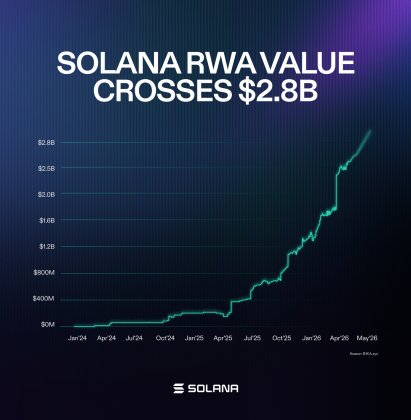
Source: Chart from Solana on X

This figure marks yet another major milestone for the leading network, reinforcing its position in the blockchain sector. The rapid expansion demonstrates the growing interest in bringing conventional financial products such as treasuries and other yield-bearing assets to the blockchain.

SOL attracting this kind of massive value in RWA is largely due to its fast transaction speed and lower costs. As institutional and developer activity around RWAs accelerates, this figure is expected to expand in the future.

SOL Perp Volume Is Trending At Its Highest Level Yet

In other areas, such as Perpetual (Perp) futures volume, the Solana network is also witnessing substantial growth. David Alexander, an on-chain data expert, reported that SOL’s perp volume has climbed sharply, opening the week at an all-time high. Such development has led to a significant rise in trader engagement and speculative activity, with derivatives markets becoming more active in response to SOL’s price fluctuations.

According to the data, the network is now handling about $20 billion in total perp volume, coming second only to Hyperliquid (HYPE), which currently handles over $42 billion. However, open interest across Solana perps is valued at just $223 million compared to the $9 billion of Hyperliquid.

Alexander highlighted that the majority of SOL’s perp volume was led by GMTrade, a leading RWA perp DEX, with $16 billion. Others include Pacifica and Jupiter Exchange, scooping up $2.9 billion and $1.3 billion, respectively.

This milestone comes just a few days after Solana perp volume saw its highest daily perp volume, recording over $4.7 billion in a single day, representing a +500% MoM. At the time of the achievement, SOL accounted for 21% of all perp activity, still only behind Hyperliquid’s 36%. In times of increased volatility and velocity like the current market state, rising perp volume is sometimes seen as an indication of increasing market interest and liquidity.

At the time of writing, SOL’s price was trading at $85, demonstrating a 0.41% increase over the last 24 hours. Its trading volume has also slightly risen by over 1.61% within the same time frame.

SOL trading at $85 on the 1D chart | Source: SOLUSDT on Tradingview.com

Trending Cryptos

Related Questions

QDespite its price action, in which sector is the Solana network experiencing significant growth according to the article?

AThe Solana network is experiencing significant growth in its Real-World Asset (RWA) ecosystem.

QWhat is the reported total value of Real-World Assets (RWAs) on the Solana network as mentioned in the article?

AThe total value of Real-World Assets (RWAs) on the Solana network has surged to over $2.8 billion, representing a new all-time high.

QAccording to the article, what are two key reasons cited for Solana's success in attracting RWA value?

AThe two key reasons are Solana's fast transaction speed and its lower costs.

QWhat milestone did Solana's Perpetual (Perp) futures volume achieve, and which platform is currently handling more volume according to the data presented?

ASolana's Perpetual futures volume opened the week at an all-time high. However, Hyperliquid (HYPE) is currently handling more volume, with over $42 billion compared to Solana's approximately $20 billion.

QAt the time of writing the article, what was the price of SOL and its 24-hour price change?

AAt the time of writing, SOL's price was trading at $85, demonstrating a 0.41% increase over the last 24 hours.

Related Reads

Grayscale Reassesses Zcash: In the Era of AI Surveillance, What is Financial Privacy Worth?

Grayscale Research reevaluates Zcash (ZEC) in the context of AI-powered financial surveillance. The report posits that stablecoins, transparent blockchains, and AI analytics tools are increasing the traceability of digital finance, potentially reigniting mainstream demand for financial privacy as a core monetary attribute. While AI could drive a third wave of privacy concern, Zcash's investment thesis hinges on whether this theoretical demand translates into sustained adoption. Zcash, operational for nearly a decade, uses zero-knowledge proofs to offer users a choice between transparent and shielded transactions, placing control of information disclosure back in users' hands. Recent infrastructure improvements—like wallet enhancements, mining pool expansions, and protocol upgrades—have reduced usability barriers. On-chain data shows shielded transactions comprise ~90% of transaction count, with ~25% of circulating ZEC in shielded pools, indicating existing use. However, significant risks remain. These include regulatory hurdles for exchanges and custodians dealing with shielded assets, past protocol vulnerabilities (theoretical, now patched), long-term quantum computing threats, and execution risks for future scalability upgrades. Grayscale's analysis suggests ZEC's current low market share (~0.6% of the "digital currency" crypto sector) offers valuation upside *if* the market reprices privacy. A scenario analysis notes that capturing 5% of this sector could imply a ~9x valuation increase, though this is a simplified sensitivity test, not a price target. Ultimately, Zcash's opportunity lies in the unresolved question: in an AI-monitored era, what price will the market assign to financial privacy? Validating the thesis requires monitoring growth in real shielded usage, wallet usability, upgrade timelines, and regulatory accessibility, not just price appreciation.

marsbit17m ago

Grayscale Reassesses Zcash: In the Era of AI Surveillance, What is Financial Privacy Worth?

marsbit17m ago

AI Democratizes Hacking, Bitcoin Red Team White Hats Race in Speed-Based Attack-Defense Contest

AI is democratizing powerful hacking tools, putting them in the hands of those with little cybersecurity expertise. Cryptocurrency developers are now in a race to find system vulnerabilities before attackers do. The Bitcoin Red Team, a group of 20-25 volunteers including anonymous developers like Calle, has formed to urgently address these AI-augmented security threats within the Bitcoin ecosystem. Calle emphasizes that while the Bitcoin core protocol itself is secure, the real risk lies in the wallets, applications, services, and other third-party software built on top of it—the software most users interact with. Incidents like the Coldcard wallet hack and the emergence of powerful Chinese AI models have accelerated their proactive security auditing efforts. The team both accepts audit requests from Bitcoin projects and proactively scans major open-source projects. They report found vulnerabilities to developers and refine their classification standards. Notably, Calle states the team frequently uses Chinese AI models over US counterparts, as the latter's strict safety guardrails often block cybersecurity research tasks, hindering their utility for finding or fixing vulnerabilities. Calle warns that AI is erasing the information asymmetry that previously protected some vulnerabilities. It lowers the technical barrier, allowing non-experts to exploit simple flaws. He describes the current state of Bitcoin software as "on fire" and believes the direct financial incentive of cryptocurrency makes it a first target in this industry-wide shift, with other sectors to follow. The era of security through obscurity is over.

marsbit38m ago

AI Democratizes Hacking, Bitcoin Red Team White Hats Race in Speed-Based Attack-Defense Contest

marsbit38m ago

Foreign Capital Sells Off $29 Billion in Short-Term US Treasuries, Why is the US Betting on Stablecoins to "Take Over"?

In June, foreign investors netted $133.5 billion into U.S. financial markets but simultaneously sold $29 billion in short-term U.S. Treasury bills. This divergence highlights a strong preference for U.S. equities over government debt. While overseas buyers purchased $181.4 billion in stocks, demand for Treasuries weakened significantly. This trend explains why the U.S. is looking to stablecoins as a potential new source of demand for its debt. Stablecoin issuers like Tether and Circle back their tokens primarily with highly liquid assets, including short-term Treasuries. As users buy stablecoins, issuers convert that dollar demand into Treasury purchases. Recent U.S. legislative efforts, such as the proposed rules under the *GENIUS Act*, formalize this by mandating stablecoin reserves be held in assets like cash and short-term Treasuries. Currently, stablecoins represent a substantial existing buyer base. For instance, Tether alone held nearly $115 billion in direct T-bill exposure in Q2. However, recent stablecoin supply growth has been minimal and does not account for the $29 billion sell-off by foreign investors in June. For stablecoins to act as a meaningful counterbalance to waning foreign demand, their circulating supply would need to expand significantly. The next TIC report will be crucial to monitor whether foreign selling continues and if stablecoin growth begins to fill the demand gap. Ultimately, the U.S. is strategically positioning the regulated stablecoin sector as a potential new pillar of demand for its government debt.

marsbit38m ago

Foreign Capital Sells Off $29 Billion in Short-Term US Treasuries, Why is the US Betting on Stablecoins to "Take Over"?

marsbit38m ago

Trading

Spot

Hot Articles

Discussions

Welcome to the HTX Community. Here, you can stay informed about the latest platform developments and gain access to professional market insights. Users' opinions on the price of SOL (SOL) are presented below.

活动图片