Solana RWA holders jump 440% YoY – Can it bridge gap to Ethereum’s XAUT?

ambcryptoPublished on 2026-04-06Last updated on 2026-04-06

Abstract

Solana's RWA ecosystem is experiencing explosive growth, with a 440% year-over-year surge in holders, totaling 218,000. This positions Solana as a major hub for tokenized real-world assets, which now have a total on-chain market cap of $24 billion. While Tether Gold (XAUT) on Ethereum leads the RWA market at $3.3 billion, Solana is gaining momentum through its strong focus on tokenized U.S. Treasuries. These assets, which make up over 50% of the RWA market, could generate revenue to strengthen Solana's digital asset treasuries (DATs) and support long-term network growth. The IMF has warned that the rapid growth of on-chain RWAs could disrupt traditional finance. Solana's expansion in this sector suggests it could become a viable alternative to Ethereum for institutional capital seeking tokenized assets.

When the International Monetary Fund (IMF) sounds the alarm, it signals that the threat is real.

Recently, the IMF has been pointing out how fast the Real World Asset (RWA) market is growing on-chain, warning that TradFi players could fall behind if this keeps up.

The logic is simple: More real-world capital is moving onto blockchain, which could change how central banks manage money and financial stability.

Notably, the numbers back it up.

The on-chain market cap of total RWAs has just hit a new all-time high of $24 billion, with Tether Gold [XAUT] leading the pack at $3.3 billion. What’s really interesting is how the market reacted immediately, with much of the momentum flowing toward Solana [SOL] as more investors look to take advantage of its growing RWA ecosystem.
Source: Token Terminal

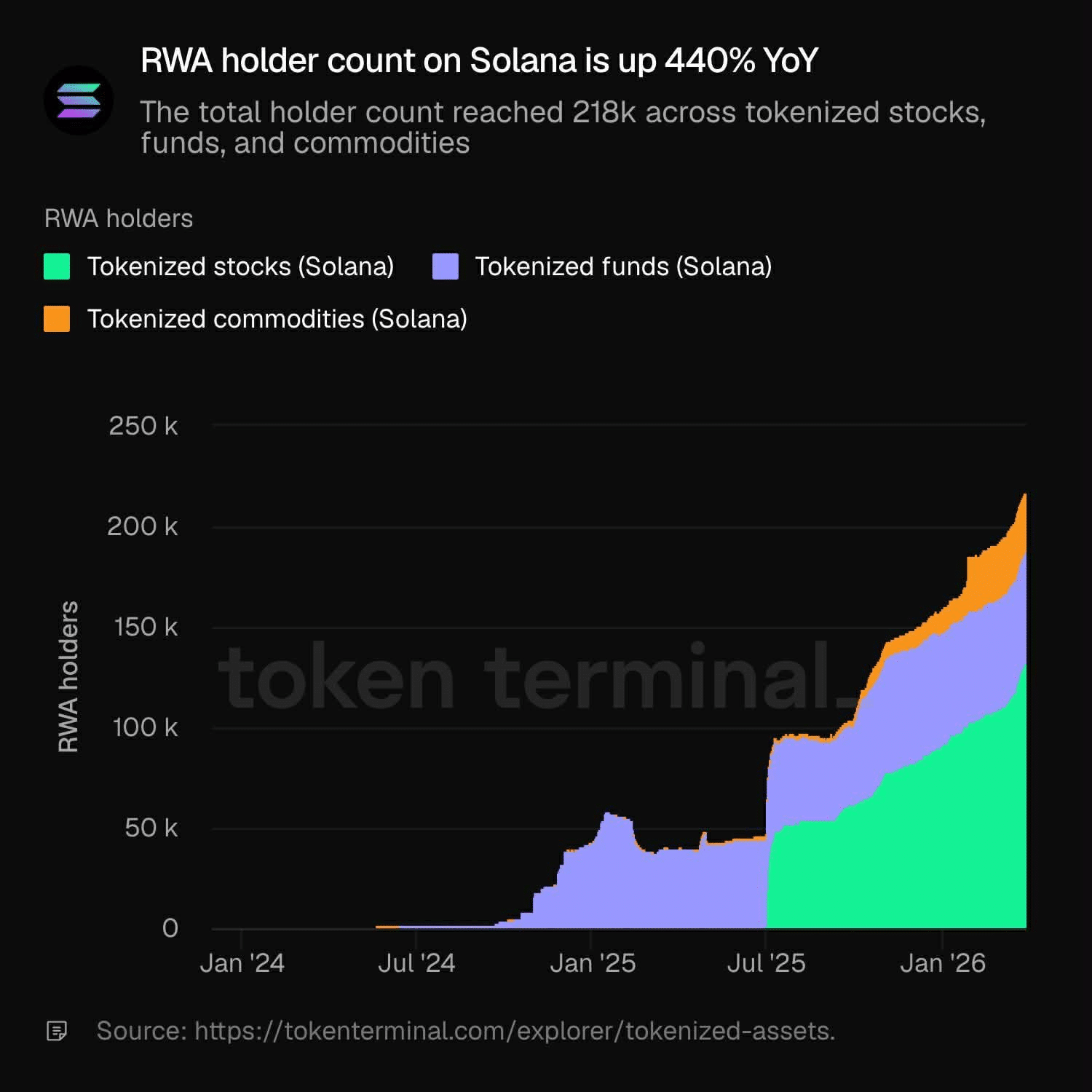
The real story? Solana’s RWA holder count.

As the chart showed, the number of RWA holders on Solana was up 440% year-over-year, totaling 218,000 across tokenized stocks, funds, and commodities.

This surge signals more than hype.

Instead, it’s a clear sign that Solana is becoming a go-to network for tokenized real-world assets.

Against this backdrop, the IMF’s raising alarms starts to make sense.

XAUT’s lead in the RWA space is particularly noteworthy. Its growth comes at a time of heightened geopolitical tensions, which usually push capital into traditional safe havens.

But instead of sticking to the old playbook, investors are flowing into a tokenized version of gold, showing how RWAs are changing the way capital moves.

That said, this also complicates the narrative around Solana as the go-to network for RWAs.

XAUT currently trades only on Ethereum [ETH], raising the question: Can Solana capture this momentum indirectly, or does it need its own tokenized gold options to really cement its position in the RWA space?

Solana’s long road to dominating tokenized real-world assets

At the aggregate level, the RWA market is over 50% made up of U.S. Treasury assets.

Solana is clearly positioning itself to capture a slice of this momentum.

According to RWA.xyz, after stablecoins, Solana’s most concentrated RWAs are U.S. Treasuries, essentially tokenized versions of government debt that allow investors to hold U.S. debt on-chain and earn routine interest.

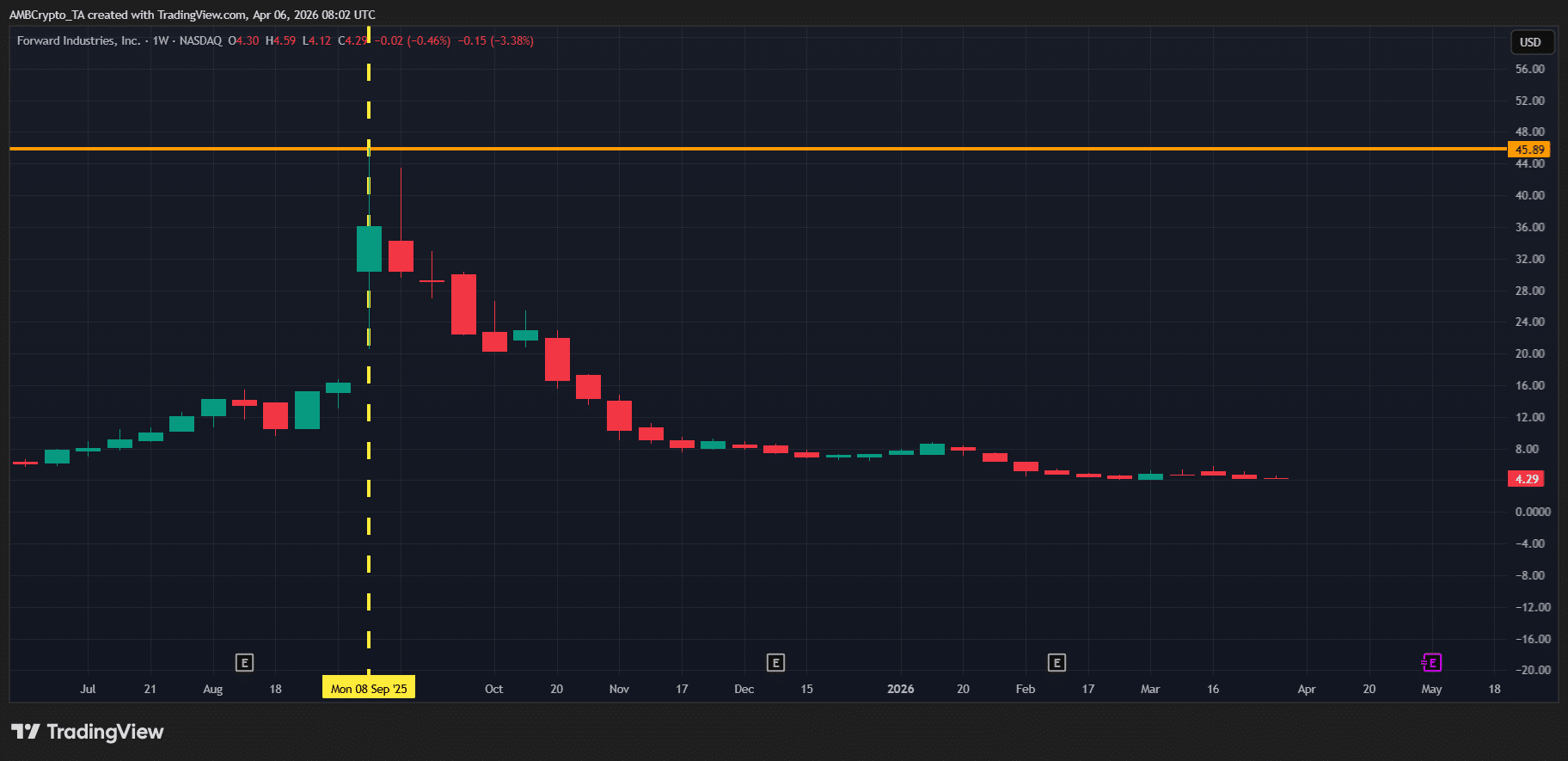
This is significant for a few reasons. Solana treasury companies are showing weak price action. Every small pump gets retraced, signaling that market confidence in treasuries hasn’t caught up with on-chain growth yet.

Take the largest SOL DAT, Forward Industries (NASDAQ: FWDI), for instance. It’s still over 80% below its pre-October crash levels.
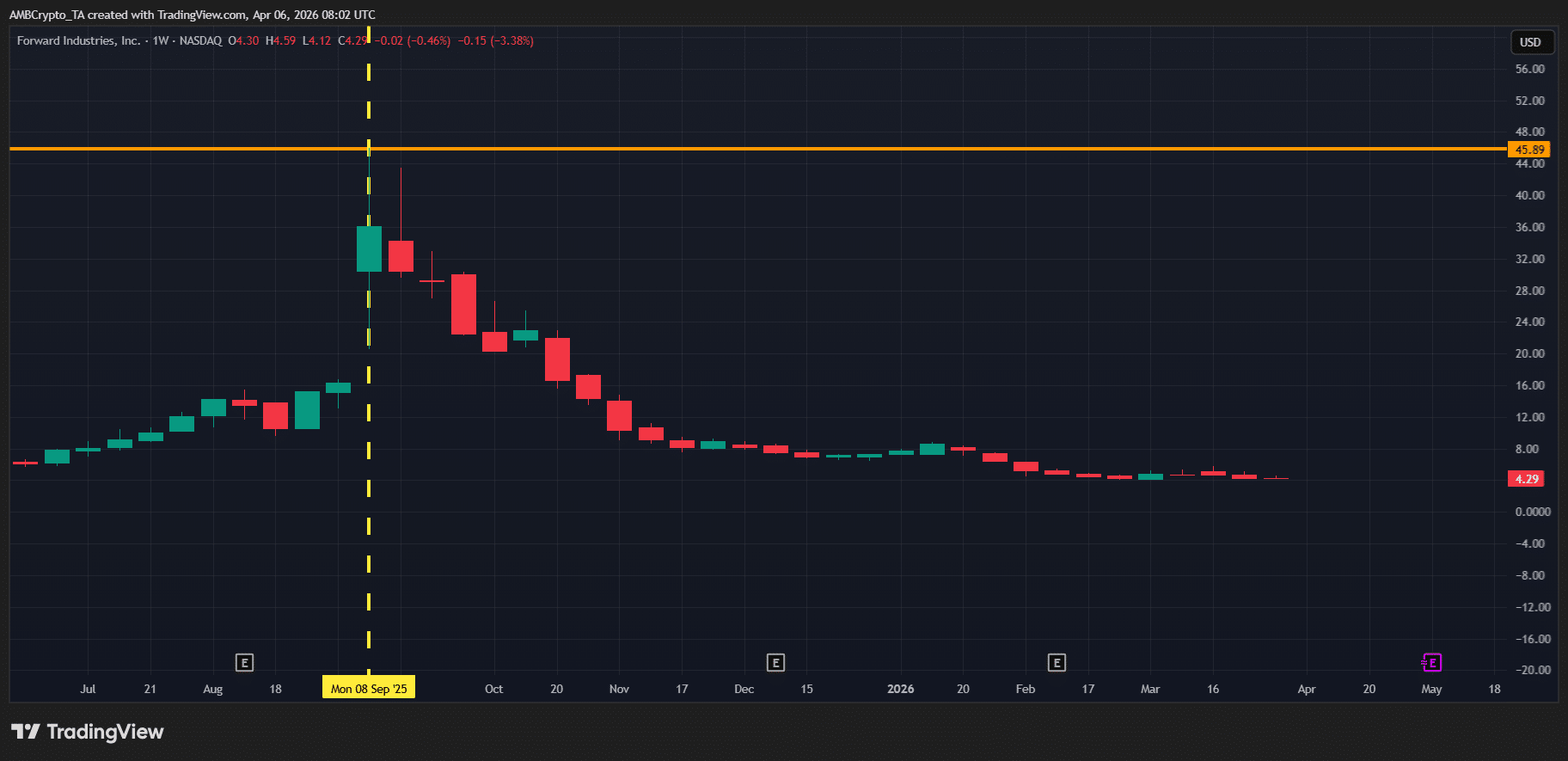
Source: TradingView (FWDI/USD)

Against this backdrop, Solana’s RWA flows act as a key catalyst.

On a macro level, tokenized U.S. Treasuries could generate revenue for Digital Asset Treasuries (DATs), which can then be used to stockpile more SOL.

With Solana already holding a strong position in tokenized bonds, this is a tangible strategy that can strengthen treasuries and support long-term network growth.

Looking at the bigger picture (RWA market growth, Solana’s rising RWA holder count, and strong capital flows into U.S. Treasuries), Solana could emerge as a viable alternative to Ethereum’s XAUT play.

If the network continues to expand its RWA ecosystem, it has the potential to establish itself as a leading hub for tokenized assets, attracting substantial institutional capital in the process.


Final Summary

  • Solana is emerging as a major hub for on-chain RWAs, with a 440% YoY increase in holders.
  • Strong flows into tokenized U.S. Treasuries could make Solana a viable alternative to Ethereum’s XAUT, offering a pathway to strengthen DATs.


Related Questions

QWhat is the year-over-year growth in the number of RWA holders on the Solana network, and what does this surge signify?

AThe number of RWA holders on Solana grew by 440% year-over-year, totaling 218,000. This surge is more than just hype; it's a clear sign that Solana is becoming a go-to network for tokenized real-world assets.

QWhich token is the on-chain RWA market cap leader, and on which blockchain does it currently trade?

ATether Gold (XAUT) is the on-chain RWA market cap leader with $3.3 billion. It currently trades only on the Ethereum blockchain.

QAccording to the article, what is the primary component (over 50%) of the aggregate RWA market?

AU.S. Treasury assets make up over 50% of the aggregate RWA market.

QWhat potential strategy is mentioned for Solana's Digital Asset Treasuries (DATs) to strengthen themselves and support long-term network growth?

ATokenized U.S. Treasuries could generate revenue for Digital Asset Treasuries (DATs), which can then be used to stockpile more SOL, thereby strengthening the treasuries and supporting long-term network growth.

QWhat key concern does the International Monetary Fund (IMF) raise regarding the article's subject matter?

AThe IMF warns that the fast-growing Real World Asset (RWA) market on-chain could cause traditional finance (TradFi) players to fall behind, potentially changing how central banks manage money and financial stability.

Related Reads

US Stock Market Trend (June 16): SpaceX Rises 42% in Two Days, New Fed Chairman Takes Office Today

**U.S. Stocks Trend (June 16): SpaceX Soars 42% in Two Days, New Fed Chair Takes Office Today** Markets surged on Monday following former President Trump's social media announcement of a completed U.S.-Iran deal to reopen the Strait of Hormuz, pending a June 19 signing. The news triggered a broad risk-on rally: oil prices crashed, tech stocks soared, bond yields fell, and defensive sectors lagged. **Market Performance:** The Nasdaq jumped 3.07%, led by semiconductor stocks like Micron (+9.2%). The S&P 500 gained 1.65%, and the Dow rose 0.92% to a record high. However, the Russell 2000 small-cap index underperformed (+0.72%). SpaceX continued its hot streak, rising another 5% pre-market after disclosures of large buys by an Australian billionaire and Cathie Wood's ARK. Boeing also rallied on the transportation optimism. Conversely, energy stocks like Chevron fell over 3% on the oil price plunge, with other defensive sectors also selling off. The day's action showed a clear rotation of funds from energy/defensive plays into AI and tech narratives. **Macro & Outlook:** The VIX fear index fell 8.37%. Treasury yields declined, and WTI crude dropped over 5%. Attention now shifts to a packed schedule: the Bank of Japan is widely expected to hike rates to 1.0% on Tuesday. The Fed's June meeting concludes Wednesday, marking new Chair Wash's debut. While rates are expected to hold, his tone on stubborn inflation and the "dot plot" will be crucial for gauging the 2024 rate path. The formal Iran deal signing is set for Friday. **Trend Perspective:** While the peace deal is a genuine positive, Monday's explosive rally may have gotten ahead of itself, pricing in a swift resolution to inflation concerns. The shortened trading week faces a triple test: BoJ tightening, the Fed's policy stance, and deal implementation details. Tech and semiconductors, which led the surge, remain vulnerable to any disappointment from these key events. The real price discovery begins with the central banks' communications this week.

marsbit18m ago

US Stock Market Trend (June 16): SpaceX Rises 42% in Two Days, New Fed Chairman Takes Office Today

marsbit18m ago

Xiaohongshu's Second Great Voyage, This Time Sailing Towards AI

Xiaohongshu's Second Voyage: Navigating Towards AI Since ChatGPT's emergence, Xiaohongshu's founder Mao Wenchao has been acutely aware of AI's potential threat, recognizing that the life advice people seek from chatbots overlaps directly with his platform's core business. Founded in 2013 as a PDF shopping guide for Chinese tourists, Xiaohongshu evolved into a massive community where millions share authentic, personal experiences—from product reviews to travel tips. This vast repository of "I've tried this" human judgment became its most valuable asset. However, the rise of AI, which delivers instant answers, challenges the very need for users to sift through numerous personal notes. Fearing its treasure trove of lived experience could become mere training data for others, Xiaohongshu is proactively adapting. In 2026, it established a dedicated AI division (Dots), launched RED Skill to turn user experiences into usable AI tools, and acquired the AI search product "Diandian." Its investments now extend to AI firms like MiniMax and hardware startups, moving upstream to address needs before they even become search queries. The platform's commercialization strategy is also evolving. With a newly acquired payment license and tools like the AIPS model to track consumer decision journeys, Xiaohongshu aims to seamlessly integrate recommendations with transactions, embedding commerce within AI-generated answers. Yet, a critical tension remains. While building smarter machines to organize and leverage its human experiences, Xiaohongshu must prevent AI from drowning out the authentic, flawed, and trustworthy "I've tried this" voices that built its community. Its core challenge is to harness AI's power without letting the map—the machine's perfect, synthesized answer—replace the territory of genuine human experience. This balance between technological advancement and preserving human trust defines its current journey and its future.

marsbit50m ago

Xiaohongshu's Second Great Voyage, This Time Sailing Towards AI

marsbit50m ago

SharpLink CEO: How to Understand Ethereum Developers Just Exceeded 1 Million?

SharpLink CEO reflects on the milestone of Ethereum surpassing 1 million historical developers, emphasizing that this figure represents the largest pool of technical talent ever assembled around an open, permissionless blockchain network. While approximately 232,000 developers remain active, the key question for the crypto industry is not which chain is fastest, but where the best builders choose to build long-term. Ethereum's advantage lies in a decade-long accumulation of infrastructure, standards, tools, liquidity, and a cohesive culture, making it the default operating system for programmable finance. This developer base is tackling complex challenges: the Glamsterdam upgrade aims to enhance scalability while preserving core principles; synchronous composability seeks to unify Rollup ecosystems; and significant efforts are underway for post-quantum security. Ethereum's deeper network effects stem from composability and shared standards (like the EVM and Solidity), creating a flywheel of more developers, tools, and liquidity. Three reinforcing strengths cement Ethereum's lead: credible neutrality (secured by ~900k validators), a modular architecture with interconnected Rollups, and a culture that attracts top researchers. The ecosystem is consolidating as the trusted coordination layer for internet-native finance, favored by large institutions valuing security and liquidity. The future of Ethereum is being built by this global community of founders and architects.

链捕手1h ago

SharpLink CEO: How to Understand Ethereum Developers Just Exceeded 1 Million?

链捕手1h ago

A Clod of Chinese Soil Chokes Two Japanese Giants

"Chinese Soil Chokes Japanese Giants" The production of a key electronic specialty gas, tungsten hexafluoride (WF6), vital for manufacturing AI chips, was halted by two leading Japanese producers—Kanto Denka and Central Glass. Their shutdown was not due to a technological failure but a sudden, critical shortage of a raw material they had long taken for granted: ultra-high-purity (6N-grade) tungsten powder, which is almost entirely sourced from China. Following a quiet Chinese export announcement in January 2026, tungsten powder shipments to Japan dropped to zero for months. Despite frantic efforts, Japanese companies found no viable alternative; imported powder was three times more expensive and lacked the required purity. Their existing stockpiles were exhausted by mid-2026. WF6 is essential for depositing tungsten into the microscopic contact holes of High Bandwidth Memory (HBM) chips, which are crucial for advanced processors like those from Nvidia. While Japanese firms had mastered producing ultra-pure WF6 gas, their entire supply chain relied on China's 6N tungsten powder—a dependency now revealed as a fatal vulnerability. China's dominance in this "soil" results from decades of painstaking R&D by companies like Xiamen Tungsten and China Tungsten & Hightech. They overcame immense technical hurdles, such as separating chemically similar molybdenum from tungsten, to achieve mass production of the world's purest tungsten powder. With their primary suppliers gone, Kanto Denka and Central Glass announced a permanent halt to WF6 production starting July 1, 2026. This immediately created a supply crisis for major semiconductor manufacturers like Samsung and SK Hynix, forcing them to urgently seek and certify new Chinese suppliers for WF6 itself. The reversal marks a dramatic shift: China has moved from exporting low-value raw materials to controlling the high-purity foundation of a critical global tech supply chain, upending a long-established industrial hierarchy.

marsbit1h ago

A Clod of Chinese Soil Chokes Two Japanese Giants

marsbit1h ago

Trading

Spot
Futures

Hot Articles

Discussions

Welcome to the HTX Community. Here, you can stay informed about the latest platform developments and gain access to professional market insights. Users' opinions on the price of XAUT (XAUT) are presented below.

活动图片