Solana enters Brazil’s main exchange as Valour expands regulated crypto access

cointelegraphPublished on 2025-12-16Last updated on 2025-12-16

Abstract

Valour, a subsidiary of DeFi Technologies, has received approval from Brazil’s main stock exchange, B3, to launch a Solana exchange-traded product (VSOL). The ETP, denominated in Brazilian reais, will provide regulated exposure to Solana and is part of Valour’s expanding lineup of crypto products in Brazil, which already includes Bitcoin, Ether, XRP, and Sui. This move reflects Valour’s strategy to grow beyond European markets, tapping into Brazil’s rapidly expanding digital asset adoption. Brazil ranks fifth globally in crypto adoption, driven by strong retail and institutional activity, stablecoin-based payments, and growing interest in tokenized real-world assets.

Valour, a subsidiary of publicly listed digital asset company DeFi Technologies, has received approval to launch a Solana exchange-traded product (ETP) in Brazil, offering local investors regulated exposure to one of the largest cryptocurrencies by market capitalization as institutional interest in the region continues to grow.

The product, Valour Solana (VSOL), is scheduled to begin trading on Wednesday following approval from Brazil’s main stock exchange, Brasil, Bolsa, Balcão (B3 S.A.), DeFi Technologies announced Tuesday.

The Solana (SOL) product will join Valour’s expanding lineup of Brazil-listed ETPs, which already provide exposure to Bitcoin (BTC), Ether (ETH), XRP (XRP) and Sui (SUI).

Like Valour’s other offerings in the country, VSOL will be denominated in Brazilian reais and designed to track the performance of Solana, one of the most active layer-1 blockchain networks, within a traditional capital markets structure.

The launch reflects Valour’s broader strategy to expand beyond its core European markets, with Brazil emerging as a key focus for its international growth.

Source: Valour Funds

Related: Why Brazil is using Bitcoin as a treasury asset and what other nations can learn

Brazilian crypto adoption accelerates

Digital asset adoption in Brazil has been gaining momentum for several years, with the country ranking fifth globally in a recent Chainalysis report, behind only India, the United States, Pakistan and Vietnam.

Brazil scored strongly across multiple categories, including retail use of centralized services, decentralized finance activity and institutional access.
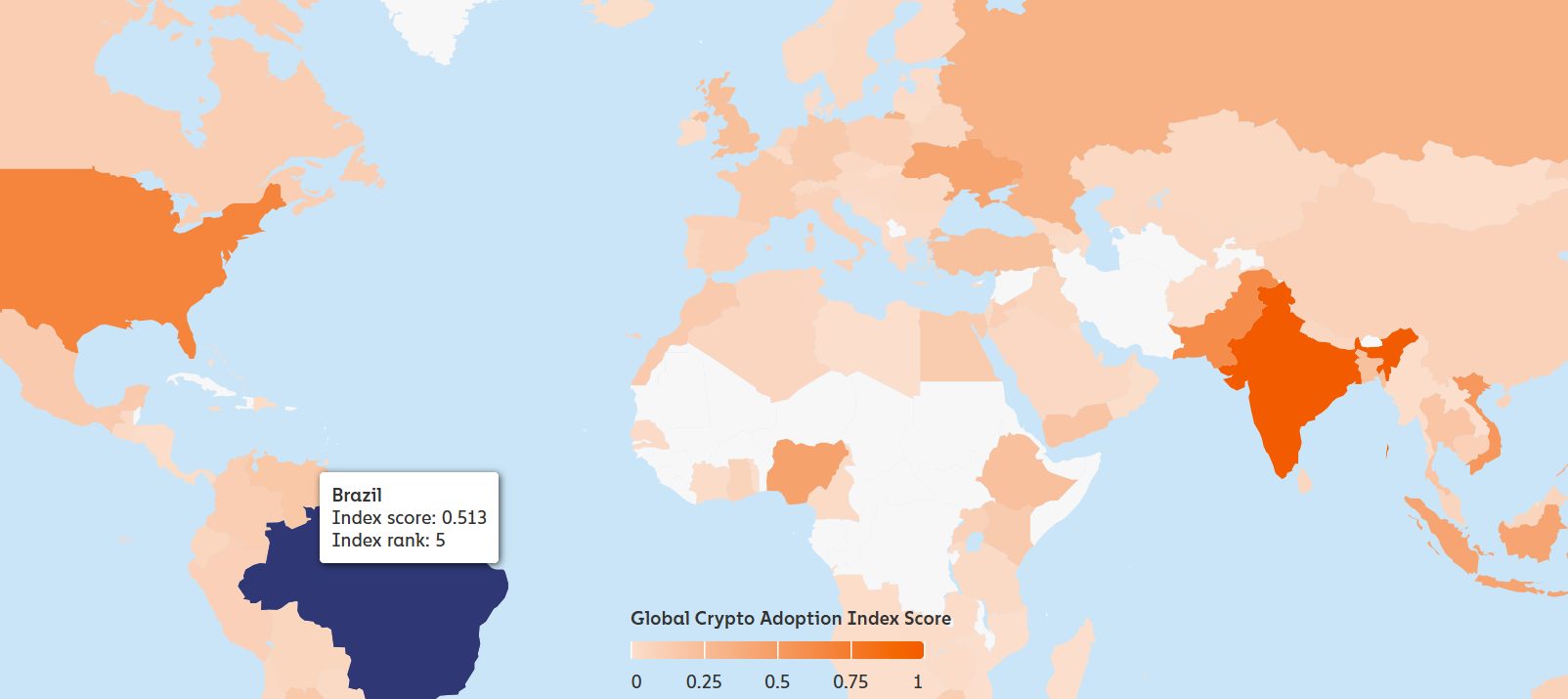
Brazil has emerged as a key hub for digital assets, driven by high transaction volumes and broad access to cryptocurrency services among both retail and institutional investors. Source: Chainalysis

A key driver of that growth has been the expansion of stablecoin-based payment rails. Brazil’s central bank has acknowledged the widespread use of stablecoins for payments, particularly in cross-border transactions.

As Cointelegraph reported, this trend enabled local fintech company Crown to raise capital for launching a real-denominated stablecoin aimed at institutional investors seeking exposure to Brazil’s fixed-income market.

Crypto exchanges have also contributed to the sector’s expansion. Mercado Bitcoin, one of Latin America’s largest digital asset platforms, has recently expanded its focus toward tokenizing real-world assets, positioning itself to meet institutional demand for blockchain-based financial products.

Related: Brazil classifies stablecoin payments as foreign exchange under new rules

Trending Cryptos

Related Reads

Just Now, Sam Altman Blasts Dario Amodei as 'Anti-Human', Secret Model Exposed the Same Day

Just now, Sam Altman strongly criticized Dario (Amodei, co-founder of Anthropic), denouncing his "doomsday marketing" as "anti-human dictator rhetoric." This came alongside the accidental exposure of OpenAI's next-generation model, codenamed "gpt-nathree," hinting at the imminent release of GPT-6 Astra. The leak occurred when an OpenAI employee's public GitHub commit mentioned the codename. Combined with previous leaks of "gpt-mewfour," it suggests these are iterative checkpoints for OpenAI's upcoming agent model, Astra. Astra is known for multi-agent collaboration and long-duration task handling, having reportedly solved previously unsolved mathematical problems. Meanwhile, two new Anthropic model codenames, "claude-marshmallow-eap" and "claude-melon-eap," were also exposed but are believed to be iterations of the Claude 5 series, not a new flagship. In a wide-ranging podcast interview, Altman admitted he was wrong about the speed of AI-driven disruption, acknowledging societal inertia slows adoption. He fiercely criticized rivals' marketing that simultaneously promises immense benefits (like curing cancer) and warns of existential risk, calling it a dangerous "benevolent dictator" narrative that seeks to concentrate power. He emphasized that people are the ultimate purpose of AI. Altman also revealed OpenAI's unconventional, consensus-defying path: spending four and a half years in the "dark" without a public product before ChatGPT's breakthrough, driven by scaling laws rather than early customer feedback. He concluded that even with superintelligent AI, genuine human connection will remain irreplaceably valuable.

marsbit19m ago

Just Now, Sam Altman Blasts Dario Amodei as 'Anti-Human', Secret Model Exposed the Same Day

marsbit19m ago

The 'Saving U.S. Treasuries' Baton Pass: Bessent Fumbled Last Week, This Week It's Wash's Turn

"Rescuing US Treasuries" Relay: After Bessent's Miss, All Eyes Are on Walsh Last week, US Treasury Secretary Bessent's announcement to at least double long-term Treasury buybacks failed to sustainably lower yields, which quickly rebounded. The market response saw a drop in the dollar alongside surges in gold and Bitcoin, interpreted as a "pressure release valve" for anxiety. The focus now shifts to Fed Chairman Walsh's upcoming Jackson Hole speech. Markets are highly sensitive to his message, seeking clarity on the Fed's policy response to stubborn inflation and worsening fiscal conditions. Analysts warn that a lack of new guidance could disappoint markets and worsen the sell-off in long-dated bonds. Analysts question the scale of Bessent's operations, noting they are too small relative to the overall debt market and do not constitute quantitative easing. A key issue is the Fed's massive holdings of long-term bonds, which distorts the market. With the Fed holding low-yielding short-term bonds that are losing money relative to its policy rate, discussion is growing around a potential Fed-led "Operation Twist." This would involve selling short-term bonds to buy long-term ones, aiming to lower long-end yields without expanding the balance sheet. The upcoming PCE inflation data will set the stage for Walsh's speech. However, the window for action is narrowing amid political pressures. A critical threshold is the 30-year yield at 5%; holding above it could increase stress on the dollar and leveraged sectors. Overall, the article suggests that without coordinated Fed action to anchor inflation expectations, Treasury interventions may ultimately fail, with investors increasingly looking to assets like gold as hedges.

marsbit49m ago

The 'Saving U.S. Treasuries' Baton Pass: Bessent Fumbled Last Week, This Week It's Wash's Turn

marsbit49m ago

Hyperliquid's Compliance Journey: From Permissionless to Permissioned via HIP-3

Hyperliquid’s Compliance Path: From Permissionless to Permissioned HIP-3 Hyperliquid currently blocks U.S. access because its permissionless, on-chain infrastructure conflicts with U.S. market structure laws, which restrict futures trading to registered exchanges, clearinghouses, and brokers. Through its Hyperliquid Policy Center (HPC), the project is advocating for regulatory modernization, proposing that regulated entities be allowed to build products on HyperCore (its exchange and clearing layer) while fulfilling their compliance obligations. The platform’s modular stack separates roles like a traditional exchange (DCM), clearinghouse (DCO), and broker (FCM), but reconstructs them on-chain with code. This enables permissionless access, self-custody, and 24/7 global trading, but clashes with U.S. rules requiring KYC, specific margin models, and custodial arrangements. To resolve this, HPC is engaging with U.S. regulators (CFTC, SEC) to seek clarity that deploying on-chain software does not itself trigger licensing, and to establish exemptions allowing non-custodial wallets to route users to regulated derivatives. Recent political signals suggest openness to this approach. On the technical side, Hyperliquid Labs has introduced permissioned HIP-3 deployers on testnet. These allow regulated entities to launch markets, perform KYC, and whitelist compliant users. While these create separate order books, whitelisted market makers can bridge liquidity between them, ensuring deep, shared liquidity across the same L1. Features like payload-based “PA” permissions enable DEX-level account controls (e.g., reduce-only orders), mirroring traditional broker authorities. The strategy is not to open the native, permissionless front-end to U.S. users, but to position Hyperliquid as neutral infrastructure that U.S. regulated firms can use while meeting their legal duties. This paves a compliant path for U.S. investor access while preserving the protocol’s core, permissionless nature.

marsbit1h ago

Hyperliquid's Compliance Journey: From Permissionless to Permissioned via HIP-3

marsbit1h ago

Two Funding Rounds in Three Months: The Chinese Version of Palantir is on Fire

Investment Community AI has learned that Beijing Zhongshu Ruizhi Technology Co., Ltd., a domestic industrial-grade causal intelligence and high-reliability decision-making AI company, has recently completed a strategic financing round worth hundreds of millions of RMB. This round saw participation from China Internet Investment Fund, Suzhou Chuangtou National Social Security Fund, Financial Street Capital, ICBC Capital, Kunlun Capital, among others, with existing shareholders also increasing their investment. This follows a Series B funding round in the hundreds of millions completed just three months prior. The rapid succession of two major funding rounds signifies strong market recognition of the company's underlying original technology and scaled commercial implementation. Often referred to as the "Chinese version of Palantir," Zhongshu Ruizhi is entering a new phase of accelerated technological iteration, widespread scenario replication, and scaled performance release, mirroring the explosive growth of China's AI market. Founded in April 2020 by Dr. Han Han, a Tsinghua University Ph.D. and former core drafter of national AI policies, the company is mission-driven to "move AI from the digital world to the physical world." It focuses on the high-reliability, strong-decision industrial AI track and enterprise-grade AI Agent full-stack infrastructure. The team tackles the challenge of applying AI to China's vast and complex industrial and energy systems by developing a new intelligent operating system from scratch. Its core technological breakthrough lies in three proprietary底层 technologies: meta-causal cognitive theory, causal models, and a dynamic ontology engine. These address critical pain points of generative large models in industrial settings—such as AI hallucinations, insufficient reasoning, lack of temporal logic, unverifiable decisions, and multi-source rule conflicts—thereby providing trustworthy, explainable, and executable智能决策 capabilities. Commercially, Zhongshu Ruizhi has achieved scaled deployment, serving over 50 central state-owned enterprises and industrial groups in sectors like power, petroleum, and aerospace, with implementations in more than 800 highly complex production scenarios. The company reported doubled revenue in 2025, demonstrating strong self-sufficiency and a viable business model—a rarity among new-generation AI firms. The latest funds will be allocated towards advancing foundational theoretical research, replicating successful application models to expand market presence (including overseas), and attracting top-tier talent. Lead investor China Internet Investment Fund highlighted that in the current shift from general AI capability contests to deep industrial empowerment, industrial-grade causal intelligence is crucial for building China's modern digital foundation and fostering new quality productive forces. They expressed support for the company's efforts to define decision-making paradigms and trustworthy standards for industrial intelligence, aiming to secure a rule-making voice in the global physical AI arena.

marsbit1h ago

Two Funding Rounds in Three Months: The Chinese Version of Palantir is on Fire

marsbit1h ago

Trading

Spot

Hot Articles

Discussions

Welcome to the HTX Community. Here, you can stay informed about the latest platform developments and gain access to professional market insights. Users' opinions on the price of S (S) are presented below.

活动图片