Solana Emerges As The Most Active Blockchain Ahead Of Major Chains By Daily Transactions

bitcoinistPublished on 2026-03-03Last updated on 2026-03-03

Abstract

Solana has emerged as the most active blockchain by daily transaction volume, significantly outperforming other major chains. As the SOL price rebounded toward $90, the network processed approximately 108.8 million daily transactions—nearly ten times more than its closest competitor, BNB Chain, which recorded 13.0 million. Other networks, including Base, TRON, Polygon, and Ethereum, trailed further behind. This surge is attributed to Solana’s high-speed infrastructure, low fees, and growing activity in DeFi, NFTs, and consumer applications. Additionally, Solana dominated in decentralized exchange (DEX) volume throughout February and continued strongly into March, with over $200 billion in DEX volume recorded in just the first two days. This reflects deeper on-chain strength and sustained user engagement, signaling a shift in liquidity toward faster and more cost-effective blockchain networks.

As Monday drew to a close, the Solana price witnessed a bounce, bringing it closer to the $90 mark, which has ignited bullish sentiment among investors. The SOL’s price rebound coincides with a significant uptick in the network’s activity and performance, with SOL emerging as the No. 1 blockchain among all major chains.

Daily Transaction Count Puts Solana On Top

Solana’s price action and network performance appear to be moving in a similar direction, with the price briefly bouncing as network activity explodes. Once again, the network has proven its position as a leader in the blockchain sector, becoming the most go-to chain in the sector on a daily basis.

Founder and Chief Executive Officer (CEO) of Sensei Holding and Namaste Group, Solana Sensei, shared on X that the SOL network has surged ahead of competition in terms of transaction volume. The report shows that SOL tops the charts in daily on-chain transactions count across all major blockchain networks.

Fueled by its high-speed infrastructure, cheap fees, and growing activity across DeFi, NFTs, and consumer-facing applications, Solana is processing more transactions per day than its closest competitors. SOL’s dominance in this area marks a notable achievement, highlighting the network’s expanding role as a high-throughput hub for on-chain operations.
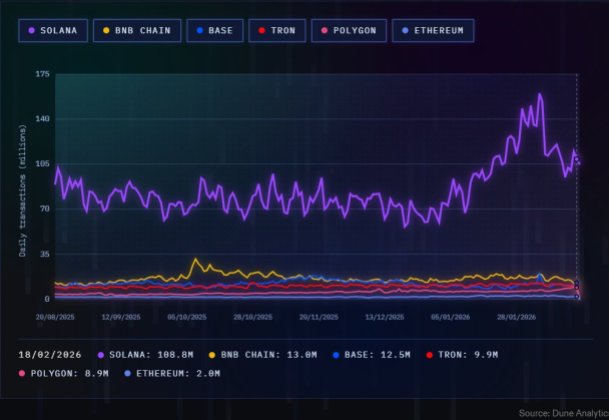
Source: Chart from Solana Sensei on X

Solana Sensei highlighted that the SOL network is currently processing nearly 10 times or more transactions than other major chains, reflecting sustained user engagement and increasing ecosystem maturity. Taking a look at the chart, SOL recorded daily transactions of approximately 108.8 million, with BNB Chain coming in second position with over 13.0 million daily transfers.

Meanwhile, leading networks like Base, TRON, Polygon, and Ethereum recorded 12.5 million, 9.9 million, 8.9 million, and 2.8 million, respectively. As developers continue to release new apps and users migrate to more affordable platforms, SOL’s transaction leadership demonstrates a wider change in where blockchain activity is concentrating in the current market cycle.

SOL DEX Volume Expands Beyond Other Chains

In another X post, Solana Sensei revealed that SOL is rapidly asserting dominance in the decentralized trading arena. According to the expert, SOL’s DEX volume has skyrocketed beyond that of competing blockchain networks. The increase in decentralized exchange activity is indicative of a larger shift in liquidity toward quicker, more affordable networks.

In the entire month of February, the SOL network dominated all major chains to secure the top spot in DEX volume. Such an increase in DEX volume indicates deeper on-chain strength, market infrastructure, and ongoing user participation rather than just transient speculation.

This notable DEX performance from SOL is starting to unfold this new month. Just 2 days into the month of March, the total Solana DEX volume has exceeded $200 billion, further reinforcing the network’s leading role in the evolving on-chain financial landscape.

SOL trading at $85 on the 1D chart | Source: SOLUSDT on Tradingview.com

Related Questions

QAccording to the article, which blockchain has the highest number of daily on-chain transactions?

ASolana has the highest number of daily on-chain transactions, with approximately 108.8 million.

QWhat are the key factors mentioned that are fueling Solana's high transaction volume?

AThe key factors are its high-speed infrastructure, cheap fees, and growing activity across DeFi, NFTs, and consumer-facing applications.

QHow does Solana's daily transaction count compare to its closest competitor, BNB Chain?

ASolana's daily transaction count of 108.8 million is nearly 10 times that of BNB Chain, which recorded over 13.0 million.

QWhat achievement did Solana secure in the decentralized exchange (DEX) volume for the month of February?

ASolana secured the top spot in DEX volume among all major chains for the entire month of February.

QWhat was the total Solana DEX volume just two days into the month of March, as stated in the article?

AThe total Solana DEX volume exceeded $200 billion just two days into the month of March.

Related Reads

Huang Renxun Dramatically 'Saves' South Korean Stock Market

In early June, South Korea's stock market experienced a sharp decline, with the KOSPI index dropping over 5% and triggering a trading halt. Amid this volatility, NVIDIA CEO Jensen Huang's visit to Seoul provided a dramatic boost to market sentiment. During his trip, Huang held a dinner meeting with SK Group Chairman Chey Tae-won and SK Hynix CEO Kwak Noh-Jung. He announced that NVIDIA's new Vera CPU would utilize SK Hynix DRAM and confirmed a multi-year technical collaboration between the two companies. This partnership aims to co-develop next-generation memory for NVIDIA's AI infrastructure roadmap, covering products from data center supercomputers to personal AI devices. Huang also publicly commented that AI company stocks were attractively priced. A key announcement was that NVIDIA's upcoming Vera Rubin AI supercomputer systems will use HBM4 memory, with supply qualifications granted to all three major suppliers: SK Hynix, Samsung Electronics, and Micron Technology. Despite this multi-sourcing strategy, Huang warned that the industry-wide chip shortage, affecting everything from wafers to packaging, is expected to persist for several years due to relentless demand from global AI factory construction. The collaboration extends beyond memory supply. SK Hynix will employ NVIDIA's AI platforms and Omniverse digital twin technology to enhance its own semiconductor design, simulation, and manufacturing processes, aiming for more autonomous factory operations. This visit builds upon a prior October 2025 agreement for SK Group to build a large-scale AI data center using over 50,000 NVIDIA GPUs. Huang's itinerary also included meetings with other Korean giants like Hyundai, LG, and Samsung, indicating NVIDIA's broader strategy to deepen ties with South Korea's tech industry.

链捕手13m ago

Huang Renxun Dramatically 'Saves' South Korean Stock Market

链捕手13m ago

When Inference Becomes a Scarce Resource, Who Captures the Value?

When Inference Becomes the Scarce Resource, Who Captures the Value? The core AI bottleneck has shifted from model training to inference (runtime execution). While concerns persisted about an "AI compute gap"—initially a $200B, now a $600B problem—the market is now recognizing that the solution and value lie in the inference layer. Nvidia's financial restructuring around "serving tokens" and Cerebras's successful IPO highlight this shift. Inference is a recurring, usage-based cost, estimated to be 10-50x larger than the one-time training market, especially with the rise of agentic AI. The inference stack spans six layers: silicon (e.g., Nvidia), bare metal (e.g., CoreWeave), GPU rental/aggregation, deployment/optimization, model APIs, and end applications. Most companies operate in one layer. However, Hyperbolic uniquely spans three layers (GPU rental, deployment, and model APIs) without owning any hardware. It aggregates fragmented GPU supply from multiple cloud providers into a standardized pool, offering developers the cheapest available compute through intelligent routing. Its multi-cloud aggregation creates a data moat and a flywheel: more supply leads to better pricing data and liquidity, attracting more developers and providers. In contrast, applications like Venice operate at the top of the stack, reselling privacy-wrapped inference but remaining dependent on and constrained by the underlying compute costs they purchase. As inference demand explodes, value accrues not just to consumer applications but increasingly to the aggregation and routing layer that captures their cost of revenue. The coming potential GPU oversupply reinforces this dynamic. While hardware owners may suffer from depreciation, asset-light aggregators like Hyperbolic benefit from price arbitrage, routing workloads to the cheapest available capacity. The ultimate winner in the inference economy may not be the entity with the most GPUs, but the one that can most efficiently discover, aggregate, and route the world's fragmented compute.

链捕手20m ago

When Inference Becomes a Scarce Resource, Who Captures the Value?

链捕手20m ago

Trading

Spot
Futures

Hot Articles

Discussions

Welcome to the HTX Community. Here, you can stay informed about the latest platform developments and gain access to professional market insights. Users' opinions on the price of SOL (SOL) are presented below.

活动图片














