Shanghai's Leading Large Model Company Initiates A-Share Listing

marsbitPublished on 2026-05-30Last updated on 2026-05-30

Abstract

Shanghai-based AI large language model leader MiniMax has initiated the process for an A-share listing in China, having filed a pre-IPO tutoring report with the Shanghai Securities Regulatory Bureau on May 29. This move positions it to compete with Zhipu AI for the title of the first major domestic LLM company to list on the A-share market. Having already completed an IPO in Hong Kong in January 2026, MiniMax's stock price has surged approximately 409% since its debut, with its market capitalization reaching around HK$263.45 billion (approximately RMB 227.55 billion) as of May 29. The company's rapid growth is supported by strong business performance. Its Annual Recurring Revenue (ARR) has grown over 100% in the past two months and now exceeds $300 million. It serves over one million global enterprise and developer clients and has around 300 million users worldwide. For the full year 2025, MiniMax reported revenue of $79.038 million, with a gross margin of 25.4%. While it reported an adjusted net loss of $250 million, the loss rate has narrowed significantly year-over-year. On the product front, MiniMax has released several flagship models this year, including MiniMax-M2.5, M2.6, and M2.7, with the first and last being open-sourced. Its models gained significant traction earlier in the year, briefly becoming the top model provider by usage share on the OpenRouter platform in February. The company has also upgraded its AI agent product, now named Mavis, and is preparing to l...

Zhidongxi May 30 report, as shown on the CSRC official website, Shanghai AI large model leader MiniMax submitted an IPO tutoring filing report to the Shanghai Securities Regulatory Bureau on May 29, initiating its A-share listing process, with CITIC Securities serving as the tutoring institution.

This also means that MiniMax, together with Zhipu AI which has also submitted its A-share IPO tutoring filing, will sprint to become the first large model stock on the A-share market.
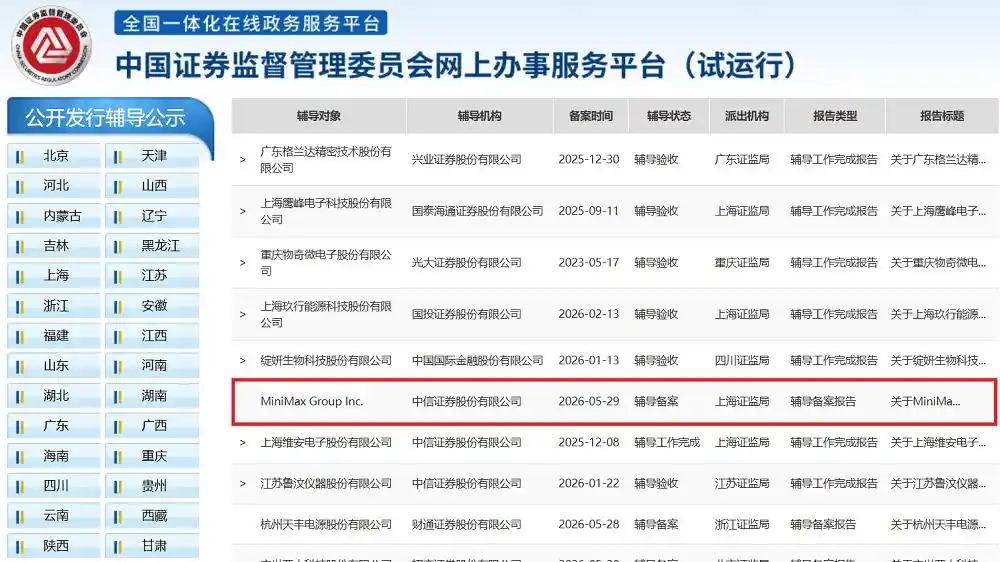
MiniMax was established in January 2022 and completed its Hong Kong IPO in January this year. After the Hong Kong IPO, MiniMax's stock price skyrocketed. As of the Hong Kong market close on May 29, its stock price was HK$840 (approximately RMB 725.24), up 409.09% compared to the issue price of HK$165 (approximately RMB 142.46), with a market capitalization of HK$263.454 billion (approximately RMB 227.545 billion). Starting from June 8 this year, MiniMax will also be included in the Hang Seng Tech Index.
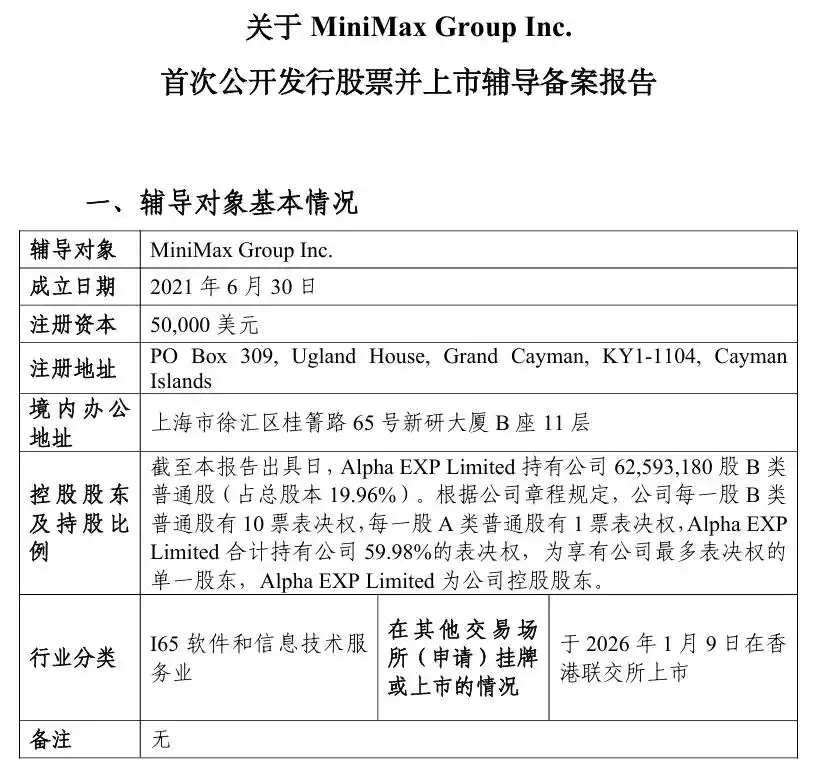
Behind the surging stock price, there is fundamental business performance as support.

On May 28, MiniMax disclosed some business data. Over the past two months, MiniMax's ARR (Annualized Recurring Revenue) achieved growth exceeding 100%. The number of global enterprise and developer customers served has exceeded one million, a fivefold increase compared to six months ago; its global user base is approximately 300 million.

In March this year, MiniMax released its first annual report after listing. During the earnings call, founder and CEO Yan Junjie revealed that the company's ARR had reached USD 150 million by February 2026.

That is to say, combined with the over 100% growth in the past two months, MiniMax's current ARR has exceeded USD 300 million.

For the full year 2025, MiniMax achieved revenue of USD 79.038 million (approximately RMB 535 million), of which revenue from AI-native products was USD 53.075 million (approximately RMB 359 million), and revenue from the open platform and other AI-based enterprise services was USD 25.963 million (approximately RMB 177 million).

Its gross profit margin improved to 25.4%, with an adjusted net loss of USD 250 million (approximately RMB 1.69 billion), and the loss ratio narrowed significantly year-on-year.
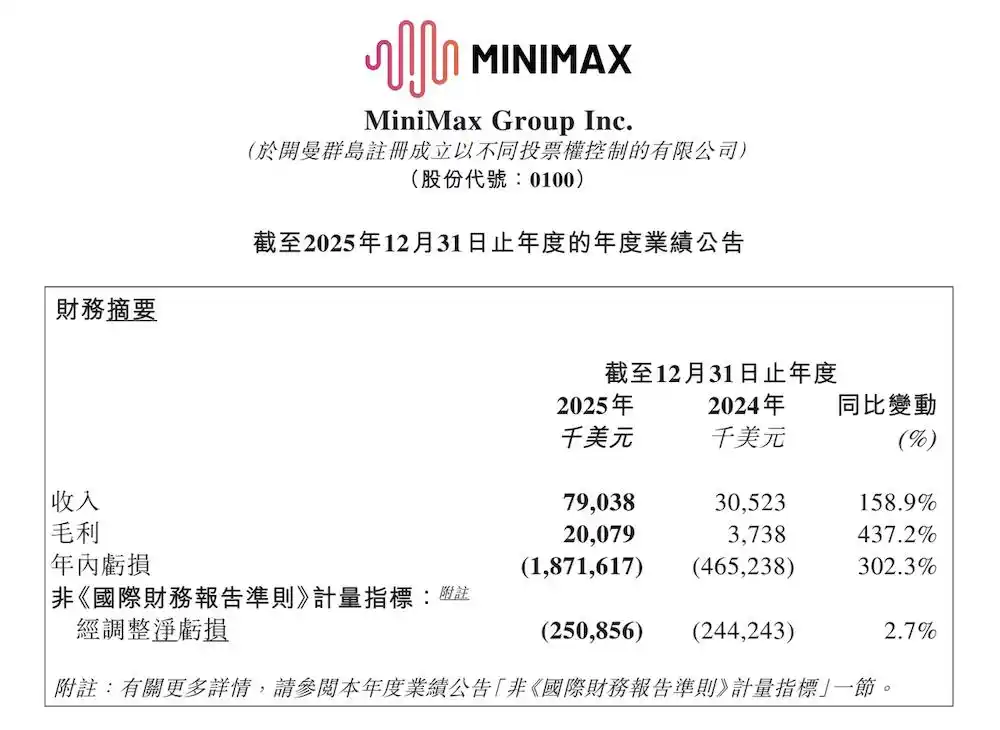
▲ Part of MiniMax's 2025 Financial Data

Regarding products, since the beginning of this year, MiniMax has successively launched three flagship large language models: MiniMax-M2.5, MiniMax-M2.6, and MiniMax-M2.7, and open-sourced the M2.5 and M2.7 models.
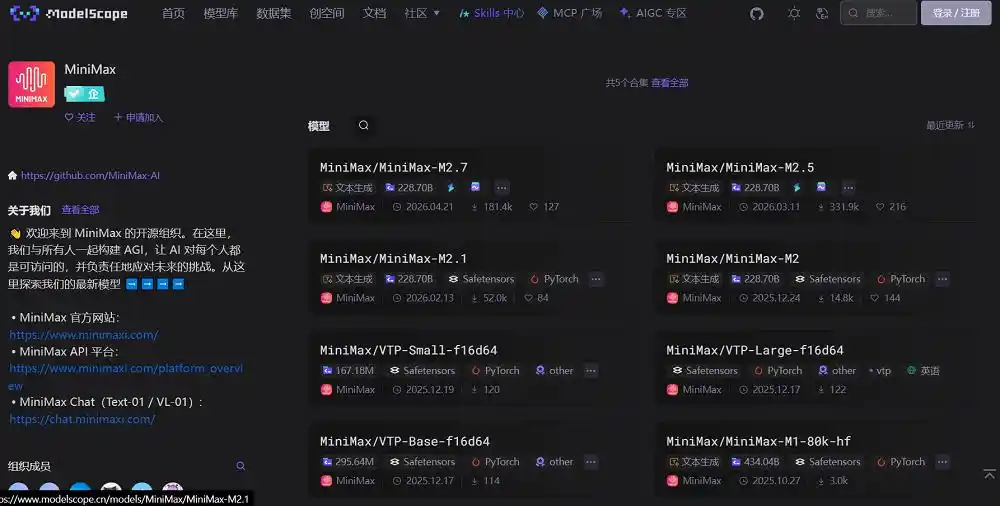
▲ Some open-sourced models from MiniMax (Source: ModelScope)

Thanks to its high cost-performance ratio, MiniMax-M2.5 gained popularity among many developers during the "Lobster Craze" (the open-source AI Agent framework OpenClaw) earlier this year and was even recommended by "Lobster Father" Peter Steinberger in a post.

In mid-February this year, on the AI model aggregation routing platform OpenRouter, MiniMax once became the model vendor with the highest market share, capturing 18.9% of model calls on OpenRouter. However, MiniMax has currently fallen out of the top 10 of this list.
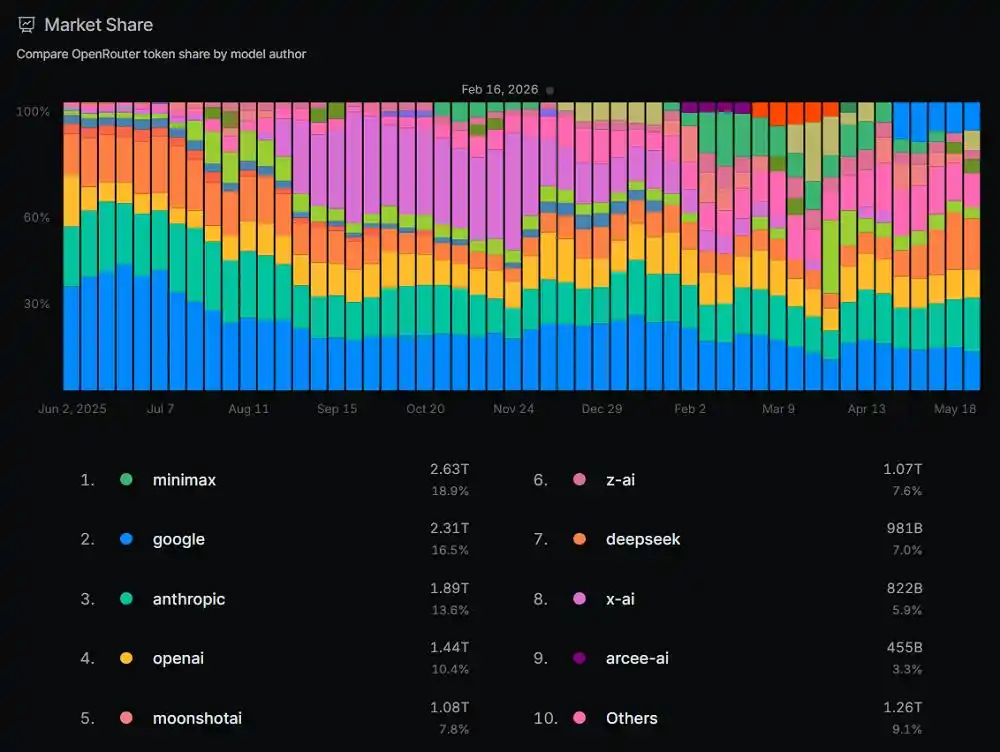
▲ OpenRouter Model Vendor Ranking in mid-February this year (Source: OpenRouter)

Additionally, in May this year, MiniMax upgraded its Agent product and renamed it Mavis, providing a multi-Agent parallel working mode, which can be used to improve the completion rate of complex long tasks.

At the end of May, the MiniMax official account hinted that MiniMax-M3 is即将发布.
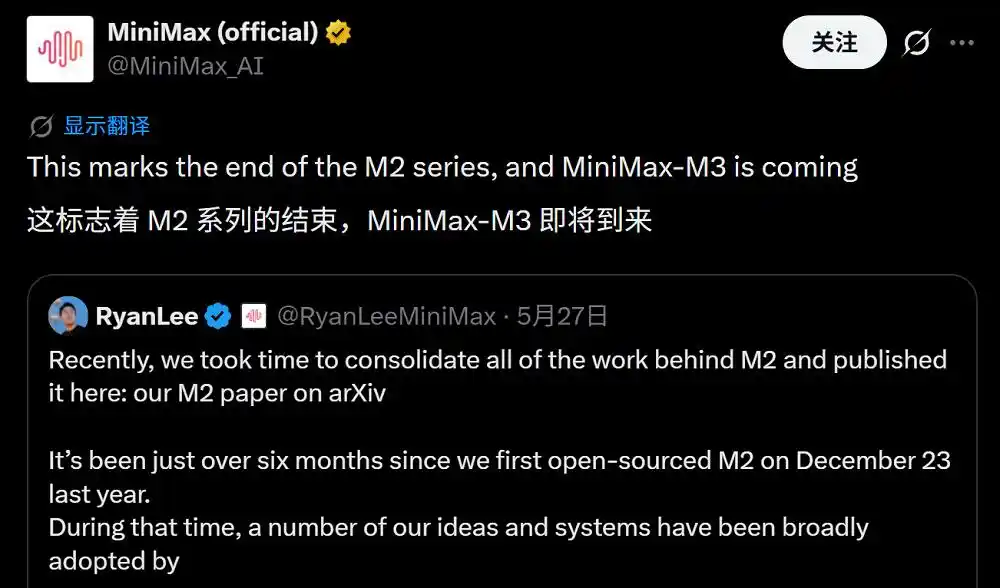
▲ MiniMax official account teases M3 model (Source: X platform @MiniMax_AI)

MiniMax Engineering Head Skyler Miao revealed more technical details about MiniMax-M3. MiniMax-M3 adopts the MiniMax Sparse Attention mechanism. Compared to MiniMax M2, in the Prefilling stage, MiniMax-M3's inference speed when processing 1 million tokens increased to 9.7 times faster; in the Decoding stage, when the KV length reaches 1 million, the speed increased to 15.6 times faster, effectively reducing attention latency.

The MiniMax Sparse Attention mechanism is based on the GQA (Grouped Query Attention) architecture. First, through the Index Branch, it uses compressed index queries (Idx Q) and keys (Idx KV) to calculate block scores and perform max pooling, selecting the Top-k block indices most relevant to the current query. Subsequently, it enters the Sparse Branch, performing sparse attention calculations only on these selected key blocks, thereby significantly reducing computational load.
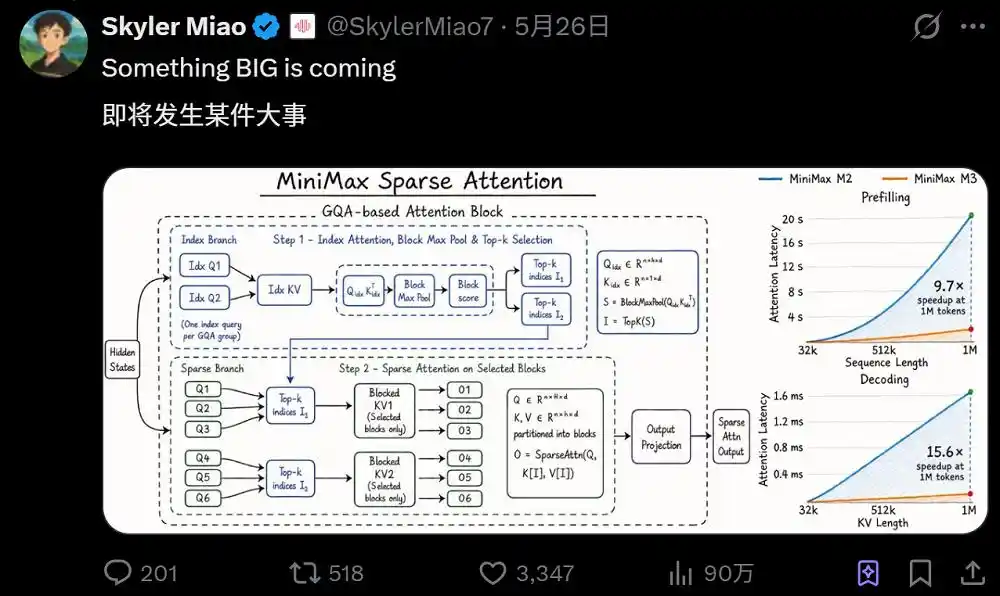
▲ Technical details of MiniMax Sparse Attention (Source: X platform @SkylerMiao7)

Conclusion: China's Leading Large Model Players Rush for Listing

Entering 2026, the moves of China's leading large model companies in the capital market have been accelerating. Besides MiniMax, Zhipu AI submitted its A-share IPO tutoring filing in April 2025 but later completed its IPO in Hong Kong first. In February this year, Zhipu withdrew its previous A-share IPO tutoring filing and registered for a new one, adding Guotai Haitong as a tutoring institution.

Furthermore, Moonshot AI, Stepfun, and 01.ai have also reportedly planned Hong Kong IPOs.

Facing high computing power investments and a not yet fully closed commercialization path, leading large model players are opening up more diverse financing channels through listings.

This article is from the WeChat public account "Zhidongxi" (ID: zhidxcom), author: Chen Junda

Trending Cryptos

Related Questions

QWhat is the significance of MiniMax filing for an A-share IPO, and who else is competing in this process?

AMiniMax's filing for an A-share IPO marks a significant step for the Chinese AI large model sector, potentially allowing it to compete with Zhipu AI to become the first large model company listed on the A-share market. This move is part of a broader trend where top Chinese AI firms like Zhipu, Moonshot AI, StepFun, and 01.AI are also accelerating their capital market activities, such as pursuing IPOs, to secure funding for their compute-intensive operations and commercialization efforts.

QWhat are MiniMax's key financial and business performance highlights as mentioned in the article?

AMiniMax has shown strong financial and business growth. Its ARR (Annual Recurring Revenue) grew over 100% in the past two months, exceeding $300 million, with a global user base of approximately 300 million and over a million enterprise/developer customers. For the full year 2025, revenue was $79.038 million, with a gross margin of 25.4%. The company's adjusted net loss was $250 million, representing a narrowing loss margin. Its Hong Kong-listed stock price has surged 409.09% from its IPO price.

QDescribe the recent product developments and announcements from MiniMax.

ARecently, MiniMax has launched several flagship large language models (MiniMax-M2.5, M2.6, and M2.7), with M2.5 and M2.7 being open-sourced. The company also upgraded its AI Agent product, renaming it 'Mavis,' which supports multi-agent parallel work. Most notably, MiniMax has previewed its upcoming 'MiniMax-M3' model, which reportedly features a 'MiniMax Sparse Attention' mechanism, leading to significant performance improvements such as up to 9.7x faster prefill and 15.6x faster decoding speeds compared to its predecessor.

QWhat was MiniMax's notable achievement in the OpenRouter platform rankings, and what is its current status there?

AIn mid-February, MiniMax briefly became the top-ranked model provider on the AI model aggregation platform OpenRouter, capturing 18.9% of the model calls. However, according to the article, it has since fallen out of the platform's top 10 rankings.

QWhat reasons does the article suggest for the rush of Chinese large model companies like MiniMax to go public?

AThe article suggests that facing enormous compute investment costs and a commercial monetization path that is not yet fully realized, leading large model companies in China are seeking IPOs to open up more diverse and substantial financing channels. This capital is crucial for sustaining their technological development and scaling their operations in a highly competitive and resource-intensive field.

Related Reads

Buyback and Burn: Just Empty Promises? The Unbridgeable Rights Gap Between Tokens and Equity

"Token Repurchase and Burn: An Empty Promise? The Unbridgeable Rights Gap Between Tokens and Equity" Holding company stock grants shareholders residual claim rights - a legally enforceable entitlement to remaining assets after all other obligations are paid. This comes with rights like voting, dividends, and a share in sale proceeds. Crypto protocols have long promised token holders similar benefits: governance participation and a share of future growth. However, this narrative is fundamentally flawed and built on voluntary promises, not enforceable legal rights. The core difference is that token holders lack any legally enforceable claim to a protocol's underlying value or revenues. Common mechanisms like using protocol revenue to buy back and burn tokens are purely discretionary; the team can alter or stop the policy at any time. Token holders have no legal recourse. This rights gap becomes critically apparent when protocols introduce traditional equity alongside tokens, as seen with Venice AI's $65M funding round. Equity investors hold legal contracts with rights to company assets and profits, while token holders' benefits depend entirely on the continued goodwill of the protocol's management. The acquisition of Houdini Swap, where equity holders were paid while token holders received nothing, starkly illustrates this disparity. Upcoming legislation like the CLARITY Act threatens to eliminate the regulatory gray area that has allowed this ambiguous "pseudo-equity" narrative. The Act would classify tokens as either digital commodities (regulated by CFTC) or investment contract assets/securities (regulated by SEC). Protocols aiming for the "digital commodity" classification would be explicitly prohibited from granting token holders any legal claim to corporate revenue, profits, or assets. Promising that tokens will appreciate from protocol profits would likely classify them as securities. Projects like Aave are attempting technical solutions, such as its automated, on-chain "Aavenomics 3.0" buyback mechanism. However, this remains code that the governance body could still vote to change, not an immutable legal contract. The industry faces a clear fork: either acknowledge tokens as digital commodities and stop promising economic rights tied to corporate profits, or formally register tokens as securities and bear the associated compliance burden. The decade-long narrative equating tokens with ownership is built on unenforceable promises. The entry of traditional equity investors with real legal rights exposes this foundational weakness, which may unravel with the next major funding deal.

Foresight News42m ago

Buyback and Burn: Just Empty Promises? The Unbridgeable Rights Gap Between Tokens and Equity

Foresight News42m ago

Navigating the World of Event Trading: Top 5 Prediction Markets for Every Type of User

The prediction market industry has grown significantly, with trading volumes exceeding $20 billion monthly by mid-2026, driven by sports, politics, and macroeconomics. Success now depends heavily on platform choice and execution logistics. This guide compares five leading networks: **Polymarket**: A high-volume, decentralized platform on Polygon, using USDC for international and crypto-native users. It offers diverse markets but lacks built-in risk tools. **Kalshi**: A CFTC-regulated U.S. exchange for institutional traders, using direct fiat. It leads in regulated volume, especially for major sports and economic events, but has limited contract listings. **Outpoll**: A CeDeFi platform for advanced traders, focusing on professional tools. It uniquely features built-in stop-loss/take-profit orders, 0.1% fees, and full API support, with settlement in USDC. **OG Predictive**: A CFTC-regulated, sports-focused platform from Crypto.com. It offers granular player props and a flat fee structure, appealing to long-term position traders. **Manifold Markets**: A play-money, no-KYC platform for casual users and developers. It allows user-generated markets on any topic with zero fees, serving as a sandbox for strategy testing. Key differentiators include regulatory models (regulated vs. decentralized), funding (fiat vs. crypto), order types, risk management features, API access, and mobile support. The conclusion emphasizes that in today's event trading, profitability hinges not just on accurate predictions but on optimizing execution through platform infrastructure, liquidity, fees, and risk tools.

TheNewsCrypto1h ago

Navigating the World of Event Trading: Top 5 Prediction Markets for Every Type of User

TheNewsCrypto1h ago

Why Are Large-Scale Crypto Conferences No Longer Glamorous?

Why Are Major Crypto Conferences Losing Their Allure? A growing sense of fatigue surrounds large in-person crypto conferences, with many founders and investors now avoiding events they would never have missed just two years ago. While complaints cite declining ROI and information quality, the root causes are more structural. Crypto, global from inception, once relied on these mega-conferences as neutral hubs for essential face-to-face connections. However, their core value has been fragmented. High-quality participants—developers, investors—have largely migrated to smaller, private side-events, leaving main stages for repetitive content already shared online. The main conference often just becomes the excuse for being in the same city, with attendees scrambling between exclusive dinners and micro-events. While these intimate gatherings offer signal-rich conversations, they lose the "serendipitous encounters" of large conferences and can create insular echo chambers, especially as talent concentrates in hubs like New York. Meanwhile, invite-only, high-caliber summits are rising, offering quality and scale but at the cost of accessibility and crypto's early egalitarian ethos. This shift isn't unique to crypto; AI events in San Francisco show a similar trend. The perception of higher-value interactions drives core groups towards smaller, private settings, potentially creating a vicious cycle that drains larger events of their vitality. Yet, a more optimistic view exists. The apparent decline of crypto-centric events may signal industry maturation. Leading projects are now focused outward—on stablecoins for traditional finance, consumer-facing digital banks, or real-world assets. Crypto topics are increasingly integrated into mainstream finance and tech conferences. Just as dedicated "internet conferences" faded, dedicated crypto summits may become redundant as the technology embeds into every sector. The future likely holds far fewer large, inward-looking crypto conferences. The industry has moved past needing frequent self-congratulatory gatherings. True growth lies in engaging with the broader economy. This evolution towards private networking and mainstream integration, for better or worse, is a mark of the industry coming of age.

marsbit1h ago

Why Are Large-Scale Crypto Conferences No Longer Glamorous?

marsbit1h ago

Coin & Stock Compass: Global Listed Companies Net Sold $85.45 Million in BTC Last Week, Strategy's Dollar Reserves Scale Up to $3 Billion (July 14)

Global Public Companies Net Sell $85.45 Million in BTC; Strategy's Dollar Reserves Hit $3 Billion (July 14) Last week saw a significant net sell-off of Bitcoin by global public companies, excluding miners, totaling $85.45 million—a 908.42% decrease from the prior week. Major buyers like Strategy (formerly MicroStrategy) and Japan's Metaplanet were notably absent from the market. However, two companies, Brazil's OrangeBTC and asset manager Strive, made purchases, adding 8 and 18 BTC, respectively. The aggregate BTC holdings of tracked public companies now stand at 1,139,635 BTC, valued at approximately $71.38 billion and representing 5.7% of Bitcoin's circulating market cap. In corporate updates, Strategy announced its dollar reserves have grown by $450 million to reach $3 billion, while its BTC holdings remain at 843,775 coins. Hyperscale Data increased its BTC reserves past 1,000 coins. Strategy will report its Q2 2026 financial results on July 30. Mining firm Cleanspark added 454 BTC, bringing its total to 13,924 BTC. Conversely, BitFuFu sold 184 BTC, Bitdeer maintained zero net BTC holdings after selling its weekly production, and Empery Digital sold 1,400 BTC to fund an AI data center project and repay debt. Overall, public companies purchased 110,000 BTC in Q2 2026, 1.8 times the volume of the previous two quarters combined. In other cryptocurrency-related corporate news, Ethereum treasury company Bitmine increased its ETH holdings by 27,801 coins, with total staked ETH exceeding 4.9 million. Solana-focused company DFDV transferred daily operations of its meme coin DONT to an independent team. BNB treasury company BNB Plus was delisted from Nasdaq for failing to meet the $1 minimum bid price and moved to trade on the OTCQB market under the symbol BNBX. The broader equity markets showed mixed signals. Bank of America warned that bullish investor positioning indicated a potential pullback risk for stocks. In contrast, Morgan Stanley predicted the ongoing earnings season could broaden market gains beyond tech giants. Specific regional highlights included continued foreign investor outflows from South Korean stocks, pressure on US equities, and the upcoming IPO of Chinese memory chip maker ChangXin Memory. Most crypto-linked stocks remained in a downtrend.

marsbit2h ago

Coin & Stock Compass: Global Listed Companies Net Sold $85.45 Million in BTC Last Week, Strategy's Dollar Reserves Scale Up to $3 Billion (July 14)

marsbit2h ago

Trading

Spot

Hot Articles

Discussions

Welcome to the HTX Community. Here, you can stay informed about the latest platform developments and gain access to professional market insights. Users' opinions on the price of S (S) are presented below.

活动图片