Securitize hires former PayPal exec as US tokenization gains traction

cointelegraphPublished on 2025-12-09Last updated on 2025-12-09

Abstract

Securitize, a major tokenization platform, has hired former PayPal executive Jerome Roche as its new general counsel to strengthen its push for tokenized equity in the US. Roche previously led PayPal’s expansion into digital assets, including the PYUSD stablecoin. The company emphasized that tokenized securities are already accessible to US investors, countering the perception that such offerings are primarily available abroad. CEO Carlos Domingo stated that Securitize operates within a clear US regulatory framework using SEC-approved infrastructure, enabling fully compliant access to onchain securities. This development follows Securitize’s recent regulatory approval in the EU and signals growing acceptance of tokenization in the US, further evidenced by the SEC ending its investigation into rival platform Ondo Finance.

Major tokenization platform Securitize has doubled down on its push to bring tokenized equity to US investors, naming a former PayPal executive as its new general counsel.

Securitize on Tuesday announced the appointment of ex-PayPal executive Jerome Roche, who led the company’s expansion into digital asset projects, including the PayPal USD (PYUSD) stablecoin.

Securitize also said its tokenized securities are already available to US investors, challenging the notion that most issuers prefer to offer such products abroad due to local stock access.

“There’s been a perception that tokenized securities must be offered primarily outside the US, but our experience shows the opposite,” Securitize CEO Carlos Domingo told Cointelegraph.

“Clear regulatory path” for tokenized stocks in the US

According to Securitize, operating real-world asset (RWA) tokenization offerings inside the US regulatory perimeter is “not only possible, but scalable, at institutional quality.”

“We’ve demonstrated that there is a clear regulatory path for issuers to natively tokenize assets for US investors,” Domingo said.

“These are not synthetic representations, or derivatives, but real securities onchain,” the CEO said, adding:

“We operate using SEC-regulated infrastructure, including a registered transfer agent broker-dealer, and fund admin, which allows US investors to access and legally hold tokenized securities in a fully compliant framework.”

Securitize’s optimistic outlook on the US tokenization comes days after the platform obtained regulatory approval to operate as an investment company and a trading ánd settlement system in the European Union on Nov. 26. According to the company, the approval positioned it as one of the first operators for regulated digital securities infrastructure in both the US and EU.
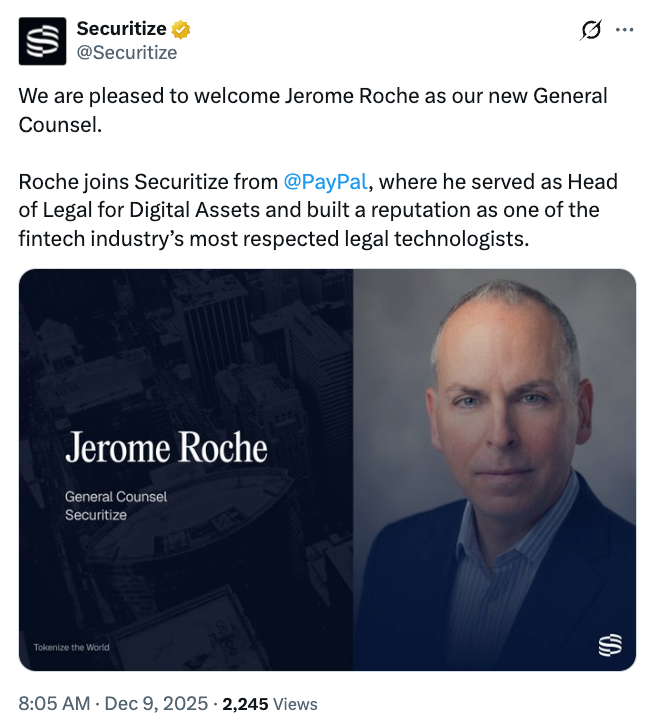
Source: Securitize

“For the first time, modern ledger technology is giving us the ability to record ownership, settle transactions, and move value in ways that are fundamentally better than the fragmented systems we’ve inherited,” Securitize’s newly appointed general counsel, Roche, said in the announcement.

“Innovation only works when it fits squarely within the guardrails of applicable law,” he added, underscoring Securitize’s global push for regulated tokenized securities.

Related: US Treasurys lead tokenization wave as CoinShares predicts 2026 growth

Securitize’s news is another sign of the US warming to tokenization. On Monday, the Securities and Exchange Commission dropped its investigation into rival tokenization platform Ondo Finance.

Ondo said the decision marks a new chapter for tokenized securities in the US, where they are poised to become a “core part of the capital markets.”

Magazine: When privacy and AML laws conflict: Crypto projects’ impossible choice

Related Reads

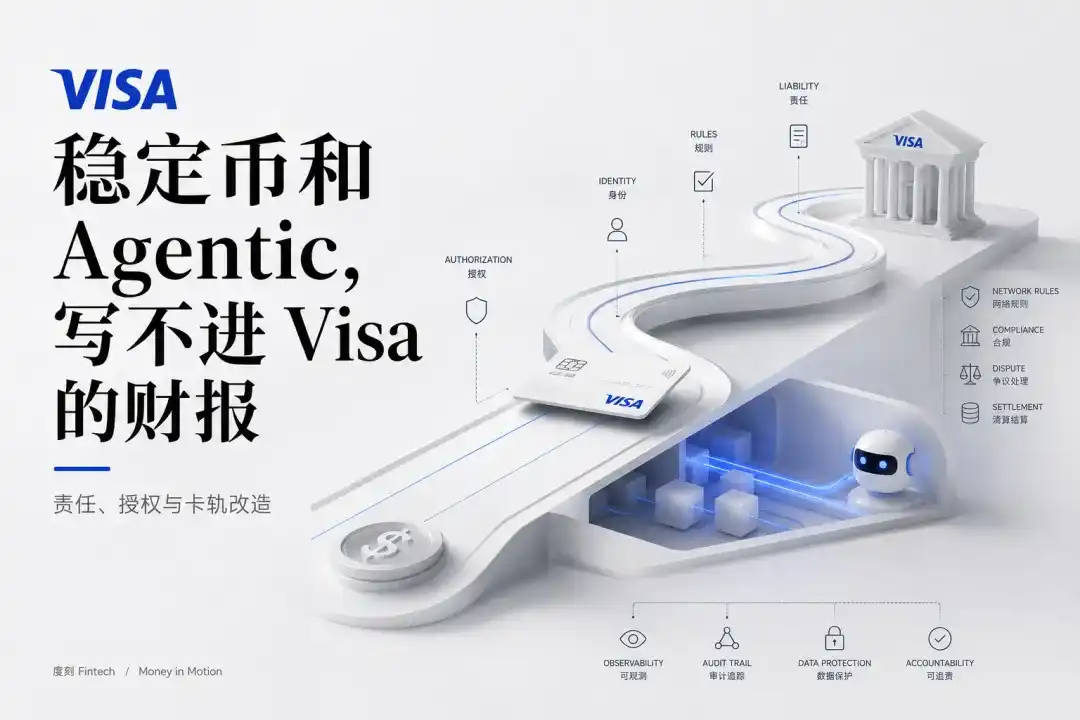
Stablecoins and Agentic Commerce Can't Make It into Visa's Earnings Report

**Title: Stablecoins and Agentic – Not Yet on Visa's Financial Statements** **Summary:** On July 16, Visa announced the Visa Stablecoin Platform (VSP), a platform for managing stablecoin issuance and movement, starting with OpenUSD. However, 12 days later, in its FY2026 Q3 earnings call, CEO Ryan McInerney detailed VSP but mentioned no revenue model, timing, or clients. CFO Christopher Suh's financial report did not mention VSP. Analysts' questions largely ignored stablecoins, focusing instead on cross-border growth and core metrics. The article examines Visa's business model using a "highway" analogy: Visa builds the payment network (the road), sets rules, and collects "tolls." Its revenue comes from four main streams: Service Revenue, Data Processing Revenue, International Transaction Revenue, and Other Revenue. After client incentives, Visa's net take-rate has remained stable at ~29 basis points. Currently, Visa's only meaningful revenue from stablecoins comes from "U Cards" – cards linked to stablecoin wallets. In these transactions, stablecoins are converted to fiat *before* entering Visa's network, so they are processed as regular card transactions, contributing to the standard 29 bps fee. Visa's other stablecoin initiatives—settlement pilots (converting *Visa's own* net obligations to stablecoins) and the new VSP platform—do not yet generate revenue; they are operational improvements or future commercial offerings. Regarding Agentic Commerce, Visa's products (Agent Score, Token Assurance Framework) are "devices" allowing AI agents to use the *existing* payment network. They are billed as value-added services. Visa views agentic commerce primarily as AI agents acting on behalf of humans in traditional commerce (replacement), not the potentially new market of machine-to-machine transactions (creation). Strategically, CEO McInerney listed stablecoins and agentic as a *fourth-tier* investment priority, behind core areas like consumer payments and value-added services. They are components within existing strategies, not standalone growth engines with defined addressable markets. In contrast, Mastercard took a different approach by acquiring BVNK for ~$1.8B to gain immediate scale in stablecoin payment processing. Visa's strategy appears conservative: building optionality without major bets. Its core moat is its decades-old dispute resolution and consumer protection infrastructure. The market values Visa for its current robust consumer spending, growing value-added services, and share buybacks—not for its stablecoin or AI agent initiatives. The narrative hype around these topics exceeds their current financial significance for the company.

marsbit6m ago

Stablecoins and Agentic Commerce Can't Make It into Visa's Earnings Report

marsbit6m ago

This Investor Day, SanDisk's 'Stunning Numbers' Shook the Market

SanDisk's Investor Day Shocks Market with "Explosive" Long-Term Targets SanDisk stunned the market at its 2026 Investor Day by unveiling an extremely aggressive long-term financial model. The company targets **mid-to-high double-digit revenue growth** for fiscal years 2028-2030. More impressively, it forecasts non-GAAP gross margins of approximately **80%** and operating margins around **75%** during that period, with an adjusted free cash flow margin of about 50%. A key strategic shift is SanDisk's focus on profitability over sheer output volume. The company clarified it will **flexibly adjust salable bit output based on profit optimization needs**, not simply chase bit shipment growth. This approach aims to avoid oversupply, especially during technology node transitions. SanDisk also committed to returning **100% of excess cash to shareholders** after funding business growth. Confidence in these targets is bolstered by new business model (NBM) agreements with eight major clients, covering roughly **50% of FY2027 and two-thirds of FY2028 bit shipments**, aiming to reduce cyclical volatility. The company sees massive tailwinds from AI, particularly the shift from training to inference, which is reshaping data center memory hierarchies. It estimates the enterprise flash TAM could reach **1.2 zettabytes by 2030**. SanDisk is advancing technologies like its CMOS Bonded Array (CBA) strategy and High Bandwidth Flash (HBF) for AI inference workloads. The announcement triggered a sharp rally, with SanDisk's stock soaring nearly 18% intraday and lifting the broader storage sector.

marsbit8m ago

This Investor Day, SanDisk's 'Stunning Numbers' Shook the Market

marsbit8m ago

Bitwise Chief Investment Officer: Revenue Reigns Supreme, The Valuation Logic for Crypto is Being Rewritten

The valuation logic of crypto assets is shifting from speculative models to a focus on real revenue and earnings, according to Bitwise CIO Matt Hougan. For years, a key criticism was that crypto tokens lacked fundamental value as they didn't generate cash flows for holders, partly due to a restrictive regulatory environment. This changed following the 2023 Ripple lawsuit and subsequent regulatory shifts, allowing projects to direct protocol revenues to token holders. Hyperliquid pioneered this model, using ~99% of its fee revenue to buy back and burn its HYPE token, creating a direct link between network activity and token value. Its success has inspired widespread adoption. Uniswap now uses all fee revenue to burn UNI, Aave has implemented automated buybacks, and new platforms like shturl.c and Lighter have built revenue-sharing mechanisms from inception. Even layer-1 blockchains like Solana and Aptos are adjusting fee models to benefit token holders. Hougan draws a parallel to early internet companies that eventually monetized their user bases. He argues that top crypto platforms possess significant pricing power and that the market undervalues them because many investors, both inside and outside crypto, have not yet recognized this fundamental shift. While tokens carry different risks than equities (e.g., governance-based revenue rights), the growing alignment of revenue with token value could lead to a significant re-rating of crypto asset valuations in the coming 12-24 months.

marsbit15m ago

Bitwise Chief Investment Officer: Revenue Reigns Supreme, The Valuation Logic for Crypto is Being Rewritten

marsbit15m ago

Shanghai Automotive Chip 'Little Giant' to IPO, Aiming to Raise 3.489 Billion Yuan

"Shanghai-based auto chip 'Little Giant' Gatsland Aims for IPO, Seeking to Raise 3.489 Billion CNY" Gatsland Microelectronics, a Shanghai-based automotive-grade millimeter-wave radar and ultra-wideband (UWB) chip company recognized as a national-level "Little Giant" specializing in core technologies, has filed for an IPO on Shanghai's STAR Market. Founded in 2014, the company is a key player in China's automotive semiconductor sector. It achieved a milestone in 2017 by mass-producing the world's first automotive-grade 77GHz mmWave radar RF front-end single-chip using CMOS process technology, breaking the industry's reliance on GaAs and SiGe multi-chip solutions. Gatsland claims to be the fourth-largest global and second-largest domestic supplier of automotive mmWave radar chips, and a leader in CMOS-based solutions. Financially, Gatsland has shown strong revenue growth, with figures rising from 206 million CNY in 2023 to 632 million CNY in 2025. However, the company remains unprofitable, reporting net losses for the reported periods, including a loss of 193 million CNY in 2025. Despite this, it maintains high gross margins, averaging around 47%, which are notably above industry peers. Over 97% of its recent revenue comes from automotive mmWave radar chips. The company's products, including its Alps and Kunlun platform chips, are used in advanced driver assistance systems (ADAS), autonomous driving, and in-cabin sensing. Its chips have been adopted by major Chinese automakers like BYD, Geely, and NIO, and it has begun supplying European Tier 1 suppliers and international OEMs including Volvo and Rivian. Gatsland's customer base is highly concentrated, with its top five direct clients accounting for over 99% of sales in recent periods. Its supply chain also relies significantly on overseas partners for wafer fabrication, packaging, and EDA tools. Notably, the National Integrated Circuit Industry Investment Fund Phase II ("Big Fund II") is among its shareholders. The management team, including founder and CEO Chen Jiashu, holds strong academic and industry backgrounds from institutions like UC Berkeley and companies such as Texas Instruments. For its IPO, Gatsland plans to raise approximately 3.489 billion CNY to fund R&D and production projects for next-generation mmWave radar and high-precision UWB chips, as well as a new innovation center. The company operates in a highly competitive landscape dominated by international giants like Infineon, NXP, and TI. While it has gained significant market share in China, Gatsland acknowledges it still faces gaps in comprehensive R&D strength and global customer reach compared to these established players.

marsbit16m ago

Shanghai Automotive Chip 'Little Giant' to IPO, Aiming to Raise 3.489 Billion Yuan

marsbit16m ago

Tether Finally Gets Audited by a Big Four Firm, But USDT's Transparency Issues Are Far From Over

Tether announced that KPMG U.S. has completed its first independent audit of Tether International's financial statements as of December 31, 2025, issuing an unqualified opinion—the highest level of assurance. The audit confirms Tether's assets exceeded liabilities by $6.814 billion at that date, with physical verification of gold bars and examination of underlying records. This represents a significant step beyond the quarterly reserve attestations Tether previously received, moving to a full financial statement audit that examines internal controls, transaction sampling, and accounting policies. However, the article highlights several ongoing transparency questions. The full KPMG audit report has not been publicly released, preventing independent verification of details like asset classification or related-party transactions. The audit covers a specific entity, "Tether International, S.A. de C.V.," leaving the scope concerning Tether's complex corporate structure unclear. Furthermore, the $6.8 billion excess reserves confirmed for end-2025 had shrunk to approximately $4.1 billion by Q2 2026. Risks within the reserve composition, particularly concerning secured loans, persist even with an audit. The audit's data is also already 8 months old, while USDT's circulation has grown rapidly. Strategically, the audit is seen as a move to bolster Tether's position amid U.S. regulatory developments like the GENIUS Act, which mandates audits for stablecoin issuers but leaves a path for foreign entities like Tether. While the KPMG opinion is a strong credibility signal, the article concludes that full transparency and regulatory compliance require further steps, starting with the publication of the complete audit report.

marsbit47m ago

Tether Finally Gets Audited by a Big Four Firm, But USDT's Transparency Issues Are Far From Over

marsbit47m ago

Trading

Spot
活动图片