Saylor: Bitcoin Down 47%, Strategy's STRC Index Up 9% Yearly

cryptonews.ruPublished on 2026-08-16Last updated on 2026-08-16

Abstract

Strategy Inc. Executive Chairman Michael Saylor highlighted the performance gap between Bitcoin and the company's digital credit securities. Over the past year, Bitcoin ($BTC) fell 47%, while Strategy's STRC perpetual preferred equity security gained 9% (including dividends). Other preferred securities—STRD, STRF, and $STRK—declined 8%, 9%, and 27%, respectively. STRC offers variable dividends (12% annualized as of August) and is designed to trade near its $100 liquidation preference. Strategy raised $7.53 billion via STRC in the year after issuance, paying $1.06 billion in total preferred dividends. The company's "Digital Credit Capital Framework" includes a $1 billion buyback program for preferred securities and allows Bitcoin sales for reserves, dividends, and buybacks. Despite STRC's positive annual return, it traded below its $100 value in recent months, hitting a low of $71.25 in June. Strategy began repurchasing STRC shares in late July at a discount. Saylor's model positions Bitcoin as the equity/capital layer, with preferred securities creating lower-volatility income instruments. However, sustaining STRC dividends depends on Bitcoin's price growth exceeding the company's break-even level. Meanwhile, Strategy's common stock (MSTR) fell roughly 75.5% year-over-year, with Q2 reporting a net loss of $8.22 billion driven by unrealized losses on digital assets.

According to an annual performance chart posted on X on August 16 by Strategy Inc. (Nasdaq: MSTR) Executive Chairman Michael Saylor, STRC has outperformed bitcoin by 56 percentage points over the past year. The chart reflects returns as of market close on August 14 and highlights the performance gap between bitcoin and Strategy's income-producing securities during the market downturn.

Saylor wrote:

"Over the past year, $BTC fell 47%. The performance of our Digital Credit instruments ranged from -27% to +9%, with $STRC up 9%".

The accompanying chart shows STRD down 8%, STRF down 9%, and $STRK down 27%, with Bitcoin trading around $63,000 on August 16. Strategy clarified that the annual calculations cover the period from August 14, 2025, to August 14 and include cash dividends and payments, providing a broader picture than just stock price changes.
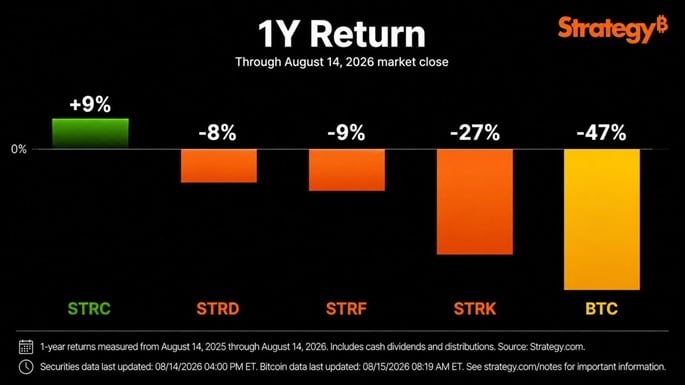
Annual performance of Strategy's preferred securities and Bitcoin. Source: Michael Saylor/Strategy Inc. via X

Stretch, trading under the ticker STRC, is a perpetual preferred stock with a variable annual dividend rate, designed to encourage trading near its $100 nominal value. On Strategy's official STRC information page, the annual rate for August is listed as 12%, with cash dividends paid twice monthly, subject to board approval.

STRD is a Strategy perpetual preferred stock with a fixed 10% annual dividend rate paid quarterly. STRF is the company's highest-priority preferred stock, offering fixed annual cash dividends of 10% paid quarterly. $STRK is a convertible perpetual preferred stock with a fixed 8% annual dividend rate paid quarterly. Dividends are not guaranteed.

Dividends Change the Performance Comparison Picture

STRC's reported annual return of 9% differs from its current 12% annual dividend rate, which applied for only part of the period. The preferred shares were issued in July 2025 at a 9% rate and saw increases for seven consecutive months before reaching the 12% level for fixing dates on or after July 1. Their market price can fluctuate, while dividends were included in the reported annual return.

In its Q2 earnings report, Strategy described digital credit as a primary financing channel. The company reported that as of July 26, 2026, STRC securities raised $7.53 billion since issuance a year prior, a 254% increase, while cumulative dividends paid across all preferred shares reached $1.06 billion.

Under its "Digital Credit Capital Framework," the company established a cash reserve policy, revised the STRC dividend policy, and authorized the repurchase of up to $1 billion in preferred securities alongside a separate $1 billion common stock repurchase program. Strategy also authorized bitcoin sales for specific purposes, including replenishing reserves, paying dividends, interest, and approved repurchases.

Saylor has positioned STRC as the income layer in a four-layer digital money structure. In his model, bitcoin serves as the equity layer, with preferred securities used to create income instruments with varying volatility and risk profiles.

Lower Volatility Does Not Eliminate Risk

Despite the positive annual return, STRC shares fell to an all-time low of $71.25 on June 26 and have since traded below their $100 nominal value. Strategy maintained the dividend rate at 12% for August after the preferred shares closed July at $89.46, reflecting the company's effort to support its share price.

Digital credit repurchases began in late July, with the company buying 288,930 STRC shares for approximately $25 million, at an average price of $86.53 per share, a 13.47% discount to the $100 nominal value. Since the start of the year, Strategy sold approximately $218.4 million worth of bitcoin to fund part of the preferred share dividends.

The dividend structure depends partly on Strategy's ability to meet ongoing cash obligations while maintaining a bitcoin-focused balance sheet. The preferred shares are not secured by the company's bitcoin assets. Saylor has previously stated that for capital gains to cover STRC preferred dividends over time, bitcoin's annual appreciation must exceed the company's break-even level on $BTC.

Bitcoin as an asset class has historically been significantly more volatile than traditional stocks, bonds, and commodities, a gap Strategy's preferred structures aim to narrow.

The Position of Strategy's Common Shares

The annual chart features four types of Strategy preferred securities alongside bitcoin, while MSTR—the company's Class A common stock—sits below them in the capital structure. On August 14, MSTR closed at $93.04, approximately 75.52% lower than a year earlier.
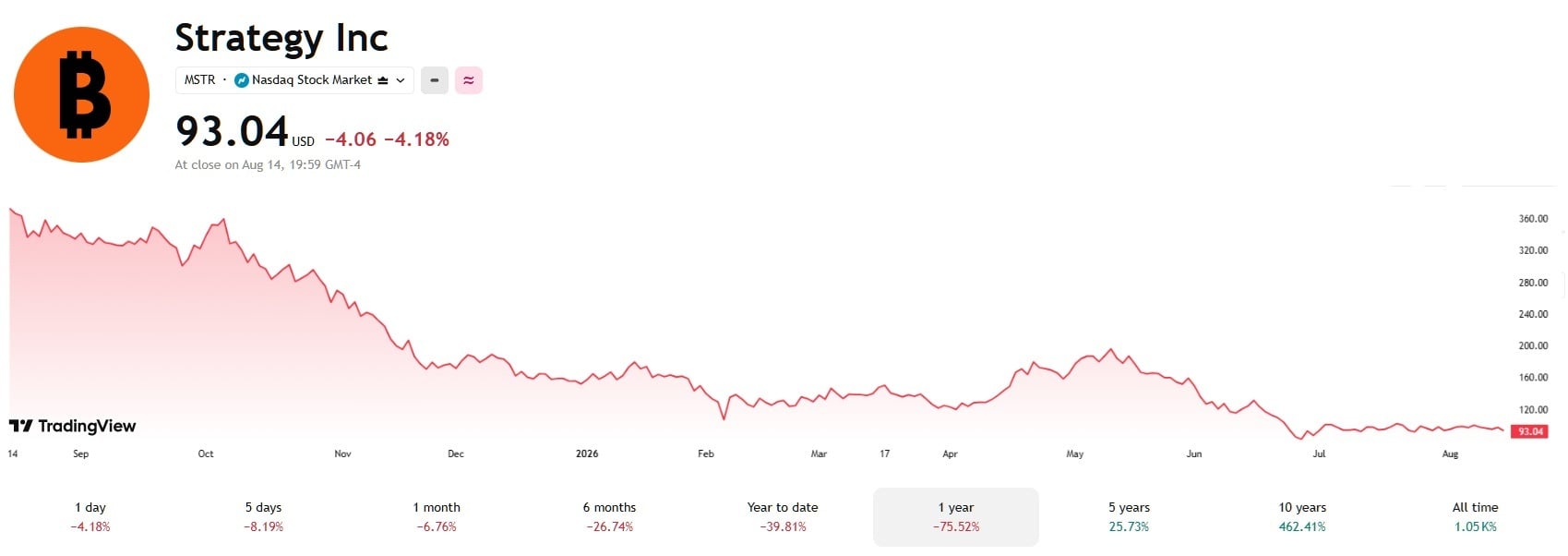
Strategy Inc. MSTR stock price chart. Source: TradingView

Common shareholders are entitled to residual earnings after preferred dividends, which alone amounted to $400.7 million in Q2. Strategy reported a Q2 net loss of $8.22 billion, or $24.45 per diluted common share, linked to an $8.32 billion unrealized loss on digital assets. The $1 billion MSTR stock repurchase program remains fully available; the company states it will consider repurchases when management believes the market price is below intrinsic value.

end-content

Trending Cryptos

Related Questions

QAccording to Michael Saylor's chart, what was the performance gap between Bitcoin and Strategy Inc.'s STRC security over the past year?

AOver the past year, Strategy Inc.'s STRC security outperformed Bitcoin by 56 percentage points. Bitcoin fell 47%, while STRC rose 9%.

QWhat is STRC, and what is its stated purpose regarding its market price?

ASTRC is a perpetual variable-rate preferred stock from Strategy Inc. It is designed to encourage trading near its $100 par value.

QHow does Strategy Inc.'s reported 9% annual return for STRC differ from its current 12% annual dividend rate?

AThe reported 9% annual return includes price changes and dividends paid over the full year. The 12% dividend rate is a current rate that applied only to a portion of the period after being raised from an initial 9% rate.

QWhat role does Bitcoin play in Strategy Inc.'s framework for funding dividends on its preferred securities?

AStrategy Inc. has sold Bitcoin to finance part of the dividends on its preferred shares. Saylor stated that for capital gains to cover STRC dividends over time, Bitcoin's annual appreciation must exceed the company's breakeven level on BTC.

QHow did Strategy Inc.'s common stock (MSTR) perform compared to its preferred securities and Bitcoin over the past year?

AStrategy Inc.'s common stock (MSTR) performed significantly worse. Its closing price on August 14 was approximately 75.52% lower than a year prior, placing it below the performance of all four featured preferred securities and Bitcoin.

Related Reads

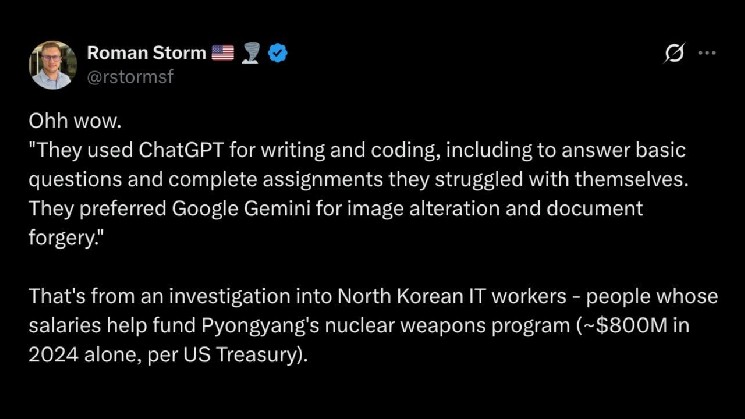
Roman Storm Accuses Google and OpenAI in Connection with U.S. Department of Justice Ruling on Cryptocurrency Case

Roman Storm, founder of the cryptocurrency anonymization protocol Tornado Cash, convicted in August 2025 for conspiracy to operate an unlicensed money-transmitting business, has accused Google and OpenAI of facilitating North Korea's nuclear program. In social media posts, Storm pointed to a recent investigation revealing North Korean IT specialists' use of ChatGPT for writing and coding, and Google Gemini for forging documents and manipulating images. He argued that, under the same legal logic the U.S. Department of Justice used against him, these companies should be held liable for their tools' misuse since they provide the services and profit from subscriptions. Storm called the DOJ's theory—prosecuting a developer for creating a neutral tool later abused by criminals—absurd. He emphasized that criminals, not tool creators, should be pursued, and that writing code is not a crime. The Tornado Cash verdict sets a negative U.S. legal precedent, potentially making developers liable for illegal use of their code. Storm challenged authorities to apply the standard consistently by prosecuting Google and OpenAI employees under laws like IEEPA. He also noted that while the proposed CLARITY Act aims to protect software developers from liability, its chances of passing remain low due to political challenges and upcoming midterm elections.

cryptonews.ru16m ago

Roman Storm Accuses Google and OpenAI in Connection with U.S. Department of Justice Ruling on Cryptocurrency Case

cryptonews.ru16m ago

Trading

Spot

Hot Articles

Discussions

Welcome to the HTX Community. Here, you can stay informed about the latest platform developments and gain access to professional market insights. Users' opinions on the price of S (S) are presented below.

活动图片