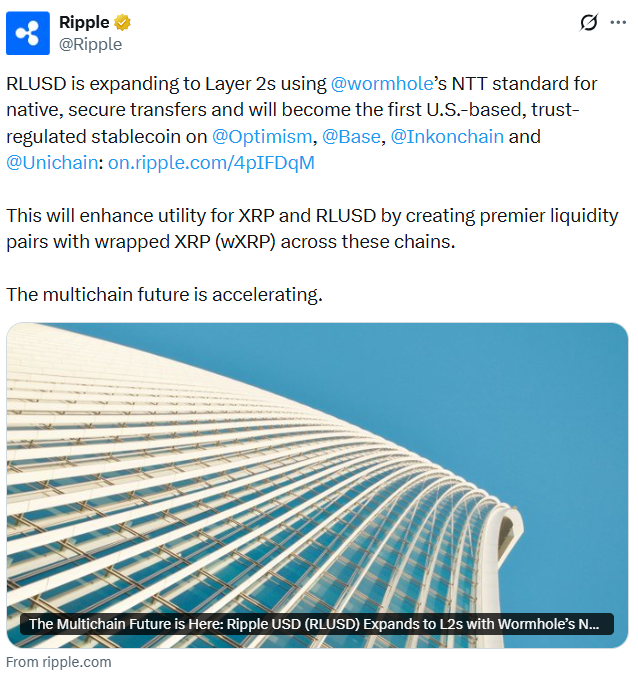
Ripple Labs is expanding its US dollar-backed stablecoin RLUSD to Ethereum layer-2 blockchains as part of a pilot while it awaits regulatory approval for a full rollout next year.
In partnership with Wormhole, a crosschain interoperability protocol that allows assets to move between different blockchains, the pilot will test RLUSD on Optimism, Base, Ink, and Unichain, according to a statement from Ripple on Monday.
Initially, RLUSD was issued on the XRP Ledger and Ethereum; however, Ripple said that the latest expansion is “essential for a scalable, efficient, and interoperable future.”
“The future of crypto is undeniably multichain, and to truly serve both institutional finance and the growing onchain economy, stablecoins must exist wherever demand and utility are.”
“As chains continue to build for real-world use, the need for a highly regulated stablecoin is stronger than ever,” the Ripple team added.
RLUSD will avoid using wrapped copy across blockchains
The Wormhole team said in an X post on Monday that its Native Token Transfers standard will allow RLUSD to move across blockchains as the real token, as opposed to a synthetic or wrapped copy, which will help maintain liquidity.
In some multichain setups, when a token is transferred, it’s locked on its original blockchain while a wrapped copy version is minted on another.
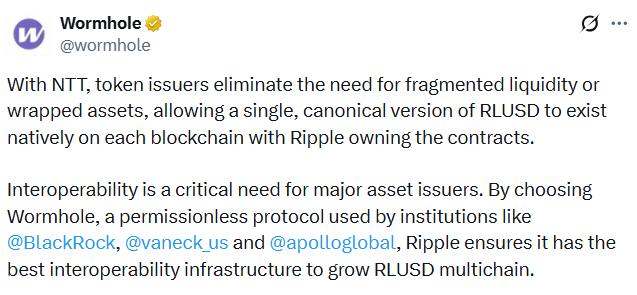
“With NTT, token issuers eliminate the need for fragmented liquidity or wrapped assets, allowing a single, canonical version of RLUSD to exist natively on each blockchain with Ripple owning the contracts,” the Wormhole team added.
More chains are coming next year
RLUSD will launch on subsequent chains next year, but the launch is still subject to final regulatory approval, according to Ripple.
RLUSD is issued under the state-level New York Department of Financial Services Trust Company Charter, while the company has also applied for a federal trust bank charter from the Office of the Comptroller of the Currency, to add Federal oversight.
Jack McDonald, senior vice president of stablecoins at Ripple, said stablecoins are the “gateway to DeFi and institutional adoption.”
“By launching RLUSD—the first US Trust Regulated stablecoin on these L2 networks—we are not just expanding utility; we are setting the definitive standard where compliance and onchain efficiency converge.”
RLUSD market capitalization sits at $1.3 billion
RLUSD, launched in December 2024, has a market capitalization of $1.3 billion, according to crypto data aggregator CoinGecko.
Related: Ripple’s RLUSD enters top 10 USD stablecoins less than year after debut
In comparison, the top stablecoin, Tether’s USDT, has a market cap of $186 billion, Circle’s USDC has a $78 billion market cap, and Sky Protocol’s USDS is the third-largest with $9.8 billion.
RLUSD has gained traction among retail users, particularly through integrations with platforms like Transak and growing adoption across self-custodial wallets, like Xaman.
Related: HIVE tests investor appetite for AI-Bitcoin infrastructure in Andean markets