Ripple Updates XRP ‘Fast Facts’ As ETF And Institutional Momentum Grows

bitcoinistPublished on 2026-01-08Last updated on 2026-01-08

Abstract

RippleX has updated its "FAST FACTS" about XRP, positioning it as infrastructure for real-world utility rather than a speculative asset. The update highlights XRP's role in settlement, liquidity, and moving value across financial systems, with a fixed supply of 100 billion. XRPL is emphasized as a decentralized blockchain with over 116 validators and 6.4 million wallets, settling over $1 trillion in value. The thread also notes XRP's growing role in real-world assets (RWA) and stablecoins, listing key issuers and partnerships. Additionally, it mentions the emergence of institutional treasuries, like Evernorth's $1B commitment, and multiple spot ETFs, signaling regulated, mainstream adoption. XRP traded at $2.20 at the time of writing.

RippleX, the developer-focused arm of Ripple,used a Jan. 6 X thread to refresh a set of “FAST FACTS” about XRP, framing the asset less as a speculative ticker and more as market infrastructure, arriving as spot ETF momentum and early institutional treasury narratives begin to form around the token.

“XRP is a digital asset of choice for real-world utility – from stablecoin settlement to real-world assets, to institutional payments,” RippleX wrote. “With new momentum around XRP ETFs and institutional treasuries forming, here are some updated FAST FACTS about XRP.”

What Is XRP?

The thread’s opening points stick to the positioning Ripple has leaned on for years: XRP as a liquidity and settlement rail between financial systems rather than an app-layer bet.

RippleX described it as “a functional digital asset designed for settlement and liquidity, focusing on moving value between financial systems,” adding that, “acting as a neutral bridge, it helps move value between payments, stablecoins, tokenized financial assets, and collateral across the global economy.”

RippleX also reiterated supply constraints and control narratives that frequently resurface in institutional due diligence. “XRP was created at the launch of XRPL in 2012 and its supply is permanently capped at 100B – no additional XRP can ever be minted and no single entity (including Ripple) controls or can change the total supply,” the post said.

Other “fast facts” were more about market posture than mechanics, including the claim that XRP is “one of the few digital assets with clear regulatory standing in the US” and that it remains a top-three asset by market capitalization.

RippleX devoted several entries to XRPL’s decentralization metrics and operational history, emphasizing that the ledger runs independently of Ripple the company.

“XRPL is a public, decentralized blockchain with 116+ independent validators and 910+ public nodes – it operates independent of Ripple as an entity,” RippleX wrote. “XRP plays a core role on the network as its native settlement and liquidity asset.”

On consensus and execution, RippleX said XRPL uses “Proof-of-Association (PoA),” describing a model with “no mining, no staking, no block rewards,” and “transaction finality in 3–5 seconds.” It also pointed to network-scale usage stats since inception: “4B+ transactions,” “100M+ ledgers,” “6.4M+ wallets,” and “$1T+ in value” settled.

Real-World Assets And Stablecoins

A notable portion of the thread focused on RWAs and stablecoins,two categories where issuers and liquidity relationships matter more than raw TPS.

RippleX said XRPL is “now one of the top 10 blockchains for RWA activity,” listing issuers and initiatives “such as Ondo Finance, OpenEden, Archax/abrdn, Guggenheim Treasury Services, Mercado Bitcoin, VERT, and the Dubai Land Department” as building or launching assets on XRPL.

On stablecoins, RippleX cited a “growing stablecoin ecosystem” including “RLUSD, USDC, XSGD, AUDD, BBRL/USBD, and EURCV,” adding that “XRP often serves as a liquidity pair,” facilitating exchange between stablecoins and other assets on the network.

RippleX’s final “fast facts” aimed directly at regulated access and institutional balance sheets. It claimed XRP “now has its first institutional treasury” via Evernorth, which “has secured more than $1B in commitments,” describing this as a shift “from a traded asset to a regulated, balance-sheet asset for institutions.”

It also said XRP is “now supported by multiple spot ETFs,” naming Bitwise (XRP), Canary Capital (XRPC), Franklin Templeton (XRPZ), and Grayscale (GXRP) as issuers—positioning ETFs as a bridge into “regulated, mainstream investment products.”

Finally, RippleX pointed to wrapped XRP as an interoperability lever, saying it extends XRP’s utility to the “XRPL EVM Sidechain” and to ecosystems including “Ethereum, Solana, Optimism, and HyperEVM.”

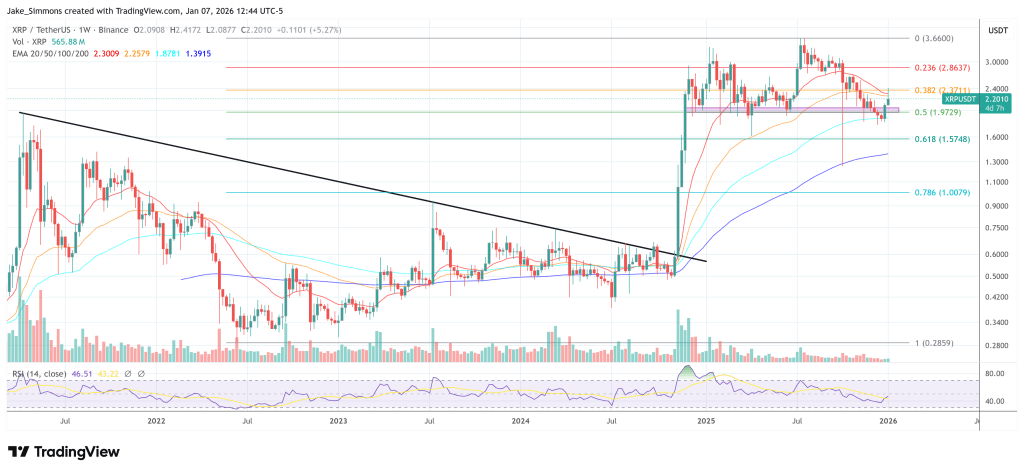
At press time, XRP traded at $2.20.

XRP faces the 0.382 Fib, 1-week chart | Source: XRPUSDT on TradingView.com

Related Questions

QWhat is the main purpose of RippleX's updated 'FAST FACTS' about XRP?

ATo frame XRP less as a speculative asset and more as market infrastructure, highlighting its real-world utility and institutional adoption as ETF and treasury momentum grows.

QHow does RippleX describe the role of XRP in the financial ecosystem?

ARippleX describes XRP as a functional digital asset designed for settlement and liquidity, acting as a neutral bridge to move value between payments, stablecoins, tokenized financial assets, and collateral across the global economy.

QWhat are some key technical features of the XRP Ledger (XRPL) mentioned in the article?

AXRPL is a public, decentralized blockchain with over 116 independent validators and 910+ public nodes, using Proof-of-Association consensus with no mining or staking, and achieving transaction finality in 3-5 seconds.

QWhich real-world asset (RWA) and stablecoin initiatives are building on XRPL according to the article?

ARWA initiatives include Ondo Finance, OpenEden, Archax/abrdn, Guggenheim Treasury Services, Mercado Bitcoin, VERT, and the Dubai Land Department. Stablecoins include RLUSD, USDC, XSGD, AUDD, BBRL/USBD, and EURCV.

QHow is XRP gaining institutional adoption through regulated products?

AXRP now has its first institutional treasury via Evernorth with over $1B in commitments, and is supported by multiple spot ETFs from issuers like Bitwise, Canary Capital, Franklin Templeton, and Grayscale, positioning it as a regulated, balance-sheet asset.

Related Reads

Kicked Out of PayPal, Musk Aims for a Comeback in the Crypto Market

Elon Musk's X (formerly Twitter) has launched its "Smart Cashtags" feature, generating approximately $1 billion in trading volume within days of its April 2026 pilot launch. The feature allows users to click on stock or crypto tickers (or even full Solana token contract addresses) in posts to view real-time price charts and discussions without leaving the app. Initially available to iPhone users in the US and Canada, with a partnership in Canada enabling direct trading via the Wealthsimple app. This move is part of Musk's broader "Everything App" vision, spearheaded by the upcoming X Money platform. Analysts, such as Mizuho's Dan Dolev, see this as a potential disruptor to the US payments market, even prompting a downgrade of PayPal's stock. X Money's beta offers services like 6% APY on deposits, cashback, and P2P transfers, with speculation it may later incorporate crypto trading and stablecoin settlements for faster transactions. However, the ambitious plan faces significant regulatory scrutiny. Senator Elizabeth Warren has questioned the sustainability of the high 6% yield and raised concerns over X's banking partner, Cross River Bank, which has a history of regulatory violations. Additional risks involve the "GENIUS Act," which may create loopholes for stablecoin issuance without full FDIC insurance coverage, potentially leaving users unprotected. The integration of social trading on a platform with over 500 million users could inject new liquidity and retail interest into the crypto market. Yet, it also amplifies risks like herd mentality and the blurring of lines between entertainment and financial speculation. Musk's return to finance, after his ouster from PayPal, hinges on balancing innovation with regulatory compliance.

marsbit2h ago

Kicked Out of PayPal, Musk Aims for a Comeback in the Crypto Market

marsbit2h ago

Trading

Spot
Futures
活动图片