Ripple President On $500 Million Raise: No IPO, No Exchange, Bigger Plans

bitcoinistPublished on 2026-01-07Last updated on 2026-01-07

Abstract

Ripple President Monica Long detailed the company's plans for its recent $500 million equity raise, which was completed at a $40 billion valuation with investors including Citadel and Fortress. The funds will be used to integrate recent acquisitions (Hidden Road, Rail, GTreasury, and Palisade) and expand Ripple's regulated stablecoin infrastructure. Long emphasized a "compliance first" approach, noting Ripple holds over 70 licenses globally. She explicitly stated the company has no plans or timeline for an IPO and does not intend to acquire a centralized exchange, despite viewing them as key partners. The strategy focuses on building digital asset infrastructure for businesses and financial institutions, moving beyond reliance on XRP.

Ripple president Monica Long says the company’s latest $500 million equity raise is being put to work on integrating a run of acquisitions and expanding Ripple’s push into regulated stablecoin infrastructure.
In an interview with Bloomberg Crypto on Jan. 6, Long addressed investor questions around the fundraising terms, Ripple’s plans for RLUSD under a new US regulatory regime, and whether the company is moving any closer to an IPO.

What Ripple Is Really Doing With Its $500M War Chest

The raise, done in the fourth quarter at a reported $40 billion valuation, brought in major names including Citadel and Fortress, alongside a number of crypto native funds. The deal reportedly allows investors to sell shares back to Ripple at a guaranteed price and return, plus preferential treatment in major events such as a sale or bankruptcy.

Long did not dwell on the specific mechanics, but framed the structure as favorable for Ripple and positioned the investor mix as strategic for where the company wants to go next.

“So the overall structure for the fundraiser is very, very positive, very favorable for Ripple,” Long said. “We were really pleased to welcome Fortress and Citadel onto our cap table in addition to a number of other crypto native premier funds. And what they really saw was that our business is working, you know, our strategy of creating digital asset infrastructure for businesses and financial institutions alongside the inflection point that stable coin payments hit last year was something that they wanted to be a part of.”

Long added that as Ripple looks “more toward applying these technologies to the world of capital markets,” investors like Citadel and Fortress can be “great strategic partners on that front.”

Pressed on whether the investor protections were necessary to secure the valuation and close the deal, Long offered limited additional detail, saying only that “to my knowledge, they were excited to be a part of to be investors in Ripple,” and that Ripple was “very pleased with how the terms of the deal panned out.”

Long said the money is supporting a company that is still in build-and-integrate mode after an acquisitive year. “You know, 2025 was a big year for Ripple for both our organic growth and then also inorganic,” she said, adding Ripple “had acquired four companies last year with the fundraise as well,” and is now focused on “integrating those businesses [Hidden Road, Rail, GTreasury and Palisade] and continuing to grow.”

Long also described Ripple’s broader effort to diversify value creation beyond the company’s XRP holdings by building what she called the “connective tissue” needed to make tokenized assets usable for institutions, custody, compliant on- and off-ramps, and regulatory permissions. She said Ripple has taken a “compliance first” approach and has acquired “70 plus licenses around the world” to support customer flows.

Long also outlined how recent acquisitions fit Ripple’s product roadmap. She pointed to “adding components like MPC custody through Palisade,” strengthening the stablecoin offering “with rail,” and buying complementary businesses that can consume Ripple’s infrastructure, citing GTreasury, which she said serves “a thousand corporates,” and Ripple Prime, which she said serves “hundreds of hedge funds,” as Ripple pushes into use cases like collateral mobility.

What Ripple Is Not Doing With The Raise

Despite adding new large investors, Long reiterated Ripple’s stance on staying private. She said the company still has “no plan, no timeline for an IPO,” arguing Ripple can fund growth and acquisitions with its existing balance sheet strength and private-market interest rather than pursuing public-market liquidity.

Asked whether Ripple might buy a centralized exchange, Long called exchanges “definitely key partners” but said Ripple does not plan an acquisition in that category, while noting the rise of decentralized exchanges and a broader trend of “verticalization” among major crypto firms.

At press time, XRP traded at $2.25.
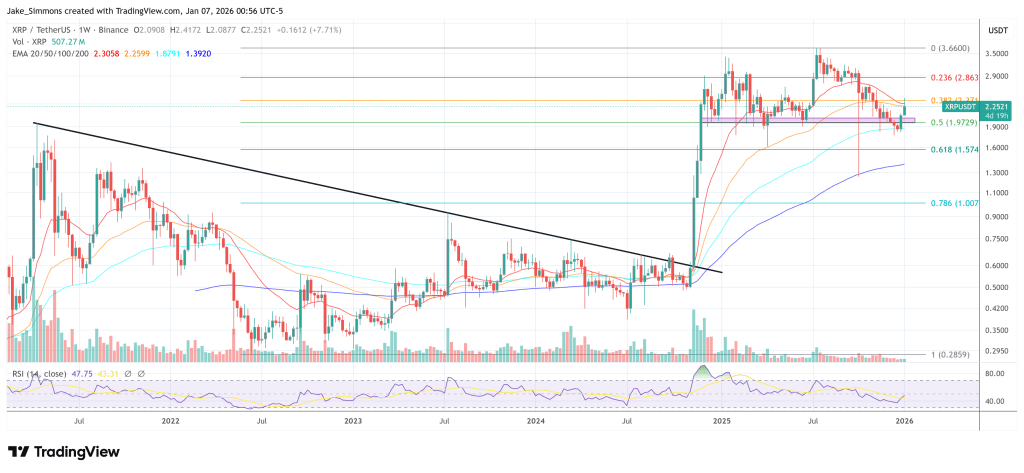
XRP faces the 0.382 Fib, 1-week chart | Source: XRPUSDT on TradingView.com

Related Questions

QWhat is the primary purpose of Ripple's recent $500 million equity raise according to President Monica Long?

AThe $500 million equity raise is being used to integrate recent acquisitions and expand Ripple's push into regulated stablecoin infrastructure, building digital asset infrastructure for businesses and financial institutions.

QWhich two major traditional finance firms were named as new investors in Ripple's latest funding round?

ACitadel and Fortress were the major traditional finance firms named as new investors in the funding round.

QDoes Ripple have any plans for an Initial Public Offering (IPO) according to the article?

ANo, President Monica Long reiterated that Ripple has no plan and no timeline for an IPO, preferring to fund growth through its balance sheet and private-market interest.

QHow many companies did Ripple acquire in the previous year, and what is the current focus regarding these acquisitions?

ARipple acquired four companies in the previous year (Hidden Road, Rail, GTreasury, and Palisade), and the current focus is on integrating these businesses and continuing to grow.

QWhat was Ripple's reported valuation at the time of the $500 million raise in the fourth quarter?

AThe raise was done at a reported valuation of $40 billion.

Related Reads

Apple's Desired On-Device AI Sees a Dark Horse Emerge: The First Cognitive Model is Born, 4B Matches GPT-5.4

A Chinese company, Tomorrow's Journey (Nextie), has introduced what it is calling the industry's first "cognitive model" for edge devices. Named New Journey Alpha, this 4-billion-parameter model reportedly matches the performance of trillion-parameter giants like GPT-5.4 in group intelligence tasks such as debate and collective decision-making. The development follows Andrej Karpathy's vision of stripping vast factual knowledge from large language models to retain only a smaller "cognitive core" capable of reasoning, planning, and knowing its own limits. This approach directly addresses the soaring computational costs and token expenses hindering AI's widespread deployment, as highlighted by incidents like Amazon shutting down an internal AI tool due to prohibitive costs. Trained via reinforcement learning on a corpus of academic papers from 1800-2020 to enhance generalization, the model enables three key advancements: 1) Improved decision quality in multi-agent systems, 2) Drastically reduced compute costs, allowing for cost-effective cloud or on-device (e.g., MacBook) deployment, and 3) The feasibility of "proactive" AI agents that act autonomously without user prompts, unlocking new commercial possibilities beyond today's reactive models. Built by the former Microsoft Xiaoice team—known for creating a 3.6B model that outperformed a 65B Llama model—the company is now focusing on the multi-agent systems sector, a field gaining significant investor interest. The model's economic impact is profound; by achieving high-level performance with minimal parameters, it fundamentally alters the cost structure of AI services, challenging the prevailing model of ever-larger parameter counts.

marsbit1h ago

Apple's Desired On-Device AI Sees a Dark Horse Emerge: The First Cognitive Model is Born, 4B Matches GPT-5.4

marsbit1h ago

OpenAI's 'Blueprint for the Future': Making AI Beneficial for Every Person on the Planet

A new transformative technology emerges every few generations. OpenAI draws a parallel with the advent of electricity in the 1920s, which initially brought convenience but ultimately enabled unprecedented progress in medicine, engineering, and living standards by empowering people to create new possibilities. AI is poised to recreate this phenomenon. Its true significance lies not in the technology itself, but in what people can achieve with it—from understanding a medical bill or starting a business to aiding scientific discovery. OpenAI believes AI should be universally accessible, allowing everyone to use it according to their own needs. This future, however, is not guaranteed. While transformative tech can centralize power, OpenAI's philosophy is that AI must serve humanity, augmenting human capabilities and broadly distributing its benefits. The company's first commitment is to build AI for human service, aiming to empower the many rather than concentrate power in a few. Safety, alignment with human intent, and oversight are paramount. OpenAI is optimistic about AI's potential to expand human welfare but remains clear-eyed about risks. The goal is to help people achieve more, not to replace them. Full automation is not the desired future; human judgment, values, and direction will become even more critical. OpenAI outlines three core goals: 1. Build automated AI researchers to accelerate and increasingly automate the research process itself, maintaining close human collaboration. The internal projection is that by March 2028, a significant portion of their research will be conducted by AI systems working alongside human researchers. 2. Accelerate economic development by advancing science, boosting productivity, and fostering growth, while ensuring the fruits are widely shared. 3. Provide a personal AGI for everyone on Earth, allowing individuals to benefit from this transformative technology in their own way. The company is entering its third phase, moving from foundational AGI research (Phase 1) to product deployment and learning from real-world use (Phase 2). The current challenge is making advanced AI abundant, affordable, safe, practical, and usable for all individuals and organizations. OpenAI concludes that a widely distributed power structure leads to a more resilient, adaptable, and free society. A positive AI future should not be controlled by a handful of entities but built, benefited from, and owned by many. If realized correctly, AI can become a cornerstone for enhancing global productivity, creativity, scientific advancement, and economic opportunity, fulfilling the mission to ensure AGI benefits all of humanity.

marsbit2h ago

OpenAI's 'Blueprint for the Future': Making AI Beneficial for Every Person on the Planet

marsbit2h ago

Arthur Hayes' New Article: AI Bubble Nears Bursting, Crypto Market Faces Short-Term Pressure

In a new essay, Arthur Hayes argues that the AI market bubble is approaching a rupture, which will place significant short-term pressure on crypto assets. He identifies rising oil prices, a trio of massive tech IPOs (SpaceX, Anthropic, OpenAI), and potential anti-AI political rhetoric from Trump as the three key catalysts for a correction. Hayes posits that the prolonged blockage of the Strait of Hormuz will drive energy prices higher, increasing operational costs for data centers and squeezing AI company profits. Simultaneously, the market may struggle to absorb the upcoming wave of multi-trillion dollar tech IPOs. Furthermore, with high inflation hurting his election chances, Trump could pivot to attacking the AI sector with proposals for heavy taxation and regulation to win over voters, spooking the market. Hayes notes that nearly all new dollar liquidity since 2022 has flowed into the AI sector, leaving little for Bitcoin, explaining its recent underperformance. He believes an AI stock crash would trigger a broad risk-off sentiment and credit contraction, dragging down crypto in the near term. Consequently, his fund, Maelstrom, has sold all AI-related stocks and non-core cryptocurrencies, retaining only Bitcoin and Ethereum while building positions in traditional energy stocks. He anticipates Bitcoin will bottom and resume its bull run only after the AI bubble pops and a new monetary easing cycle begins.

marsbit2h ago

Arthur Hayes' New Article: AI Bubble Nears Bursting, Crypto Market Faces Short-Term Pressure

marsbit2h ago

Trading

Spot
Futures

Hot Articles

Discussions

Welcome to the HTX Community. Here, you can stay informed about the latest platform developments and gain access to professional market insights. Users' opinions on the price of S (S) are presented below.

活动图片















