Ripple Just Moved This $2 Billion Industry Onto The XRP Ledger

bitcoinistPublished on 2026-05-20Last updated on 2026-05-20

Abstract

The XRP Ledger is now hosting a significant tokenized asset: electricity. A token called JMWH, issued by blockchain infrastructure company Justoken and backed by Latin American energy producers, represents real megawatt-hours of power on-chain. With a total asset value of approximately $2.229 billion, it is a major component of the Ledger's real-world asset (RWA) market. The tokenization process allows electricity to be transparently tracked from production to consumption, with tokens being burned once the energy is used. This move expands the XRP Ledger's use beyond payments and financial instruments into the commodity sector, specifically energy. The growing RWA market on the XRP Ledger, now valued at over $3.57 billion, demonstrates rapid expansion as more issuers tokenize real-world assets.

The XRP Ledger is hosting tokenized US Treasuries, money market funds, and real estate instruments, but it is also hosting something far more fundamental than these.

Electricity has become one of the largest real-world assets now represented on the XRP Ledger. Data from RWA.xyz shows JMWH, an energy-linked token issued through Justoken, with a total asset value of about $2.229 billion, putting tokenized power production directly on the Ledger infrastructure.

$2 Billion Tokenized Electricity On The XRP Ledger

Data from RWA.xyz shows over $2 billion worth of electricity tokens are currently tokenized on the XRP Ledger. This development is centered on JMWH, a digital token that represents real electricity on-chain.

JMWH is listed on RWA.xyz as a commodity-backed represented asset issued through Justoken. The asset description on RWA.xyz says each JMWH token represents one real megawatt-hour of energy backed by energy companies, with the total token amount reflecting contractual commitments covered by generation capacity assigned to clients.

The token is issued by Buenos Aires-based blockchain infrastructure company Justoken, backed by energy producers in Latin America.
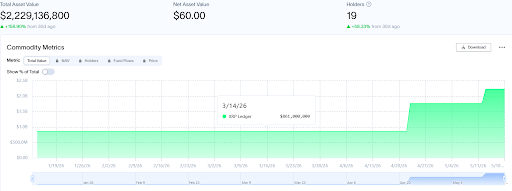
Source: Chart from RWA.xyz

Energy contracts are converted into blockchain-based tokens, allowing electricity to be tracked from production to consumption with full transparency. Once electricity is used, the corresponding tokens are burned, permanently removing them from circulation.

According to data from RWA.xyz, reflected in the image below, JMWH’s total asset value has now reached $2.229 billion, up 158.90% from 30 days ago, with 19 holders recorded on-chain.

Industrial Tokenization On The Ledger

JMWH is important because it changes the type of asset associated with the XRP Ledger. The network is often discussed through cross-border payments, stablecoins, tokenized Treasuries, and institutional settlement. Tokenized electricity adds another category entirely of energy as a recorded commodity on the Ledger.

This is more than a simple token listing. As noted by an enthusiast that goes by the name X Finance Bull, this is physical energy flowing through power grids being represented, traded, and settled on the same blockchain that powers XRP. $2 billion in tokenized electricity generates constant transactional demand. Every new account on the Ledger requires XRP reserves. More companies, more brokers, more settlement accounts, more wallets holding tokenized energy. Each one locks the altcoin just to exist on the ledger.

At the time of writing, the XRP Ledger has $3.57 billion in represented asset value, up by 71.47% from 30 days ago. This growth shows how quickly the Ledger’s real-world asset market is expanding, especially as more issuers begin using the network to represent commodities, stablecoins, financial contracts, and other real-world assets with links to the real-world economy.

XRP trading at $1.37 on the 1D chart | Source: XRPUSDT on Tradingview.com

Related Questions

QWhat is the name and estimated value of the tokenized electricity asset being hosted on the XRP Ledger?

AThe tokenized electricity asset is called JMWH, and its total asset value is approximately $2.229 billion.

QWhat does a single JMWH token represent, and how is its lifecycle managed on the blockchain?

AA single JMWH token represents one real megawatt-hour of energy. The tokens are burned, or permanently removed from circulation, once the electricity they represent is consumed.

QWhich company is responsible for issuing the JMWH token, and where is it based?

AThe JMWH token is issued by Justoken, a Buenos Aires-based blockchain infrastructure company.

QAccording to the article, why is the tokenization of electricity on the XRP Ledger significant beyond just adding a new asset type?

AIt's significant because it creates constant transactional demand and requires new accounts (for companies, brokers, settlement accounts, etc.) to hold the tokens. Each new account must lock up XRP reserves, increasing utility and demand for XRP itself.

QWhat is the total value of all represented assets on the XRP Ledger, and what is its growth over the last 30 days as mentioned in the article?

AThe total represented asset value on the XRP Ledger is $3.57 billion, which represents a growth of 71.47% from 30 days ago.

Related Reads

Can Alibaba Cloud Rewrite Itself?

Over the past five months, Alibaba Cloud's MaaS (Model as a Service) revenue has surged 15x, marking a strategic overhaul where the company is shifting its 17-year-old system designed for "humans using cloud" to a new paradigm centered on "Agents consuming Tokens." At its recent summit, Alibaba Cloud announced a full-stack upgrade encompassing "chip-cloud-model-inference," all optimized for AI Agents. Key launches include the new AI product portal "QianWen Cloud," hyper-node servers powered by the in-house AI chip Zhenwu M890, and the latest flagship model, Qwen3.7-Max. Senior VP Liu Weiguang described this as building "China's largest AI factory," where chips are raw materials, the cloud is the workshop, models are machines, and the inference platform is the assembly line, with Tokens as the final product. The company is now emphasizing its chip strategy, unveiling the Zhenwu M890 and a two-year roadmap for future chips. With over 560,000 chips deployed across 400+ clients, Alibaba Cloud aims to control the marginal cost per Token, mirroring Google's integration of TPU and Gemini for optimal cost-performance. The cloud infrastructure itself is being rewritten. Traditional cloud interfaces are being transformed into standardized, Agent-callable Skills. A new scheduling logic focuses on "task scheduling" over "resource scheduling" to handle the unpredictable, elastic workloads of Agents. Liu noted that AI applications now automatically provision cloud resources, with one customer's daily automated provisioning equaling two weeks of manual work. For models, the focus has shifted from conversational prowess to execution capability. Qwen3.7-Max demonstrated this by autonomously writing and optimizing a production-grade AI compute kernel for the new Zhenwu M890 chip over 35 hours, achieving a 10x performance improvement. The underlying Bailian platform was upgraded for efficiency, and it maintains an open ecosystem, hosting third-party models. This restructuring extends beyond technology to sales, organization, and metrics. Alibaba Cloud has established dedicated MaaS sales teams, separated from traditional IaaS, with new KPIs focusing on high-quality Tokens that solve real problems, the number of core business systems integrated with models, and the efficiency of Agent task completion. The underlying bet is clear: AI represents an opportunity orders of magnitude larger than before. Despite the uncertainty, Alibaba Cloud is aggressively rebuilding its entire system, betting on an AI-driven future where Tokens could become its largest product line.

marsbit32m ago

Can Alibaba Cloud Rewrite Itself?

marsbit32m ago

Warsh's First Conundrum: Rate Cuts, Inflation, and a Fractured Fed

Walsh's First Dilemma: Rate Cuts, Inflation, and a Divided Fed Kevin Warsh officially assumed the Fed Chairmanship on May 15th, inheriting a central bank deeply divided over inflation. Contrary to market expectations of a dovish stance due to his appointment by President Trump, Warsh's historical record shows early and consistent hawkish concerns about inflation. The Fed he leads is fractured, with three FOMC members recently dissenting against even hinting at future rate cuts. The immediate challenge is surging inflation. While the Iran-related oil shock is a temporary factor, core CPI and services inflation are accelerating, showing signs of becoming entrenched—echoing the Fed's 2022 "transitory" misstep. Warsh faces the task of building consensus within a committee where several members believe policy may not be restrictive enough, especially if the neutral interest rate (r-star) is higher than currently estimated. Politically, Warsh is caught between Trump's desire for rate cuts and the economic reality of persistent price pressures. Any move perceived as bowing to political pressure could undermine Fed independence. Market implications are significant. Long-term Treasury yields (e.g., 30-year at 5.19%) could rise further, especially if the June FOMC statement hints at possible tightening. Tech stocks face continued valuation pressure from higher rates. The key variable is progress in Iran negotiations; a breakthrough before the June meeting could temporarily ease oil-driven inflation, but stubborn services inflation would remain. All eyes are on Warsh's first post-FOMC press conference on June 17th. His wording on inflation and policy will reveal how much the market has mispriced his stance and the Fed's likely path forward.

marsbit53m ago

Warsh's First Conundrum: Rate Cuts, Inflation, and a Fractured Fed

marsbit53m ago

Trading

Spot
Futures

Hot Articles

What is XRP 2.0

XRP 2.0: A New Frontier in the Cryptocurrency Landscape Introduction to XRP 2.0 In the ever-evolving realm of cryptocurrency, new projects continuously emerge, vying for attention and adoption. One such promising initiative is XRP 2.0, a novel cryptocurrency project designed to leverage advanced blockchain technology and robust encryption methodologies. While the name draws parallels with Ripple’s XRP, it’s crucial to note that XRP 2.0 operates independently, focusing on enhancing transaction security, privacy, and scalability. As the digital financial landscape increasingly embraces decentralized solutions, XRP 2.0 aims to contribute meaningfully to web3 and the overall expansion of crypto projects. What is XRP 2.0? At its core, XRP 2.0 is a cryptocurrency project that aims to create a secure and decentralized digital currency ecosystem. Its foundational technology integrates sophisticated blockchain principles with cutting-edge encryption techniques. The overarching goal of XRP 2.0 is to establish itself as a reliable and efficient platform enabling swift transaction execution while prioritizing enhanced privacy protections for its users. The project is promoted as a solution to many limitations faced by existing cryptocurrencies, proposing a system that can handle a higher volume of transactions with improved speed and privacy. This versatility positions XRP 2.0 as a significant contender in a marketplace riddled with various digital currencies. Who is the Creator of XRP 2.0? The identity of the creator behind XRP 2.0 has been flagged as ‘Wilbur.’ However, comprehensive details regarding Wilbur or their associated entity remain elusive. The anonymity of many cryptocurrency creators is not an uncommon phenomenon in the industry, often designed to maintain a degree of privacy and security. Who are the Investors of XRP 2.0? As of now, specific information related to the investment foundations or organizations supporting XRP 2.0 is not publicly available. In the cryptocurrency sector, the backing by reputed investors can significantly influence a project's credibility and success, yet the transparency regarding the financial supporters of XRP 2.0 has not been established. How Does XRP 2.0 Work? XRP 2.0 stands out by employing a combination of blockchain technology and advanced encryption algorithms that ensures secure and decentralized transactions. Its innovative structure includes unique features designed to foster user engagement and broaden functionalities beyond conventional cryptocurrency transactions. Among these features, XRP 2.0 incorporates AI-powered capabilities, such as text-to-image and text-to-speech functionalities. These additions are designed to enhance the interactive experience for users, promoting broader applicability across various sectors. By bridging technological advancements with user-centered design, XRP 2.0 aims to capture the attention of a diverse range of individuals and enterprises looking to integrate cryptocurrency solutions into their operational frameworks. Timeline of XRP 2.0 Understanding XRP 2.0 requires examining the milestones that have defined its journey thus far: July 23, 2023: XRP 2.0 is introduced as a novel cryptocurrency project, aiming to revolutionize secure and decentralized transaction capabilities in the blockchain domain. September 8, 2023: The launching of another project, XRP20, occurs, marking the emergence of an ERC-20 token on the Ethereum blockchain that remains unrelated to XRP 2.0. November 13, 2023: The XRP Ledger undergoes a significant update with the release of rippled server software version 2.0.0. It is essential to note that this development is disconnected from the XRP 2.0 cryptocurrency project. Key Points About XRP 2.0 To distill the essence of XRP 2.0, several critical factors emerge: Unique Features: The inclusion of features like AI-powered text-to-image and text-to-speech further diversifies the potential applications of XRP 2.0. Blockchain Technology: The framework utilizes advanced blockchain mechanisms and encryption protocols, ensuring a secure and decentralized environment for transactions. Scalability and Privacy: XRP 2.0 prioritizes enhanced privacy protections in transaction processes and the scalability necessary to accommodate a growing user base. No Affiliation with Ripple: Importantly, despite its name, XRP 2.0 does not have any allegiance or collaboration with Ripple’s XRP, distinguishing its operational framework and objectives within the cryptocurrency ecosystem. Conclusion XRP 2.0 represents an ambitious venture into the cryptocurrency sphere, aiming to offer a combination of security, privacy, and efficiency in digital transactions. By integrating sophisticated technologies and user-friendly features, the project sets out to broaden the horizons of what cryptocurrency can achieve in today's digital economy. While the anonymity of its creator and lack of disclosed investors might raise questions for some, XRP 2.0's focus on advanced functionalities and decentralisation enhances its appeal amidst an increasingly crowded crypto market. As the cryptocurrency landscape continues to evolve, XRP 2.0 may yet emerge as a pivotal player in the expansion of secure and scalable blockchain solutions.

942 Total ViewsPublished 2024.04.01Updated 2024.12.03

What is XRP 2.0

Discussions

Welcome to the HTX Community. Here, you can stay informed about the latest platform developments and gain access to professional market insights. Users' opinions on the price of XRP (XRP) are presented below.

活动图片