Author: Claude, Deep Tide TechFlow
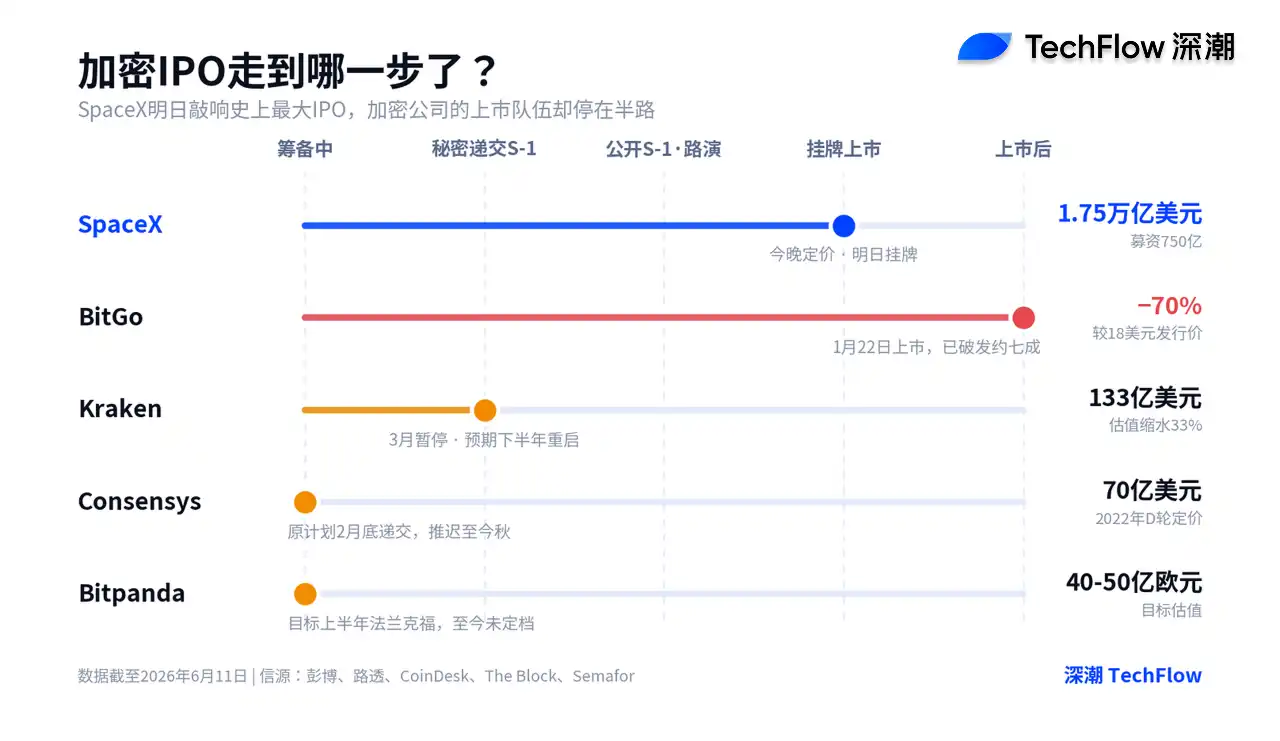
Deep Tide Introduction: SpaceX will price its offering tonight and list on Nasdaq tomorrow, aiming to raise $75 billion with a valuation of $1.75 trillion, marking the largest IPO ever. Meanwhile, the crypto IPO pipeline has frozen solid: the only company to list this year, BitGo, is down about 70% from its issue price; Kraken's valuation has shrunk 33% in five months; Consensys has been pushed back to autumn; Bitpanda is on the verge of missing its deadline. With just five months left until the midterm elections in November, the window for crypto companies to go public is narrowing.
After the U.S. stock market closes tonight, SpaceX will finalize its issue price. Tomorrow, the ticker SPCX will debut on Nasdaq. According to Reuters, the company plans to issue approximately 557 million shares at $135 per share, raising $75 billion at a valuation of $1.75 trillion. This will be the largest IPO in history by both fundraising size and valuation, with the fundraising amount more than double that of the previous record holder, Saudi Aramco.
Outside this grand feast, the queue of crypto companies waiting to go public is falling apart.
SpaceX Siphons Liquidity, Bitcoin Falls Below $60k Concurrently
SpaceX's listing pace is unusually fast. It confidentially filed its registration on April 1, publicly released its S-1 prospectus on May 20, and kicked off its roadshow on June 4, several days ahead of schedule due to an unexpectedly swift SEC review process. It took just over two months from confidential filing to bell-ringing.
The crypto market trended in the exact opposite direction during the same window. According to CoinDesk data, Bitcoin traded around $61,500 on June 10, down about 17% for the week and briefly falling below $60,000 for the first time in 2024. The Fear and Greed Index registered a reading of 9, indicating "Extreme Fear." The total crypto market cap shrank to around $2.21 trillion. The explanation for the capital flows isn't complicated: continuous outflows from Bitcoin ETFs, coupled with funds rotating towards the AI sector and SpaceX's subscription, have seen risk appetite sucked dry by this $1.75 trillion behemoth.
For any company wanting to go public, liquidity is oxygen. $75 billion in subscription demand is locked up by SpaceX alone. Filing a prospectus at this point is like flying a kite in a typhoon.
BitGo: The Year's Only Listing Sample, Stock Down About 70%
The crypto industry hasn't been without attempts. BitGo listed on the NYSE on January 22 with an issue price of $18, above the indicated range of $15 to $17, raising $213 million. It was the first and, so far, only crypto-native company to complete an IPO in 2026.
The start didn't look bad. It opened at $22.43 on its first day, up 24.6% from the issue price, and briefly surged to $24.5 intraday. But those gains were wiped out by the close, ending the day with just a 2.7% gain, followed by a steady decline. According to Benzinga data, BTGO closed at $5.61 on June 3, down about 69% from its issue price. Goldman Sachs cut its price target from $10.5 to $9 on June 4, and even this slashed target is 60% higher than the current price.
BitGo was once hoped to be the bellwether for 2026 crypto IPOs. Now it indeed serves as a bellwether, just pointing in the opposite direction. When Kraken paused its listing plans in March this year, multiple media reports cited BitGo's post-listing slump as a cautionary tale for management. If an infrastructure company with over $100 billion in assets under custody and a defensive business model fares this poorly, what valuation would a pure exchange story receive in the secondary market? The companies in line are well aware.
Kraken: Valuation Evaporates 33% in Five Months, Deutsche Börse Seizes Opportunity
Kraken is the company that progressed the furthest in the queue. On November 19, 2025, its parent company Payward confidentially submitted a draft S-1 to the SEC, shortly after completing an $800 million funding round with investors including Jane Street and Citadel Securities, valuing the company at $20 billion. Reuters reported at the time that its target was to go public in Q1 2026.
Then the market soured. In March this year, multiple media reports stated Kraken had frozen its listing plans. On April 14, co-CEO Arjun Sethi confirmed at the Semafor World Economy Summit in Washington that the confidential filing remained active but declined to provide a timeline, offering size, or valuation range. According to Semafor, Kraken was valued at $13.3 billion in a funding round in April, a 33% contraction from its peak last November.
This funding round contains a noteworthy subplot: Deutsche Börse Group invested $200 million for approximately 1.5% of Kraken's fully diluted shares, with the transaction expected to close in Q2. The operator of the Frankfurt Stock Exchange is buying in at a time when a U.S. exchange's valuation is at its lowest ebb. Considering Bitpanda's choice discussed below, the Germans' intent to snatch business as the U.S. window tightens is quite evident.
Media consensus currently expects Kraken's listing restart to wait until the second half of the year.
Consensys Pushed to Autumn, Bitpanda on the Verge of Missing Deadline
Consensys, the parent company of MetaMask, has a more straightforward script. According to a CoinDesk report on May 13, the company led by Ethereum co-founder Joe Lubin originally planned to confidentially file its S-1 with the SEC by the end of February, with JPMorgan and Goldman Sachs leading the underwriting. However, due to persistently weak market conditions, the IPO has been postponed until at least this autumn. Consensys' last valuation was from its Series D in 2022, a $450 million funding round at a $7 billion valuation. How much of this number can be preserved in the current market environment will only be known when the prospectus is unveiled.
Bitpanda's problem is the calendar. According to a Bloomberg report in January, this Vienna-based company, backed by Peter Thiel, plans to list in Frankfurt with a target valuation of €4-5 billion, with Goldman Sachs, Citigroup, and Deutsche Bank acting as underwriters. The schedule was set for the first half of the year, potentially Q1. Today is June 11, with less than three weeks left in H1, and the company has yet to officially announce a date. Unless it launches suddenly in the coming days, missing its own deadline is almost certain.
Looking at the four together: one listed but is down 70%, one filed but paused, one pushed to autumn, and one on the verge of missing its self-imposed deadline. The original Reddit post described these four as "sprinting to go public within 12 months." The wording isn't wrong, but the sense of direction is. This team isn't sprinting; they're each looking for an exit ramp.
Five Months Until the Midterm Elections
The clustering of crypto companies targeting 2026 for listings has a common, invisible deadline.
This year's regulatory climate has been relatively favorable for the crypto industry, but the U.S. midterm elections in early November could rewrite the congressional power balance. Many companies' timelines were originally compressed before the election, betting on five months of policy certainty.
Precedents aren't encouraging. Among the crypto companies that went public in 2025, Gemini's stock price had fallen over 60% from its issue price (data as of end-January), Bullish hovered around its issue price, and Coinbase, which listed in 2021, remains below its opening price from that year. Circle is a rare exception that has significantly outperformed its issue price. The pricing given by the secondary market with real money is more honest than any roadshow PowerPoint.
Returning to that Reddit post, the poster actually had a valid point: once an exchange goes public, its financials are no longer a black box. Quarterly audited reports will reveal whether revenue truly comes from trading fees, custody fees, or idle fund interest. Retail investors get their first chance to judge an exchange by numbers rather than "withdrawal smoothness."
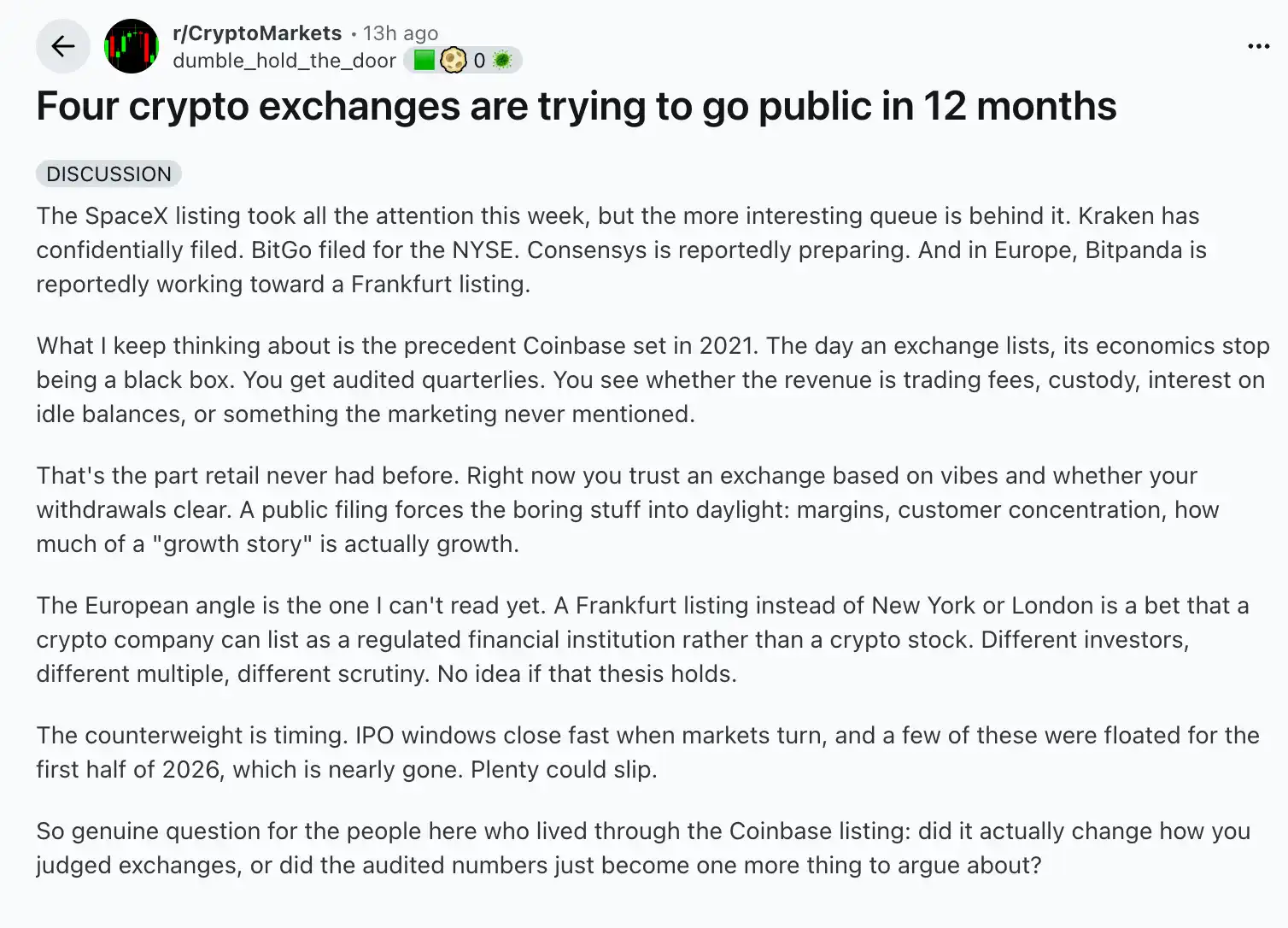
The problem is the sequence. Transparency is a consequence of going public, not the motivation for it. In a market with Bitcoin at $61,500 and the only listing sample down 70%, no company is in a hurry to lay its cards on the table.
Over the next five months, three specific milestones are worth watching: whether Kraken restarts in H2, whether Consensys actually files its S-1 in autumn, and when Bitpanda officially admits to missing its deadline.
There's another variable to be revealed tomorrow. If funds absorbed by SpaceX's listing flow back and market liquidity recovers, this window might crack open again. If even the largest IPO in history performs tepidly, this year's crypto listing wave will likely have to wait until after the elections.