Payy Unveils Privacy-First L2 for Institutional Capital: Why $BMIC is the Missing Layer of Quantum Defense

bitcoinistPublished on 2026-02-05Last updated on 2026-02-05

Abstract

Payy has launched a privacy-focused Ethereum Layer 2 solution using zero-knowledge proofs to enable institutions to settle transactions on-chain without exposing sensitive data to competitors. While this addresses transparency and front-running risks, it doesn’t protect against the long-term threat of quantum computing, which could decrypt current cryptographic systems. This vulnerability is where BMIC ($BMIC) positions itself as a critical security layer. It introduces a quantum-resistant financial stack using post-quantum cryptography (PQC) to safeguard private keys and assets from future quantum attacks. BMIC’s architecture includes AI-enhanced threat detection and integrates with ERC-4337 smart accounts for a user-friendly yet highly secure experience. The project has raised over $432K in its presale, with the token priced at $0.049474. $BMIC supports ecosystem operations through a "Burn-to-Compute" mechanism and enables quantum-secure staking. As institutional adoption of privacy L2s grows, BMIC aims to become an essential component in protecting high-value on-chain transactions from quantum decryption threats.

The friction between blockchain’s radical transparency and traditional finance’s need for discretion has long been a bottleneck for institutional adoption. Now, Payy is moving to break that deadlock.

With the launch of its privacy-enabled Ethereum Layer 2, the protocol uses zero-knowledge proofs to offer banks and fintechs a way to settle transactions on-chain without broadcasting their entire ledger to competitors.
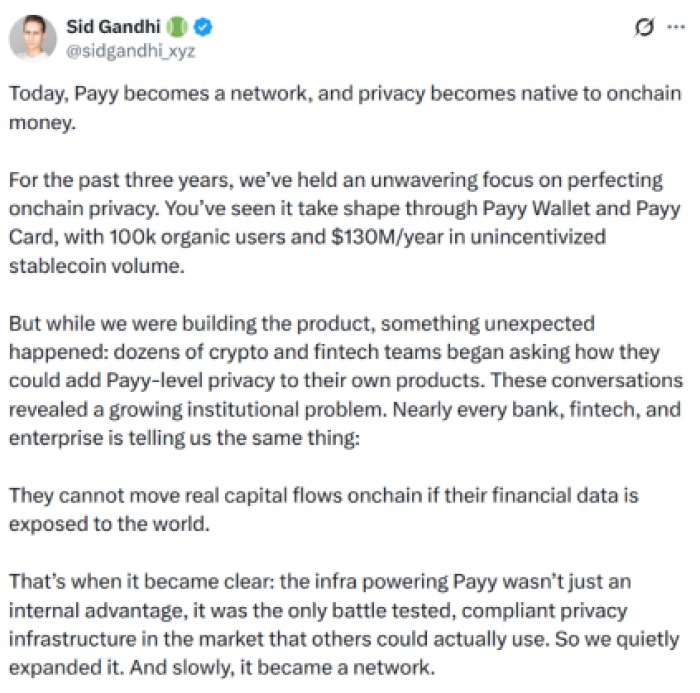
This isn’t just about masking transactions. For years, major financial institutions have hesitated to move proprietary trading algorithms or sensitive settlement layers onto public ledgers like Ethereum.

Why? The ‘dark forest’ of the mempool, where MEV bots and rivals front-run visible trades, is simply too risky. While Payy’s integration with MetaMask suggests a seamless bridge for Web3 natives, the real target is the massive institutional flow that demands regulatory compliance paired with on-chain finality.

But let’s be honest: privacy is only half the battle. While Payy obscures the flow of funds, the assets themselves remain vulnerable to a quieter, existential threat: quantum computing. As banks move billions onto these new rails, they face the ‘harvest now, decrypt later’ vector, where hostile actors collect encrypted data today to crack it once quantum processors mature.

This specific gap, protecting the vault rather than just the transaction, is driving smart money toward BMIC ($BMIC), a project building the first quantum-secure financial stack for the Ethereum ecosystem.

Quantum-Proofing the Institutional Ledger

If Payy secures the pipe, BMIC is engineering the steel plating for the vault. The current cryptographic standards securing the $2.5T crypto market (Elliptic Curve Cryptography) are notoriously vulnerable to Shor’s algorithm.

That’s the method quantum computers will eventually use to reverse-engineer private keys from public addresses. For a retail trader, it’s a risk. For a bank moving nine-figure sums on Payy’s L2? It’s an unacceptable systemic failure point.

BMIC addresses this with a full finance stack running on post-quantum cryptography (PQC). Unlike legacy wallets that expose public keys during signing, BMIC uses a zero public-key exposure protocol. That matters.
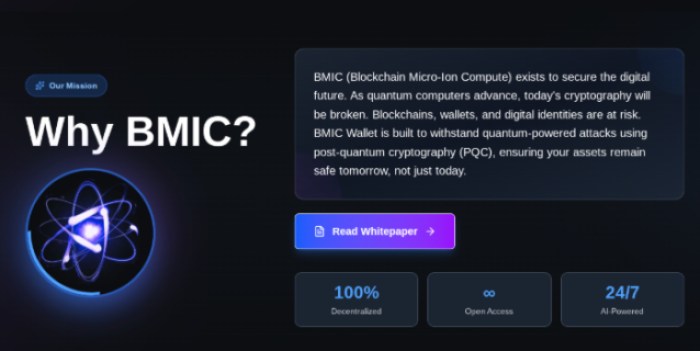
It neutralizes the primary vector for quantum attacks before they even begin. The platform’s ‘Quantum Meta-Cloud’ architecture insulates assets from underlying chain vulnerabilities, creating an environment where institutions can stake, store, and transact without fear of retrospective decryption.

The technological leap here is the integration of AI-enhanced threat detection within the wallet infrastructure itself. By combining quantum-resistant algorithms with ERC-4337 smart accounts, BMIC offers a user experience that mimics the ease of MetaMask, essential for Payy’s target demographic, while operating on a security standard that exceeds current military-grade requirements.

As the industry pivots toward privacy L2s, the infrastructure securing the keys themselves becomes the most critical, yet undervalued, layer of the stack.

LEARN MORE ABOUT THE BMIC’S QUANTUM SECURITY

$0.049474 Entry Point Attracts Defensive Capital

The market is waking up to the reality that privacy rails like Payy need quantum-resistant locks. BMIC has already raised over $432K in its ongoing presale, signaling growing awareness of the ‘quantum threat’ among sophisticated investors.

Currently priced at $0.049474, the token offers an entry point into a sector that many analysts predict will be mandatory for institutional volume by 2026. It’s easy to see why it could be the best new cryptocurrency.

Frankly, the token utility distinguishes the presale raise. $BMIC isn’t just for governance; it fuels the ecosystem’s computational power (via the ‘Burn-to-Compute’ mechanism) and is required for quantum-secure staking. In a market where yield often carries the risk of smart contract exploits or key exposure, BMIC offers a secure staking environment where cryptographic integrity beats complex, risky DeFi loops.

For investors watching the infrastructure narrative, the correlation is clear: as adoption of privacy L2s like Payy grows, the underlying security layer must scale to match the assets it protects. With the presale still under half a million dollars, the valuation hasn’t yet priced in the inevitable shift toward post-quantum standards.

As regulatory frameworks tighten around data security, protocols offering harvest-resistant encryption could decouple from the broader altcoin market.

CHECK OUT THE $BMIC PRESALE PAGE

This article is for informational purposes only and does not constitute financial advice. Cryptocurrencies are high-risk assets. The “harvest now, decrypt later” threat is a long-term projection. Always conduct your own due diligence before investing.


Trending Cryptos

Related Questions

QWhat is the primary purpose of Payy's new Ethereum Layer 2 solution?

APayy's privacy-enabled Ethereum Layer 2 uses zero-knowledge proofs to allow banks and fintech companies to settle transactions on-chain without broadcasting their entire ledger to competitors, addressing the friction between blockchain transparency and traditional finance's discretion.

QAccording to the article, what is the 'harvest now, decrypt later' threat?

AThe 'harvest now, decrypt later' threat is a vector where hostile actors collect encrypted data today with the intention of decrypting it once quantum processors become powerful enough, posing a risk to assets secured by current cryptographic standards.

QHow does BMIC ($BMIC) aim to protect against quantum computing threats?

ABMIC uses a full finance stack running on post-quantum cryptography (PQC) with a zero public-key exposure protocol. Its 'Quantum Meta-Cloud' architecture insulates assets from underlying chain vulnerabilities, preventing quantum computers from reverse-engineering private keys.

QWhat technological features does BMIC integrate to enhance its security and user experience?

ABMIC integrates AI-enhanced threat detection within its wallet infrastructure and combines quantum-resistant algorithms with ERC-4337 smart accounts. This provides a user experience similar to MetaMask while operating on a security standard that exceeds current military-grade requirements.

QWhat is the current price and key utility of the $BMIC token as mentioned in the article?

AThe $BMIC token is currently priced at $0.049474 in its presale. Its utility includes fueling the ecosystem's computational power via a 'Burn-to-Compute' mechanism and is required for participating in quantum-secure staking, offering a secure alternative to risky DeFi yield strategies.

Related Reads

The New Cold War is a Tech Stock War

The New Cold War is a Tech Stock War The article argues that the contemporary geopolitical and economic rivalry between the US and China represents a "New Cold War," but one fundamentally fought through technology and financial markets, not physical barriers or conventional trade. Historically, US dominance was secured through financial systems. The Soviet Union, reliant on the rigid "Transferable Ruble," was ultimately undermined by its dependency on the US dollar for oil trade. Later, Japan's semiconductor challenge was countered not just by tariffs (e.g., Plaza Accord, 301 investigations) but by binding it to US Treasury bonds. China presents a more complex, "embedded" challenger. While it holds vast dollar reserves and US debt like Japan, its industrial base is stronger and more diversified than the Soviet Union's. Surviving the initial 2018 trade war phase, the conflict has evolved into a "tech-financial war." The core battlefield is now the stock market. US tech stocks (AI, semiconductors) are treated as sovereign assets, buoyed by bipartisan national will. China is pushing to strengthen its own financial markets to convert industrial strength into financial power and fund its tech ambitions. Companies like ChangXin (semiconductors), Moonshot AI, and DJI compete not just for market share but as financial proxies for their respective systems. The new paradigm is moving from globally efficient monopolies (Apple, Google) towards companies that achieve monopolistic profits within their respective geopolitical spheres. This competition over "pricing power" and financial valuation in segmented markets defines the current era, making the stock market the primary arena for this tech-centric struggle.

marsbit10m ago

The New Cold War is a Tech Stock War

marsbit10m ago

RWA Weekly: Ten European Financial Institutions Establish Tokenized Asset Cooperative; Ondo Launches New Execution Network Ondo Network

RWA Weekly: European Banks Form Tokenized Asset Cooperative; Ondo Launches New Execution Network Ondo Network Covering July 24-31, 2026, the RWA sector saw a steady on-chain total value locked (TVL) of $36.8 billion, with holder count hitting a record high. However, stablecoin transfer volumes fell sharply (~30%), indicating low on-chain settlement demand. Key regulatory moves include South Korea advancing stablecoin legislation and a push to scrap crypto taxes, Kenya lowering capital requirements for stablecoin issuers, and Zimbabwe approving seven projects for its crypto sandbox. In project developments, BIS-led Project Agorá successfully tested cross-border payments with tokenized funds across six currencies. Ten major European financial institutions formed the RL1 blockchain cooperative to build tokenized asset infrastructure. Other notable updates: Aviva launched a tokenized dollar liquidity fund on XRPL, POSCO International tokenized commercial invoices on Injective, and a Brazilian farmer used tokenized cattle as collateral for a loan. Additional progress includes BNY Mellon migrating its core transfer agent operations to blockchain, Securitize gaining SEC investment advisor registration, and Tether’s compliant stablecoin USA₮ launching on Celo. Ondo Finance introduced Ondo Network, a new execution layer focused on speed and privacy, moving away from its initial chain plans. An analysis highlights that despite the growing scale of on-chain RWAs (~$32B), approximately 90% remain underutilized in DeFi, pointing to a critical challenge in unlocking liquidity and fostering real-world application beyond mere issuance.

marsbit10m ago

RWA Weekly: Ten European Financial Institutions Establish Tokenized Asset Cooperative; Ondo Launches New Execution Network Ondo Network

marsbit10m ago

South Korean Stock Market Sees Sharp Rebound After Forceful De-leveraging, SK Hynix Rises 30%

On July 31, South Korean stocks staged a historic rebound. The benchmark KOSPI index surged 18.27%, with chipmaker SK Hynix hitting a 30% gain limit. This followed a brutal, near-40% decline in the KOSPI over the previous month, driven largely by a deleveraging spiral involving leveraged ETFs. Analysts attributed the sharp sell-off to structural liquidity issues rather than deteriorating corporate fundamentals. The rally was triggered by a confluence of positive catalysts. Firstly, strong earnings from U.S. cloud giants Microsoft and Amazon alleviated fears of an "AI bubble burst," boosting global tech sentiment. Secondly, SK Group Chairman Chey Tae-won made a rare personal purchase of SK Hynix shares, seen as a strong vote of confidence. Thirdly, the South Korean government announced a 20 trillion won ($139 billion) AI investment fund. In response to the market turmoil, South Korean regulators are tightening controls on leveraged ETFs, admitting oversight shortcomings. Measures include raising minimum cash保证金 requirements for散户 investors and suspending new product launches. While the rebound signals eased liquidity pressure, analysts note deep structural issues remain. The market's future stability is seen as dependent on global tech capital expenditure trends and memory chip price cycles, with some viewing the surge as a technical correction rather than a definitive trend reversal.

marsbit31m ago

South Korean Stock Market Sees Sharp Rebound After Forceful De-leveraging, SK Hynix Rises 30%

marsbit31m ago

Cryptocurrency Company Wintermute Makes Pessimistic Statements Regarding Expected Altcoin Growth! Here are the Details

Crypto market maker Wintermute has made a pessimistic assessment regarding the anticipated altcoin season, suggesting that any upcoming rally may benefit only a limited number of projects. The company reports a record 72% of its spot OTC trading volume in H1 2026 came from institutional clients, whose capital is becoming more selective and concentrated. Data shows institutional traders act quickly on price spikes, while retail interest lasts longer. This selective behavior indicates the classic altcoin season, where hundreds of tokens rise simultaneously, may be changing. Wintermute believes only projects with strong use cases, high liquidity, and institutional appeal will stand out. Supporting this view, CryptoQuant data shows altcoin trading volume against Bitcoin is near its lowest since 2021, with the top 10 altcoins (excluding stablecoins) holding about 80.5% of the total altcoin market cap. Similarly, Kaiko reports that the top 10 altcoins now account for 63% of total altcoin trading volume, up from ~50% a few months ago, indicating capital concentration. Analysts suggest that in the current cautious institutional climate, projects with advanced technology, liquidity, and robust ecosystems will attract disproportionate attention. Therefore, any potential new altcoin season may be less broad than past bull markets, with gains concentrated in a narrower set of promising tokens.

cryptonews.ru31m ago

Cryptocurrency Company Wintermute Makes Pessimistic Statements Regarding Expected Altcoin Growth! Here are the Details

cryptonews.ru31m ago

Trading

Spot

Hot Articles

Discussions

Welcome to the HTX Community. Here, you can stay informed about the latest platform developments and gain access to professional market insights. Users' opinions on the price of LAYER (LAYER) are presented below.

活动图片