Paradigm's Stalling Moment: When a 'Research-Driven Crypto VC' Faces Reality Test

marsbitPublished on 2025-12-30Last updated on 2025-12-30

Abstract

Paradigm, once a leading research-driven crypto VC, is facing significant challenges marked by an unprecedented wave of high-level departures since April, including multiple partners. Its investment strategy, which previously yielded iconic deals like Uniswap and Flashbots, has struggled to adapt to shifting industry trends toward application-layer innovation and financial products. The firm has made several high-valuation, late-stage investments—such as Farcaster, Babylon, and Monad—that have underperformed post-token, while missing early opportunities in high-return areas like derivatives and RWA. Its incubation initiatives, including the EIR program, have also seen setbacks, with projects like Shadow and Yield Protocol halting operations. Recently, Paradigm has increased investment frequency and shifted toward earlier-stage deals. It is now focusing heavily on Tempo, a payment-focused Layer-1 blockchain developed with Stripe, aiming to regain its influence in a more results-driven market. Despite these challenges, Paradigm remains one of the best-capitalized VCs in crypto.

Author: Gu Yu, ChainCatcher

For a long time, Paradigm has been an iconic venture capital firm in the crypto industry, representing the top-tier investment style and aesthetic, with its research-driven crypto VC approach highly praised. However, affected by the industry's cyclical downturn, Paradigm has not been immune to the current widespread VC slump. One manifestation is an unprecedented wave of executive departures, with at least seven employees leaving since April this year, including several partners.

In December, Charlie Noyes, Paradigm's first employee and general partner, and Nick Martitsch, Head of Market Development at Paradigm, announced their departures successively.

In September, Gina Moon, General Counsel at Paradigm, and researcher Transmissions11 left.

In June, Teresa G. Grandía, Head of Business Operations at Paradigm, departed.

In April, Loren Siebert, Head of Engineering at Paradigm, and research partner samczsun left successively.
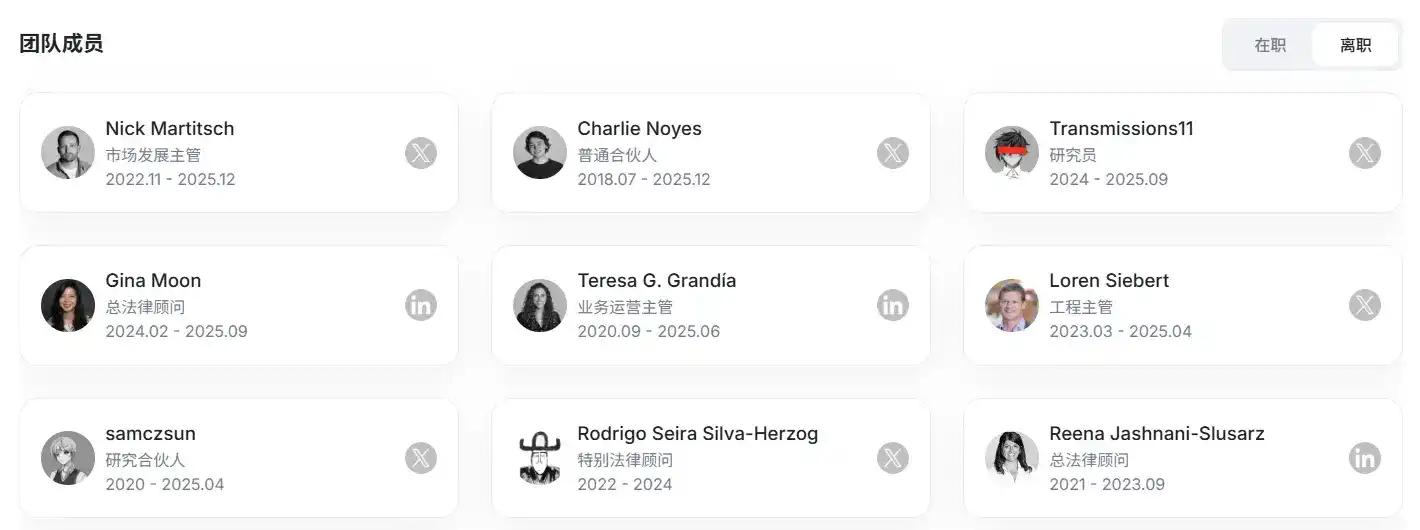
Source: RootData

Such a wave of departures is extremely rare among first-tier VCs, reflecting that Paradigm is in a rather difficult phase. Judging from its public portfolio and transaction frequency, Paradigm's investment pace has significantly slowed over the past two to three years, lacking industry-consensus "masterpiece" investments and missing out on many high-return projects, which are likely the main sources of Paradigm's predicament.

Frequently Taking Over Late Rounds, Missing Star Projects

Paradigm's golden era roughly spanned 2019 to 2021. During this period, it completed investments in key projects like Uniswap, Optimism, Lido, and Flashbots, thereby establishing a strong brand identity: technical infrastructure, Ethereum core ecosystem, long-termism, which also earned Paradigm considerable reputation within crypto entrepreneur and investor circles.

These typical investments shared several common features: they were not short-term trends but rather underlying protocols or critical middleware; the investment timing was relatively early but not extremely so; and they were highly aligned with Paradigm's internal research directions.

It was during this phase that Paradigm formed its clear and repeatedly emphasized investment strategy: research-driven. However, the problem is that this methodology gradually revealed its lack of adaptability in subsequent cycles, facing rapid changes in industry logic, leading to a noticeable gap between Paradigm's investment performance and its influence.

Starting in 2022, the new generation of high-growth projects began to emerge more in areas like the application layer, financial structure innovation, mechanism design, and product experience, such as prediction markets, yield structuring protocols, and perpetual contract protocols. This wave of projects often iterated quickly, were more product-oriented, tolerated higher levels of "technical correctness," and were more sensitive to "user growth" and "mechanism efficiency."

In the last cycle, Paradigm notably supported and invested in the hit projects Blur and Friend.tech, becoming one of the main drivers behind their popularity. However, both projects declined rapidly after token launches, with teams dumping large amounts of tokens and becoming inactive, leading the market to question Paradigm's investment acumen and style.

Simultaneously, Paradigm also took over later-stage financing rounds for many high-valuation projects. While this strategy had been profitable during the bull market, due to the continued slump in the altcoin market and issues with the invested projects themselves, Paradigm's heavily invested projects almost all fell below their cost price quickly after token launches or faced poor development and sought transformations.

In May 2024, Paradigm led a $150 million Series A round for Farcaster at a $1 billion valuation. Farcaster has now announced abandoning the social track to pivot to the wallet space.

In May 2024, Paradigm led a $70 million round for Babylon at an $800 million valuation. Babylon's token FDV is now only $180 million.

In April 2024, Paradigm led a $225 million round for Monad at a $3 billion valuation. Monad's token FDV is now only $1.7 billion.

In June 2022, Paradigm participated in a $130 million round for Magic Eden at a $1.6 billion valuation. Magic Eden's token FDV is now only $200 million.

More difficult for Paradigm to accept is that it also missed early investments in many high-return projects in recent years, such as Ethena, Pump.fun, Ondo Finance, MYX, etc. In the hot derivatives and RWA sectors, Paradigm has not invested in any projects in recent years.

Regarding the prediction market sector, which has been highly favored by the capital market in the crypto industry these past few years, Paradigm invested in the prediction market project Veil as early as January 2019, but the project ceased operations less than a year later.

The prediction market model is not novel in theory, and the technical difficulty is not top-tier. The failed investment experience led to Paradigm not participating in any of the first five funding rounds of Polymarket. Perhaps it wasn't until Polymarket announced a $150 million funding round at a $1.2 billion valuation in January this year that Paradigm realized the value of this sector,转而开始 heavily betting on Polymarket's competitor Kalshi. It first led an $185 million round for Kalshi at a $2 billion valuation in June this year, then participated in two subsequent rounds within six months at valuations of $5 billion and $11 billion respectively. This is also the highest valuation project Paradigm has invested in historically.

This shows that Paradigm is determined not to miss core investment targets in the hottest sectors, even to the point of having a "FOMO" (fear of missing out) mentality.

Stalled Incubation

Deep involvement in project incubation has long been a signature style of Paradigm, with Uniswap and Flashbots being representative cases from previous cycles.

In a previously published article, the firm stated that Paradigm is a group of developers aimed at supporting other developers. The most fruitful collaborations often involve deep cooperation with startup teams to solve important business and research challenges together.

For a VC, joining a project at the conceptual stage allows for better influence on product design and strategic direction, thereby unlocking greater value potential and achieving higher bargaining power and returns on investment.

With several success cases, Paradigm continued to explore the incubation model in recent years and even introduced an institutionalized EIR (Entrepreneurs-in-Residence) model, where both parties work together in the same office, with the VC providing substantive support in strategy, technology, recruitment, etc. However, judging from recent cases, this model has also hit a wall for Paradigm.

In December 2023, Paradigm co-developed the on-chain developer platform Shadow through the EIR mechanism and invested $9 million, but the project ceased development this year, with the founding team转而 launching Ventuals, a platform for derivatives on unlisted company equity.

The decentralized fixed-rate protocol Yield Protocol, in which Paradigm previously participated in writing the whitepaper, development, and investment, also announced it was ceasing operations in October 2023.

Subsequently, Paradigm shifted its focus to the infrastructure track. In October 2024, crypto VC firm Paradigm announced a $20 million investment in its spin-off company Ithaca. Ithaca is developing a new Layer 2 blockchain called Odyssey, with Paradigm's CTO and General Partner Georgios Konstantopoulos serving as CEO of Ithaca while retaining his position at Paradigm. Paradigm co-founder Matt Huang serves as Chairman of Ithaca.

This team structure shows that Ithaca is entirely developed by Paradigm's core team, with deeper involvement than previous projects like Uniswap. Choosing the Layer 2 sector at this time点, in hindsight, was not a wise choice. In the following year, Ithaca had almost no significant developments in the market.

Earlier this year, the crypto industry's trend completely towards stablecoins and the payments sector, and Paradigm once again "followed the trend," jointly launching Tempo, a high-performance Layer 1 public chain for payment scenarios, with internet payment giant Stripe in August this year. Paradigm co-founder Matt Huang serves as CEO of the project. In October, Tempo acquired Ithaca, with all members of the latter joining Tempo.

By this time, the payments sector already had powerhouse projects like Arc, RedotPay, Plasma, Stable, 1Money, and BVNK making efforts. Tempo holds a leading position in terms of funding amount and has the resource support of Stripe, giving it a relatively leading position in the fierce competition.

The battle for payments with Tempo will become a decisive campaign for Paradigm to prove its product and research capabilities once again.

Conclusion

Whether Paradigm will find its rhythm again remains to be seen. But one thing is certain: it is at a position where change is necessary.

Since January this year, Paradigm's investment frequency has increased significantly, from an average of 1 deal per month in 2023-2024 to an average of 2 deals per month, with a明显 increase in the proportion of early-stage investments. In June last year, Paradigm also announced the completion of an $850 million fund raise, remaining one of the VCs with the largest cash reserves today.

Team turnover and setbacks in investment strategy are not unique to any single VC but are inevitable challenges almost all long-term institutions face during cross-cycle development. If the past Paradigm represented the "engineer era" of the crypto industry, then what it must face next is perhaps a stage that is more pragmatic and more results-oriented. The success or failure of this adjustment will also determine whether it can continue to play the role of a definer rather than a bystander in the next cycle.


Related Questions

QWhat is the main challenge that Paradigm, a research-driven crypto VC, is currently facing according to the article?

AParadigm is facing significant challenges including an unprecedented wave of executive departures (at least 7 employees since April, including several partners), a noticeable decrease in investment frequency over the past few years, a lack of industry-consensus 'masterpiece' investments, and missing out on several high-return projects.

QHow did the article characterize Paradigm's investment strategy and its recent shortcomings?

AParadigm's strategy is characterized as 'research-driven,' focusing on technical infrastructure, Ethereum core ecosystem, and long-termism. However, this methodology has shown insufficient adaptability to the industry's shift towards application layers, financial structure innovation, and product experience, causing it to miss high-growth projects and often invest in high-valuation follow-on rounds that later underperformed.

QCan you name some specific high-profile investment missteps or 'catch-up' moves mentioned for Paradigm?

AYes. The article cites Paradigm leading a $150M Series A in Farcaster at a $1B valuation before it pivoted from social to wallets; leading a $70M round in Babylon at an $800M valuation (current FDV is $180M); leading a $225M round in Monad at a $3B valuation (current FDV is $1.7B); and participating in a $130M round for Magic Eden at a $1.6B valuation (current FDV is $200M). It also highlights a 'fomo' move into Kalshi after missing Polymarket.

QWhat issues has Paradigm encountered with its signature incubation model and EIR program?

AParadigm's incubation efforts have faced setbacks. The Shadow project, developed through its EIR program with a $9M investment, halted development. The Yield Protocol, which Paradigm helped develop and invest in, shut down. Its deeply involved Layer 2 project, Ithaca, had little market traction before being acquired by its new payment-focused project, Tempo.

QDespite its current challenges, what resources does Paradigm still possess for a potential comeback?

AParadigm remains one of the best-capitalized VCs, having announced an $850 million fund raise in June last year. Its investment frequency has also increased from an average of 1 deal per month in 2023-2024 to 2 deals per month since January of this year, with a greater focus on early-stage investments.

Related Reads

Near Returns to the AI Stage: Transformation into a Public Chain Due to 'Payroll Difficulties,' Agent and Privacy Emerge as New Growth Narratives

NEAR Returns to AI Origins: From Payroll Struggles to Blockchain, Now Focusing on AI Agents and Privacy NEAR Protocol's journey began not with grand blockchain ambitions, but from a practical hurdle: its AI startup founders, including Transformer paper co-author Illia Polosukhin, couldn't efficiently pay international developers in 2017. This led them to pivot and build a high-performance, scalable blockchain. After years navigating various crypto narratives like sharding and cross-chain interoperability, NEAR is now leveraging its AI roots to re-enter the AI arena. A key driver is its "NEAR Intents" layer, which abstracts complex cross-chain transactions. Users simply state their goal (e.g., swap BTC for ETH), and a solver network finds the optimal route. This system has processed over $20B in cross-chain volume, generating significant fee revenue. A major growth area is private transactions via "Confidential Intents/Swaps," which hide trade details until settlement to protect against MEV and front-running. Remarkably, private swaps recently accounted for over 40% of NEAR's transaction volume, highlighting strong demand but also potential regulatory scrutiny. With its AI-founder pedigree, NEAR is positioning itself at the intersection of blockchain, AI agents, and privacy, aiming to become infrastructure for the emerging agent economy while navigating the challenges of its rapid adoption.

marsbit2h ago

Near Returns to the AI Stage: Transformation into a Public Chain Due to 'Payroll Difficulties,' Agent and Privacy Emerge as New Growth Narratives

marsbit2h ago

From Ethereum to AI's 'CROPS': What Exactly is This Set of 'Slow Variables' That Vitalik Repeatedly Emphasizes?

In recent discussions, Vitalik Buterin has frequently emphasized the concept of "CROPS," a framework defining core values for Ethereum's development. CROPS stands for Censorship Resistance, Capture Resistance, Open Source, Privacy, and Security. Initially outlined in the Ethereum Foundation's "EF Mandate," it represents a commitment to user sovereignty, ensuring that the network resists external control, remains open, protects privacy, and prioritizes security. The relevance of CROPS extends beyond Ethereum's foundational principles, becoming crucial in the context of AI integration. As AI agents begin handling wallet operations and automated transactions, the risk increases that users may cede control over their digital assets, privacy, and intentions to centralized AI service providers. A "CROPS AI" would therefore emphasize local execution where possible, privacy-preserving remote model calls (e.g., using zero-knowledge proofs), and transparent, verifiable processes to maintain user agency. Vitalik highlights a significant convergence between "CROPS Ethereum access layer" and "CROPS AI." Both address the same fundamental challenge: how users can access powerful services—be it blockchain data via RPCs or AI models—without exposing sensitive information or relinquishing ultimate control. This intersection points toward a future digital entry point that is more private, secure, and user-controlled. Ultimately, CROPS is not merely an abstract ideal but a practical guidepost. It steers development—from protocol resilience and wallet design to AI agent safety—towards a future where users retain self-sovereignty even as digital systems grow more complex and powerful. In an era of accelerating AI adoption, these "slow variables" of censorship resistance, openness, privacy, and security may define Ethereum's enduring value.

marsbit2h ago

From Ethereum to AI's 'CROPS': What Exactly is This Set of 'Slow Variables' That Vitalik Repeatedly Emphasizes?

marsbit2h ago

Silicon Valley 'Startup Guru' Steve Hoffman: Web3 + AI Could Be a Trap

Silicon Valley investor and "Godfather of Startups" Steve Hoffman warns that combining Web3 with AI is likely a trap, not a promising venture. In an interview, Hoffman argues that while AI is a foundational technology touching all industries, Web3 adds complexity, friction, and regulatory risk without solving mainstream consumer or business needs. He advises founders to focus on deep, specialized applications where startups can out-iterate giants, rather than on generic features easily replicated by large tech companies. Hoffman observes that Silicon Valley will lead foundational AI research, while China excels at rapid, large-scale application and commercialization, particularly in robotics. He stresses that AI-driven autonomous agents capable of collaborative, multi-step tasks are 2-4 years away, which will cause significant job displacement. The solution is not to slow AI but to redesign business models around human-AI collaboration and reform social systems like education and retraining. For startups, Hoffman recommends focusing on vertical, expertise-heavy domains to build defensibility. He sees major opportunities in AI fraud detection and cybersecurity. Key founder mindsets include systemic thinking over feature-focus, relentless customer centricity, building adaptive teams, and deeply understanding AI's capabilities and limits. Hoffman is also leading a non-profit initiative to establish university centers aimed at training future leaders in responsible, human-value-aligned AI innovation.

marsbit3h ago

Silicon Valley 'Startup Guru' Steve Hoffman: Web3 + AI Could Be a Trap

marsbit3h ago

Token Inefficient, Economy Tokenless

The article "Tokens Aren't Economical, Economics Aren't Tokenized" analyzes a pivotal shift in the AI industry from a technology-driven narrative to one dominated by capital efficiency. It highlights two concurrent trends: a severe capital shortage due to the exorbitant and recurring costs of compute (e.g., OpenAI's high burn rate) and a wave of corporate spin-offs where major tech companies are separating their AI units (like Kuaishou's Kling and Baidu's Kunlunxin). The core argument is that AI's "anti-internet" business model, where user growth increases costs rather than profits, has created a disconnect between high valuations and actual cash flow. Spin-offs address this by allowing AI assets to be valued independently. Within a parent company, they are seen as cost centers, but as standalone entities, they are priced based on their growth potential and scarcity in the primary market, leading to massive valuation premiums (e.g., Kling's estimated value tripling post-spin-off). The industry is at an inflection point, moving from "model worship" to "value realization." The competition is evolving from a pure compute (GPU) race to a broader focus on systemic efficiency and full-stack engineering (involving CPUs and orchestration) to achieve viable commercialization. The year 2026 is framed as a critical moment where the industry must definitively answer how to economically translate AI capability into tangible business value, reshaping the sector's future power structure.

marsbit3h ago

Token Inefficient, Economy Tokenless

marsbit3h ago

Trading

Spot
Futures

Hot Articles

Discussions

Welcome to the HTX Community. Here, you can stay informed about the latest platform developments and gain access to professional market insights. Users' opinions on the price of S (S) are presented below.

活动图片