Overseas Funds Accelerate Withdrawal, U.S. Bonds Face Largest Selling Pressure in Six Years

marsbitPublished on 2026-03-25Last updated on 2026-03-25

Abstract

Overseas official investors are accelerating their withdrawal from U.S. Treasuries, with foreign official accounts at the New York Fed shedding $75 billion over the past four weeks—the largest monthly decline since the COVID-19 pandemic hit in March 2020. According to Deutsche Bank research, this implies net sales of approximately $60 billion, marking the most significant sell-off since the pandemic began. The sell-off is particularly concentrated in the mid-term segment of the yield curve, contributing to recent rapid yield rises. Unlike in March 2023, the drawdown was not offset by increased use of the Fed’s FIMA repo facility, indicating outright sales or non-reinvestment of maturing securities. The drop in custody holdings aligns with observed FX intervention by Asian central banks and a broader slowdown in foreign purchases of dollar assets. Historical correlation suggests custody data explains about 50% of the variation in official net flows reported in TIC data. Deutsche Bank warns that sustained foreign selling could erode the “convenience yield” advantage enjoyed by U.S. debt due to its reserve currency status. Estimates suggest the 10-year yield may be suppressed by 90–100 basis points due to dollar dominance. A continued retreat of foreign demand could push long-term yields significantly higher, increasing refinancing costs and affecting global financial conditions.

Author: Bu Shuqing

Source: Wall Street Insights

The U.S. bond market is facing potential selling pressure from overseas official investors, a development that has raised high alert in the market.

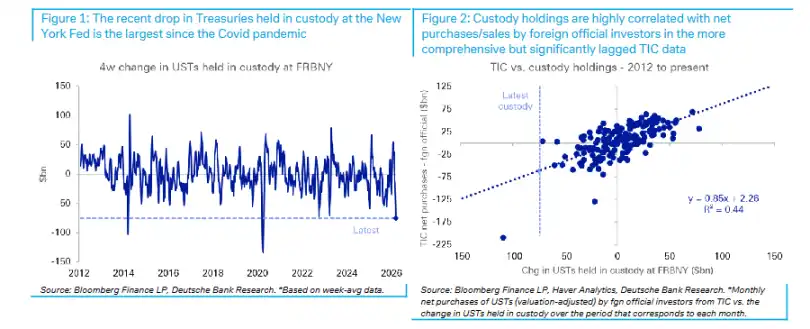
According to the Trading Desk, a research report released by Deutsche Bank on March 23 shows that the U.S. bond holdings of foreign official accounts custodied at the New York Fed plummeted by $75 billion over the past four weeks, marking the largest monthly decline since the impact of the COVID-19 pandemic in 2020. Based on historical data models, this change implies that foreign official investors actually net sold approximately $60 billion in U.S. bonds, also the largest since the pandemic.

This data aligns with the recent sharp rise in U.S. bond yields, particularly the abnormal upward movement in mid-term (belly) yields—a segment where foreign official investors' holdings are concentrated. Deutsche Bank warns that if overseas demand continues to shrink, the "convenience yield" advantage of U.S. bonds will be eroded, posing a substantive upside risk to long-term yields.
Custody Data Reveals Selling Signals

The most authoritative data source for tracking the movements of foreign official investors in U.S. bonds is the U.S. Treasury's TIC (International Capital Flows) report, but this data has significant lag—the March data will not be available until mid-May at the earliest.

As an alternative indicator, the New York Fed's weekly H.4.1 report includes a memorandum entry recording the face value of securities custodied for foreign official and international accounts, with a lag of only one day. Deutsche Bank strategists Matthew Raskin, Steven Zeng, and Andrew Fu noted in the report that the latest H.4.1 data shows, based on weekly averages, that the U.S. bond holdings of foreign official custodied accounts fell by $75 billion over the past four weeks, not only the largest decline since March 2020 but also the second-largest single-week drop in the past decade.

Notably, unlike a similar situation in March 2023, the scale of FIMA repo operations did not rise simultaneously this time, indicating that this round of reduction was due to direct sales or non-renewal at maturity, rather than liquidity financing through repo operations with the Fed. Foreign reverse repos, foreign official deposits, and FIMA securities lending also showed little change over the past month.

High Correlation Between Custody Data and TIC Data

To what extent can custody holding data represent the overall changes in U.S. bond holdings by foreign official investors? Deutsche Bank conducted a systematic verification.

The report shows that over the past 15 years, the correlation between changes in custody holdings and the net purchases by foreign officials in TIC data has been significant, with the former explaining about 50% of the latter's changes. Even when shortening the sample to post-2019 to eliminate potential interference from changes in reserve management models, this relationship remains robust.

Based on this historical relationship, a $75 billion decline in custody holdings corresponds to a net sale of approximately $60 billion by foreign official investors. Deutsche Bank pointed out that this would be the largest net sale by foreign official accounts since the COVID-19 pandemic; to find a comparable case, one would need to go back to December 2018.

Shift in Capital Flows Amid Foreign Exchange Intervention

The decline in U.S. bond custody holdings is highly consistent with recent market dynamics observed by Deutsche Bank's foreign exchange strategy team.

According to a previous report by Deutsche Bank's foreign exchange strategy team, despite the outbreak of the Iran war and soaring oil prices, the U.S. dollar failed to strengthen as expected, partly due to large-scale foreign exchange interventions by several Asian central banks. Meanwhile, the team's high-frequency ETF monitoring data also showed a significant slowdown in foreign investors' purchases of U.S. dollar assets.

The combination of these two clues leads to a conclusion: foreign official investors are reducing their allocation to U.S. dollar assets, and the sale of U.S. bonds is a direct manifestation of this trend.

Sustained Selling Could Push Long-Term Yields Up by Over 100 Basis Points

Deutsche Bank's analysis reveals a structural concern: U.S. bond yields have long benefited from the "convenience yield" brought by the U.S. dollar's reserve currency status, and this advantage is now being tested.

The report cites previous Deutsche Bank research, indicating that the current 10-year U.S. bond yield is more than 100 basis points lower than the reasonable level implied by the U.S. net international investment position (NIIP). Another recent academic working paper estimated that the U.S. dollar's reserve currency status keeps long-term U.S. interest rates about 90 basis points lower than "normal levels."

Deutsche Bank warns that if foreign demand continues to decline, this convenience yield will face regression pressure, and the term premium and overall yield of U.S. bonds will have substantive upside space, posing a direct impact on investors holding U.S. bonds.


Related Questions

QWhat does the sharp decline in foreign official holdings of U.S. Treasuries at the New York Fed indicate, according to Deutsche Bank's report?

AIt indicates that foreign official investors have been net selling approximately $60 billion in U.S. Treasuries over the past four weeks, marking the largest net selling since the COVID-19 pandemic began.

QHow does the recent movement in U.S. Treasury yields, particularly in the belly of the curve, relate to the actions of foreign official investors?

AThe abnormal rise in mid-term (belly) Treasury yields is corroborated by the sell-off, as foreign official investors' holdings are concentrated in that specific maturity segment.

QWhy is the H.4.1 report from the New York Fed used as a proxy for tracking foreign official investor activity, and what is its key advantage?

AThe H.4.1 report is used because the official TIC (Treasury International Capital) data has a significant publication lag. The key advantage of the H.4.1 data is that it is updated weekly with only a one-day lag.

QWhat two key market dynamics observed by Deutsche Bank's FX strategy team point towards foreign official investors reducing their dollar asset allocations?

AThe two dynamics are: 1) Large-scale FX interventions by several Asian central banks, which prevented the dollar from strengthening as expected, and 2) A noticeable slowdown in foreign investors' purchases of U.S. dollar assets, as shown by high-frequency ETF flow data.

QWhat is the 'convenience yield' of U.S. Treasuries, and what is the potential impact if foreign demand continues to decline?

AThe 'convenience yield' is the advantage U.S. Treasuries enjoy due to the dollar's reserve currency status, which has been estimated to suppress long-term yields by over 100 basis points. If foreign demand declines persistently, this premium could erode, leading to a substantial rise in term premiums and overall yields.

Related Reads

STRC Major De-pegging's First Financial Report, How Will Strategy Repair Its Capital Flywheel?

Bitcoin treasury company Strategy released its Q2 2026 earnings report on July 31. Despite a 6.9% year-over-year revenue increase to $122 million, the company recorded a net loss of $8.22 billion, largely due to $8.32 billion in unrealized losses from Bitcoin price fluctuations. As of quarter-end, Strategy holds 843,775 BTC with an average cost of $75,000 per coin, and Bitcoin per share increased. The report highlights a critical shift in Strategy's capital model following the de-pegging of its key financing tool, STRC (Strategic Coin), which fell below its $100 target. Management's top priority is restoring STRC to its target value, aiming for a recovery by September 8. They rule out discounted STRC issuances and plan to maintain its dividend yield at 12%, instead focusing on bolstering its $3.75 billion cash reserve. Strategy has moved from a one-way "buy-and-hold" Bitcoin strategy to active capital management. This new approach, part of its "Digital Credit Capital Framework," involves flexibly managing its balance sheet across four elements: BTC, USD cash, common stock (MSTR), and digital credit securities like STRC. This allows for BTC monetization (having sold $218.4 million in BTC so far), strategic repurchases of discounted securities, and debt optimization, as seen with a $1.5 billion convertible bond buyback. The company's future hinges on two key tests: successfully re-pegging STRC to restore market confidence in its digital credit system, and a long-term recovery in Bitcoin's price to ultimately support its growth thesis.

marsbit36m ago

STRC Major De-pegging's First Financial Report, How Will Strategy Repair Its Capital Flywheel?

marsbit36m ago

STRC's First Financial Report Post-Depegging, How is Strategy Restoring the Capital Flywheel?

On July 31, 2026, Bitcoin treasury company Strategy released its Q2 financial report. Despite a 6.9% year-over-year increase in revenue to $122 million, the company recorded a substantial net loss of $8.22 billion, primarily due to $8.32 billion in unrealized losses from Bitcoin holdings. While Strategy's core Bitcoin strategy remains intact—its holdings grew 11% to 843,775 BTC—the company is undergoing a fundamental shift in its capital model. Following the de-pegging of its key financing tool, the STRCoin (STRC), from its $100 target in May, Strategy has pivoted from a one-directional "raise funds, buy Bitcoin" cycle to a more dynamic, multi-asset capital management approach. A key part of this new framework is the "Monetization Program," through which Strategy has sold approximately $218.4 million worth of BTC to bolster liquidity. The company's top priority is repairing STRC's peg, committing not to issue discounted shares until it returns to its target range. It has initiated a $1 billion buyback program for discounted digital credit securities, having repurchased $28.9 million face value of STRC so far. Management aims to restore the peg around September 8, 2026. Strategy now actively manages a matrix of assets: Bitcoin (for accumulation or strategic sales), USD cash reserves (now at $3.75 billion), common stock (MSTR), and digital credit securities like STRC. This allows for tactical moves like repurchasing discounted debt or equity to capture value. The future success of Strategy's "capital flywheel" hinges on two factors: the short-term ability to successfully re-peg STRC to restore market confidence in its digital credit system, and the long-term price trajectory of Bitcoin, upon which its entire investment thesis ultimately depends.

Odaily星球日报41m ago

STRC's First Financial Report Post-Depegging, How is Strategy Restoring the Capital Flywheel?

Odaily星球日报41m ago

With Two Consecutive Quarters of Losses, Coinbase Must Rely on Paths Beyond Trading

Coinbase posted its second consecutive quarterly net loss of $359 million on $1.22 billion in revenue for Q2, highlighting its vulnerability to crypto market cycles where weaker prices and lower volatility reduce user trading. However, the report also reveals a strategic shift in its business model. Despite a 25% quarter-over-quarter decline in global spot trading volume, Coinbase increased its market share to a company-record 10.3%. This suggests its position as a compliant U.S. on-ramp is strengthening even in a cooler market. A key development is the diversification of revenue streams. Transaction revenue fell to $599 million, nearly equaling subscription and services revenue of $555 million. Stablecoin services, generating $292 million, are becoming a crucial revenue "floor." This income, derived from interest on the $20 billion average USDC balance held on its platform, is less tied to daily trading activity. Furthermore, while spot trading volume dropped significantly, derivatives volume held steady at $1.03 trillion. Coinbase is pushing to integrate spot, stablecoin, and derivatives liquidity to create a more interconnected and sticky ecosystem for users. The GAAP net loss includes non-cash expenses like stock-based compensation and crypto asset valuation changes. Its adjusted EBITDA remained positive at $208 million for the 14th straight quarter, indicating core operations can cover ongoing costs. The company is also reducing expenses to manage the downturn. The central question moving forward is whether Coinbase's growing market share, stablecoin revenues, and expanding product integration can sufficiently offset the inherent cyclicality of its core trading business during future market contractions.

marsbit56m ago

With Two Consecutive Quarters of Losses, Coinbase Must Rely on Paths Beyond Trading

marsbit56m ago

Trading

Spot
活动图片