OpenAI Shuts Down Sora, Disney's $1 Billion Investment Goes Down the Drain, AI Video Market Reshuffles

marsbitPublicado a 2026-03-27Actualizado a 2026-03-27

Resumen

OpenAI has officially shut down its AI video generation product Sora, including its consumer app, API, and the sora.com domain, as of March 24, 2026, just six months after its public launch. This decision also led to the cancellation of Disney’s three-year licensing agreement and a planned $1 billion investment in OpenAI. The tech community’s reaction highlighted Sora’s lack of real-world adoption, with many questioning whether the product was ever widely used. Competitors like Runway Gen-4, Kling 3.0, and Google Veo are now positioned as the main players in the AI video market. Sora’s shutdown is attributed to high operational costs—estimated at $15 million daily during peak usage—coupled with limited revenue alignment ahead of OpenAI’s expected IPO. Deepfake concerns related to Sora’s content generation features also contributed to its termination. OpenAI will retain Sora’s underlying technology for internal "world simulation" research aimed at robotics field, but no consumer-facing video products are planned. Current Sora users are advised to migrate to alternatives such as Runway, Kling, or Pika. The exit of OpenAI is expected to lead to market consolidation, potential price increases from remaining providers, and greater enterprise opportunities for competitors like Kling. Runway, in particular, may raise subscription prices due to increased demand.

Author: RoboRhythms

Compiled by: Deep Tide TechFlow

Deep Tide Guide: On March 24, 2026, OpenAI shut down Sora's App, API, and domain all at once. Disney's three-year licensing agreement and $1 billion investment subsequently collapsed.

The first reaction from the tech community was not regret, but "Did anyone actually use this thing?"—this statement speaks volumes more than any official announcement. Runway, Kling, and Google Veo are now the only real players left in the AI video space.

Full Text Below:

The product that was supposed to bring AI video generation to the masses has disappeared. OpenAI shut down Sora on March 24, 2026, taking down the standalone App, API, and sora.com, just about six months after the product's high-profile public release.

The timing is awkward. Disney signed a three-year licensing agreement in December 2025, authorizing OpenAI to use iconic characters like Mickey Mouse and Cinderella for Sora-generated content, and planned to invest $1 billion in OpenAI.

All of this is now canceled.

I think the most telling thing is the reaction from the tech community: the mainstream sentiment wasn't regret, but "Did anyone actually use this thing?" This statement reveals the product's actual trajectory more truthfully than any official announcement.

If you were using Sora or planning to build a product based on its API, here's what you need to know.

What Exactly Happened

Sora's shutdown is a complete product termination, covering the App, developer API, and the sora.com domain.

OpenAI confirmed on March 24 that the entire Sora product line would be completely shut down. This is not a pivot, a rebrand, or a merger into another product.

The App is gone, the API is being shut down, sora.com is being taken offline.
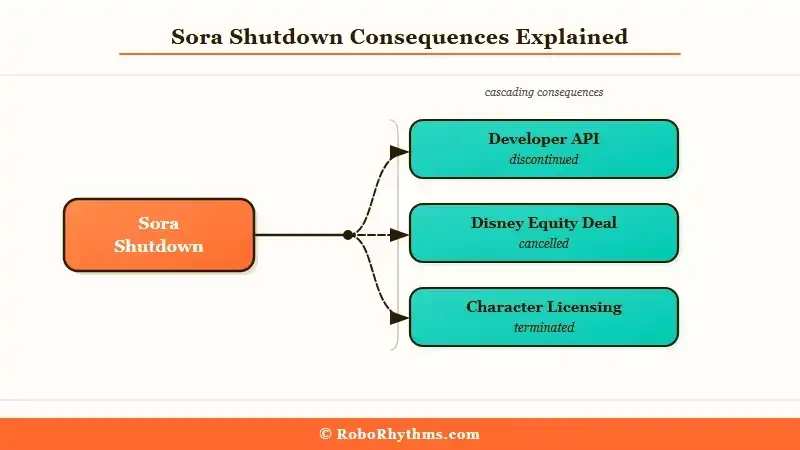
Here is everything that was terminated:

  • Sora consumer App (text-to-video)
  • Sora API (developer and enterprise access)
  • sora.com website

Disney's planned $1 billion equity investment in OpenAI

The three-year character licensing agreement with Disney announced in December 2025

The Disney angle is not a footnote. A $1 billion deal collapsing within three months of its announcement suggests the relationship had already become complicated before the shutdown was officially announced.

Both Variety and Bloomberg confirmed that the deal was directly called off due to Sora's cessation of operations.

Only one part of Sora remains: the internal research team continues to advance what OpenAI calls "world simulation" research, aimed at robotics applications.

This project has nothing to do with the video product you might have used. OpenAI explicitly positions this as infrastructure research, not a future consumer product.

This also aligns with a pattern I've reported on before. OpenAI has a history of terminating products that no longer fit its revenue roadmap, and the timing—ahead of a planned IPO—follows the same logic.

Why This Is More Serious Than It Sounds

Sora's shutdown isn't just a product failure; it's OpenAI publicly conceding an entire AI category to the competitors it once looked down upon at its launch.
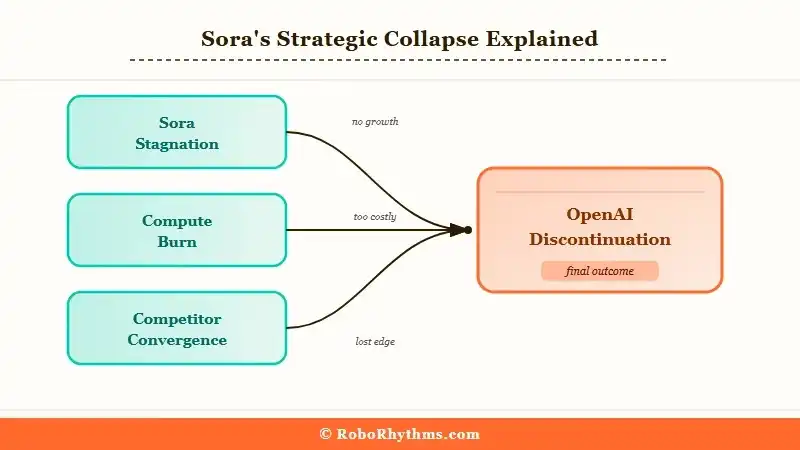
When Sora first debuted in 2024, the demos were stunning. Posts on r/singularity garnered hundreds of thousands of views, with a widespread belief that OpenAI had once again leapfrogged all competitors overnight.

Runway, Pika, and Kling were supposed to become irrelevant.

But the product stalled after its public launch. Runway Gen-4 kept iterating and shipping, Kuaishou's Kling 3.0 closed the quality gap faster than most analysts expected.

Google Veo's compute advantages were something OpenAI couldn't easily match in this non-core revenue赛道 (market).

Compute cost is the most staggering number. Analysts estimate Sora's compute cost peaked at around $15 million per day during peak usage.

For a company focused on pre-IPO financials, this was an extremely difficult expense to justify when the models that actually drive revenue (GPT-5 series, Operator API, enterprise contracts) all require more investment.

Then there was the deepfake issue. TechCrunch, in its shutdown report, called Sora "the most disturbing app on your phone," referring to the cameo feature that allowed users to insert real people into AI-generated scenes.

The backlash from this feature was significant, and in my view, the reputational drag made the shutdown decision easier than it otherwise might have been.

The industry impact is now clear: Runway, Kling, and Google Veo are the true players in AI video. The strategic uncertainty that OpenAI's presence created for every competitor has now been removed.

What This Means For You

If you were using Sora or accessing its API, you need to act immediately. The shutdown timeline is effective now.
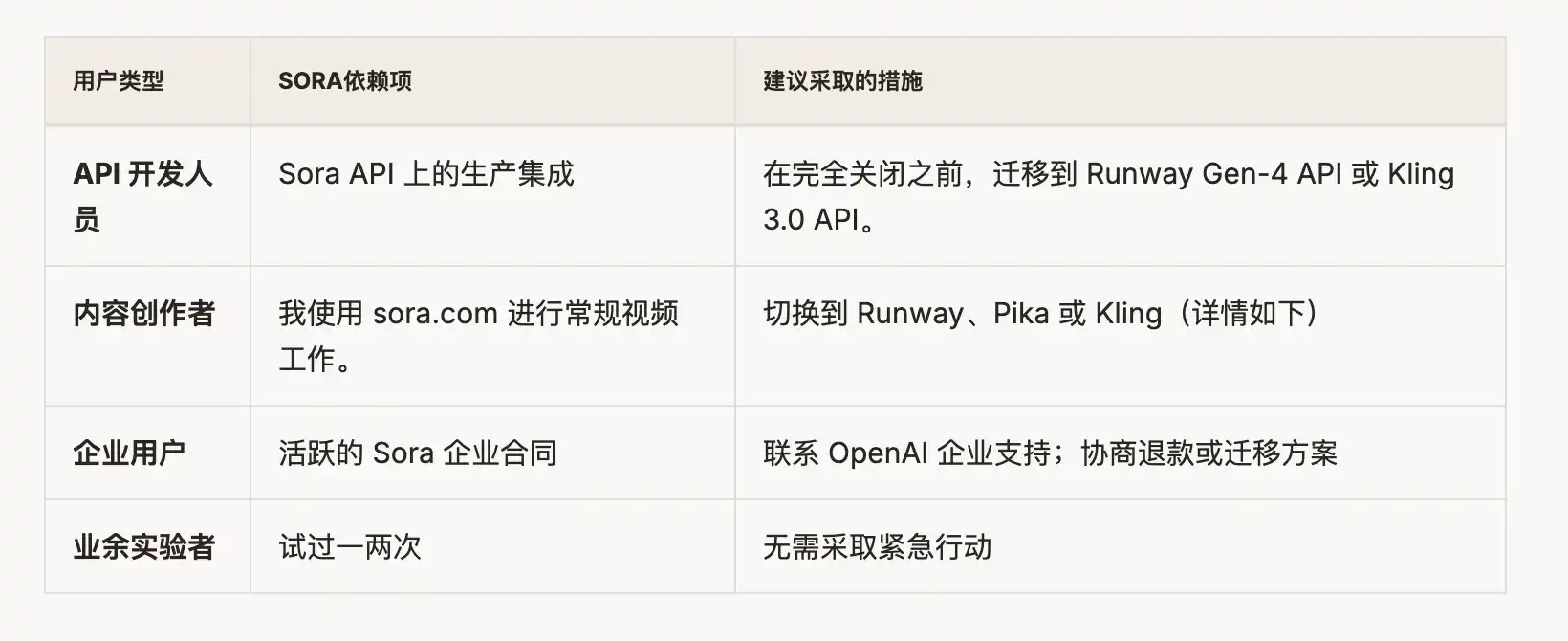
The three tools currently best positioned to absorb Sora's former user base:

Runway Gen-4—Technically closest to Sora's cinematic quality goals, with a mature API and an active developer community. Best for professional long-form video production.

Kling 3.0—Kuaishou's model has become the community's top choice for realistic motion effects and is the tool most recommended by former Sora users in migration discussions. Developer API available.

Pika 2.0—Faster, cheaper, and easier to use than the above two. Plans start around $8/month. Best for content creators prioritizing speed over cinematic quality.

If your primary use case is for virtual avatars or talking head videos, rather than purely generative scenes, the tool choice differs.

What Happens Next

The AI video market is about to consolidate, and prices will rise.

With OpenAI's exit, Runway, Kling, and Google Veo no longer operate in a market where a well-funded new entrant could颠覆 (disrupt) everyone's pricing expectations at any moment.

This changes the commercial dynamics for all remaining players.

My predictions for the next six months:

Runway will raise subscription prices. Demand will surge with the influx of Sora users, and Runway's pricing has been below what its competitive position could support. The diminished threat from OpenAI gives them clear room to reprice.

Google Veo will more aggressively push a consumer product. Google had been deliberately quiet about a public rollout for Veo; the addressable market is now clearer. Expect a more prominent consumer product before the end of 2026.

Kling will target the enterprise contracts Disney's departure leaves behind. Kuaishou has been building Kling as a professional-grade product. The OpenAI-Disney deal effectively blocked some enterprise relationships that are now reopening.

An outcome I don't see happening: OpenAI returning to AI video with a consumer product. Internal signals point to video being recast as robotics infrastructure research, and the window for re-entering the market is shorter than this company's typical development cycles.

From my experience observing every AI category, the company that wins is the one that accumulates iterations over time, not the one that released the best demo. Sora peaked at the demo; Runway has been accumulating for three years.

Frequently Asked Questions

Q: As of March 2026, is the Sora App still usable?

As of March 24, 2026, Sora has entered the shutdown process. OpenAI has not announced a specific final access date for all users, but the termination process has begun. Do not rely on its continued availability for any production environment work.

Q: What is the best alternative to Sora for API developers?

Runway Gen-4 currently has the most mature and stable developer API among AI video tools. Kling 3.0 also offers API access and is widely recommended in developer migration discussions. It's advisable to test both before fully migrating.

Q: Why did Disney cancel its $1 billion investment in OpenAI?

Disney's investment and the three-year licensing agreement were directly tied to the Sora product line, including rights to use Disney characters in AI-generated videos. With Sora's shutdown, the licensing arrangement lost its foundation. Both parties have called it off, according to Bloomberg and Variety.

Q: What will happen to the internal Sora research team at OpenAI?

The team continues to work on world simulation research for robotics. This work will not result in any consumer or developer-facing video products. OpenAI positions it as infrastructure research, not something on the product roadmap.

Q: Does this mean OpenAI is broadly scaling back consumer products?

OpenAI has made it clear that pre-IPO resources are focused on enterprise software, programming tools, and agent products. Sora's shutdown aligns directly with this direction.

Q: Is Google Veo now the best Sora alternative?

Veo is technically strong, but for developers and content creators, Runway Gen-4 and Kling 3.0 are currently more accessible and better supported. For most users needing to migrate today, Runway or Kling is the more practical choice.


Preguntas relacionadas

QWhat was the main reason for OpenAI shutting down Sora according to the article?

AThe article states that Sora was shut down due to its high operational costs (estimated at $15 million daily in compute costs during peak usage) and because it did not align with OpenAI's pre-IPO focus on revenue-generating products like enterprise software, coding tools, and agent products. Additionally, reputational issues from deepfake concerns made the decision easier.

QWhich companies are now considered the main players in the AI video generation market after Sora's shutdown?

AAccording to the article, the main players in the AI video generation market after Sora's shutdown are Runway (Gen-4), Kling (3.0 by Kuaishou), and Google Veo.

QWhat was the financial and strategic impact of Sora's shutdown on Disney?

ADisney's planned $1 billion equity investment in OpenAI and a three-year character licensing deal, announced in December 2025, were both canceled as a direct result of Sora's shutdown. The deal had granted OpenAI rights to use Disney characters like Mickey Mouse and Cinderella in AI-generated content.

QWhat is the future of the internal Sora research team at OpenAI?

AThe internal Sora research team will continue its work, but it has been re-focused on 'world simulation' research for robotics applications. This is positioned as infrastructure research and will not lead to any future consumer or developer-facing video products.

QWhat does the article predict will happen to the AI video market in the next six months following Sora's exit?

AThe article predicts market consolidation and price increases. Specifically, it forecasts that Runway will raise its subscription prices, Google will more aggressively push Veo as a consumer product, and Kling will target the enterprise contracts that were previously blocked by the OpenAI-Disney deal.

Lecturas Relacionadas

The Trillion-Yuan Market Cap 'Yi Zhong Tian': Who is the True Value King?

The article analyzes the three leading Chinese optical module companies, collectively nicknamed "Yi Zhong Tian": Xinyisheng, Zhongji Innolight, and TFC Optical Communication. It evaluates their "cost-performance" not by current stock price, but through three lenses: PEG ratio (growth vs. valuation), earnings quality, and premium/discount for certainty. Xinyisheng shows the most attractive PEG ratio and high profitability, but its valuation reflects discounts for risks like high customer concentration and reliance on overseas markets. Zhongji Innolight, the most expensive, commands a premium for its market leadership, dominant share in key products like 800G/1.6T modules, and higher earnings certainty, though it faces geopolitical risks. TFC Optical, as an upstream component supplier ("water seller"), has the highest gross margin and bets on the long-term CPO/NPO architecture trend, but trades at a high valuation with more stable, less explosive growth. The core argument is that while these companies dominate module assembly, the true profit pool and technological moat lie upstream in laser and switch chips, currently controlled by U.S. firms like Lumentum and Coherent. The long-term "cost-performance" for these Chinese leaders hinges on whether the domestic industry, exemplified by companies like Yuanjie Technology, can successfully move up the value chain into high-power laser chips. Otherwise, their high growth may remain confined to the lower-margin assembly segment.

marsbitJusto ahora

The Trillion-Yuan Market Cap 'Yi Zhong Tian': Who is the True Value King?

marsbitJusto ahora

Has the Crypto Market Bottomed? Here's What Institutions Think

The crypto market is in a period of significant debate, with leading institutions offering differing views on whether a bottom has been reached. Three prominent firms have published detailed analyses: * **Galaxy Digital** argues Bitcoin has **not yet bottomed**. Their analysis of 13 historical indicators across six dimensions (valuation, profit-taking, miner pressure, etc.) shows only four are fully met. They project a potential bottom range between $30k and $54k. * **NYDIG** states a bottom is **possible but not likely**. While metrics are close to historic bear market extremes, they note the absence of a classic panic-selling event. They also suggest increased institutional adoption may have structurally altered the market cycle, potentially leading to a shallower downturn. * **Standard Chartered Bank** asserts the **bottom has already occurred** at around $59k. They cite two key factors: potential US-Iran diplomatic progress and the anticipated SpaceX IPO, which they believe absorbed capital and caused ETF selling pressure that is now subsiding. They forecast a year-end price target of $100k. Despite the surface-level disagreement, the reports share critical common ground more valuable for long-term investors: 1. All three believe the market bottom will form **within this year**. 2. All agree the current price is **closer to the bottom than to previous highs**. 3. All maintain a **bullish long-term outlook** for Bitcoin and a new cycle. The core takeaway is that while the exact bottom price ($40k, $50k, or $60k) is debated, the consensus is that a bottom is imminent. For long-term holders, the primary focus should not be pinpointing the absolute low, but on the future potential for prices to reach $100k, $200k, or higher. The fundamental thesis for Bitcoin—sovereign debt accumulation, inflation, declining trust in centralized institutions, global digitization, and improved accessibility—remains intact and is arguably strengthening. The overall landscape is viewed as more favorable than in previous crypto winters.

marsbitHace 10 min(s)

Has the Crypto Market Bottomed? Here's What Institutions Think

marsbitHace 10 min(s)

The 'Chip' Challenge and Breakthroughs in China's Optical Industry Chain

China's Photonics Industry: Bottlenecks and Breakthroughs In the global AI race, computing chips dominate the narrative, but the underlying bottleneck increasingly defining the scale of AI clusters is light—or more specifically, optical connectivity. Optical modules, which translate electrical signals to light and vice versa, are crucial for connecting thousands of GPUs in AI data centers, preventing data congestion and ensuring efficient model training. High-speed modules (800G, 1.6T) are now standard, with performance hinging on advanced DSP (Digital Signal Processor) chips. This is where a critical dependency lies. Two US giants—Marvell and Broadcom—collectively dominate over 90% of the high-end DSP chip market. Chinese optical module leaders like Zhongji Innolight and Eoptolink rely on these chips to manufacture modules for overseas AI customers, primarily in North America. While this creates a supply chain vulnerability, complete decoupling is difficult. Marvell derives over half its revenue from Greater China, and the US firms depend on Chinese partners for chip packaging and optical components. The risk from laser chips (e.g., from Lumentum), another key component, is considered more manageable due to multiple global suppliers and faster progress in domestic alternatives from companies like YOFC and Accelink. To mitigate risks, China's industry is pursuing a multi-pronged strategy: diversifying supply chains and locking in long-term orders; fostering a domestic market ecosystem to adopt homegrown DSPs from firms like Huawei HiSilicon and CETC; accelerating R&D in high-speed DSPs and advanced packaging; and investing in next-gen technologies like silicon photonics and Co-Packaged Optics (CPO) to reduce reliance on discrete DSPs. The ultimate solution lies not in short-term博弈 but in persistent advancement of domestic high-end chip R&D and manufacturing. While challenges remain in performance, certification, and ecosystem building, China's vast domestic market and manufacturing base provide a crucial buffer, buying time for the industry to achieve greater technological independence.

marsbitHace 24 min(s)

The 'Chip' Challenge and Breakthroughs in China's Optical Industry Chain

marsbitHace 24 min(s)

Behind SpaceX's $2 Trillion Market Cap: Why Does Musk Always Have the Next Move Planned?

On June 12th, SpaceX debuted on the Nasdaq, reaching a valuation that briefly touched $2 trillion. This marked the culmination of a 24-year journey from its founding in 2002, driven by Elon Musk's frustration at the high cost of buying rockets. The company's path was defined by early failures, with its first three Falcon 1 launches ending in explosions before a successful 2008 flight opened the era of commercial spaceflight. Key to its model was a fixed-price NASA contract, incentivizing cost reduction. SpaceX mastered rocket reusability, first achieving a Falcon 9 landing in 2015, which drastically cut launch costs. This enabled its profitable Starlink satellite internet constellation, envisioned years before reusability was proven, to create an internal market for frequent launches. Similarly, the next-generation Starship rocket was in development long before its first flight, with its business case evolving from Mars colonization to supporting the emerging concept of in-orbit data centers for AI—a story now central to its valuation. The company's recent IPO, a reversal of its long-standing "no IPO" stance, is funding this ambitious "space-based compute" vision. While major tech players like Google, Blue Origin, and others are investing heavily, significant technical and cost hurdles remain. Ultimately, SpaceX's history is one of creating its own demand: first with Starlink and now with space-based AI compute, betting that its next rocket will enable its next giant market.

marsbitHace 27 min(s)

Behind SpaceX's $2 Trillion Market Cap: Why Does Musk Always Have the Next Move Planned?

marsbitHace 27 min(s)

Trading

Spot
Futuros
活动图片




