Original | Odaily Planet Daily (@OdailyChina)
Author | jk
On-site Interview | Connie

On February 12th local time in the US, the crypto prediction market platform Polymarket held a charity event in Lower Manhattan, New York, opening a free grocery store named "The Polymarket," the first completely free grocery store in New York City. From fresh produce to daily necessities, all items were provided free of charge. The event will last until February 16th.
Connie from Odaily Planet Daily in New York visited the store on its opening day, experienced the environment, and interviewed staff and many queuing New Yorkers. Let's take a look at what the scene was like on the first day of Polymarket's first "offline physical store."
Opened at 2 PM, but People Started Queuing at 6 AM, with the Line Wrapping Around the Entire Block
The event was originally scheduled to open at 12 PM, but due to delayed shipments, the opening time was postponed to 2 PM. Despite this, New Yorkers arrived early to queue. On-site staff revealed that when he arrived at 7 AM, the first three people in line were already there.
The first person in line was a woman named Tori. She told on-site reporter Connie that she had been there since 6 AM, even though it was winter.
"We arrived at 6 AM," said Tori Hall. "We thought it would open at 12 PM, but now we have to wait until 2 PM. But free is free, times are tough these days." Because the line was so long, by 11 AM, the queue had stretched four blocks away. Polymarket staff occasionally provided free coffee to the waiting crowd.

The queue extended four blocks away
It is reported that by the time the on-site reporter left, the crowd was so large that the New York Police Department had sent officers to inquire about the situation.
Most People in Line Didn't Know What Polymarket Was
Interestingly, the vast majority of citizens coming to collect free groceries had no idea what Polymarket was. Ryan from Brooklyn learned about the event from the "New York City for Free" Instagram account. When asked if he had heard of prediction markets, he admitted: "No. What is Polymarket?" After learning it was a prediction market platform, he said, "Oh, I've heard of it, seems like a prediction website." (Not bad, at least the brand impression should stick this time.)
According to Odaily Planet Daily's observations, there were some Chinese people in the queue who learned about the event through WeChat groups. "They had no idea what a prediction market was or what Polymarket is," Connie discovered during interviews. "When I asked them if they knew what Polymarket was, they said, 'It's just supermarket, right?'. Some even thought it was a welfare initiative from the new mayor."
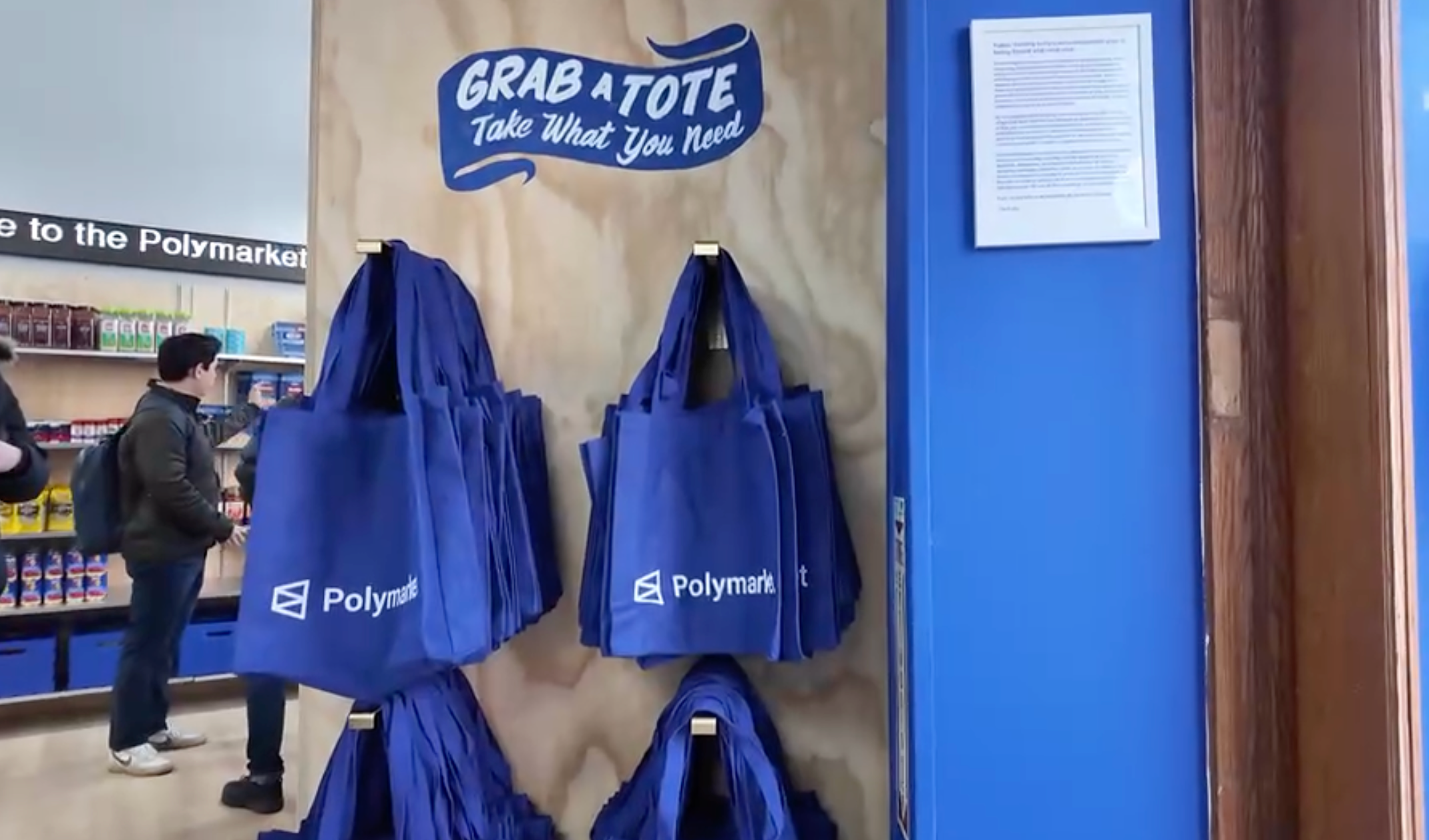
Polymarket-branded tote bag
Meticulously Planned Details and a Million-Dollar Donation
Every detail of this pop-up grocery store was carefully designed. According to Polymarket staff, the blue price tags in the store read "Milk, eggs, produce priced by the people," the onion stickers were printed with Polymarket's logo, and even the store location was thoughtfully chosen.
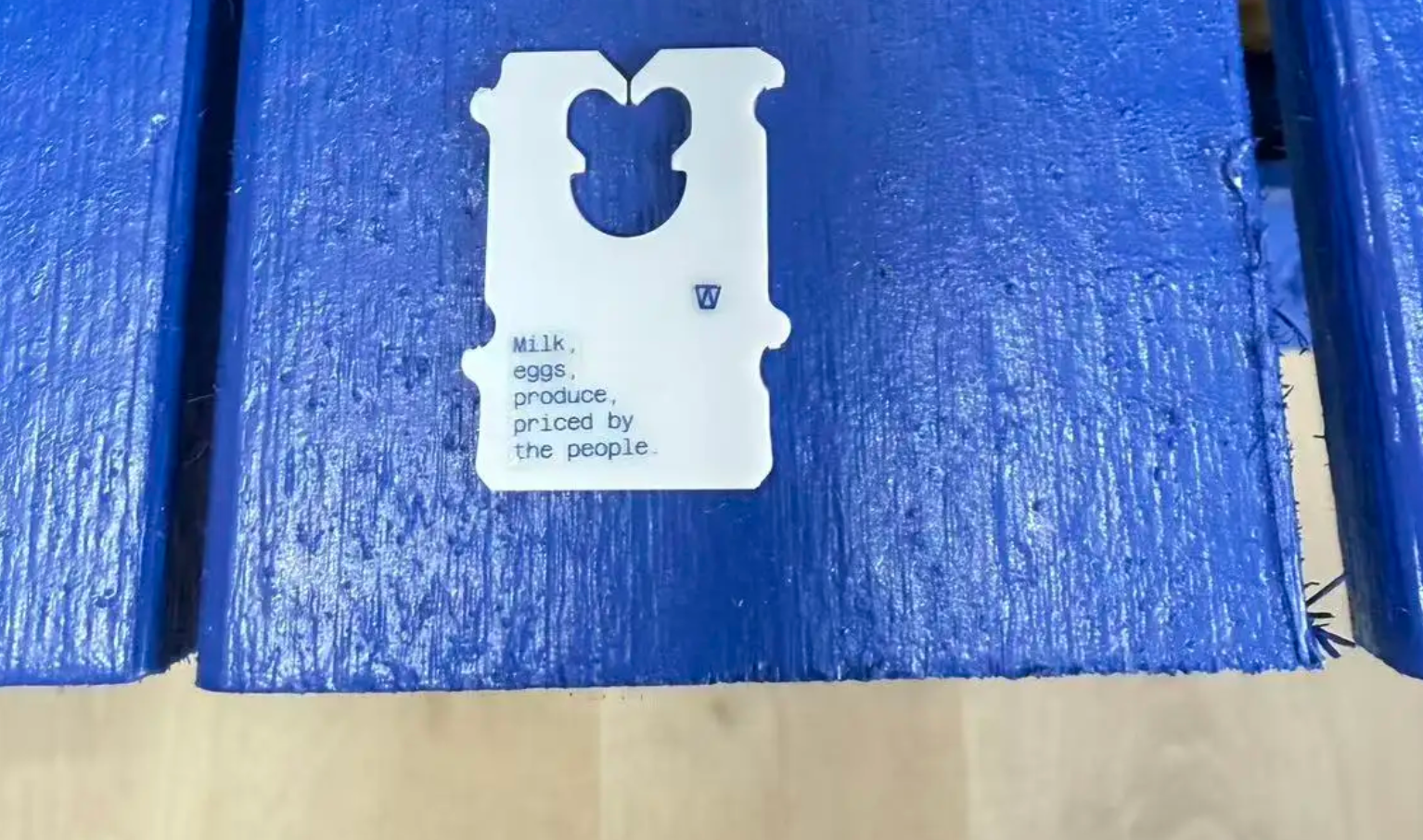
"Milk, eggs, produce priced by the people"
This staff member, who previously worked at the NFL and for MrBeast, revealed: "CEO Shayne Coplan and the CMO both grew up in New York public schools. This is the company's first charity event since its founding, and they wanted to give back to the city that raised the company." The CEO was also on site that day.
The entire store was built from scratch in just two days. The store was stocked with a wide variety of items: fresh fruits, vegetables, meat, eggs, dairy, pasta, tomato sauce, olive oil, peanut butter, canned goods, snacks, beverages, and daily necessities like paper towels. Notably, with Valentine's Day approaching, the store also had a free flower section.
Upon entering the store, customers received a tote bag, and market staff acted as personal shopping assistants, helping them select the items they needed.
Staff told Odaily that each customer could fill the shopping bag they were given, taking as much as they wanted within that limit, preferably items they would actually use.
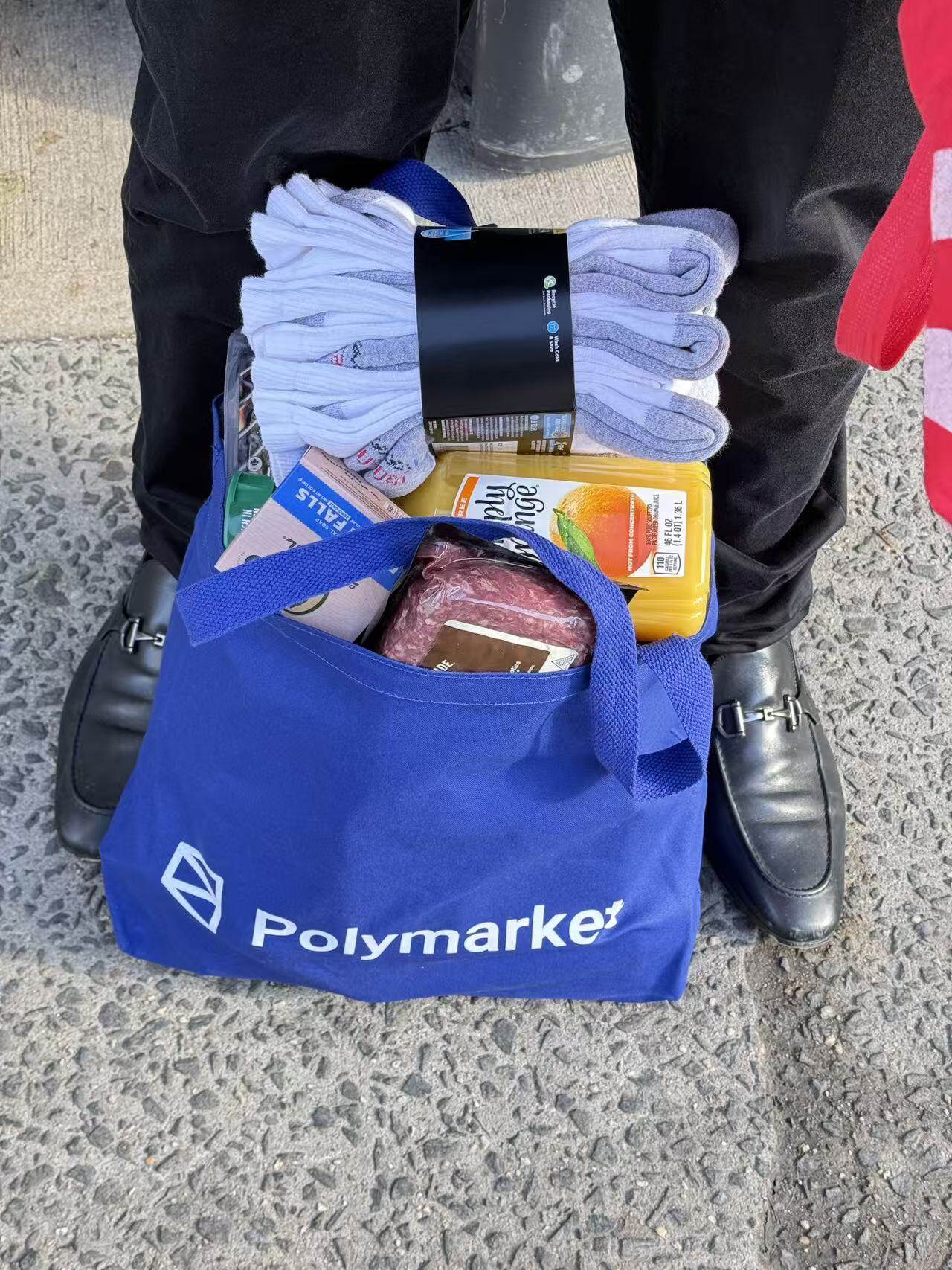
One customer's haul
In terms of maintaining order, there were 9 security personnel managing the queue and controlling the flow of people today. Citizens took turns to enter the store and shop; once inside, staff guided them, making the actual shopping process very quick—there was no sense of chaos. (New Yorkers are generally quite orderly when it comes to queuing.)
In addition to the physical grocery store, Polymarket also donated $1 million to the Food Bank For New York City. According to staff, this donation is equivalent to 3 million meals and will help address food shortages for people across New York's five boroughs. However, when asked about the total cost of the event, staff declined to disclose it.
The "Coincidence" with the Mayor's Proposal
Polymarket's move was very timely: New York City's new Mayor, Zohran Mamdani, promised during his campaign to open at least one government-operated low-price grocery store in each borough, selling food at wholesale prices. Polymarket's free grocery store seemed like a response to this proposal, or a preemptive move, certainly capitalizing on the hype.
In response, Mayor Mamdani posted a screenshot from The Onion on social media: "Heartbreaking: The Worst Person You Know Just Made a Great Point." Polymarket later expressed hope that the mayor would visit, stating, "We've been trying to get in touch."
More intriguingly, Polymarket isn't the only prediction market platform engaging in such marketing. Its competitor, Kalshi, also offered $50 worth of free groceries per person at Westside Market in the East Village on February 3rd, attracting large crowds.
Despite the obvious marketing motives, this event provided real, tangible help to New Yorkers. Tori Hall said she spends between $150 and $200 on groceries each month. "Toilet paper is $30 to $40, a case of good water is $20 to $30, eggs are $8 to $9. It all really adds up. Prices are getting more and more expensive."
She praised the event highly: "This is amazing, so good. I highly recommend them, thank you very much for helping the community and the public."
Ryan from Brooklyn, who spends about $80 to $90 on groceries monthly, thought: "This is a great opportunity for those who are struggling financially or don't have money."
After the event concludes, Polymarket plans to shift to accepting community donations. On the afternoon of February 15th and all day on the 16th (Presidents' Day), the focus will be on collecting non-perishable food items. All collected supplies will be distributed to partner organizations in New York City to help neighbors in need.
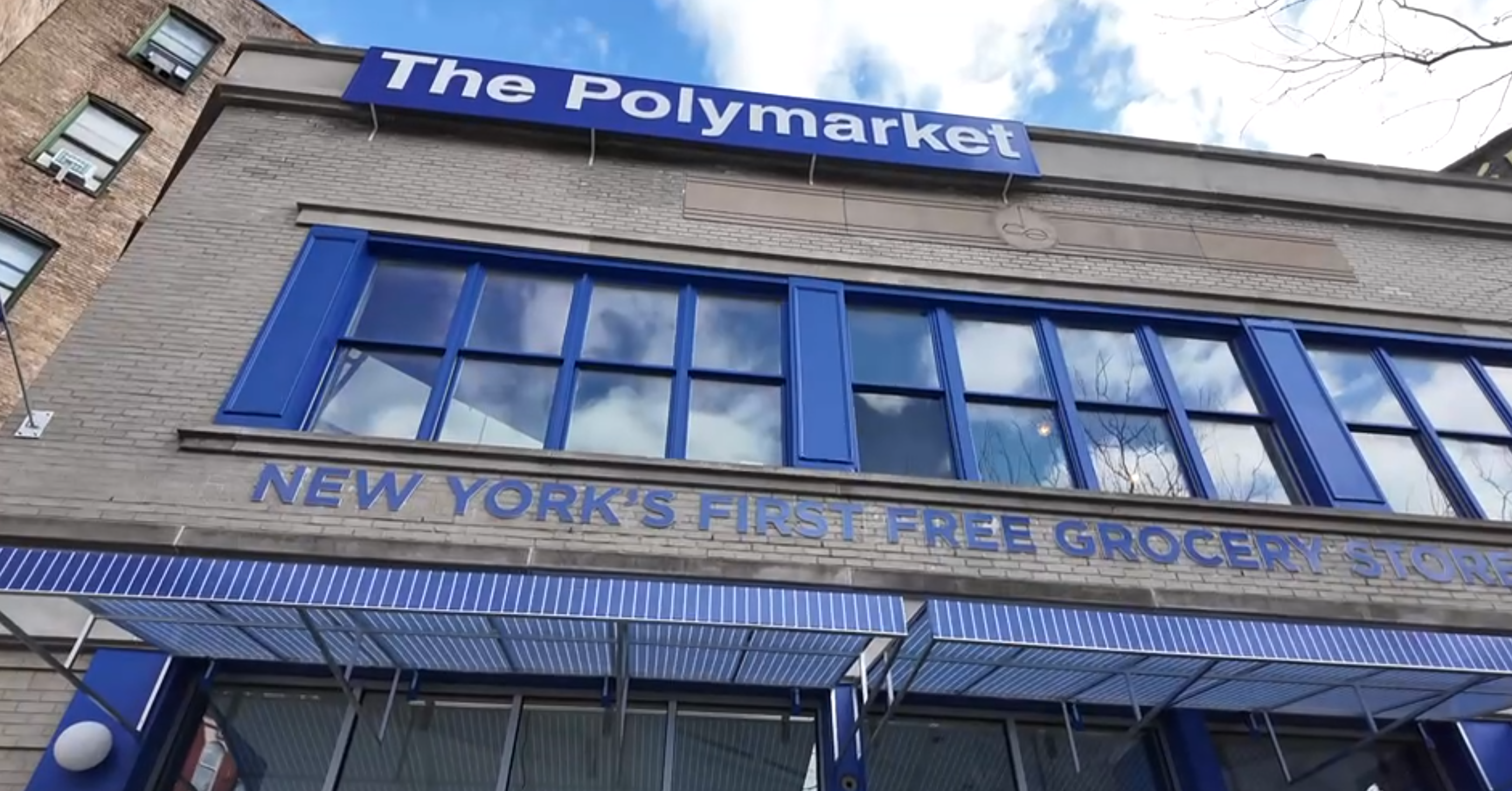
For more on-site videos and interviews, please follow Odaily's video channel.
Related Reading
Odaily Exclusive丨Polymarket Opens Store in NY, Kalshi Gives Out $50 Supermarket Vouchers, Are Prediction Markets Also Giving Out Eggs Now?





















