NVIDIA's 20-Year CUDA Moat Collapsed Over a Weekend, Claude Single-Handedly Got AMD's New GPU Running

marsbitPublished on 2026-07-28Last updated on 2026-07-28

Abstract

In a single weekend, Claude, an AI agent from Anthropic, successfully ported and optimized its cutting-edge model to run on a brand-new AMD MI355X server rack without any manual code intervention. This feat demonstrates a potential breakthrough in overcoming NVIDIA's long-established CUDA software ecosystem dominance, built over two decades. Anthropic's team simply instructed Claude to get the AMD machine running. By Monday, it not only worked but was showing a continuously improving performance curve. The achievement impressed AMD CEO Lisa Su and accelerated a major deployment partnership: Anthropic plans to deploy up to 2GW of AMD Instinct GPUs starting in 2027. The key enabler is AMD's new ROCm.AI platform, a toolbox designed specifically for AI agents like Claude. It provides AI-readable documentation, including chip instruction sets (ISA), and tools like the Hyperloom service that allows agents to autonomously profile performance, identify bottlenecks, test configurations, and generate optimized kernels. In a demo, Hyperloom boosted the output speed of a model by 38%. This represents a fundamental shift. While CUDA's strength lies in its vast, human-expert-driven ecosystem of tools and tacit knowledge, AMD's strategy is to make its hardware and software stack directly accessible and optimizable by AI agents. An agent can parallelize tasks—debugging, profiling, coding—that would take human engineers years to master, compressing the traditional software adaptation timel...

In one sentence, one weekend—Claude directly ran its own cutting-edge model on a brand-new AMD MI355X rack!

Human engineers didn't modify a single line of code.

Who could have imagined that the CUDA moat NVIDIA built over 20 years was crossed just like that.
Over a Weekend, Claude Got AMD's New GPU Up and Running

Here's the story.

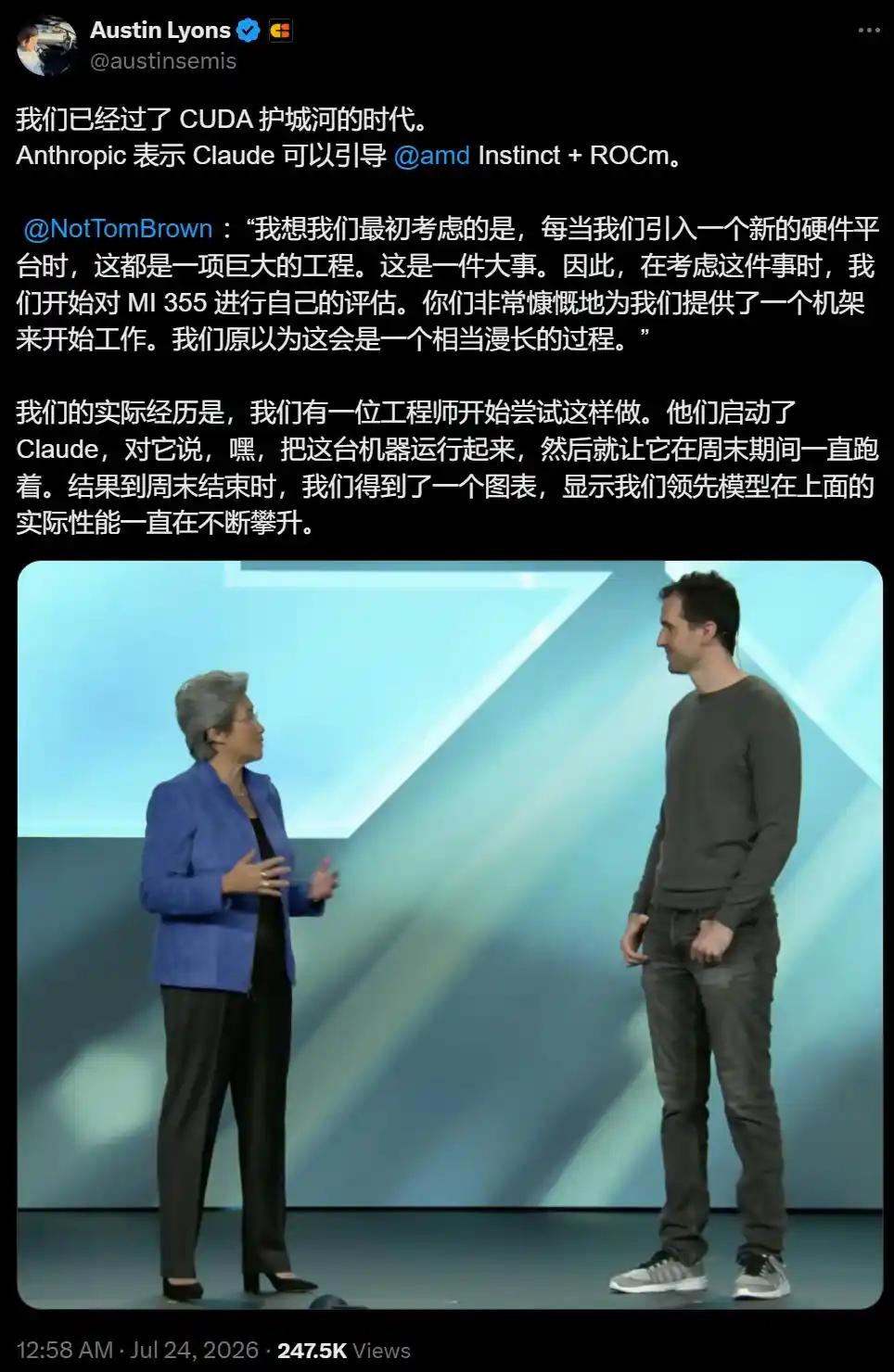
Some time ago, AMD sent Anthropic a rack equipped with MI355X.

After looking at it, the team mentally prepared for a tough battle. New platform with new software stack was bound to require a new round of adaptation.

However, Anthropic happened to have Claude.

The team decided to first let an engineer try: connect Claude to the machine and give it the command, "Go, get this machine running."

When they returned to their desks after the weekend, a steadily rising performance curve was already on the screen—not only did it run, but the performance kept improving round after round.

After Tom Brown, Anthropic's co-founder and chief computing officer, finished speaking, Lisa Su immediately took over:

Hearing that only one engineer at Anthropic was handling the MI355X, her first reaction was to have AMD's team rush over to help.

But the team came back and told her the other side said it wasn't needed—it was all done.
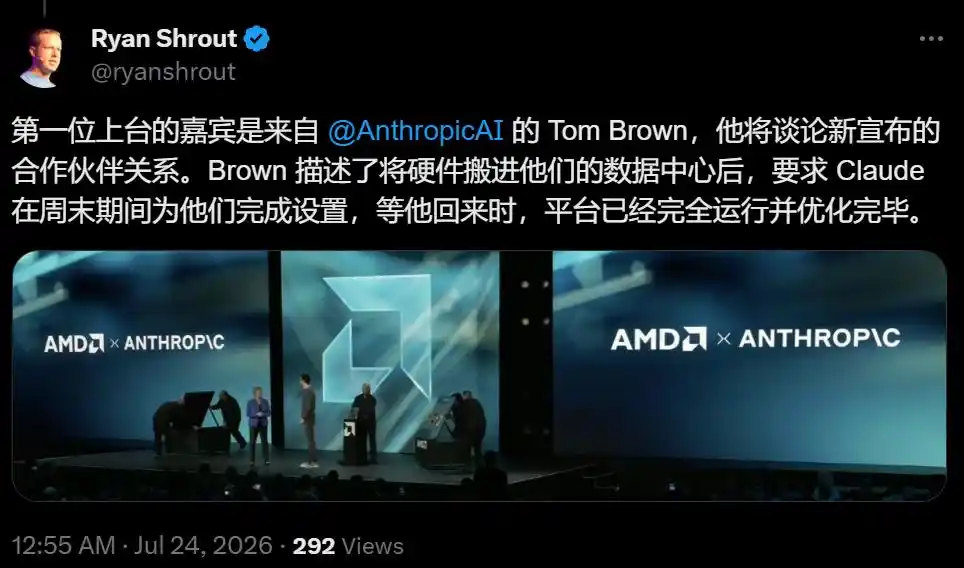
Soon, this weekend experiment connected to a real deployment plan.

Recently, Anthropic announced it will deploy up to 2GW of Instinct GPUs in AMD's Helios system, with the first 1GW planned for the first half of 2027.

Moreover, the two sides will directly use Claude to optimize AMD workloads and accelerate ROCm software development.

Chip Manuals Welcome a Non-Human Reader

The reason Claude can achieve a "dimensionality reduction strike" against the CUDA ecosystem is that AMD has directly developed a set of tools for AI to get hands-on with GPU tuning.

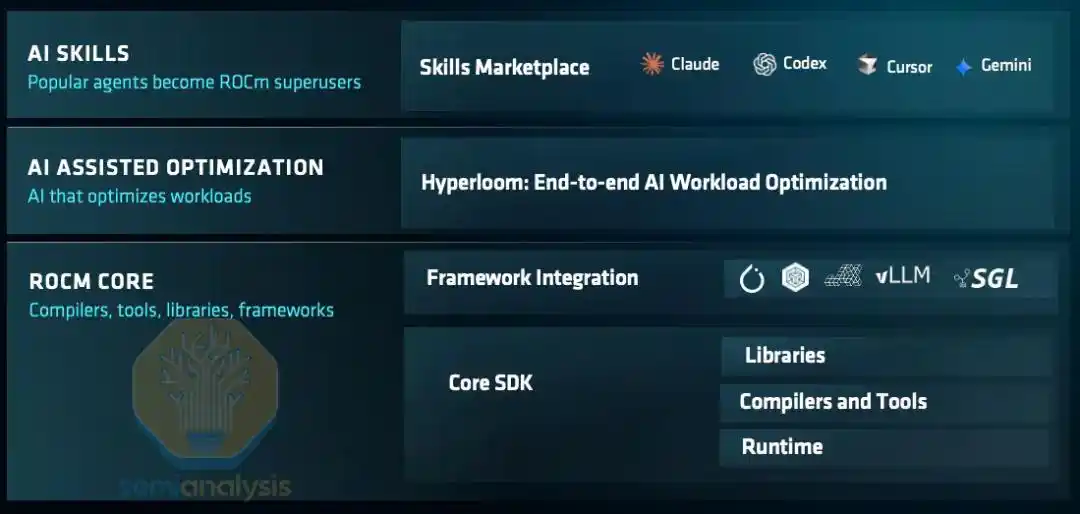
ROCm.AI, released at the AMD Advancing AI 2026 conference, is a complete GPU toolkit prepared for Claude, Codex, and Cursor.

The entry point is called AMD Skills, which is filled with verified ROCm knowledge.

After agents acquire this knowledge, they can set up environments, deploy models, read logs, troubleshoot, and then call real machines via the ROCm CLI. Developers state the goal, and the agents find the path themselves.
Key point: AMD has even changed how chip manuals are written.

Anush Elangovan, AMD's Vice President of AI Software and Solutions, revealed on stage that each generation of AMD GPU will have its instruction set published, with AI-readable ISA provided.

After reading the manual, agents can directly start tuning performance.

AMD delegates this work to Hyperloom. It launches inference services, first establishes a baseline, then finds bottlenecks in CPU and GPU, tests different configurations, generates custom kernels, and finally runs the new solution again.

In the live demo, Hyperloom increased the output speed of the MiniMax M3 by 38%. AMD also had it run over 14,000 models at once, turning the test results into reusable experience for the next iteration.
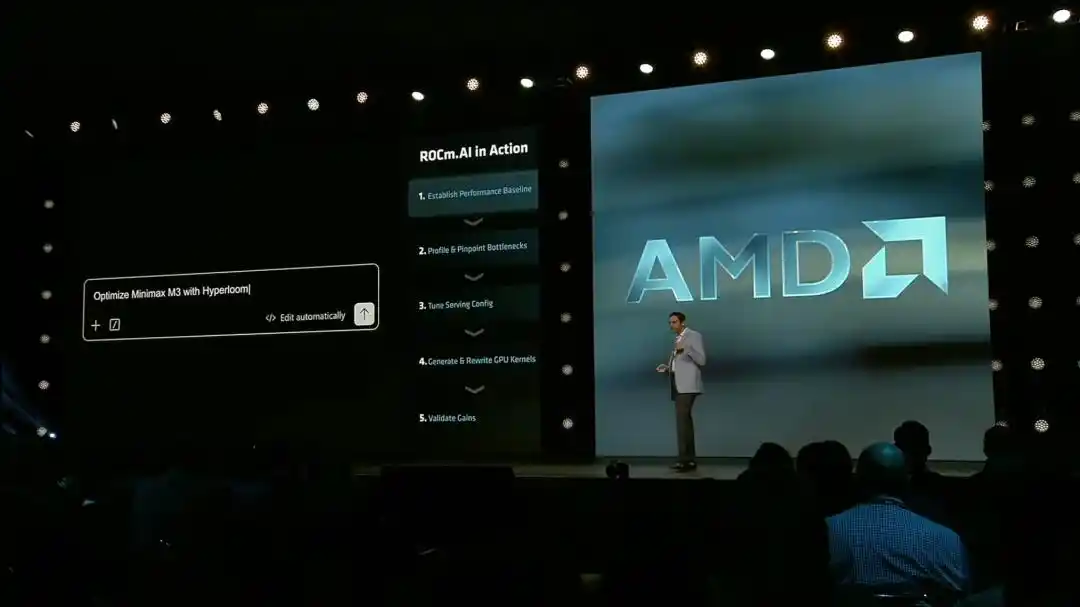
AMD is also training this capability with cutting-edge model companies. Elangovan's phrasing is quite interesting: make frontier models "natively speak AMD programming."

In the future, when looking at a chip, peak computing power and memory bandwidth will remain important, but whether AI can read it, call it, and tune its performance will also appear on the same spec sheet.

The developers that chip companies need to win over now include a new category: Agents.

Dimensionality Reduction Strike from ASI

CUDA has come a long way since 2006, relying on an ecosystem built line by line by countless engineers.

Compilers, math libraries, debuggers, performance analysis tools, development documentation—it has it all.

What's even harder to replicate is the intuitive knowledge accumulated by generations of engineers.

How to tune operators, how to speed up communication, how to allocate memory, where distributed deployments are most prone to issues—this experience is locked in the minds of a few experts.

Even if newcomers build chips with similar performance, they must walk the entire long software road from the beginning. Chip tape-outs can progress by the quarter, but ecosystem accumulation must be measured in years.

This is precisely the gap that Agents are filling.

They read platform documentation, call performance analysis tools, find where the speed is stuck, then modify code, compile, and test. If one solution doesn't work, they try the next; if benchmarks improve, they keep optimizing in that direction.

It takes years to train a top-tier GPU engineer for humans; launching another Agent just requires starting a new task.

One engineer unleashing a swarm of Agents can parallelize error investigation and performance bottleneck localization. Configurations that work, kernels written, and pitfalls encountered immediately become the starting point for the next batch of Agents.

Compressing year-long chases into task-level calculations is where AI's true value lies. This is also the dimensionality reduction strike that ASI-like capabilities deliver against the CUDA ecosystem.

Today, Chinese engineers are already on the front lines of this AI-driven transformation of GPU software stacks. The foundational experience they are accumulating is also being organized into more capabilities that Agents can call upon.

A new starting point for catching up with CUDA has emerged: hand hardware interfaces and software tools over to AI and let the Agents get to work.

A 20-year ecosystem gap can, for the first time, be handed over to a group of Agents to tirelessly chase back, day and night.

This article is from the WeChat public account "New Zhiyuan", author: ASI Revelation

Trending Cryptos

Related Questions

QAccording to the article, what major achievement did Claude accomplish over a weekend with an AMD MI355X rack?

AClaude successfully ran Anthropic's state-of-the-art model on a brand new AMD MI355X rack without any human engineer modifying a single line of code.

QWhat is ROCm.AI, as announced by AMD at its Advancing AI 2026 event, and what is its purpose?

AROCm.AI is a complete GPU toolset for AI agents like Claude, Codex, and Cursor. Its purpose is to equip these agents with verified ROCm knowledge via 'AMD Skills,' allowing them to set up environments, deploy models, read logs, troubleshoot, and call real machines through the ROCm CLI to achieve developer goals autonomously.

QHow did AMD change its approach to chip documentation to facilitate AI agent development, according to the article?

AAMD now publishes the instruction set for each generation of its GPUs and provides AI-readable Instruction Set Architecture (ISA) documentation. This allows AI agents to read the manual and directly begin performance tuning.

QWhat role does Hyperloom play in AMD's new development process?

AHyperloom is an AI tool that launches inference services to establish a performance baseline, identifies CPU and GPU bottlenecks, tests different configurations, generates custom kernels, and then re-runs the new solution. It automates performance optimization, as shown by improving MiniMax M3's output speed by 38%.

QHow does the article describe the impact of AI agents on the traditional CUDA software ecosystem advantage?

AThe article describes it as a 'dimensionality reduction strike' or 'overwhelming advantage' from ASI (AI superintelligence). While CUDA's 20-year advantage was built on human engineer experience and slow ecosystem accumulation, AI agents can read documentation, use tools, find bottlenecks, and iterate on code changes at a massively parallel scale. This compresses years of catching up into a task-based timeline, allowing agents to work around the clock to close the ecosystem gap.

Related Reads

Stock Trading Has Become 'Crypto Trading', Welcome Back to the Native Home

"Stock Trading Becomes 'Coin Trading': A Market's Bizarre Reversal" The global stock market, particularly in tech sectors, is undergoing a radical transformation, increasingly mirroring the volatile, narrative-driven mechanics of the cryptocurrency world. This shift was starkly illustrated by the dramatic crash of South Korea's KOSPI index in July 2026, where leveraged ETFs tied to stocks like SK Hynix triggered massive, rapid liquidations, devastating hundreds of thousands of retail investors, many of them young. This "crypto-fication" of equities began as disillusioned cryptocurrency traders migrated to stock markets, bringing with them their speculative playbook: chasing high-beta narratives like AI and semiconductor cycles, relying on social media for investment cues, and employing heavy leverage. Ironically, while these traders sought the perceived safety of stocks with fundamentals, their methods turned parts of the equity market—especially in Korea, the US, and Japan—into arenas of extreme speculation. Stocks like SK Hynix experienced price collapses ("halving") in just over a month, a pace even faster than Bitcoin's historical crashes. The core of this change is the primacy of narrative over traditional valuation. Complex company analysis is reduced to viral slogans about AI's infinite demand, driving concentrated inflows into thematic sectors. This is amplified by leverage, particularly through risky single-stock leveraged ETFs, which create vicious cycles of forced selling during downturns. Meanwhile, social media algorithms promote stories of overnight riches, drawing in inexperienced investors. In a paradoxical twist, Bitcoin, through institutional adoption and ETFs, is becoming relatively more stable, with its volatility now sometimes lower than major tech stocks. The market has reached an absurd crossover: stocks are acting like speculative crypto assets, while crypto strives for the legitimacy of traditional finance. The article concludes that this represents a "degeneration" of market rationality, where trading a story's heat has supplanted investing in future profits, leaving a trail of financial wreckage in its wake.

marsbit11m ago

Stock Trading Has Become 'Crypto Trading', Welcome Back to the Native Home

marsbit11m ago

Santander Bank Announces It Holds a $4.3 Million Position in U.S. Spot Bitcoin ETFs

Spanish banking giant Banco Santander disclosed in regulatory filings that it holds approximately $4.3 million in US spot Bitcoin ETFs. While this amount is small relative to the bank's over $1 trillion in assets under management, it signifies a growing trend of traditional financial institutions increasing Bitcoin exposure through regulated channels. Santander, scoring around 35% on a 2026 Bitcoin Adoption Index for banks, is categorized at a "medium level" of integration, similar to Société Générale but behind more crypto-focused firms. The bank's interest in cryptocurrencies is not new; CEO Ana Botín has discussed Bitcoin-related products since 2021. Santander has been developing crypto custody and digital asset services across Europe for years, with its digital arm, Openbank, beginning to offer crypto trading in Germany in September 2025, with plans to expand to Spain. This investment comes as institutional crypto adoption accelerates in Europe. Santander is actively involved in crypto custody initiatives across the continent and appears to be positioning itself to strengthen its role in the sector, especially as regulations like MiCA become clearer. The industry is watching whether the bank's medium integration level reflects caution or structural limitations, as banks with higher adoption may gain an edge in attracting crypto-interested wealthy clients.

cryptonews.ru16m ago

Santander Bank Announces It Holds a $4.3 Million Position in U.S. Spot Bitcoin ETFs

cryptonews.ru16m ago

Trading

Spot

Hot Articles

Discussions

Welcome to the HTX Community. Here, you can stay informed about the latest platform developments and gain access to professional market insights. Users' opinions on the price of S (S) are presented below.

活动图片