NVIDIA Chose Unitree but Replaced Its Hands

marsbitPublished on 2026-06-10Last updated on 2026-06-10

Abstract

Nvidia selected Unitree, a leading humanoid robotics company, for its Isaac GR00T reference platform but replaced Unitree's own dexterous hand with one from Sharpa, a two-year-old Singapore-based startup with origins in Hesai's robotics team. While Unitree provides the robot body, celebrated for its advanced motion control, the focus shifted to Sharpa's Wave hand. This hand, featuring 22 active degrees of freedom and a high-precision Dynamic Tactile Array (DTA) sensor system for real-time force and texture feedback, demonstrated superior capabilities in complex manipulation tasks like handling playing cards, peeling eggs, and assembling computers. Nvidia's choice highlights a key industry pivot from locomotion to sophisticated, tactile-enabled manipulation. The integration places Sharpa's hardware within Nvidia's Isaac Lab framework, central to simulation and AI training pipelines for embodied intelligence. However, the dexterous hand sector remains highly competitive, with rivals like Lingxin Qiaoshou, Critical Point, and Parxeni Perception rapidly advancing in funding, technology, and product development.

Unitree was selected by NVIDIA, but NVIDIA did not choose Unitree's hands.

While Unitree Technology passed its IPO review on the STAR Market, its H2 Plus robot was also chosen by NVIDIA as the body for NVIDIA's Isaac GR00T reference humanoid robot.
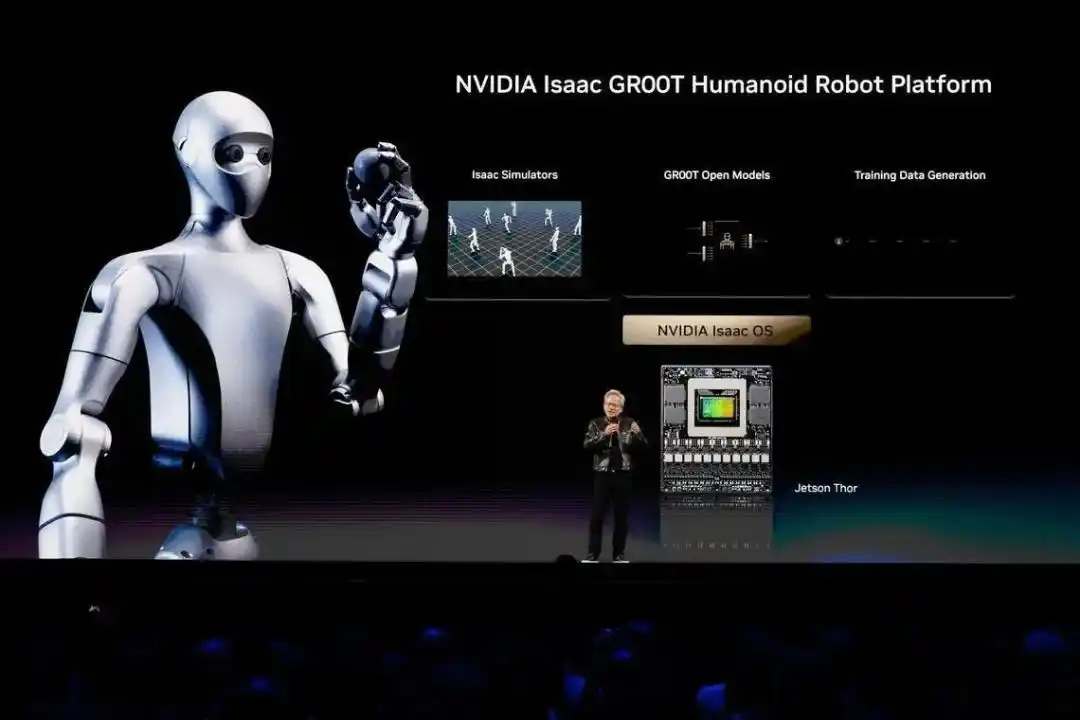
This powerful partnership has ignited excitement in both the Embodied AI and broader AI circles. After all, NVIDIA's leading position in the industry speaks for itself, and Unitree has secured its place in the global top tier of humanoid robots with its outstanding robot locomotion capabilities.

What's truly surprising is that this reference robot does not use Unitree's own dexterous hands; they have been replaced with hands from Sharpa Wave.

Sharpa is a dexterous hand company founded only two years ago, headquartered in Singapore. Its core team originates from the dexterous hand team established by Hesai Technology in 2024. It doesn't have the same high profile as Unitree, nor does it appear frequently in funding news like Lingxin Qiaoshou or Lingjiedian.

Sharpa's dexterous hands also appeared on this year's CCTV Spring Festival Gala in the sketch "My Most Unforgettable Night" featuring Shen Teng and Ma Li. However, within the niche dexterous hand sector, it remains a very low-key player.
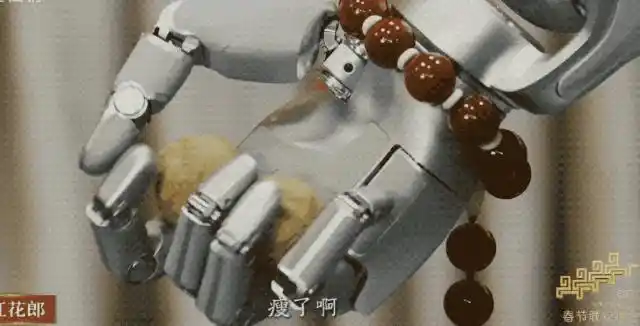
Now, however, it stands alongside Unitree at NVIDIA's embodied AI table.

One is responsible for the body, the other for the hands.

The question is, what makes a two-year-old dexterous hand company worthy of NVIDIA's attention?

Unitree's Hands Lost This Time

In reality, Unitree does have its own dexterous hands.

Judging from its public product lineup, Unitree has already launched the Dex series of dexterous hands, ranging from three-finger to five-finger configurations, and their performance is not bad.

But what NVIDIA wanted this time might not just be "hands that can be mounted on a humanoid robot."

From a technical perspective, Sharpa's dexterous hands indeed have their advantages.

In 2024, Hesai Technology formed a dexterous hand team, which became the predecessor of Sharpa. Transitioning from Hesai's LiDAR for autonomous driving to dexterous hands seems like quite a "crossover" move for Sharpa.

To many, autonomous driving and robotics are two completely different industries.

But for a company like Hesai, there is some common technical accumulation between the two fields.

Autonomous driving requires machines to perceive, understand, and make decisions in real-time within complex environments, demanding high sensor accuracy, system reliability, and engineering capabilities. Robots face similar problems when entering the real world to perform tasks.

The difference lies in that autonomous driving solves "how the vehicle sees the world," while dexterous hands solve "how the robot touches the world."

It is precisely because of this that Sharpa migrated its past capabilities to another track. Soon after its founding, Sharpa launched its flagship product, the Sharpa Wave dexterous hand.
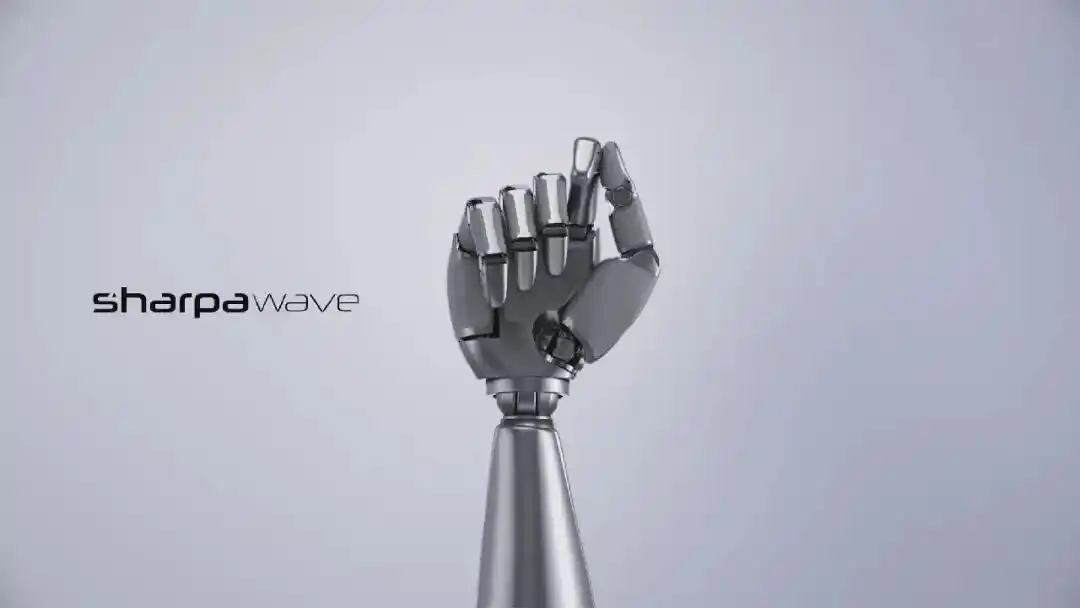
In the field of dexterous hands, a long-standing contradiction exists: performance and mass production are often difficult to achieve simultaneously.

Some products use underactuated designs, controlling multiple joints with fewer motors, which lowers costs but limits flexibility and control precision. Others pursue capabilities close to the human hand, resulting in complex structures, high prices, and difficulty in large-scale deployment.

Sharpa chose a middle path.

The Sharpa Wave features 22 active degrees of freedom, with overall dimensions close to a 1:1 ratio with the human hand. To achieve higher control precision, it employs a direct-drive transmission architecture, enhancing joint responsiveness and motion control capability.

However, more crucial than the number of degrees of freedom is Sharpa's investment in its tactile sensing system.

In the humanoid robot industry, an increasingly clear trend is that vision alone is insufficient to meet complex manipulation needs.

Sharpa developed a tactile system called the Dynamic Tactile Array (DTA). It integrates micro-cameras and over 1,000 tactile sensing units inside each fingertip, allowing the robot to perceive pressure changes, recognize textures, slipping, and contact states, thereby gaining a form of "tactile feedback" similar to human fingertips.

According to data disclosed by Sharpa, its tactile sensing precision can reach the 0.005N level, with a refresh rate of 180Hz; the control frequency for the entire hand reaches 500Hz, and the output force of a single fingertip exceeds 20N.

These specifications all point toward the same goal: to truly enable robots to handle objects in the real world.

This is not entirely the same direction as Unitree's own dexterous hands.

Unitree's Dex series is more closely aligned with its own integrated robot system. Whether it's the three-finger or five-finger configuration, the focus is on enabling the robot to perform grasping and manipulation within its own body, locomotion control, and development ecosystem.

In other words, it's not that Unitree's hands are inferior; it's just that for NVIDIA's reference robot, Sharpa's hands better meet the requirements.

Therefore, the value of Sharpa Wave lies in turning "touching the world" into a data entry point that robots can perceive, provide feedback on, and train with.

But specifications are just specifications. To prove that a dexterous hand truly has the ability to "touch the world," it must be demonstrated through specific tasks.

And the reason Sharpa has gained market attention is precisely because it has translated these specifications into a series of operational demonstrations that have caught the eye of its peers.

Sexy Dexterous Hand, Dealing Cards Online

At the IROS 2025 (International Conference on Intelligent Robots and Systems) product exhibition, a demonstration by Sharpa left a deep impression on the industry: a Sharpa dexterous hand drew a single playing card from a deck held in another hand and placed it on a table.
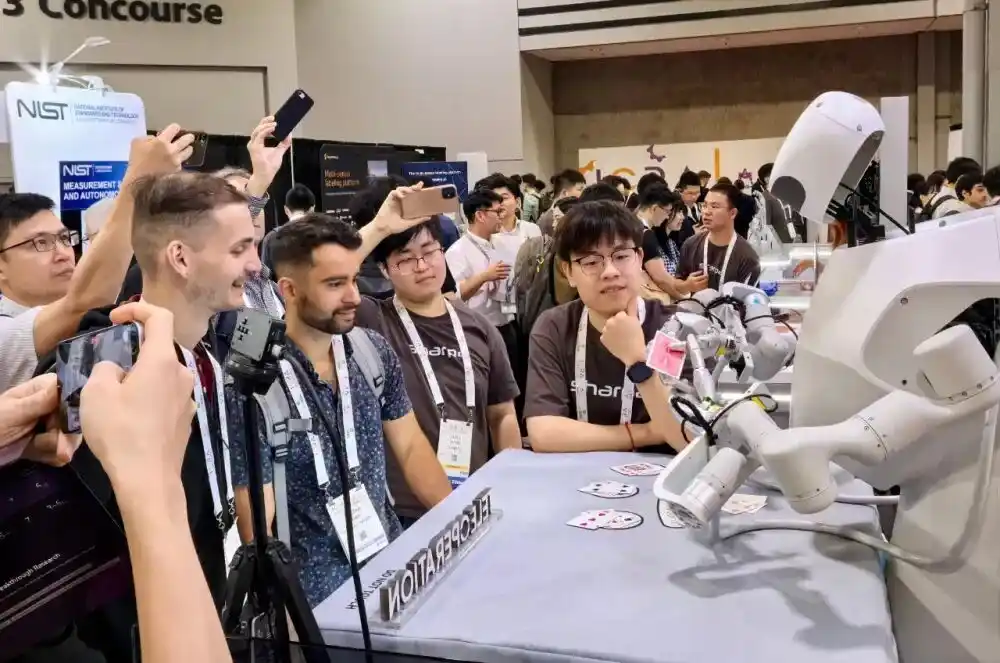
The reason it was so impressive lies in the fact that the action of dealing a playing card places extremely high demands on the force control precision of the dexterous hand and its predictive capability regarding the sliding and extraction of the card.

Furthermore, Sharpa has released a series of demonstration videos: autonomously peeling an eggshell, peeling an apple, dealing playing cards, folding paper pinwheels, and even assembling a computer case—including precisely inserting a graphics card and tightening the securing screws.

These tasks might seem like fun demos, but for the robotics industry, they represent entirely different levels of technical difficulty. Because grasping an object is not difficult; what's truly challenging is controlling the contact process.

A robot can easily pick up an egg but might not know when to increase or decrease force; it can recognize a playing card but may struggle to prevent the paper from slipping or deforming.

Many of the capabilities demonstrated by Sharpa essentially point to the same question: Can a robot adjust its actions in real-time through tactile feedback, just like a human?

This is where the DTA tactile system comes into play.

When the robot makes contact with an object, its fingertips can perceive pressure changes, friction states, and object slipping trends in real-time and feed this back to the control system for dynamic adjustment. Objects like eggs, paper, and fruit—soft or fragile—precisely highlight the value of this system.

At the same time, Sharpa is not content with being just a supplier of dexterous hands. In 2026, the company officially released its first full-body humanoid robot: Sharpa North.

At CES 2026, North demonstrated tasks such as playing table tennis, taking photos with a selfie stick, and dealing playing cards. However, the most representative demonstration was the autonomous assembly of a paper pinwheel, a task involving over 30 steps.

The entire process, from identifying parts and grasping materials to folding, assembling, and final completion, lasted several minutes and involved a large amount of bimanual coordination and sequential action planning. This indicates that the Sharpa robot possesses the potential to complete long-sequence, multi-step tasks.

From dexterous hands to humanoid robots, from a hardware supplier to a full-stack system developer, Sharpa's path is becoming increasingly clear:

It is not satisfied with being just a component of a robot. What it truly aims to do is become part of the next-generation embodied intelligence platform.

And "platform" is also a key word for NVIDIA's reference robot this time.

If the previous demonstrations proved that Sharpa's hands can perform complex manipulations, then the next, more crucial question is: What can such hands bring to NVIDIA?

Peers Are Racing to Flip the Table

For Sharpa, being chosen by NVIDIA is undoubtedly a landmark moment.

But the more critical point is that within this reference robot system, Sharpa occupies a rather pivotal position.

Because NVIDIA's goal with the "reference robot" is to build a reusable development foundation for the embodied intelligence industry, enabling developers, research institutions, and robotics companies to conduct training, verification, and development based on this framework.

In this framework, Unitree provides the body. With its locomotion control capabilities, Unitree solves the problem of how a robot stands up, walks, and moves.

What Sharpa adds is how the robot actually reaches out and does work once it stands in front of an object.

But for NVIDIA, this is not the whole story.

More importantly, Sharpa's product has been integrated into Isaac Lab. This is the most core open-source simulation training framework within NVIDIA's robotics ecosystem.

In the teleoperation phase, a human operator can control the 22-DOF dexterous hand using a data glove, mapping hand movements in real-time to robot joint movements. These recorded movements then become data for imitation learning and policy training, turning into samples that can be trained, reused, and expanded upon later.

Precisely because of this, Sharpa has secured more than just an ordinary hardware seat. It has inserted itself into NVIDIA's entire workflow, from teleoperation data collection, simulation training, policy evaluation, to real-world deployment. This is the core value of its collaboration with NVIDIA.

Of course, being favored by NVIDIA doesn't mean Sharpa has already secured victory, as the dexterous hand sector is evolving rapidly.

Over the past year or so, capital has been chasing this "hand" forward: companies like Lingxin Qiaoshou, Lingjiedian, InSight Robotics, AII Technology, Paxon Perception, etc., are all accelerating iteration around high degrees of freedom, tactile feedback, force control precision, and mass production capabilities.

Some are competing on funding speed and product deployment.

For example, Lingxin Qiaoshou has completed multiple rounds of funding since 2025, with its valuation reportedly reaching $3 billion after its B+ round in 2026, and its target valuation for the next round rumored to be as high as $6 billion. InSight Robotics also completed C1 and C2 funding rounds totaling hundreds of millions of RMB in 2026, continuing to focus on R&D for dexterous manipulation technology, innovation in core components, and product delivery capabilities.

Others are competing on tactile sensing.

Paxon Perception's product line already covers multi-dimensional tactile sensors, the DexH series of tactile dexterous hands, the humanoid robot TORA, and completed a B+ round of over 1 billion RMB in funding in March 2026.

AII Technology's new-generation dexterous hand also prominently features high-density array tactile sensors, pressure sensing capability from 0.1N to 25N, and other selling points.

This means that today's specifications—22 DOF, DTA tactile system, and NVIDIA reference design—could be surpassed tomorrow by new hands with lower costs, higher stability, or stronger data-closing capabilities.

But at least for this moment, NVIDIA has made its judgment clear:

As the industry shifts from "who can make the robot walk" to "who can make the robot work," a pair of sufficiently smart hands has become as important as its legs.

This article is from the WeChat public account "Blue Character Plan," author: Chester

Related Questions

QWhy did NVIDIA choose Unitree's H2 Plus robot as the reference humanoid body for its NVIDIA Isaac GR00T platform, but then replace its hands?

ANVIDIA selected Unitree's H2 Plus for its excellent locomotion and full-body control capabilities, which placed it in the global first tier of humanoid robots. However, NVIDIA replaced Unitree's own Dex-series dexterous hands with Sharpa Wave hands because Sharpa's hands, with their 22 active degrees of freedom, high-precision direct-drive architecture, and advanced Dynamic Tactile Array (DTA) system, were deemed better suited for the complex manipulation tasks and data-collection needs of the reference platform.

QWhat are the key technological features of Sharpa's Wave dexterous hand that distinguished it for NVIDIA's selection?

ASharpa Wave's key features include: 22 active degrees of freedom in a human 1:1 scale, a direct-drive transmission architecture for high-speed response and control precision, and its proprietary Dynamic Tactile Array (DTA) system. The DTA integrates micro-cameras and over 1,000 tactile sensing units in each fingertip, providing high-frequency (180Hz) and high-precision (0.005N) force/tactile feedback. This allows the hand to perceive texture, slippage, and contact states, enabling complex, real-world manipulation tasks.

QHow does Sharpa's background at Hesai Technology relate to its development of advanced robotic hands?

ASharpa's core team originated from the dexterous hand team formed by Hesai Technology (a leading LiDAR company for autonomous vehicles) in 2024. While autonomous driving and robotics seem different, they share common technical challenges: high demands for sensor precision, system reliability, and engineering capabilities in complex, real-world environments. Sharpa leveraged Hesai's expertise in these areas, transferring capabilities from solving 'how vehicles see the world' to solving 'how robots touch and interact with the world.'

QWhat is the strategic significance of Sharpa Wave being integrated into NVIDIA's Isaac Lab framework?

AIntegration into NVIDIA's Isaac Lab—the core open-source simulation training framework for robotics—positions Sharpa not just as a hardware supplier but as a key part of NVIDIA's embodied AI development stack. In this framework, human operators can use data gloves to control the 22-DoF hand for teleoperation, generating real-time manipulation data. This data then becomes foundational for imitation learning and policy training within Isaac Lab, creating a closed-loop from data collection and simulation to real-world deployment. This gives Sharpa a crucial role in NVIDIA's platform ecosystem.

QWhat does NVIDIA's choice of Sharpa over Unitree's own hand signify about the current priorities in the humanoid robotics industry?

ANVIDIA's choice signals a shift in industry focus from 'who can make the robot walk and move' to 'who can make the robot perform useful work.' While stable locomotion (Unitree's strength) remains foundational, advanced manipulation capabilities are now considered equally critical for practical application. The selection highlights the growing importance of high-fidelity tactile sensing, precise force control, and the ability to handle complex, long-horizon manipulation tasks as key differentiators for next-generation embodied intelligence platforms.

Related Reads

Partner at Pantera Capital: How Tokenization Can Restructure the Private Equity and Early-Stage Investment Ecosystem?

"Tokenized Startups: Rebalancing Access to High-Growth Companies" by Jay Yu, compiled by Jiahuan, ChainCatcher The article explores how tokenization could democratize access to high-growth private companies, addressing a market gap created as firms like Stripe and SpaceX stay private for over a decade, depriving public investors of early growth returns. It identifies three converging trends enabling this shift: the explosive growth of Special Purpose Vehicles (SPVs) as makeshift liquidity tools, the rise of tokenized real-world assets (RWA), and the breakdown of the "token vs. equity" consensus where project tokens often fail to capture value. The landscape of tokenized startup platforms is analyzed across two dimensions: investment mechanisms (from equity-holding SPVs like PreStocks to perpetual futures like TradeXYZ) and company stage (early-stage to pre-IPO giants). A key finding is a strong power-law concentration, with most platform volume driven by a few high-profile pre-IPO names like SpaceX and Anthropic. Platforms providing direct equity exposure (e.g., Robinhood Ventures) currently see higher volumes than pure synthetic/perpetual platforms. The discussion highlights major challenges and opportunities: 1. **Founder/Team Alignment:** Gaining company consent for tokenization is critical, as seen when Anthropic and OpenAI objected. Proposed solutions include tokenized startup baskets, accelerator models (e.g., Street, MetaDAO helping startups grow), and community token distributions to align incentives. 2. **Non-U.S. Jurisdictions:** Tokenization offers significant potential in regions with less efficient capital markets (e.g., South Korea), providing global liquidity and better valuations for local champions. 3. **Price Discovery for Perpetuals:** Synthetic/perpetual platforms avoid consent issues but face price discovery challenges for illiquid private assets. TradeXYZ's success with Cerebras Systems' pre-IPO perpetual, which accurately predicted the IPO price, showcases potential but scalability remains unproven. 4. **Legal & Regulatory Structure:** Regulatory treatment varies. Issuer-sponsored tokens are treated as traditional securities. Third-party tokens face complex classifications—custodial tokens represent claims on held shares, while synthetic tokens (perpetuals, linked notes) are separate securities subject to strict rules, often restricting U.S. retail access. In conclusion, tokenized startup mechanisms represent an attempt to restore the public market's historical function of providing early, liquid exposure to high-growth companies. For crypto tokens, successfully capturing real economic upside in startups could resolve their current identity crisis and fulfill their original promise.

marsbit25m ago

Partner at Pantera Capital: How Tokenization Can Restructure the Private Equity and Early-Stage Investment Ecosystem?

marsbit25m ago

Partner at Pantera Capital: How Tokenization Could Reshape the Private Equity and Early-Stage Investment Ecosystem?

The article discusses how tokenization could reshape private equity and early-stage investment. Historically, public markets allowed early access to high-growth companies, but today's leading tech firms (e.g., Stripe, SpaceX) remain private for over a decade, with private capital capturing their growth phase. Temporary fixes like SPVs and secondary markets have emerged but are not fundamental solutions. Tokenized venture assets present a potential solution, converging three trends: the explosive growth of SPVs, the rapid expansion of tokenized real-world assets (RWA), and the breakdown of the "token vs. equity" consensus, where project tokens have become subordinate to equity in value capture. This creates an opportunity for tokenized startups to offer public, liquid exposure to venture-scale returns. The landscape includes various models: equity-backed tokens via SPVs or funds (e.g., PreStocks, Robinhood Ventures) and synthetic perpetual futures offering only price exposure (e.g., TradeXYZ, Ventuals). Trading volume is heavily concentrated in late-stage, pre-IPO companies like SpaceX and Anthropic and shows a power-law distribution across platforms. Key challenges and opportunities include aligning with founder/team interests, which can be addressed through models like tokenized startup baskets, accelerator models, or community token distributions. Expanding into non-U.S. jurisdictions with less efficient capital markets offers another path. For perpetual futures models, the central challenge is accurate price discovery for private assets without reliable oracles; TradeXYZ's success with Cerebras Systems pre-IPO pricing demonstrates potential. Regulatory and legal structures for these tokenized instruments remain nascent and untested. In conclusion, tokenization represents an effort to restore the early, liquid access to high-growth companies that public markets once provided. It could also resolve the identity crisis of project tokens by granting them genuine claims on venture-scale upside, potentially fulfilling crypto's original promise with more mature infrastructure.

链捕手44m ago

Partner at Pantera Capital: How Tokenization Could Reshape the Private Equity and Early-Stage Investment Ecosystem?

链捕手44m ago

SpaceX's Core Window for Listed Trading: July 7th Nasdaq Inclusion Date and Post-Q2 Earnings Lockup Expiration

SpaceX is set for its historic IPO on June 12 at $135 per share, with a paper valuation of $1.75 trillion. A key insight from analyst Alexandra Mertz highlights the IPO's unique structure, where an extremely low initial public float of only 4.3% is expected to create a significant supply vacuum. This scarcity is set to collide with massive forced buying from index funds like Vanguard, CRSP, and FTSE Russell, which are scheduled to start adding SpaceX to their indices as early as June 18/22 and July 7 (NASDAQ 100 inclusion). This could propel the stock price sharply higher, with AI models like Grok predicting a potential doubling from the IPO price around July 7. Another critical date is the post-Q2 earnings call (estimated late July), when early insider shareholders (excluding Elon Musk, who has a 366-day lock-up) become eligible to sell. However, actual selling pressure may be only 10-15% of shares, as major holders like Ron Baron and BlackRock have expressed intentions to hold or buy more. The discussion introduces a compelling "Goldilocks scenario": a potential stock-for-stock merger announcement between SpaceX and Tesla in the window between the July 7 price peak and the late-July unlock period. This timing could help Elon Musk manage a personal $7 billion tax liability related to exercising Tesla stock options by August 15, while leveraging high valuations for both companies. Furthermore, the inclusion of former Tesla adversaries like Charles Schwab, Morgan Stanley, and J.P. Morgan as SpaceX IPO underwriters is seen as a strategic move to secure their "yes" votes for a potential Tesla merger approval in a November shareholder vote. The rationale for SpaceX acquiring Tesla, rather than the reverse, centers on SpaceX's superior governance structure, which offers Musk stronger control through super-voting shares and mandatory arbitration clauses, protecting the combined entity from activist investors and legal challenges.

marsbit1h ago

SpaceX's Core Window for Listed Trading: July 7th Nasdaq Inclusion Date and Post-Q2 Earnings Lockup Expiration

marsbit1h ago

Trading

Spot
Futures

Hot Articles

Discussions

Welcome to the HTX Community. Here, you can stay informed about the latest platform developments and gain access to professional market insights. Users' opinions on the price of S (S) are presented below.

活动图片