New Crypto Market Structure Bill Draft Could Be Ready By Week’s End, Senator Scott Says

bitcoinistPublished on 2026-03-19Last updated on 2026-03-19

Abstract

Senator Tim Scott announced that a new draft of the crypto market structure bill (CLARITY Act) could be ready by the end of this week. Speaking at the DC Blockchain Summit 2026, Scott highlighted progress made over the past month, crediting White House involvement for breaking a two-month deadlock. Key issues include controversial policies around DeFi restrictions and stablecoin yield payments, which have caused tension between the banking and crypto industries. The bill previously stalled due to opposition to prohibiting interest payments to passive token holders. Scott expressed optimism, stating that bipartisan efforts are addressing remaining challenges, including DeFi, ethics, and AML regulations. He emphasized the importance of clear legislation and artificial deadlines to maintain momentum.

Senator Tim Scott discussed the impact of digital asset legislation and the progress on the highly anticipated crypto market structure bill on Tuesday, revealing that a fresh draft could be ready by the end of the week.

Crypto Market Structure Bill Sees Progress

Speaking at the DC Blockchain Summit 2026, Senate Banking Committee Chairman Tim Scott highlighted the “powerful impact for good” that the landmark stablecoin legislation, the GENIUS Act, has already had in the market.

Scott emphasized the importance of clear legislation, noting that politicians and bureaucrats often act arbitrarily without any rules of the road. “The market structure gives us the rules of the road for what I believe is going to be the most powerful force for good for kids like me growing up in poverty in a single-parent household,” he stated.

When asked about the status of the crypto market structure bill, known as the CLARITY Act, he humorously said, “Let us pray,” before revealing that significant progress has been made over the past month, largely due to the White House’s involvement.

For context, the crypto market structure bill has been stalled for two months since the Senate Banking Committee published its draft in mid-January. The text included several controversial policies, including significant restrictions for DeFi and the payment of interest on stablecoins.

The latter has become a major point of contention between the banking and crypto industries. As reported by Bitcoinist, the banking side has criticized the GENIUS Act for loopholes that could put the financial system at risk, arguing that allowing interest payments on stablecoins could distort market dynamics.

To address this issue, banks urged lawmakers to include language in the CLARITY Act to ban yield on stablecoins from crypto exchanges, brokers, and related entities, rather than only issuers.

The Senate Banking Committee’s draft proposed that issuers offer rewards for specific actions, such as account openings and cashback. However, it also prohibited interest payments to passive token holders, which ultimately delayed the bill’s January markup session due to backlash.

After weeks of negotiation, the US President’s Council of Advisors on Digital Assets stepped in, holding multiple meetings to negotiate key issues that have stalled the crypto market structure bill.

“I tell you, we have made a lot of progress over the last 30 days. Thank God for the White House getting involved. Patrick Witt has been incredibly helpful,” he told the DC Blockchain Summit.

Following the recent negotiations, Scott explained, lawmakers now have a bipartisan coalition working on “the more important issues that remain undone,” but added that they are making progress “on all the other parts that we don’t hear about,” including issues related to DeFi, ethics, and Anti-Money Laundering (AML).

CLARITY Could Come Soon

Speaking about the proposed deadlines that have not been met throughout the past two months, Scott shared that he had “some artificial deadlines (...) put in place to kind of force the conversation because it had been languishing for too long.”

“We missed lots of my artificial deadlines, but I put them in place so that we would actually have the conversation and create a sense of urgency because I do believe that at some point, politics takes over everything,” he affirmed.

The senator called the stablecoin yield compromise the “largest publicly celebrated challenge” lawmakers and crypto legislation have faced, but affirmed that “big Mo’ momentum is finally on our side, and we are heading in the right direction,” with a new, amended draft for the crypto bill potentially being completed this week.

“I believe that this week we will have the first proposal in my hands to take a look at. And if that actually happens before the end of this week, and I think that it will, we’ll at least know that the sketch looks like the person. And if that’s the case, I think we’re going to be in much better shape”, he concluded.
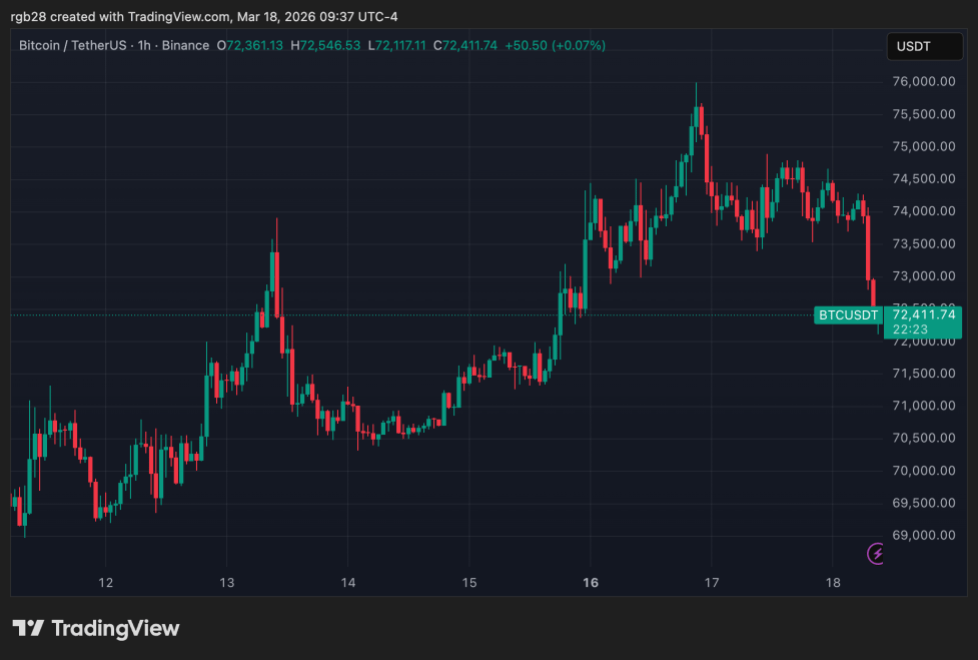
Bitcoin (BTC) trades at $72,411 in the one-week chart. Source: BTCUSDT on TradingView


Related Questions

QWhat is the expected timeline for the new draft of the crypto market structure bill according to Senator Tim Scott?

ASenator Tim Scott stated that a fresh draft of the crypto market structure bill could be ready by the end of the week.

QWhat is the name of the stablecoin legislation mentioned in the article and what impact has it had?

AThe stablecoin legislation mentioned is the GENIUS Act, which has had a 'powerful impact for good' in the market according to Senator Scott.

QWhat was a major point of contention between the banking and crypto industries regarding the CLARITY Act?

AA major point of contention was the payment of interest on stablecoins. The banking industry criticized the GENIUS Act for loopholes and urged lawmakers to ban yield on stablecoins from crypto exchanges, brokers, and related entities, not just issuers.

QWhich key entity stepped in to help negotiate the stalled issues in the crypto market structure bill?

AThe US President’s Council of Advisors on Digital Assets stepped in, holding multiple meetings to negotiate key issues that had stalled the bill.

QWhat did Senator Scott call the 'largest publicly celebrated challenge' for lawmakers and crypto legislation?

ASenator Scott called the stablecoin yield compromise the 'largest publicly celebrated challenge' they have faced.

Related Reads

UBS: The Crowdedness of A-Share Tech Stocks Is Far From Reaching Historical Peaks

UBS: A-share tech stocks still far from peak crowding levels A-shares' technology sector has seen a strong rebound, with trading activity hitting record highs, raising concerns about market crowding. However, UBS Securities argues that a key indicator of institutional positioning suggests the current crowding level remains well below historical peaks. While the large-cap tech sector's share of total A-share trading volume and market capitalization have reached historical highs, the overweight ratio of domestic mutual funds in this sector stood at 9.9% in Q1 2026. This is down from 11.6% in Q3 2025 and significantly lower than the historical peak of 14.1% in Q4 2015. It also pales in comparison to the historical peak overweight of 18.7% for the consumer sector. UBS notes that typical cycles from a low to a peak in fund overweighting last about three years, and the current outperformance of the tech/growth style has lasted less than two years since the policy pivot in September 2024. UBS expects A-share earnings recovery to accelerate, providing fundamental support. It forecasts 2026 A-share profit growth to rise to 11% from 3.9% in 2025. Non-financial A-share profits grew 11.8% YoY in Q1 2026, with gross and net profit margins at their highest since 2023. Persistent fund inflows, the expansion of thematic ETFs, and a recovery in private fund issuance are supporting market liquidity. In tactical allocation, UBS favors growth and cyclical styles under its "slow bull" base case, with overweight ratings on six sectors: Electronics (benefiting from semiconductor inventory recovery and AI innovation), Communications (driven by AI computing demand), Machinery (aided by domestic capex recovery), Non-ferrous Metals (due to rising copper/aluminum prices), Chemicals (supported by anti-involution policies), and Electrical Equipment (driven by policy support and AI data center power demand).

marsbit14m ago

UBS: The Crowdedness of A-Share Tech Stocks Is Far From Reaching Historical Peaks

marsbit14m ago

Should You Buy SpaceX Stock at $1.7 Trillion? Here's What the Market Is Worried About

SpaceX is preparing for a massive IPO aiming to raise around $75 billion at a valuation of approximately $1.75 trillion. While its achievements in reusable rockets and the profitable Starlink satellite internet service are clear, the market is concerned about the aggressive valuation. Key issues include: the current $1.75 trillion valuation, which is about 94 times 2025 revenue, seems to price in not just existing businesses but also unproven future ventures like AI infrastructure and orbital data centers. Financially, while Starlink is profitable, the AI division, bolstered by the acquisition of xAI, is incurring massive losses and consuming the majority of capital expenditures. This acquisition also introduced complex related-party financing arrangements and debt onto SpaceX's balance sheet. Furthermore, corporate governance poses a challenge. SpaceX's dual-class share structure ensures founder Elon Musk retains absolute control, limiting ordinary shareholders' influence over high-risk, long-term strategic decisions. The future success of ambitious projects like the Starship rocket—critical for lowering costs and enabling new services—remains a significant variable for the valuation. In summary, the market's apprehension (FUD) centers not on doubting SpaceX's past technological triumphs but on questioning how much premium public investors should pay for a future that combines proven profits with highly speculative and capital-intensive new ventures, all under a governance structure that offers limited shareholder oversight.

marsbit1h ago

Should You Buy SpaceX Stock at $1.7 Trillion? Here's What the Market Is Worried About

marsbit1h ago

Breaking the DeFi Cascading Liquidation Curse: Vitalik Proposes a New Solution

Vitalik Buterin has proposed a new DeFi design to eliminate the automatic liquidation mechanism that causes market instability during sharp downturns. The current system, used by protocols like Aave, triggers forced sales when collateral value falls below a threshold, often exacerbating price drops and creating systemic selling pressure. Buterin's alternative model is based on splitting an asset like ETH into two synthetic option-like tokens, P and N, pegged to a price index. Their combined value always equals one ETH. Instead of sudden liquidation, a position's value gradually drifts from its target peg if the market moves. Users must proactively rebalance their holdings to maintain their desired exposure, transferring the management burden from the protocol to the user or automated tools. A key advantage is the reduced reliance on real-time oracles. Pricing decisions are deferred until contract expiry, allowing for more robust, fault-tolerant oracle designs. This removes a clear liquidation threshold that speculators can target for manipulation or MEV extraction. However, significant challenges remain. Frequent rebalancing could incur high slippage and transaction costs, necessitating new liquidity provider models. The design is better suited for hedging instruments than for stablecoins requiring a rigid 1:1 peg. While not an immediate replacement for existing systems, the proposal challenges the foundational assumption that instantaneous forced liquidation is an unavoidable necessity in DeFi, opening the door for fundamentally different risk management architectures.

marsbit1h ago

Breaking the DeFi Cascading Liquidation Curse: Vitalik Proposes a New Solution

marsbit1h ago

Trading

Spot
Futures
活动图片