Musk's Million-Dollar Creative Bounty: The Revival of Long-Form Content and the Ambition for an Everything App

marsbitPublished on 2026-01-19Last updated on 2026-01-19

Abstract

Elon Musk's X (formerly Twitter) has launched a "$1 Million Article Challenge" in early 2026, aiming to incentivize long-form content creation on the platform. This move comes amid growing competitive pressure from Meta’s Threads, which has surpassed X in global daily active users (DAU) and is rapidly closing the gap in the U.S. market. X’s advertising revenue has also significantly declined since Musk’s acquisition. The push for long-form content is strategic: X’s algorithm favors content that increases "user time well spent," and long articles naturally keep users engaged longer. This approach supports Musk’s vision of making X the "earth’s first news source" and provides high-quality training data for his AI project, Grok. Despite global trends toward fragmented reading, X is betting on a revival of in-depth content to boost platform stickiness and attract professional creators. This effort is part of a broader ambition to transform X into an "Everything App" like WeChat. However, X still lags far behind in user base, engagement time, and functional diversity. Musk’s anxiety is palpable as he races to enrich X’s ecosystem and realize his super-app vision.

Entering 2026, X (Twitter) has been making frequent moves. While we can't see if anxiety is written on Musk's face, we can see Musk's anxiety written in his tweets.
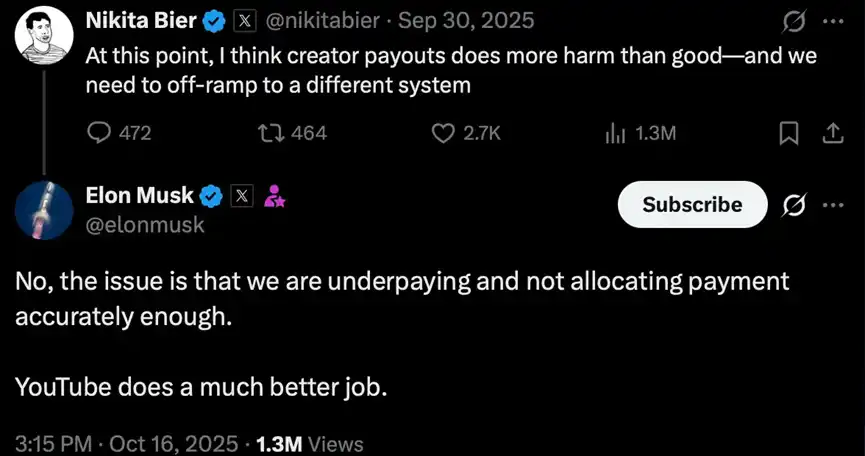
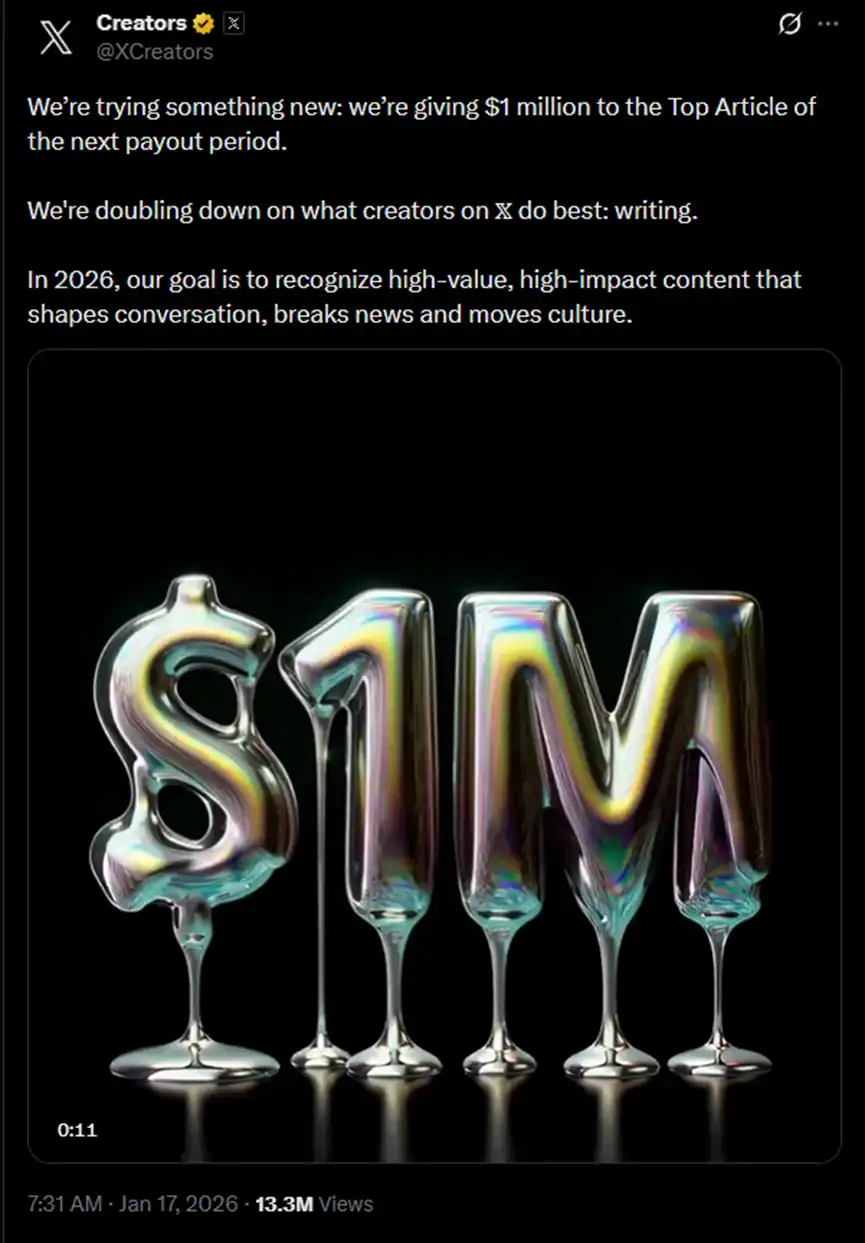
And last weekend, X officially launched a "Million-Dollar Article Bounty Activity," sparking a wave of "long-form content fever" on the platform.
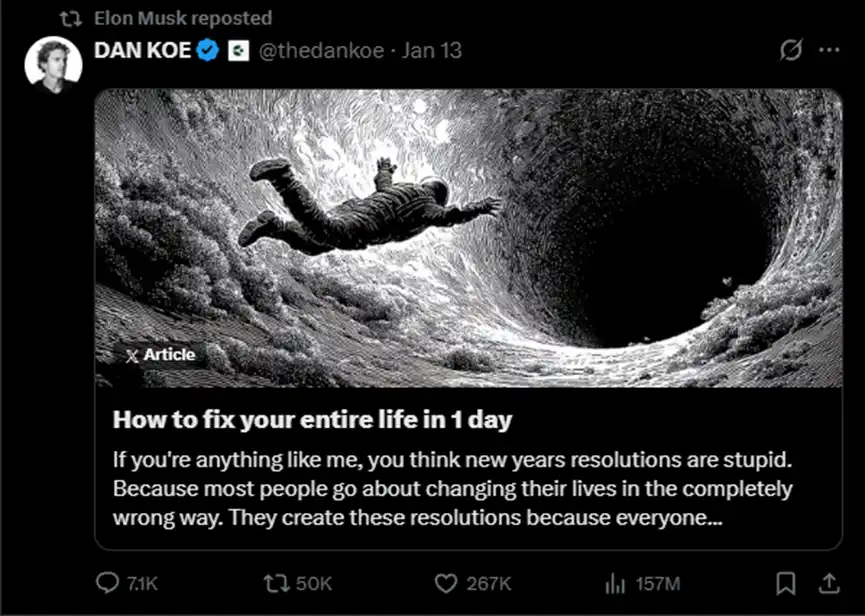
Currently, the most impactful article is from DAN KOE titled "How to Fix Your Life in 1 Day." This article has already garnered over 150 million reads and received a retweet from Musk.
It has been several years since Musk acquired X. Why is he now vigorously promoting X's creator ecosystem this year? In an era where global user reading habits are fragmented, why choose long-form content as the key focus? And can the revival of long-form content truly support Musk's ambition for an Everything App?

Musk's Anxiety

Every family has its own troubles; even geniuses have anxieties to face. The relentless pressure from competitors and X's own financial performance have made even the old Musk restless.

X is facing fierce competition in user growth and engagement, especially from Meta's Threads, which has seen rapid growth since its launch in 2023 and has already surpassed or closed in on X in several metrics.

According to the latest data released by analytics firm Similarweb in early January 2026, Threads' global mobile daily active users (DAU) have exceeded X's, averaging 143.2 million, compared to X's 126.2 million. In terms of growth trends, X's global DAU decreased by 11.9% year-over-year, while Threads achieved a staggering 37.8% growth. Even in X's home market, the United States, although X still leads with 21.2 million DAU compared to Threads' 19.5 million, the gap is narrowing rapidly, with the latter's annual growth rate reaching 41.8%, while X's fell by 18.4%.

Threads also performs excellently in monthly active users (MAU). As of January 2026, its MAU has reached 320 million, growing from 350 million to 400 million in 2025. In comparison, although X's MAU still has a scale of about 611 million, it has lost approximately 32 million users since Musk's acquisition. This shifting dynamic undoubtedly puts immense pressure on Musk.

The decline in user data directly impacts X's core revenue source—advertising. According to public data, X's global advertising revenue dropped to $2.5 billion in 2024, nearly halving from $4.4 billion in 2022. Although it is expected to rebound slightly to $2.26 billion in 2025, the overall downward trend remains evident, with some institutions predicting it will only recover to $2.7 billion by 2027.

Meanwhile, competitor Threads is highly favored by the capital markets. Analysts predict that Threads' advertising revenue could reach $11.3 billion in 2026, several times that of X's projected revenue. Although X achieved quarterly revenue growth at the end of 2025, the company as a whole remains in a loss-making state due to high restructuring costs.

Although subscription users (X Premium) saw significant growth in 2025, their revenue contribution is far below Musk's initial goal of "50% of total revenue." Therefore, X has directly linked the growth of Premium subscriptions to creator earnings, not only offering higher creator payouts but also explicitly basing the earnings calculation on paid user views (Verified Home Timeline impressions). This incentivizes creators to produce high-quality content that attracts paying users, thereby driving more users to subscribe to Premium services.

This ultimately led to the "Million-Dollar Article Bounty Activity" initiated by old Musk, akin to buying a千里马骨 (a metaphor for attracting talent with high rewards). Users in the Chinese region jokingly say that old Musk is running an American "New Concept Essay Competition" in 2026.

The Revival of Long-Form Content

Musk's choice to make long articles the breakthrough for X's creator ecosystem is not a whim but a deep strategic consideration based on X platform's positioning.

Currently, X's recommendation algorithm has a core metric—"regret-free user time," which is the total effective time users spend on a piece of content. Musk explicitly stated that this mechanism naturally favors long-form content because it can "accumulate more user seconds," thereby increasing the content's algorithmic weight and the platform's overall user engagement.

Long articles, by providing depth, context, and complete narratives, naturally extend user dwell time, contrasting sharply with the quick consumption mode of short posts or短视频. Recent algorithm updates have even introduced "content format weighting," explicitly favoring long-form content that requires more creative effort and has greater impact. This is not only an incentive for creators but also a data-driven decision: high-quality long articles can reduce user jumps to external links, keep users longer within the platform, and also provide more high-quality training data for Musk's AI project, Grok AI.

Musk has also repeatedly emphasized his hope to make X the "number one news source on Earth," replacing traditional media by aggregating "collective intelligence" in real-time. The long-form article feature allows users to publish "complete articles or even books," enabling domain experts, event witnesses, and deep creators to share their full insights directly on the platform, rather than fragmented information. At the same time, compared to the huge subsidies for short videos on other platforms, the incentive model for long articles is easier to commercialize through a subscription system, thereby attracting more professional journalists and writers back to the X platform.

However, a question arises. You might ask, given that global users' reading habits are now fragmented, why is old Musk pulling this "Renaissance" move?

It is undeniable that global users' digital reading habits are showing a clear trend towards fragmentation, especially under the impact of short video platforms. Gen Z and other younger groups prefer "fragmented" reading—multiple times a day for 5-10 minutes each time. However, data also shows that people's overall reading volume is actually increasing. As a counter-movement, "slow, immersive reading" is on the rise. Amid digital fatigue, people are beginning to seek depth, emotional connection, and meaningful content consumption.

What X wants is not to become another entertainment platform like TikTok, but to become a "life hub" deeply integrated into the daily life of every American, like WeChat—the "Everything App" that Musk keeps talking about. To achieve this, it is essential to极大地丰富 (greatly enrich) the platform's content and service ecosystem, increase users' "regret-free usage time," give them more reasons to stay on the platform, and complete more tasks here.

The Ambition for an Everything App

All of Musk's efforts ultimately point to a grand goal: to build X into an "Everything App" like WeChat. However, to realize this ambition, X still has a long way to go.

Compared to WeChat, X lags significantly in several key metrics. In terms of monthly active users (MAU), WeChat boasts over 1.4 billion users, while X has only 557 million, less than a third of the former. Such a huge user base gap makes it difficult for X to form the powerful "network effect" that WeChat has—where users cannot leave because all their friends, family, and life services are on the platform. WeChat has become a daily necessity for many, while X, in the eyes of most users, remains a social media platform for getting news and expressing opinions—still the old Twitter, that "American Weibo."

The gap in user stickiness is equally evident. The average daily usage time for WeChat users is as high as 82 minutes, while X users only spend 30-35 minutes. The reason behind this is that users can complete a large number of "productive" tasks within WeChat, such as chatting, payments, shopping, and accessing municipal services, while content consumption on X is still primarily passive browsing, which easily leads to "scroll and leave."

Old Musk doesn't want X to become TikTok, so he first needs to摆脱 (rid X of) the "scroll and leave" entertainment-oriented user experience. He needs high-quality, deep content to enhance user stickiness, attract and retain high-value users, and then, based on this content, gradually嫁接 (graft on) more services like payments and e-commerce, ultimately paving the way to the "Everything App."

And the grander this dream is, the deeper Musk's anxiety will be.

Trending Cryptos

Related Questions

QWhat is the main reason behind Elon Musk's recent push for a creator ecosystem on X (Twitter) in 2026?

AThe main reason is the intense competition from platforms like Meta's Threads, which has surpassed X in key metrics like daily active users (DAU) and is growing rapidly, coupled with X's declining advertising revenue and user base, which has increased pressure on Musk to incentivize high-quality content creation to attract and retain users.

QHow does the X platform's algorithm currently favor long-form content according to the article?

AX's recommendation algorithm uses a core metric called 'regret-free user time,' which measures the total effective time users spend on content. This mechanism naturally favors long-form content because it accumulates more user seconds, increasing the content's algorithmic weight and overall platform engagement.

QWhat strategic role does long-form content play in Musk's vision for X as an 'Everything App'?

ALong-form content is strategic because it enhances user engagement and time spent on the platform, providing depth and context that keeps users from leaving. This helps X move beyond being a mere social media site towards becoming a comprehensive life hub, similar to WeChat, where users can access various services and content, thereby supporting Musk's ambition of an 'Everything App'.

QHow does X's user engagement and revenue compare to its competitor Threads as of early 2026?

AAs of early 2026, Threads has surpassed X in global mobile daily active users (DAU) with 143.2 million compared to X's 126.2 million. Threads also shows a 37.8% growth in DAU, while X's DAU declined by 11.9%. In advertising revenue, Threads is projected to reach $11.3 billion in 2026, significantly higher than X's estimated $2.26 billion in 2025.

QWhat is the 'Million-Dollar Article Contest' initiated by X, and what was its impact?

AThe 'Million-Dollar Article Contest' is an initiative by X to incentivize creators to produce high-quality long-form content by offering financial rewards. It sparked a trend of long articles on the platform, with one notable example being DAN KOE's 'How to Fix Your Life in 1 Day,' which received over 150 million reads and was retweeted by Elon Musk, highlighting the contest's success in driving engagement.

Related Reads

In Conversation with Ray Dalio: We Are Currently in an AI Bubble, with 1% of My Portfolio in Bitcoin

Ray Dalio, founder of Bridgewater Associates, warns in an interview that the current AI boom shows classic bubble characteristics, which could lead to significant economic downturns as seen in past cycles like 1929 or 2000. He explains that speculative enthusiasm, fueled by debt and overvaluation, often precedes a crash when rising rates or taxation force asset sales, causing widespread losses and recession. Dalio also outlines his "Big Cycle" theory, describing an approximate 80-year pattern where widening wealth gaps, massive government deficits, and shifting geopolitical power (like China's rise) create internal conflict and global instability. He emphasizes that we are in a late-cycle, transitional phase where traditional powers like the US and UK face decline. For personal wealth protection, Dalio advises diversification beyond cash into assets like stocks, bonds, real estate, and particularly gold, which he prefers over Bitcoin. While he holds about 1% of his portfolio in Bitcoin as a non-printable hard asset, he views gold as more secure from technological or governmental threats. Regarding AI's impact, Dalio believes it will disproportionately benefit capital owners, worsening inequality by replacing both physical and cognitive labor. He suggests that human intuition and emotional intelligence, combined with AI, will be key for future workers. On taxation, Dalio argues that wealth taxes are impractical and risk triggering asset sell-offs, reducing productive investment. He points to the UK as a cautionary example of debt, low productivity, and political strife. Geopolitically, Dalio foresees a more regionalized world, with the US showing weakness in prolonged conflicts like with Iran, akin to past imperial declines. The ideal outcome, he suggests, is coexisting powerful blocs (e.g., Americas, China-Asia Pacific) without major war.

marsbit3h ago

In Conversation with Ray Dalio: We Are Currently in an AI Bubble, with 1% of My Portfolio in Bitcoin

marsbit3h ago

Daily 7.2 Trillion KRW: Foreign Capital's Record Net Buying on Friday! Wall Street Says Headwinds for Korean Stock Fund Flows Have Subsided

South Korean stock market sees a dramatic shift in fund flows. On July 31, foreign investors made a record net purchase of approximately KRW 7.2 trillion in KOSPI stocks, marking a fundamental reversal from the persistent large-scale net outflows seen in previous months. This contributed to a significant narrowing of foreign net selling in July to KRW 9.8 trillion, down sharply from KRW 48.4 trillion in June and KRW 44.5 trillion in May. Simultaneously, domestic institutional pressure eased. South Korean pension funds and asset managers turned to a net buying position in July, purchasing KRW 1.0 trillion worth of KOSPI shares, contrasting with net sales in May and June. Market volatility is expected to be dampened by new financial regulations. Effective July 31, the Financial Services Commission tightened access for retail investors to single-stock leveraged ETFs by raising the minimum cash deposit requirement. Trading volumes for these products subsequently dropped to about 50% of their monthly average. Citigroup Research maintains its year-end KOSPI target of 10,000 points. The firm cites several supportive factors: the substantial easing of headwinds from capital outflows, a robust fundamental outlook for the semiconductor sector, historically low market valuations, strong economic fundamentals, and the potential for policy support from financial authorities if needed.

marsbit3h ago

Daily 7.2 Trillion KRW: Foreign Capital's Record Net Buying on Friday! Wall Street Says Headwinds for Korean Stock Fund Flows Have Subsided

marsbit3h ago

Thanks to Dice Rolls, Bitcoin Keys Are Stored Offline, But Not Everyone Will Do It

The article discusses using dice rolls to generate secure Bitcoin wallet seeds, providing entropy independent of potentially flawed hardware random number generators. It explains that each fair dice roll offers about 2.585 bits of entropy, with around 50 rolls needed for a standard 12-word seed phrase and 99+ recommended for higher security. This method gained attention after a vulnerability was revealed in some Coldcard hardware wallets, where a faulty firmware RNG (dating back to 2021) compromised generated keys. The analysis notes that while a dice-generated main seed was safe from this specific flaw, other Coldcard functions (like creating paper wallets, backup keys, or passwords) could still be vulnerable if they used the defective RNG. The piece argues that while dice-based entropy is technically robust, the manual process is error-prone, tedious, and unrealistic for most new users, who might make mistakes in recording or inputting rolls. It concludes that while manual entropy generation should remain an option for advanced users, the long-term goal is to develop reliable, user-friendly hardware and software that securely generates randomness without requiring specialized knowledge. Coldcard users are advised to check their firmware version and replace any secondary secrets (like paper wallet keys) created with vulnerable devices, while also considering multi-signature setups with devices from different manufacturers for added security.

cryptonews.ru8h ago

Thanks to Dice Rolls, Bitcoin Keys Are Stored Offline, But Not Everyone Will Do It

cryptonews.ru8h ago

Trading

Spot

Hot Articles

Discussions

Welcome to the HTX Community. Here, you can stay informed about the latest platform developments and gain access to professional market insights. Users' opinions on the price of S (S) are presented below.

活动图片















