Making a Profit of $100,000 from 'Mosquito Meat' with 170 High-Frequency Trades per Day?

比推Published on 2026-02-11Last updated on 2026-02-11

Abstract

A quantitative trading bot, planktonXD, generated over $106,000 in profit on Polymarket within a year by executing more than 61,000 predictions—averaging 170 trades per day. Instead of betting on high-risk "black swan" events, it employed a high-frequency market-making and arbitrage strategy, focusing on small, consistent gains with minimal drawdowns. The bot capitalized on mispriced odds in low-liquidity markets—such as regional esports matches and crypto price predictions—by placing tiny bets on highly improbable outcomes that were statistically undervalued. For example, it achieved returns as high as 23,750% on a VALORANT match and 9,285% on a SOL price prediction by buying nearly worthless shares that surged during market panics or emotional mispricings. Key takeaways include the power of compounding small gains, the necessity of automated tools and API access, and the importance of probability management over high-risk bets. The strategy highlights that success in prediction markets lies not in forecasting outcomes, but in exploiting liquidity gaps and probabilistic edges.

Author: Ma He, Foresight News

Original Title:Making a Profit of $100,000 from 'Mosquito Meat'


Another miracle has occurred on Polymarket.

Through extensive monitoring and疯狂下注 (frenzied betting), an address has managed to turn微利 (small profits) into a net gain of $100,000 in just one year through compound interest.

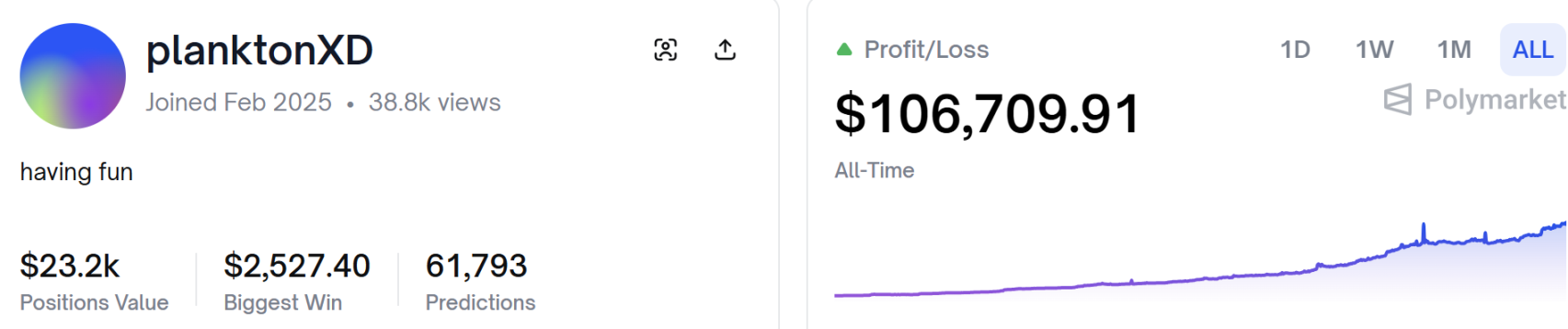
The address we are reviewing, planktonXD (0x4ffe49ba2a4cae123536a8af4fda48faeb609f71), is an extremely typical high-frequency quantitative trader. Since joining in February 2025, it has generated a net profit of $106,000 through over 61,000 predictions in just one year.


In prediction markets, most people are gambling on "black swan" events or chasing big news, but planktonXD has taken a completely different path: extreme certainty and terrifying execution frequency.

Looking at planktonXD's historical transaction data, the most震撼的 (astounding) aspect is its 61,000 predictions. From February 2025 to February 2026, it conducted approximately 170 transactions per day on average.

This frequency far exceeds the limits of manual human operation, so it can be concluded that this player is using an automated trading script (Bot). It is not "predicting" outcomes but "harvesting" price differences.

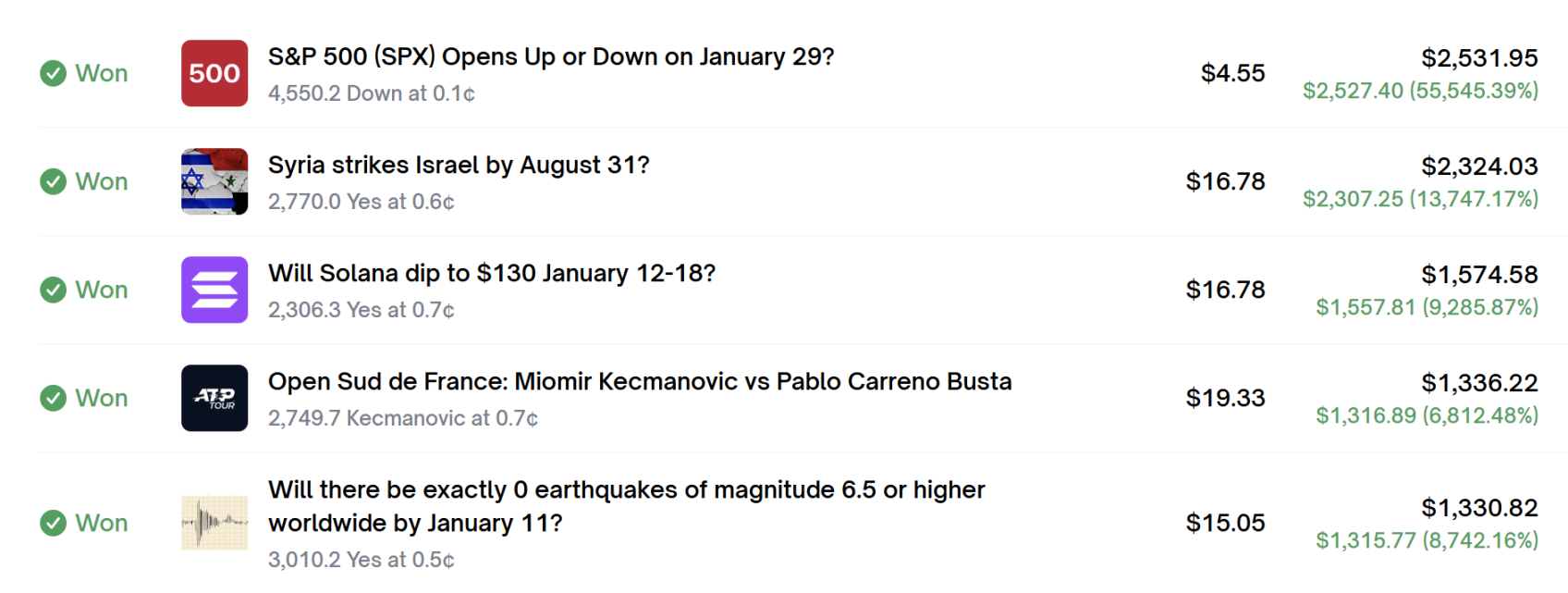
A very interesting phenomenon is that planktonXD's "Biggest Win" is only $2,527.4. Compared to its total profit of $100,000, this single largest win appears very "small" (only about 2% of the total profit).

Some retail players always hope to make a big score, betting all their chips on a confidently held judgment.

Winning is good, of course, but losing makes it difficult to get back to the table.

Even if you could win every time you go ALL IN, just one loss would mean a big loss.

Looking at its trading history, it never goes all-in on a single extreme event, nor does it bet on high odds. Its profit curve shows a perfect 45-degree smooth upward trend with almost no major drawdowns. This indicates it uses a market maker strategy: placing orders on both sides of the order book to earn the bid-ask spread, or conducting微型套利 (micro-arbitrage) using price fluctuations between different markets.


It does not always hold positions long-term (Buy and Hold) but frequently enters and exits the market. This "light position, fast turnover" approach极大地降低了 (greatly reduces) single-point risk. Even if an unexpected event occurs in a particular prediction market (like a sudden change in election results), its impact on the total capital pool is minimal.

This quantitative robot does not specialize in trading vertical sectors like weather, as some do, but places bets across multiple sectors: sports, weather, coin prices, politics, etc. It monitors thousands of prediction markets on the platform 24/7, looking for moments of pricing inefficiency.

VALORANT Challengers is a classic实战案例 (practical case study) for this trader.

You can think of it as the "secondary league" or "regional league" in the esports world. Fuego and LYON are professional teams in the Latin American region. Because such matches have a small audience and extremely high information asymmetry, they正好成了 (become perfect) "arbitrage paradises" for quantitative robots.

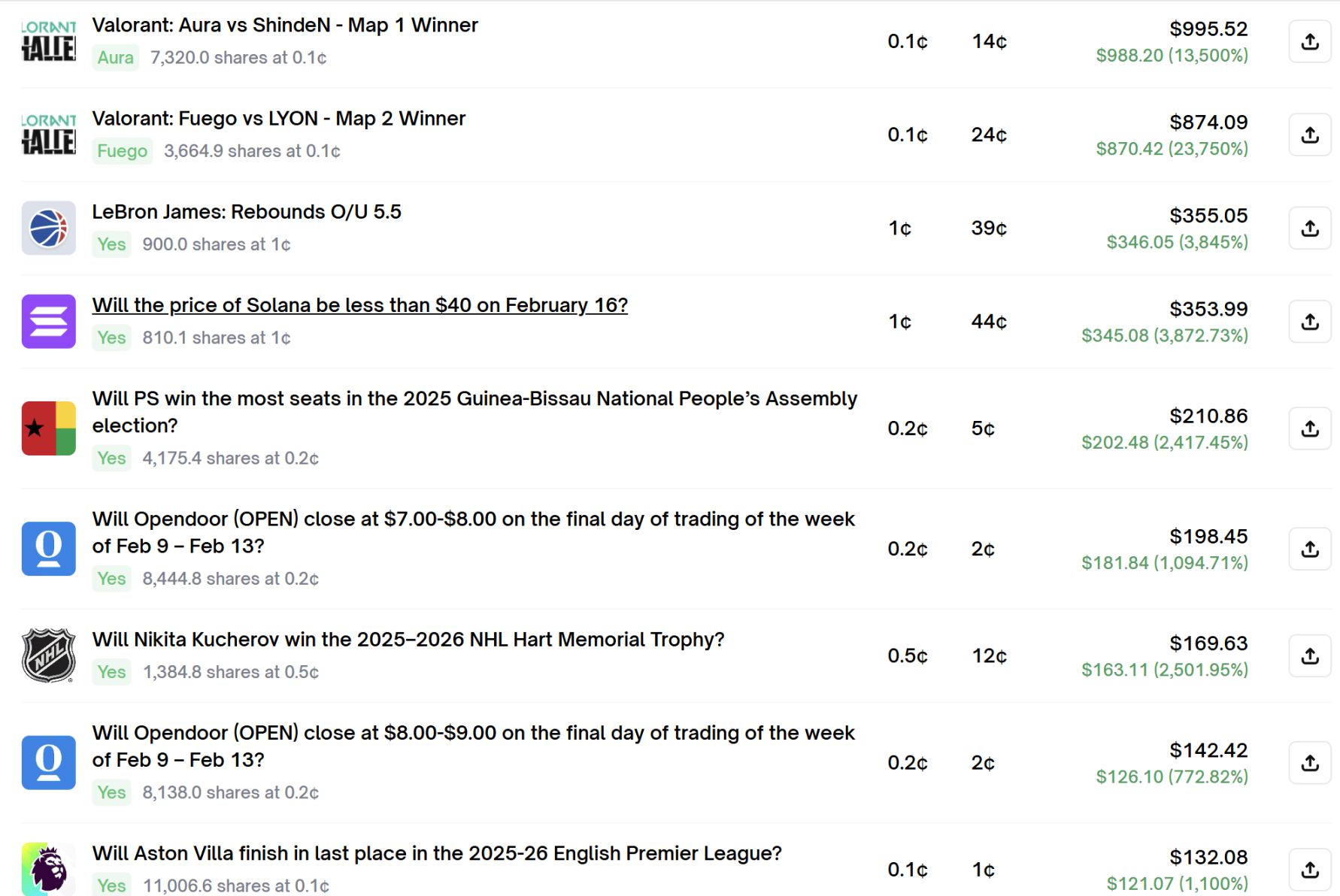
It bought 3,664.9 shares of Fuego winning at a unit price of 0.1¢.最终这笔交易 (Ultimately, this trade) yielded a return of $874.09, with a return rate reaching a恐怖的 (terrifying) 23,750%!

This is a typical "small position博取大赔率" (betting for big odds with a small position). In markets with extremely poor liquidity or where the public is extremely bearish on a certain option—long-tail markets like the round results of esports matches—it uses a Bot to monitor options that are mispriced to near "zero." It doesn't need to predict who will win; it only needs to know that Fuego's probability of winning is absolutely not just 0.1%. This本质上是在收割 (is essentially harvesting) the market's "extreme emotions" and "lack of liquidity."

When it comes to emotions, coin prices are the most vivid embodiment.

Will the SOL price drop to $130 between January 12-18?

It invested about $16 at a price of 0.7¢ (the market believed the probability of success was less than 1%) and ultimately took away $1,574, with an astonishing return rate of 9,285%.

Why did this "almost impossible" prediction allow it to make big money at that time?

During periods of剧烈波动 (violent fluctuations) in the cryptocurrency market, mainstream predictions tend to be bullish or sideways. planktonXD would capture those "extremely bearish" options priced at 0.1¢ – 1¢ around the clock. These options are like worthless paper in the eyes of ordinary people, but they are extremely cheap insurance in the eyes of quant traders. As long as the market experiences one deep price spike or sudden bad news, these "worthless papers" can instantly surge thousands of times. Additionally, in specific price ranges (e.g., SOL < $40), because the current price is极远 (extremely far) from the predicted price, the order book is often very thin. planktonXD uses automated scripts to place orders in these "no-man's lands," scooping up cheap shares抛出的 (thrown out) due to panic or misoperation. This is essentially acting as a probability搬运工 (porter).

planktonXD's SOL strategy shows that on Polymarket, buying "impossible" outcomes does not mean it believes they will happen, but because the "probability of occurrence" is underestimated by the market. It uses a cost of a few dollars to buy out the market's one-in-ten-thousand possibility of panic. This is typical "antifragile" trading.

planktonXD's success offers three core启示 (revelations) for ordinary retail investors:

The power of compound interest should not be underestimated. Earning 0.5% daily through high-frequency trading yields much more stable returns after a year than betting on a 10x coin. Technology is the killer app. In the Crypto era, quantitative tools and API capabilities are standard for top players. Finally, certainty is greater than odds. In prediction markets,寻找那些概率极高 (finding those opportunities with extremely high probability) (e.g., 90%+ certainty) for small profits is easier to survive on than gambling on 50/50 major events.

After all, the most advanced玩法 (play) in prediction markets is not predicting the future, but managing probability and liquidity.


Twitter:https://twitter.com/BitpushNewsCN

Bitpush TG Discussion Group:https://t.me/BitPushCommunity

Bitpush TG Subscription: https://t.me/bitpush

Original link:https://www.bitpush.news/articles/7611051

Trending Cryptos

Related Questions

QWhat is the main strategy used by the address planktonXD to generate profits on Polymarket?

AThe main strategy used by planktonXD is high-frequency automated trading (using a bot) to capture small, certain profits through market making and micro-arbitrage, rather than predicting outcomes. It focuses on exploiting pricing inefficiencies and liquidity gaps across thousands of prediction markets.

QHow many trades did planktonXD execute over the one-year period, and what was the average daily trading frequency?

APlanktonXD executed over 61,000 trades in one year, with an average of about 170 trades per day.

QWhat was the total profit earned by planktonXD, and how does its biggest single win compare to the total profit?

APlanktonXD earned a total profit of $106,000. Its biggest single win was $2,527.4, which is only about 2% of the total profit.

QCan you provide an example of a specific market where planktonXD achieved an extremely high return on investment?

AOne example is in a VALORANT Challengers esports match between Fuego and LYON. PlanktonXD bought 3,664.9 shares of Fuego winning at a price of $0.001 each, and the trade returned $874.09, achieving a return rate of 23,750%.

QWhat are the three key insights for ordinary retail investors from planktonXD's success?

AThe three key insights are: 1) The power of compounding—small daily gains through high-frequency trading can be more stable than betting on high-risk events. 2) Technology is essential—quantitative tools and API capabilities are standard for top players. 3) Certainty is more important than odds—seeking high-probability, small-profit opportunities is easier than gambling on 50/50 events.

Related Reads

Two Legends Lost in Three Days: Is Google's AI Talent Dam Cracking?

In three days, Google lost two AI legends. On June 18, Noam Shazeer, co-author of the seminal "Attention is All You Need" paper and Gemini co-lead, left for OpenAI. Just 48 hours later, John Jumper, 2024 Nobel laureate and AlphaFold lead, departed DeepMind for Anthropic. This follows Andrej Karpathy joining Anthropic in May. These moves highlight a structural trend: top AI talent is concentrating at mission-driven, pre-IPO firms like OpenAI and Anthropic, while Google becomes a primary source. The exodus stems from a core mission mismatch. Google's ad-centric model often subordinates AI research to product and revenue goals, creating friction for pioneers like Shazeer, who returned in 2024 only to leave again. In contrast, OpenAI and Anthropic offer singular focus on pushing AI boundaries, whether towards AGI or safety-aligned models, which deeply appeals to top researchers like Jumper. Financial incentives amplify the pull. With both OpenAI and Anthropic nearing IPO, employees stand to gain immensely from equity, an upside Google's mature stock cannot match. Furthermore, the 2023 merger of Google Brain and DeepMind, intended to consolidate strength, has instead created cultural tension and slowed the path from research to product, as evidenced by Gemini's pace. This talent redistribution is reshaping the AI landscape. While Google retains vast data and compute resources, its true crisis is the quiet, continuous loss of the people who define the field's future. The real moat in AI is not infrastructure, but the concentration of brilliant minds—a battle Google is currently losing.

marsbit47m ago

Two Legends Lost in Three Days: Is Google's AI Talent Dam Cracking?

marsbit47m ago

Behind the AI Report Card, Lies a Chinese 'Exam Setter'

Beyond the familiar performance charts like MMLU-Pro and MMMU, which major AI models strive to ace, stands a key "examiner": Chinese-Canadian researcher Wenhu Chen. An assistant professor at the University of Waterloo and founder of TIGERLab, Chen addresses the crucial need for more rigorous AI evaluation. As models like GPT-4 began scoring near-perfect results on older benchmarks like MMLU, it became difficult to distinguish their true capabilities. In response, Chen introduced MMLU-Pro in 2024, featuring harder, more reasoning-focused questions with more answer choices, successfully reintroducing meaningful performance gaps. His work extends to multi-modal evaluation with MMMU and its enhanced version, MMMU-Pro. These benchmarks test a model's ability to understand and reason with complex information from images, charts, and text across diverse academic subjects, exposing the significant challenges even top models face in genuine comprehension. Chen's background in complex QA, table reasoning, and his experience at Google DeepMind on projects like Gemini inform his approach. He understands that effective benchmarks must anticipate how models might "cheat" by memorizing data or avoiding visual analysis. His lab also actively researches video understanding and generation models (e.g., UniVideo, Vamba), ensuring his evaluation work is grounded in practical model-building challenges. Now at Meta's Super Intelligence Lab, Chen continues his focus on multi-modal data and evaluation, representing the deep yet often unseen contributions of Chinese talent in shaping the fundamental tools of the AI industry.

marsbit59m ago

Behind the AI Report Card, Lies a Chinese 'Exam Setter'

marsbit59m ago

Alliance Co-founder's Letter to Entrepreneurs: Written at the Moment Cursor Sold for $600 Billion

Alliance Co-founder's Letter to Entrepreneurs: On Cursor's $60 Billion Sale Many aspiring founders see massive exits like Cursor's $60B sale and wonder why they can't achieve the same, often concluding opportunities are exhausted. But great companies aren't built in obvious, crowded spaces. Cursor, like Stripe, Figma, and Shopify before it, started with a non-consensus belief about the future. Before ChatGPT, they believed AI would transform knowledge work. They focused on a genuinely exciting domain, became their own customer, and obsessed over power users. Their journey involved years of "glass-chewing" effort before the market was ready. The pattern is consistent: identify a long-term technological shift, find a missed entry point, and execute for years before the trend becomes obvious. First-generation products (PayPal, Adobe, Amazon) prove a market exists. Second-generation winners (Stripe, Figma, Shopify) rebuild that market around new insights, technology, or changing customer behaviors. Founders must identify their phase in the cycle. Early entrants like Coinbase or Cursor focus on making new technology usable for power users. Later entrants find the "yin" to the established "yang"—the blind spots incumbents miss as they grow distant from individual users. The key is deep market immersion. Use every product in your space. Talk to users. Build an audience. Stop looking for ideas and start *seeing* them everywhere. Then, choose one. The idea must offer a 10x improvement or solve a "hair-on-fire" pain point—something severe enough that users are already crafting workarounds. When building, avoid feature bloat. Ask: why would someone switch? Great startups rarely force new behaviors; they improve familiar workflows with drastically lower friction (e.g., Cursor forked VS Code instead of creating a new editor). Distribution is the underestimated moat. Before product-market fit, achieve distribution-market fit. How do customers discover new tools? Founders like those at Airbnb, Stripe, and Cursor did unscalable, manual work to recruit early users. The final, unteachable ingredient is resilience. Cursor built for years pre-market, faced rejection, and persisted. So did Airbnb, Nvidia, and Rain (which launched post-FTX collapse). The lesson isn't that these founders were smarter, but that they stayed in the game long enough for their insights to compound. Framework: Spot technological cycles. Cultivate unique insight. Obsess over your market. Talk to customers. Find a hair-on-fire problem. Build the simplest wedge. Win your distribution channel. Above all, don't quit when it gets hard. Most people won't do these things consistently. The few who do build the next generation of great companies. Go build.

marsbit1h ago

Alliance Co-founder's Letter to Entrepreneurs: Written at the Moment Cursor Sold for $600 Billion

marsbit1h ago

Weekly Editor's Picks (0613-0619)

Weekly Editor's Picks (0613-0619): Market Insights & Analysis This weekly digest curates in-depth analysis often lost in the information flow, focusing on key insights across macro trends, investment, and technology. **Macro & Geopolitics:** With the Strait of Hormuz reopening and military conflict shifting to negotiation, markets are pivoting from "war shock" to "supply restoration." Trades include shorting crude risk premiums, longing airlines/tourism, Asian energy importers, and bond duration, while shorting inflation expectations. LNG, fertilizer, and chemical chains are also being repriced. **Investment & VC:** Ray Dalio advises against betting on concentrated AI giants dominating indices, advocating for diversified portfolios of high-quality, low-correlation assets instead. Analysis covers the 4-year crypto cycle, predicting the core surviving product by 2029 will be asset trading markets. Current BTC metrics suggest a potential bottoming zone, presenting a patient accumulation window. SpaceX's high-profile IPO at a $2.1T valuation faces scrutiny over fundamentals, with key watchpoints being its likely inclusion in the Nasdaq index and Q2 earnings. Concerns are raised about potential "gamma squeeze" and systemic risks if its narrative-driven valuation gets amplified by passive index funds. Robinhood (HOOD) is noted for breaking its high correlation with crypto, bolstered by its stock trading and new underwriting business. **Web3 & AI:** A warning highlights ~$1.8T in off-balance-sheet AI infrastructure commitments (purchase commitments, leases) as a potential systemic risk if AI monetization lags. AI models are being used for World Cup predictions, adding a new layer for betting markets. A cost breakdown of a $20 AI subscription reveals the supply chain from model companies to cloud, GPUs, and power. **Prediction Markets:** The emergence of prediction market "concept stocks" is noted, with Robinhood developing its own platform, Rothera, signaling a shift from market competition to a "channel war" for user access. **CeFi & DeFi:** The SpaceX IPO tested perpetual contract mechanisms for pre-IPO assets, highlighting challenges in handling corporate actions like stock splits on-chain. The de-pegging of STRC (Strategy's preferred share) to ~$89 reflects market concerns over MicroStrategy's capital structure and BTC-backed leverage model. BlackRock's covered-call Bitcoin ETF (BITA) offers yield but caps upside, appealing to yield-seeking institutions. **Ethereum:** An opinion piece argues Ethereum's core strength is its vast developer community and composability, solidifying its role as the default operating system for the financial internet. **Weekly Hot Topics:** Include the US-Iran deal reopening the Strait of Hormuz, Fed's hawkish hold, Anthropic restricting model access, SpaceX acquiring Cursor, and a humorous stock surge for "Liuliumei" due to its "LLM" ticker.

marsbit1h ago

Weekly Editor's Picks (0613-0619)

marsbit1h ago

Alliance's Co-Founder's Letter to Entrepreneurs: Written on the Occasion of Cursor's $60 Billion Sale

In this letter to entrepreneurs, Alliance reflects on the success of Cursor's $60 billion sale to Elon Musk, using it as a case study to counter the misconception that opportunities in crowded fields like AI or crypto are exhausted. The piece argues that great companies like Cursor, Stripe, Figma, and Shopify are not built by geniuses with perfect ideas, but by founders who start with a non-consensus belief about the future and build for years before that future becomes obvious to everyone. They identify long-term shifts, find overlooked entry points, and execute relentlessly. The framework for success involves: 1. **Identifying your place in the technology cycle**: Early-stage opportunities focus on making new tech usable for power users (e.g., Coinbase, Cursor). Later-stage opportunities involve finding the "yin" to an existing "yang"—the blind spots of first-generation players (e.g., Stripe vs. PayPal, Figma vs. Adobe). 2. **Cultivating unique insights**: Immerse yourself deeply in the market. Use every product, talk to users, and build an audience. Insights will emerge naturally from deep engagement. 3. **Finding a "hair-on-fire" problem**: Look for a 10x improvement or a severe, urgent pain point. The strongest signal is people already building clumsy workarounds. 4. **Building a focused MVP**: Don't just add features because you can. Ask why users would abandon their current tool for yours. The best startups rarely force new behaviors; they improve familiar workflows with drastically lower friction. 5. **Winning a distribution channel**: Distribution is often the moat. Before product-market fit, achieve channel-market fit. Find where your customers are and build an engine to reach them, even through unscalable, manual efforts initially. 6. **Persistence**: The final, unteachable ingredient is resilience. Success stories like Cursor, Airbnb, and Nvidia involved years of grinding, rejection, and perseverance when the path forward seemed unclear. The conclusion is that there is no secret. Most people fail to consistently execute these steps over the long term. The few who do build the companies that define the next era. The world is yours to create.

链捕手1h ago

Alliance's Co-Founder's Letter to Entrepreneurs: Written on the Occasion of Cursor's $60 Billion Sale

链捕手1h ago

Trading

Spot
Futures

Hot Articles

What is DOGE M

Doge Matrix ($doge m): The New Breed of Community-Driven Cryptocurrency Introduction In the ever-evolving landscape of cryptocurrency, new projects constantly emerge, each aiming to capture the interest of investors and enthusiasts alike. One of the latest entrants to this domain is Doge Matrix, represented by the ticker symbol $doge m. This project has attracted attention thanks to its roots in the popular meme culture surrounding Dogecoin, establishing its place within the web3 space. This article aims to provide a comprehensive analysis of Doge Matrix, covering its overview, creator, investors, functionality, timeline, and notable aspects. What is Doge Matrix ($doge m)? Doge Matrix is a community-driven cryptocurrency project that seemingly builds upon the widespread appeal of Dogecoin, a digital currency known for its Shiba Inu mascot and its meme origins. While the overarching objectives of Doge Matrix are not extensively defined, it is characterized by a commitment to harnessing community involvement and support. Unlike traditional cryptocurrencies that often emphasize utility or intrinsic value through underlying technologies, Doge Matrix positions itself within a space that embraces the cultural phenomenon of cryptocurrencies, particularly appealing to those who resonate with the ethos of meme-based assets. Drawing on the strengths of the Dogecoin community, Doge Matrix operates as part of a broader ecosystem, inviting participation and engagement from users who share an interest in cryptocurrency and the digital landscape. Who is the Creator of Doge Matrix ($doge m)? The identity of the creator of Doge Matrix remains unknown. This lack of transparency is not an uncommon occurrence in the cryptocurrency space, where some projects are launched without revealing the identities of their founders. The absence of information regarding the founding team can raise questions among potential investors about the project’s accountability and direction. Who are the Investors of Doge Matrix ($doge m)? As it stands, there is no publicly available information detailing the investors or investment foundations that back Doge Matrix. The project appears to rely primarily on community support rather than institutional investment. This model aligns with the community-driven nature of the initiative, fostering an environment where the direction of the project is shaped by its participants rather than being dictated by a select few financial backers. How Does Doge Matrix ($doge m) Work? The specifics regarding the operational mechanisms of Doge Matrix are somewhat vague, reflecting a broader trend of projects in the meme coin space where innovative functionalities are not always clearly articulated. Nonetheless, Doge Matrix seems designed to tap into the existing cryptocurrency ecosystem by encouraging user participation while tapping into the familiar cultural references associated with Dogecoin. Its potentially unique characteristics derive from community interactions rather than technological advancements, emphasizing shared experiences and collaboration among token holders. While the exact innovations have not been explicitly outlined, the project appears to create a space where community members can engage, share ideas, and propel the project's potential forward. Timeline of Doge Matrix ($doge m) Reflecting on the project’s timeline reveals notable events that have defined its journey thus far: November 25, 2024: Doge Matrix reached its all-time high value, marking a significant milestone in its early history. January 1, 2025: Conversely, Doge Matrix hit its all-time low value, illustrating the volatility often associated with cryptocurrencies, especially in the early stages of a project's lifecycle. Ongoing: The project continues to be actively traded and supported by its community, although specific future milestones or objectives have yet to be disclosed. Key Points About Doge Matrix ($doge m) Community Focus At the heart of Doge Matrix is a commitment to community engagement. The project thrives on the premise of collaboration and shared objectives among its members, emphasizing the importance of collective effort. Unlike centralized projects that often have a defined leadership structure, Doge Matrix at present showcases a more fluid approach to governance, where every community member's voice matters. Volatility The cryptocurrency market is notorious for its volatility, and Doge Matrix is no exception. Its price history reflects significant fluctuations between high and low values, which is typical of many new cryptocurrencies but underscores the risks associated with investment in emerging tokens. Lack of Detailed Information One of the most striking features about Doge Matrix is the scarcity of detailed information regarding its technological underpinnings and operational mechanisms. This ambiguity necessitates that potential investors conduct thorough due diligence before engaging with the project. Conclusion In summary, Doge Matrix ($doge m) illustrates a new wave of cryptocurrency projects that lean heavily on community engagement and cultural relevance. While lacking in certain specifics—such as clear leadership, defined objectives, and detailed functionality—the project has managed to generate interest within the crypto community, leveraging the established appeal of meme culture. As with any investment in the cryptocurrency space, understanding the inherent risks and conducting comprehensive research is essential for potential participants. Doge Matrix stands as a reminder of the dynamic, sometimes unpredictable nature of the crypto industry, marked by constant evolution and enthusiasm for community-driven initiatives.

3.8k Total ViewsPublished 2025.02.03Updated 2025.02.03

What is DOGE M

What is $M

Understanding Mantis ($M): A New Era in Cross-Chain Interoperability In the continually evolving landscape of Web3 and cryptocurrency, new projects strive to offer innovative solutions aimed at enhancing the user experience and expanding functional possibilities within the decentralized financial ecosystem. One such project garnering attention is Mantis ($M), a pioneering protocol founded on the principles of cross-chain interoperability and intent-based settlements. This article delves into the essential aspects of Mantis, including its core functionality, creators, investment backing, innovative features, and critical milestones. What is Mantis ($M)? Mantis is described as a multi-domain intent settlement protocol that simplifies cross-chain interactions, enabling users to execute complex financial transactions across various blockchain platforms seamlessly. The protocol operates through three primary layers: Intent Expression: Users can articulate their transaction goals using natural language facilitated by the DISE LLM, an advanced AI language model. For instance, a user might express a desire to swap Ethereum (ETH) for Solana (SOL) with a specific slippage tolerance of 1%. Execution: This layer employs a network of solvers that compete to fulfill user intents. Transactions are executed using mechanisms such as Coincidence of Wants (CoWs) and Order Flow Auctions (OFAs), which ensure that user demands are met optimally. Settlement: Leveraging the Inter-Blockchain Communication (IBC) protocol, Mantis enables atomic cross-chain transactions, allowing users to operate across various supported chains, including Ethereum, Solana, and Cosmos. Mantis is engineered to introduce native yield generation for idle assets, employing cryptographic proofs to maintain the integrity of transactions throughout the entire process. Creators & Development Team Mantis was conceived by the Composable Foundation, a research-driven organization notable for its emphasis on blockchain interoperability solutions. This foundation collaborates with esteemed academic institutions, including Harvard University and the University of Lisbon, contributing to extensive research and development efforts that inform Mantis's architecture and functionality. The Composable Foundation’s commitment to fostering innovation in the blockchain space positions Mantis as a robust solution for the growing demand for interoperability among multiple blockchain networks. Investors & Backing While specific details about individual investors have not been publicly disclosed, Mantis enjoys substantial backing from various entities, including: Ecosystem grants from IBC-enabled chains, which support the protocol's growth and integration within decentralized finance ecosystems. Strategic partnerships with infrastructure providers that enhance Mantis's network capabilities and deployment strategies. Funding through the Composable Foundation's treasury, ensuring sustained financial support for ongoing development and operational costs. These collaborative efforts reflect a consensus among stakeholders about the importance of enhancing cross-chain functionality and the potential utility of Mantis's infrastructural innovations. Key Innovations Mantis sets itself apart through several pioneering innovations that enhance its functionality and utility: Chain-Agnostic Intents: Users can initiate transactions from any supported chain while settling on another. This flexibility empowers users, driving increased interaction among different platforms. AI-Powered Interface: The integration of DISE LLM allows users to conduct complex DeFi operations using natural language, thereby simplifying interactions and making blockchain technology accessible to a broader audience. Cross-Domain MEV Capture: Mantis creates an internal market for maximal extractable value (MEV) through competitions among solvers. This innovative approach allows for greater efficiency and value extraction in complex transactions. Modular Settlement Layer: The protocol supports various verification methods, including zero-knowledge proofs and optimistic rollups, providing a versatile framework that can adapt to emerging blockchain technologies. Historical Timeline Mantis's development is marked by several critical milestones that chart its trajectory and growth: | Year | Milestone | |————|————————————————————————-| | 2022 | Initial concept development within the Composable Foundation's research division. | | Q3 2024 | Launch of the testnet with bridging capabilities between Solana and Ethereum. | | Q1 2025 | Anticipated Token Generation Event (TGE) alongside the mainnet launch. | | Q2 2025 | Expected integration of DISE LLM and expansion of cross-chain capabilities. | | 2025 H2 | Planned support for over 15 chains through further IBC upgrades. | This timeline outlines Mantis's evolution, from conceptual discussions to active implementation and future growth phases. Ecosystem Growth Strategy Mantis's strategy for ecosystem growth includes several initiatives designed to encourage user participation and developer engagement: Credits System: Users can earn protocol credits by providing liquidity and engaging in referral programs. These credits are redeemable for incentives in the future, fostering a robust user community. Modular Software Development Kit (SDK): This toolkit empowers developers to create applications based on intent-driven models utilizing Mantis's infrastructure, thus promoting innovation within its ecosystem. Governance Model: As the protocol matures, $M token holders will have a voice in protocol governance, allowing them to vote on proposed upgrades and changes, thereby enhancing community engagement and decentralization. Mantis represents a significant advancement in the realm of cross-chain architecture. By seamlessly integrating advanced AI algorithms with a robust settlement framework, Mantis seeks to tackle the problems of fragmentation within multi-chain ecosystems. Its innovative approach prioritizes improved user experiences while adhering to the foundational principles of decentralization and security, setting a new standard for the future interoperability of blockchain technologies. As Mantis continues its journey of growth and implementation, it promises to be a project to watch closely in the competitive landscape of Web3 and decentralized finance. With its focus on crossing boundaries and elevating user engagement, Mantis is poised to be an integral part of the future developments in the cryptocurrency space.

255 Total ViewsPublished 2025.03.18Updated 2025.03.18

What is $M

How to Buy M

Welcome to HTX.com! We've made purchasing MemeCore (M) simple and convenient. Follow our step-by-step guide to embark on your crypto journey.Step 1: Create Your HTX AccountUse your email or phone number to sign up for a free account on HTX. Experience a hassle-free registration journey and unlock all features.Get My AccountStep 2: Go to Buy Crypto and Choose Your Payment MethodCredit/Debit Card: Use your Visa or Mastercard to buy MemeCore (M) instantly.Balance: Use funds from your HTX account balance to trade seamlessly.Third Parties: We've added popular payment methods such as Google Pay and Apple Pay to enhance convenience.P2P: Trade directly with other users on HTX.Over-the-Counter (OTC): We offer tailor-made services and competitive exchange rates for traders.Step 3: Store Your MemeCore (M)After purchasing your MemeCore (M), store it in your HTX account. Alternatively, you can send it elsewhere via blockchain transfer or use it to trade other cryptocurrencies.Step 4: Trade MemeCore (M)Easily trade MemeCore (M) on HTX's spot market. Simply access your account, select your trading pair, execute your trades, and monitor in real-time. We offer a user-friendly experience for both beginners and seasoned traders.

7.3k Total ViewsPublished 2025.07.02Updated 2026.06.02

How to Buy M

Discussions

Welcome to the HTX Community. Here, you can stay informed about the latest platform developments and gain access to professional market insights. Users' opinions on the price of M (M) are presented below.

活动图片