Maelstrom’s Bitcoin Grants Hit 20 Months — 5 Developers, 4 Active, Here’s What They’ve Accomplished

bitcoinistPublished on 2026-06-10Last updated on 2026-06-10

Abstract

Maelstrom, the family office of BitMEX co-founder Arthur Hayes, has published the first annual report for its Bitcoin Grant Program. Over a 20-month period beginning in October 2024, the program has supported five developers, with four currently active. They are paid monthly in Bitcoin, with grants capped at $400,000 per developer annually. Two developers focus on Bitcoin Core: **Rkrux** is a prolific code reviewer, working on MuSig2 and wallet descriptor modernization. **Stratospher** focuses on critical consensus and peer-to-peer network code, fixing bugs that could cause network splits. Two others advance Bitcoin privacy: **Benalleng** develops Payjoin, a protocol that breaks common surveillance heuristics, with integrations in several wallets. **Macgyver** works on Silent Payments, enabling reusable static addresses without on-chain reuse, driving wallet adoption and standardization. The program funds only open-source Bitcoin protocol work with no commercial ties. The report highlights this model as a direct, transparent way for successful industry participants to fund the essential, unglamorous development underpinning Bitcoin's security and privacy.

Maelstrom, the family office of BitMEX co-founder Arthur Hayes, has published its first annual report for its Bitcoin Grant Program — revealing that four active developers have collectively advanced Bitcoin’s privacy, security, and codebase resilience across a 20-month program that began in October 2024, with five developers supported in total since inception.

The report, authored by Grant Program Administrator Jonathan Bier, covers the technical output of four currently active grantees — Rkrux, Stratospher, Benalleng, and Macgyver — two of whom work on Bitcoin Core directly and two of whom focus entirely on advancing Bitcoin’s privacy infrastructure. Grants are issued on 12-month contracts, paid monthly in Bitcoin, and can be stacked up to a cap of $400,000 per developer per year. The program is wholly funded by Maelstrom, per the report.

Bitcoin Core: The Unglamorous Work That Keeps The Network Safe

Two grantees are dedicated to Bitcoin Core — the software that runs the nodes securing the most valuable financial network ever built.

Rkrux, a grantee since October 2024, has become one of the project’s most prolific reviewers. In 2025 alone he made 1,155 review comments across more than 200 pull requests, ranking him the 11th most active commenter on the entire codebase, per a dashboard built by developer Niklas Gögge cited in the report. In the first five months of 2026 he added more than 400 additional PR comments.

His work spans MuSig2 — a protocol that makes multisignature transactions indistinguishable from single-signature transactions on-chain, simultaneously improving privacy and reducing fees — as well as the deprecation of legacy wallets in favor of modern descriptor-based wallets that improve interoperability across the ecosystem.

Stratospher, a grantee since November 2025, has focused on the areas where bugs carry the most catastrophic potential consequences — consensus-critical validation code and the peer-to-peer network. She discovered and fixed an undefined behavior bug in Bitcoin Core’s FindMostWorkChain function, contributed to the removal of the BLOCK_FAILED_CHILD flag, and worked on DLEQ cryptographic proofs in libsecp256k1 in relation to Silent Payments.

She also presented at the Africa Bitcoin Conference on two panels covering open source development and privacy. Her report notes directly that bugs in consensus code can cause nodes to disagree on the state of the network — a failure mode with no clean recovery path.
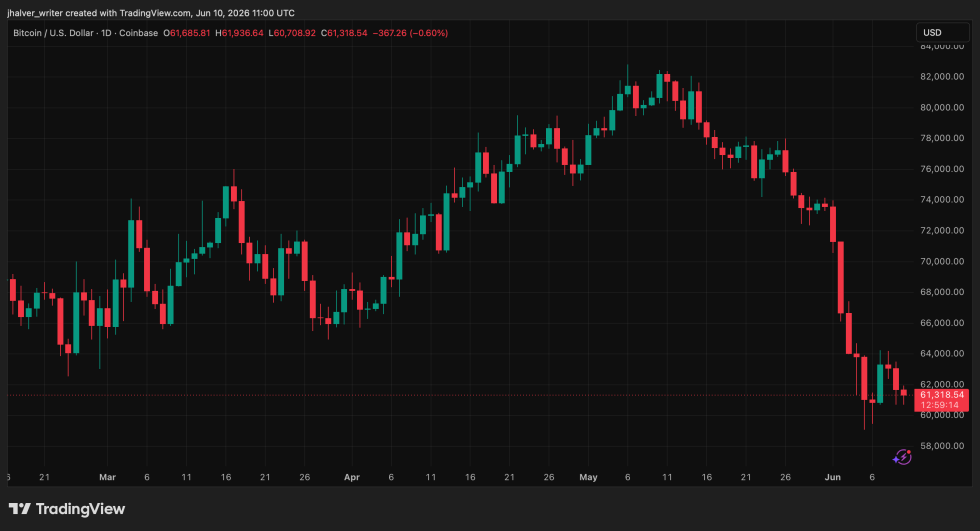
BTC's price trends to the downside on the daily chart. Source: BTCUSD on Tradingview

Privacy: The Infrastructure Bitcoin Still Needs

The other two grantees are wholly dedicated to Bitcoin privacy technologies — an area the report describes as central to Maelstrom’s philosophy.

Benalleng, funded since June 2025, works full time on Payjoin — a transaction protocol that allows both the sender and receiver to contribute inputs to a Bitcoin transaction, systematically breaking the surveillance heuristic that all inputs in a transaction belong to the same party. The Payjoin API has been integrated into Bull Bitcoin and Cake Wallet, with five or more additional wallet integrations currently in progress, per the report.

Bindings for Python, Javascript, Dart, and CSharp have been released to maximize developer accessibility. The report makes an argument that deserves attention: even minority adoption of Payjoin degrades chain surveillance capabilities for the entire network, including users who never use Payjoin themselves — a game-theoretic asymmetry Maelstrom considers one of Bitcoin’s most underappreciated privacy levers.

Macgyver, also funded since June 2025, is focused on Silent Payments — a protocol proposed by Ruben Somsen in 2022 that allows senders to make multiple payments to a recipient using a single static address, without ever reusing that address on-chain. Wallet adoption has progressed materially over the past 12 months: Blindbit-Desktop, Cake Wallet, and Dana Wallet now support both send and receive phases, while Sparrow Wallet and Nunchuk have added send support.

Bitcoin Core has draft implementations for both phases but they remain on hold pending a dependency on the Silent Payments module in libsecp256k1, per the report. Macgyver has formalized the Silent Payments roadmap, produced BIP-375 test vectors, proposed the first working BIP-375 hardware signer implementation for Coldcard, and organized monthly Silent Payments working group meetups.

What The Program Represents

Maelstrom’s grant framework is deliberately narrow — it funds open-source Bitcoin protocol work only, with no commercial strings attached and no token incentives involved. The review committee is two people: Arthur Hayes and Jonathan Bier. The funding comes from a single source.

And the work being done — reviewing consensus code, hardening P2P privacy, building transaction obfuscation tooling — is the kind of development that receives no headlines, generates no token price and yet underpins the security and privacy of a network that now holds hundreds of billions of dollars in value.

This development marks a pivotal moment for how the nascent sector’s most successful participants choose to give back. A family office that has profited substantially from Bitcoin’s appreciation deploying capital directly into the protocol’s open-source development stack — paid in Bitcoin, reviewed by peers, and published transparently — is a model the industry rarely produces and almost never documents this clearly.

Cover image from Grok, BTCUSD chart from Tradingview

Related Questions

QAccording to the article, what are the key focus areas of Maelstrom's Bitcoin Grant Program, and how many developers are currently active?

AThe Maelstrom Bitcoin Grant Program focuses on advancing Bitcoin's privacy, security, and codebase resilience. There are four currently active developers working in the program.

QWho are the two grantees working directly on Bitcoin Core, and what specific contributions did they make as highlighted in the report?

AThe two grantees working on Bitcoin Core are Rkrux and Stratospher. Rkrux is a prolific reviewer, making over 1,155 review comments in 2025 alone and working on MuSig2 and wallet deprecation. Stratospher focuses on consensus-critical validation and the peer-to-peer network, having fixed an undefined behavior bug and contributed to removing the BLOCK_FAILED_CHILD flag.

QWhat are the main privacy technologies being worked on by the other two grantees, Benalleng and Macgyver?

ABenalleng works full-time on the Payjoin transaction protocol to break surveillance heuristics. Macgyver focuses on the Silent Payments protocol, which allows multiple payments to a static address without on-chain reuse.

QHow is the Maelstrom grant program structured in terms of funding and administration?

AThe program issues 12-month contracts, pays monthly in Bitcoin up to a cap of $400,000 per developer per year. It is wholly funded by Maelstrom and administered by a two-person review committee consisting of Arthur Hayes and Jonathan Bier.

QWhy does the article consider the Payjoin protocol's adoption significant for Bitcoin's overall privacy, even if adopted by a minority of users?

AThe article argues that even minority adoption of Payjoin degrades chain surveillance capabilities for the entire network, benefiting users who never use Payjoin themselves. This creates a game-theoretic asymmetry that is considered one of Bitcoin's most underappreciated privacy levers.

Related Reads

After Tokenization of Assets, How to Exit?

Title: How to Exit After Asset Tokenization? Author: Symbiotic Compiled by: Hu Tao, ChainCatcher Summary: Tokenization addresses how assets go on-chain but largely leaves the redemption question unresolved. While tokenized assets can settle instantly, the underlying redemption for assets like treasuries, private credit, or real estate can take from T+1 to 180 days. This gap hinders DeFi adoption of Real World Assets (RWAs). Three emerging models aim to provide instant exit liquidity, differing primarily in their capital structure and efficiency: 1. **Balance Sheet Model (e.g., Grove Basin):** A single entity (like Sky) provides immediate liquidity from its balance sheet, acting as a bridge during the settlement period. It offers simplicity and deep initial liquidity but is constrained by a single entity's capacity and risk appetite. 2. **Asset-Specific Vault Model (e.g., Upshift Clear):** Independent liquidity providers fund dedicated vaults for each supported asset, earning fees. It decentralizes capital sources but isolates liquidity and capital per asset, leading to potential fragmentation. 3. **Shared Liquidity Layer Model (e.g., Symbiotic Liquid Lane):** A shared capital pool supports multiple RWA types simultaneously. Funds remain productive between redemptions (e.g., earning yield in lending markets). Exits are settled via a competitive RFQ market. This model aims for higher capital efficiency, scalability across assets, and serves longer-duration assets like private credit. Key differentiators are: 1) Source of capital and risk bearer, 2) Redemption pricing mechanism, 3) Capital efficiency, 4) Scalability to new asset types, and 5) Composability. The shared liquidity layer model represents a move from piecemeal solutions toward scalable infrastructure, enabling T+0 exits by pooling capital, maintaining yield, and using competitive pricing, thus enhancing RWA utility in DeFi.

marsbit12m ago

After Tokenization of Assets, How to Exit?

marsbit12m ago

After Tokenizing Assets, How to Exit?

After tokenization, a key unresolved issue is providing holders with a reliable exit mechanism, as underlying asset settlement (taking days to months) lags far behind on-chain token settlement. Three primary models for instant liquidity have emerged, differing in their capital structure and efficiency: 1. **Balance Sheet Model (e.g., Grove Basin):** A single, well-capitalized entity (like Sky) provides immediate liquidity from its own reserves. This offers simplicity and deep initial liquidity but is constrained by that single balance sheet's capacity and risk appetite, limiting scalability. 2. **Dedicated Vault Model (e.g., Upshift Clear):** Independent liquidity providers (LPs) fund separate vaults for each supported asset. This decentralizes capital sources but isolates liquidity and capital, which becomes inefficient as the number of tokenized assets grows. 3. **Shared Liquidity Layer Model (Symbiotic Liquid Lane):** Independent capital providers fund shared vaults that can support multiple tokenized assets simultaneously. Capital remains productive between redemptions (e.g., earning yield in DeFi markets). Exits are settled via a competitive RFQ market where market makers bid. The article argues that the shared layer model offers superior capital efficiency and scalability. It transforms exit liquidity from an asset-specific patch into shared market infrastructure, allowing liquidity capacity to grow with overall market participation rather than being fragmented per asset. This is particularly valuable for longer-duration assets like private credit, where reliable T+0 exits can significantly enhance their utility in DeFi.

链捕手26m ago

After Tokenizing Assets, How to Exit?

链捕手26m ago

Anthropic's Triple Moment: Code Leak, Government Confrontation, and Weaponization

This article analyzes Anthropic's recent conflicts and strategic moves following the U.S. government's emergency halt of its new Fable model, citing national security concerns over potential "jailbreaks." The author argues this incident reveals deeper tensions between AI labs, governments, and the software industry. While critics view Anthropic's safety-focused rhetoric as marketing fear, the author suggests it serves as a commercial moat masking the company's core economic imperative: moving closer to end-users and their valuable data to avoid being commoditized. The piece outlines a coming clash between frontier AI labs like Anthropic and established software companies. Labs need real-world usage data for model improvement via reinforcement learning, creating a cycle where better products attract more users and more data. This threatens software firms who, as Microsoft's Satya Nadella warns, risk having their value captured by a few dominant models. Anthropic's controversial policy changes—initially secretly degrading Fable's performance for LLM development and expanding data retention—are framed as assertions of control, justified by its safety narrative. The company's foundational belief that it alone is sufficiently concerned about superintelligent AI dangers legitimizes its actions, from resisting government demands to shaping usage policies. The author concludes that this alignment of mission, talent, and business strategy is powerful but concerning, as it concentrates immense potential power in the hands of those convinced of their own righteous understanding.

marsbit35m ago

Anthropic's Triple Moment: Code Leak, Government Confrontation, and Weaponization

marsbit35m ago

Trading

Spot
Futures

Hot Articles

Discussions

Welcome to the HTX Community. Here, you can stay informed about the latest platform developments and gain access to professional market insights. Users' opinions on the price of S (S) are presented below.

活动图片