If we were to summarize prediction markets in 2025 in one sentence, it might be:
This is the first year prediction markets no longer rely on black swan events but instead begin to rely on structural trading demand.

This was almost unimaginable in the past. For a long time, prediction markets were more like "event tools": they only became briefly active during major uncertainties like elections, pandemics, or wars, then quickly cooled down. But this year, high-frequency events such as sports matches, macroeconomic data, and policy changes provided prediction markets with a stable trading rhythm, making them exhibit, for the first time, operational characteristics close to those of financial exchanges—sustained liquidity, frequent trading, and clear settlements.
On the surface, this is a change in scale; but more importantly, it is a change in role.
Prediction markets are shifting from "betting on whether something will happen" to "how the market prices uncertainty." In other words, probabilities are no longer just personal opinions but are beginning to be treated as price signals that can be repeatedly referenced, much like interest rates, exchange rates, or stock prices.
The True Scale of Prediction Markets in 2025
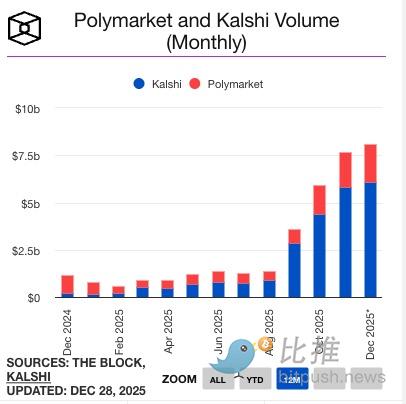
The overall trading volume of prediction markets has grown by an order of magnitude over the past two years. According to industry data from Dune & Keyrock, the monthly trading volume of prediction markets has increased from less than $100 million in early 2024 to stabilize in the range of over $1 billion by the end of 2025, showing explosive growth.
Taking leading platforms as an example, data from The Block shows that Kalshi approached a trading volume of nearly $6 billion in November 2025, with sports contracts contributing the vast majority of the transactions;
Meanwhile, on-chain data and platform disclosures from Polymarket indicate that it also maintained monthly trading volumes in the tens of billions of dollars during several peak months in 2025.
The message behind these numbers is clear: prediction markets no longer rely on "occasional major events" but have entered a stage where they can operate sustainably in everyday environments.
The Industry Gradually Forms "Five Major Camps"
If we only look at trading volume, it is easy to overlook the most critical change in 2025—platforms have embarked on completely different development paths.
For the average reader, it can be simply understood as: some platforms are striving to "become like exchanges," some are trying to "make predictions lighter and more frequent," and others are exploring "whether predictions can be embedded into everyday products."
These differences determine the form prediction markets will take in the future.
First Camp: The Mainstream of Compliant Prediction Markets—Parallel Competition of Two Paths

In 2025, the true marker of prediction markets entering mainstream finance was not the growth in trading volume but the clear differentiation of compliance paths.
One path is the "local compliance, exchange-oriented route" represented by Kalshi. Kalshi chose from the outset to operate entirely within the regulatory framework of the U.S. Commodity Futures Trading Commission (CFTC), defining prediction contracts as standardized event derivatives. In 2025, with the large-scale launch of sports contracts, its trading structure evolved significantly toward high frequency and short cycles, and its product form increasingly resembled that of traditional financial exchanges.
The other path is represented by Polymarket. This is a more challenging route: after initially building scale by leveraging global liquidity, Polymarket completed a compliance restructuring in 2025, acquiring a licensed entity and gaining regulatory approval to officially return to the U.S. market. This made it one of the few platforms in the industry with both a global user base and U.S. compliance status.
The difference between the two lies not in "whether they are compliant" but in the accumulation before compliance. Kalshi's advantage lies in institutional certainty and local distribution capabilities; Polymarket's advantage lies in the global liquidity it has already formed and broader event coverage. They represent two different evolutionary directions for prediction markets within the regulatory framework.
Second Camp: Crypto-Native Experimental Platforms
Outside the mainstream compliance path, there remains a category of platforms that serve the function of trial and error and innovation.
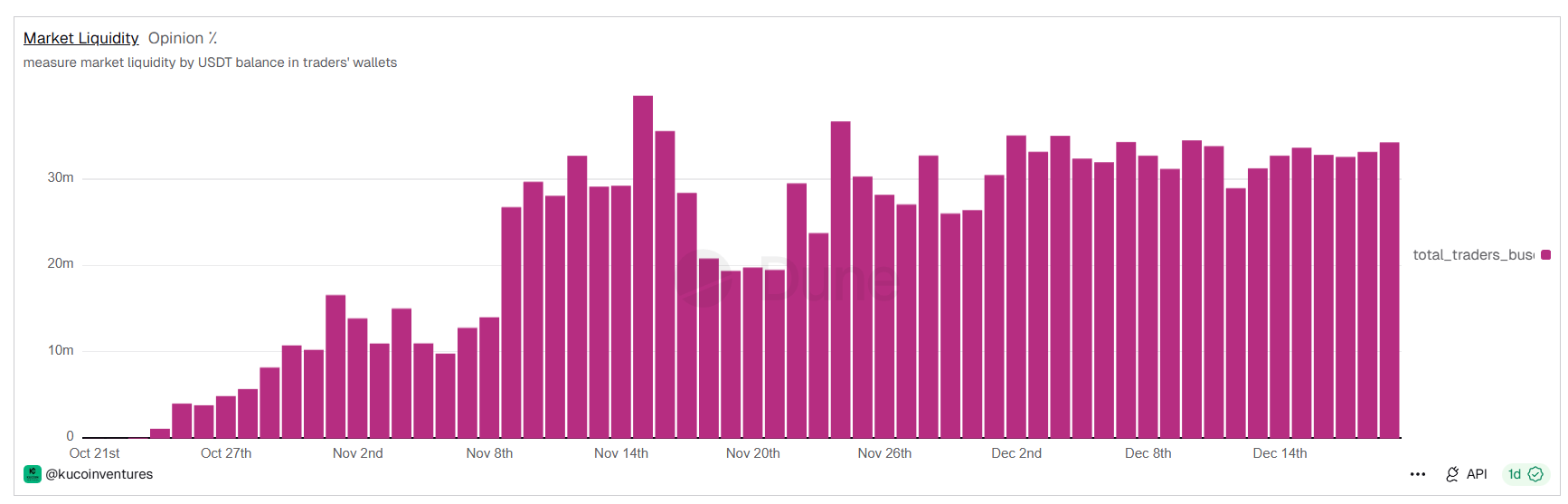
Represented by platforms like Opinion, this camp leverages the native liquidity and community diffusion capabilities of the crypto ecosystem to achieve rapid growth. They are more aggressive in event selection, often covering crypto policies, extreme hypotheses, or highly controversial issues that mainstream platforms have not yet addressed.
The significance of these platforms lies not in short-term scale but in being the first to price highly uncertain questions. However, their trading data often comes from platform displays or third-party statistics and has not yet entered a clear compliance framework, so long-term sustainability remains to be verified.
Third Camp: High-Frequency, Exchange-Thinking Prediction Markets
Platforms represented by Limitless are pushing prediction markets in a new direction.
Here, prediction is no longer an act of "waiting for results" but a trading behavior of high-frequency entry and exit of positions. Contract cycles are deliberately shortened, settlement frequencies are continuously increased, and user behavior resembles that of short-term traders rather than event analysts.
This model blurs the line between prediction markets and derivative trading, also hinting that regulators may need to address new product definitions in the future.
Fourth Camp: The Wallet and Super-Entry Embedded Route
The value of Myriad Markets lies not in trading volume but in its path choice.
Through integration with mainstream wallets, prediction markets are embedded into users' daily asset management processes. Users do not "enter a prediction market" but participate casually while viewing assets or completing interactions.
The long-term significance of this model is its extremely low customer acquisition cost and highly natural user conversion, indicating that prediction markets are shifting from "high-participation-cost behavior" to "everyday light decision-making behavior."
Fifth Camp: Information Markets Native to Public Chains and Content Ecosystems
Platforms represented by predict.fun attempt to treat prediction markets as a native information application.
They rely on public chain ecosystems for diffusion, use incentive mechanisms to drive participation, and deeply integrate prediction behavior with content and communities. At the same time, traditional media are exploring similar directions, using prediction markets as interactive supplements to news content rather than mere trading tools.
Although this camp may struggle to compete with compliant platforms in terms of trading scale in the short term, the product forms and participation mechanisms they explore could influence the usage methods and content organization structures of prediction markets in the medium to long term.
Compliance Is Not Deregulation but Setting Boundaries
In 2025, prediction markets were not "fully liberalized."
A more accurate description is: regulators explicitly acknowledged for the first time that prediction contracts can exist as financial instruments but did not relinquish control over their boundaries. Federal-level attitudes gradually clarified, while state-level gambling regulations became new sources of friction. This inconsistency means prediction markets will remain in a state of "expandable but not uncontrollable."
For the average user, the most important cognitive shift in 2025 is: prediction markets are no longer just about "betting on right or wrong" but about "trading the market's pricing of uncertainty."
Price reflects consensus rather than fact; liquidity is often more important than opinion; profit comes from judgment differences, not the final result itself; and the biggest risk often comes from rule changes, not misjudgment.
Conclusion
Looking back at 2025, the real change in prediction markets is not which platform is more lively, but that a more fundamental question began to be taken seriously:
Who has the right to price uncertainty?
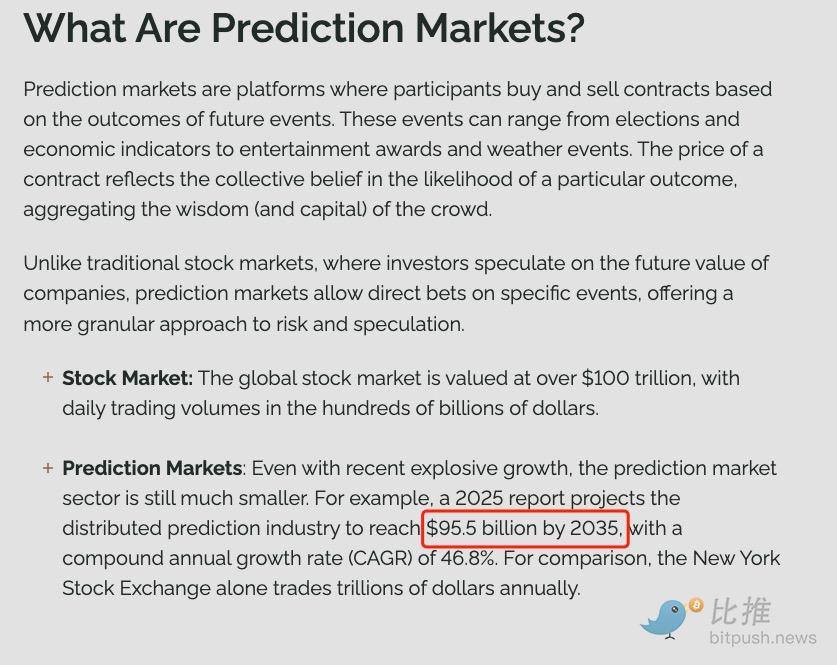
Compliant platforms are setting boundaries, experimental platforms are exploring possibilities, and the true winners may not emerge until after 2026. What is certain is that prediction markets are no longer just gambling but are becoming a tool to help people understand uncertainty. A report released by Certuity predicts that by 2035, the prediction market size could reach $95.5 billion, with a compound annual growth rate of 46.8%.
2025 is just the beginning.
Author: Bootly
Twitter:https://twitter.com/BitpushNewsCN
Bitpush TG Discussion Group:https://t.me/BitPushCommunity
Bitpush TG Subscription: https://t.me/bitpush