Lei Jun Earns 7 Billion in One Day from CXMT's IPO? Xiaomi Executive Responds

marsbitPublished on 2026-07-28Last updated on 2026-07-28

Abstract

On July 28th, Changxin Technology's stock price on the Sci-Tech Innovation Board experienced minor fluctuations. The company had made a historic market debut the previous day, becoming the first A-share stock to record a single-day trading volume exceeding 1 trillion yuan. This led to significant paper gains for its strategic investors. Among them, Xiaomi's wholly-owned subsidiary was allocated 18.24 million shares with an initial investment of approximately 158 million yuan. Reports estimated a paper profit of 717 million yuan for Xiaomi founder Lei Jun based on his shareholding structure. However, a Xiaomi executive clarified that this was a corporate investment and should not be conflated with personal wealth. Other major beneficiaries included Alibaba and Nio. Alibaba, an early investor, held nearly a 5% stake through two entities, with an estimated paper gain exceeding 160 billion yuan. Nio, participating in the strategic placement, also saw substantial paper returns. Additionally, state-owned banks and insurance institutions that invested in Changxin recorded potential gains in the hundreds of billions. Conversely, companies like Country Garden reportedly missed out on nearly 50 billion yuan in potential gains after divesting their stakes before the IPO due to liquidity pressures. The article notes that these are paper profits based on the listing price, as the allocated shares are subject to lock-up periods, and final realized gains will depend on future stock perf...

On July 28, the second trading day of ChangXin Memory Technology (CXMT) on the STAR Market, it opened at 45.22 yuan. As of the time of writing, it was trading at 48.72 yuan, down 0.57%, with a market capitalization of 3.26 trillion yuan.
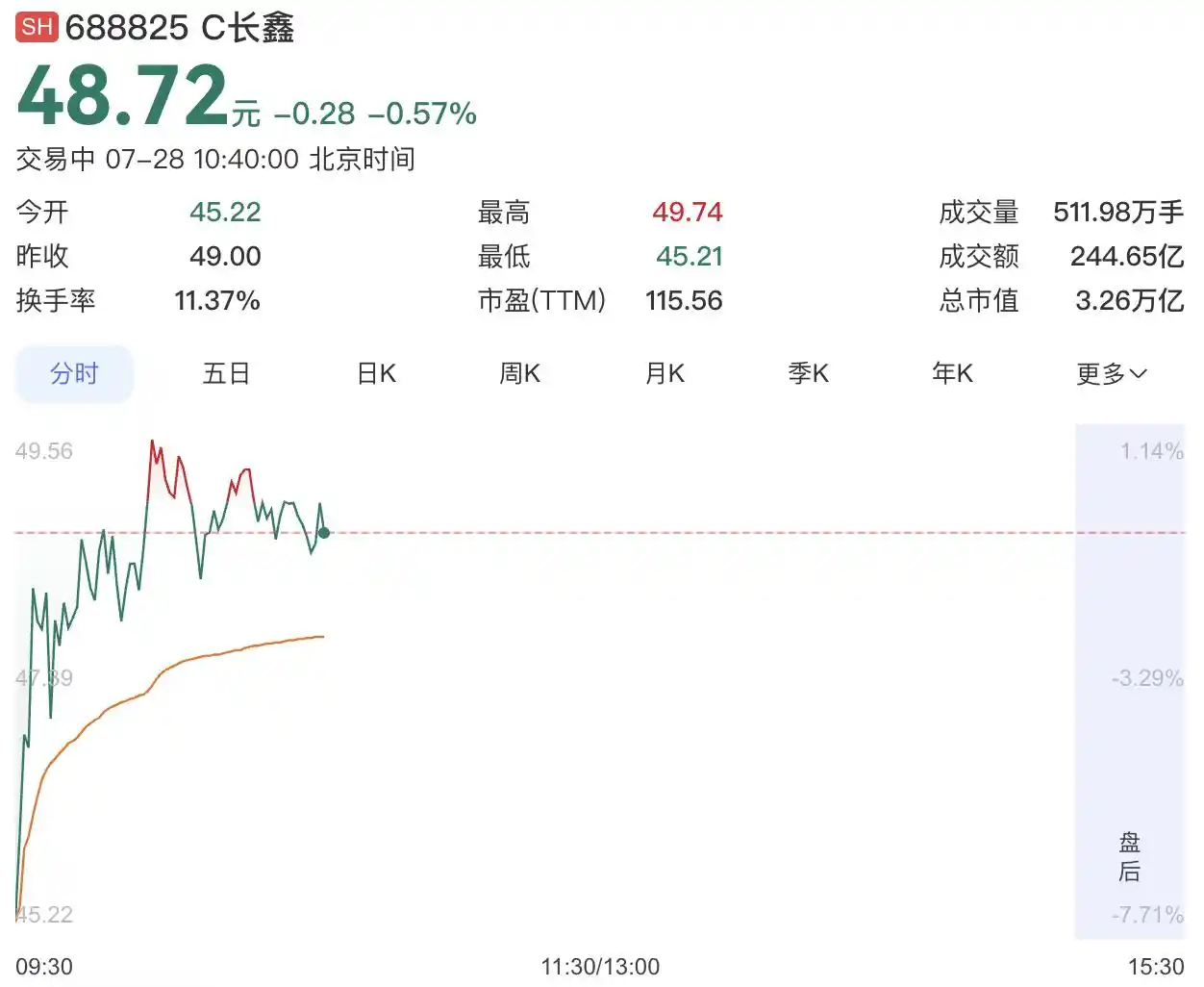
Just yesterday, this leading domestic DRAM manufacturer officially debuted on the STAR Market. Its first-day performance set several new A-share historical records, with a full-day turnover of 141.187 billion yuan, becoming the first A-share stock in history to exceed 100 billion yuan in single-day turnover. This resulted in huge paper gains for all strategic placement shareholders, including Xiaomi founder Lei Jun.

According to the preliminary offline placement results announced by CXMT on July 20, Xiaomi's wholly-owned subsidiary, Wuhan 1810 Enterprise Management Co., Ltd. (hereafter "1810"), was included in the strategic placement list, receiving an allocation of 18,244,800 shares. Based on the issue price, the total investment was approximately 158 million yuan.

Information from Tianyancha shows that 1810 was established in 2021, primarily engaged in business services, with a registered capital of 5.3 billion yuan and paid-in capital of 3.7857 billion yuan. The company's controlling shareholder is Xiaomi Technology Co., Ltd., in which Lei Jun holds a 97.48% stake. Based on this calculation, Lei Jun's paper profit through 1810 on CXMT's listing day was 717 million yuan.

However, on the morning of July 28, Xu Jieyun, Special Assistant to the Chairman of Xiaomi Group and Deputy General Manager of the Strategy and Market Department, responded by saying, "Friends should just take it as fun, don't take it seriously. Actually, it can't be calculated this way; this is a corporate investment action. The specific subsidiary entity and personal wealth cannot be conflated. Also, once again, congratulations to CXMT."

Image Source: Xu Jieyun's Personal Weibo

Alibaba and Nio also benefited from investing in CXMT. Alibaba Group holds nearly 5% of CXMT's shares through two entities, with a cumulative investment of approximately 7.6 billion yuan. Based on the latest market value on the listing day, the value of Alibaba's holdings exceeds 170 billion yuan, representing a paper gain of over 160 billion yuan and a total return multiple exceeding 20 times.

In fact, Alibaba first invested in CXMT as early as December 2021. At that time, Alibaba (China) Network Technology Co., Ltd. invested about 1.5 billion yuan to acquire approximately 1.12% of CXMT's shares. In June 2026, Alibaba invested another 6.1 billion yuan through its subsidiary Zhejiang Alibaba Cloud Computing Co., Ltd. to participate in CXMT's capital increase and share expansion, raising its total stake to nearly 5%. Alibaba Cloud Computing thus became CXMT's sixth-largest shareholder and the largest industrial investor in the final pre-IPO round.

Nio appeared on CXMT's IPO strategic placement list, committing to subscribe to shares worth 158 million yuan with an 18-month lock-up period, subscribing to approximately 18,244,800 shares. Based on CXMT's closing price of 49 yuan per share on July 27, Nio's paper gain is about 740 million yuan, with a yield exceeding 465%.

Regarding the news that "Nio became a strategic investor in CXMT," Nio Chairman Li Bin told the media that cooperation is currently progressing smoothly and that partnering with CXMT helps stabilize Nio's supply chain. Li Bin himself recently attended a thank-you banquet held by CXMT.

Headquartered in Hefei, Anhui, CXMT has three 12-inch DRAM wafer fabs in Hefei and Beijing. According to Omdia data, the company is China's number one and the world's fourth-largest DRAM manufacturer.

It is worth noting that Hefei's state-owned capital had already begun laying out the integrated circuit industry before CXMT's birth. In 2013, Hefei City issued an integrated circuit industry development plan, first proposing to build an influential "China Silicon Valley." The listing of CXMT marks a historic leap for Hefei's integrated circuit industry investments, bringing over one trillion yuan in paper gains to Hefei's state-owned capital. Hefei's total A-share market capitalization has exceeded 4 trillion yuan, making it the second-highest city in the Yangtze River Delta by A-share market capitalization.

Within CXMT, 14 directors, senior managers, core technical personnel, and their close relatives collectively indirectly hold 2.034 billion shares of the company. Based on the closing price of 49 yuan per share, the total market value of their holdings reaches 99.666 billion yuan.

Banks and insurance institutions that bet on CXMT also reaped substantial profits. Five major state-owned banks invested in CXMT through their AICs (Asset Investment Companies) and affiliated funds: Agricultural Bank Investment, CCB Investment, ICBC Financial Investment, BOC Asset, and BOCOM Financial hold approximately 574 million shares, 498 million shares, 383 million shares, 230 million shares, and 230 million shares, respectively, totaling about 1.915 billion shares. Additionally, China Merchants Bank, SPD Bank, and Huishang Bank also hold equity through participating in funds and other means. The potential appreciation for this group of banks' holdings exceeds 100 billion yuan.

Regarding insurance companies, Hexie Health holds 901 million shares, China Life Investment holds 476 million shares, PICC Capital holds 467 million shares, Sunshine Life holds 225 million shares, China Post Life holds 225 million shares, and PICC Science and Technology Innovation holds 90 million shares, totaling about 2.384 billion shares, also valued at over 100 billion yuan.

However, some companies regrettably missed out. Market information shows that Country Garden once held a small stake in CXMT during its financing stages. Due to its own debt and liquidity pressures, it completely exited before the IPO, directly missing out on nearly 50 billion yuan in potential paper gains.

It should be noted that the placement shares this time have a relatively long lock-up period. The paper gains calculated for Lei Jun and the Xiaomi-affiliated group, the banking and insurance institutions, and internet giants are merely static estimates. Subsequent stock price fluctuations will directly affect the final realized gains.

According to a report from Dawan News, in response to online discussions about CXMT, a CXMT employee said, "We should keep a calm mindset. No matter what is said online, it doesn't have much to do with us ordinary employees. We ordinary employees are more concerned about whether our future salaries and benefits will change."

This article is from "Jiemian News," reporter: Song Jianan

Trending Cryptos

Related Questions

QWhat was the core reason Xiaomi's executive clarified regarding rumors of Lei Jun's massive one-day profit from CXT?

AThe core reason was to clarify that the investment was made by a subsidiary company (Wuhan 1810 Enterprise Management Co., Ltd.), not a personal investment by Lei Jun. The executive stated that corporate investment behavior cannot be simply equated with personal wealth.

QBesides Xiaomi, which other major companies were highlighted as benefiting from CXT's IPO?

ABesides Xiaomi, Alibaba Group and Nio were highlighted as major beneficiaries. Alibaba's holdings saw a paper profit exceeding 1.6 trillion yuan, while Nio's strategic placement shares yielded a paper profit of approximately 740 million yuan.

QWhat milestone did Changxin Xinqiao achieve on its first trading day according to the article?

AOn its first trading day, Changxin Xinqiao became the first A-share stock in history to achieve a single-day trading volume exceeding 1 trillion yuan, with a total turnover of 141.187 billion yuan.

QWhich company was mentioned as having missed out on significant potential gains from CXT's IPO and why?

ACountry Garden (BGY) was mentioned as having missed out. Due to its own debt liquidity pressures, it sold off its small equity stake in CXT just before the IPO, directly missing out on nearly 50 billion yuan in potential paper profits.

QWhat is the main caution the article provides regarding the reported paper profits from CXT's IPO?

AThe main caution is that the reported paper profits are static calculations. The shares acquired through strategic placement have a long lock-up period, and subsequent stock price fluctuations will directly affect the final actual realized profits.

Related Reads

The Turning Point of the AI Bull Market: Leverage Blow-ups, Overcapacity in Compute, Why This Macro Analyst is Fully Bearish

AI Bull Market Reaches Inflection Point: Analyst Turns Bearish Due to Leverage, Chinese Competition, and Overcapacity Fidenza Macro analyst Geo Chen explains his decision to sell all AI semiconductor and infrastructure holdings in June, offering a comprehensive bearish thesis. He argues the AI-driven bull market has peaked, citing several key factors. First, unsustainable buying pressure: a massive influx of "low-quality" capital from Korean retail investors using highly leveraged ETFs on stocks like SK Hynix created a parabolic, fragile rally. Recent liquidations have wiped out billions and impacted over a million accounts, removing a key market driver. Second, a competitive threat: the rapid rise of powerful, cost-effective open-source AI models from China, such as MoonShot AI's Kimi K3 and Alibaba's Qwen 3.8, is commoditizing intelligence. This undermines the pricing power and high-valuation financing prospects of closed-source leaders like OpenAI and Anthropic, potentially creating a "single point of failure" for the ecosystem. Third, an impending capacity glut: while AI compute and components are currently in shortage, Chen warns this is typical of a cycle top. Massive, committed capex from cloud providers will likely lead to a supply overhang within 1-2 years. Data shows token spending has already peaked and declined since June, while bond spreads for data center companies are widening, signaling rising credit risk. Chen also highlights broader macro headwinds: the protracted Iran conflict acts as a persistent stagflationary force, and the Federal Reserve under Chair Kevin Warsh is losing credibility in its inflation fight. Long-term Treasury yields breaking above 5.2% present a new challenge for equities. In summary, Chen believes the convergence of speculative excesses, competitive disruption, looming overcapacity, and adverse macroeconomic conditions marks a significant turning point for the AI investment theme.

marsbit15m ago

The Turning Point of the AI Bull Market: Leverage Blow-ups, Overcapacity in Compute, Why This Macro Analyst is Fully Bearish

marsbit15m ago

Saeed Al-Marri: How Tokenization Unlocks New Opportunities for Shipping Funds

Said Al-Marri: How Tokenization Opens New Opportunities for Shipping Funds For centuries, commercial shipping has been a capital-intensive asset class limited to institutional funds and shipping dynasties. Said bin Saleh Al-Marri, CEO of Ethra Invest and Ethra Ship, aims to break down these barriers by combining Real World Asset (RWA) tokenization with conservative private equity principles. This bridges decentralized finance (DeFi) with the physical realities of global trade. Tokenization allows fractional ownership of ships on a blockchain, giving smaller investors access to previously inaccessible markets. However, Al-Marri warns it is not a regulatory loophole or a cure for asset illiquidity. The core physical risks are isolated in Special Purpose Vehicles (SPVs) for qualified investors. While tokenization enhances transparency and ownership record-keeping, Al-Marri stresses that a liquid secondary market depends on transparent asset valuation and must not interfere with ship operations managed by professionals. Regarding legal enforcement, smart contracts cannot physically seize a ship. Legal recourse still relies on traditional maritime courts, ship mortgages, and flag state laws, with blockchain records needing to mirror legal ownership in the SPV perfectly. Beyond ownership, the industry faces administrative hurdles like paper-based bills of lading. Al-Marri argues the bottleneck is legal and operational standardization, not technology. He advocates for a hybrid model combining digital trade documents and programmable settlements with support from regulated financial institutions, rather than a full crypto replacement for tools like Letters of Credit. A major challenge is decarbonizing the global fleet by 2050. Transitioning to green fuels requires massive upfront investment. Al-Marri emphasizes a conservative, holistic approach to underwriting these projects, evaluating technology, fuel availability, safety, and resale value. Investments must be justified under conservative forecasts, not just optimistic ones. By combining pragmatic risk management with digital infrastructure, leaders like Al-Marri show that the evolution of maritime finance is about mobilizing capital to build a modernized and sustainable global fleet, not just putting ships on a blockchain.

cryptonews.ru30m ago

Saeed Al-Marri: How Tokenization Unlocks New Opportunities for Shipping Funds

cryptonews.ru30m ago

Trading

Spot

Hot Articles

Discussions

Welcome to the HTX Community. Here, you can stay informed about the latest platform developments and gain access to professional market insights. Users' opinions on the price of S (S) are presented below.

活动图片