Is RWA Entering the 'Equity Era'? The Backstory Behind Securitize, Ondo, and Coinbase's Simultaneous Moves

marsbitPublished on 2025-12-24Last updated on 2025-12-24

Abstract

RWA is entering an "equity era," marked by a significant shift in focus from major players Securitize, Ondo, and Coinbase toward equity tokenization (Equity RWA). This synchronized move is not coincidental but is driven by clear regulatory direction. In December 2025, SEC Chairman Paul Atkins stated that the U.S. financial markets would migrate to blockchain within two years, a sentiment echoed by Nasdaq's plans for on-chain stock trading. Industry consensus is converging on an on-chain capital market future, with leaders from Maple Finance and Binance emphasizing RWA's potential to bridge blockchain with real-world assets. While private credit and U.S. Treasuries currently dominate RWA due to their regulatory clarity and stability, large institutions are now progressing toward equities. Each platform offers a distinct approach: Ondo provides tokenized stocks with liquidity directly backed by Nasdaq and NYSE-listed shares, targeting non-U.S. investors. Securitize is developing a fully compliant, native on-chain equity model where tokens represent direct shareholder rights. Coinbase is integrating stock trading into its platform, aiming to create a unified financial super-app for diverse assets. This collective pivot signals that on-chain equity is transitioning from an exploratory concept to a structurally significant component of the future financial system, representing a major milestone in RWA's evolution.

By: RWA Knowledge Circle

Edited by: RWA Knowledge Circle

Introduction

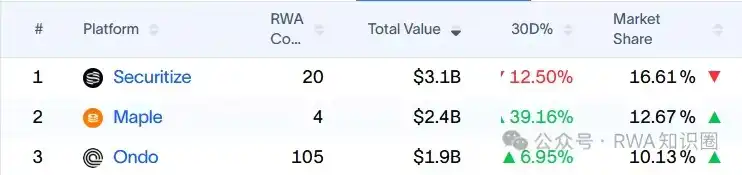
Recently, a noteworthy phenomenon has emerged in the RWA space. Securitize, ranked first in RWA market share, Ondo, ranked third, and leading digital asset exchange Coinbase have almost simultaneously focused their attention on the same thing—Equity RWA (tokenization of equity).

If this had happened a year or two ago, such "synchronization" would not have been common.

Securitize and Ondo both started with compliant financial asset RWA, with core products concentrated in U.S. Treasuries and cash-like assets; Coinbase has long been seen as an infrastructure platform for the crypto market, gradually expanding from exchanges and public chains to the application layer.

But recently, these three institutions have coincidentally begun to embrace on-chain stocks, which is clearly not a coincidence.
I. Not a Platform's "Whim," but Regulation Setting the Direction

Timing is crucial. On December 7, 2025, U.S. SEC Chairman Paul Atkins publicly stated:

In the next two years, the U.S. financial market will migrate entirely to the blockchain.

The SEC (U.S. Securities and Exchange Commission) is the core regulatory body for the U.S. capital market, responsible for securities issuance, exchange supervision, and market order. Public statements by the SEC Chairman often reflect not just personal views but the concentrated release of regulatory direction for the coming years.

Almost simultaneously, the Nasdaq exchange also clearly stated that it is advancing an on-chain trading solution for stocks.

These two signals, combined, make it clear: Equity on-chain is evolving from an "exploratory direction for Web3" to a recognized institutional migration path in traditional finance.

Against this backdrop, compliant RWA platforms like Securitize and Ondo, as well as platform infrastructure like Coinbase, entering equity tokenization is not radical innovation but a顺势而为 (going with the flow).

II. Industry Consensus Is Converging Toward an "On-Chain Capital Market"

Beyond regulation, internal industry judgments are also rapidly unifying.

On December 21, Sid Powell, co-founder and CEO of Maple Finance, the second-largest platform by RWA market share, stated:

In a few years, institutions will no longer distinguish between DeFi and TradFi; ultimately, all capital market activities will be completed on-chain.

Earlier, on October 8, Binance founder CZ also publicly expressed a similar judgment, believing that RWA is one of the most important directions for Web3 in the coming years because it truly enables systematic connection between blockchain and real-world assets.

From a market structure perspective, this consensus did not emerge out of thin air.

Currently, private credit and government bonds still dominate the RWA market, for practical reasons:

  • Not all real-world assets have high-frequency trading demand

  • Insufficient volatility limits on-chain liquidity

  • Regulatory recognition of RWA varies significantly across countries; whitelists, KYC, and permitted issuance are not yet unified

In contrast, the legal and regulatory paths for financial assets are highly mature, with clear ownership and transaction logic, making them more suitable for scaling first.

Thus, a clear trend is evident:

Larger institutions increasingly prefer to advance RWA along the mature path of Government Bonds → Stocks, rather than starting with assets from SMEs with complex equity structures.

III. Despite the Same Goal of "Stock RWA," the Three Offer Different Solutions

Interestingly, although the goal is the same, the implementation methods of the three institutions are completely different.

1. Ondo: Bringing the "Real Stock Market" On-Chain

Ondo Global Markets launched in September this year, offering over 100 types of on-chain tokenized stocks, allowing non-U.S. investors to participate in the U.S. stock market via blockchain settlement, 24/7.

Its biggest feature: Liquidity does not come from AMM pools but directly from Nasdaq and the NYSE.

In other words, Ondo's stock tokens are not "swapped on-chain with each other"; each token is 100% backed by real custodied shares, a model closer to the reserve mechanism of stablecoins. This results in almost no slippage for large trades. On compliance, Ondo has obtained FMA approval to offer tokenized U.S. stocks and ETFs in 30 European countries.

The data is also telling:

In the first week of December, the trading volume of Ondo stock tokens on the Bitget platform exceeded $88 million, capturing a 73% market share. Currently, Ondo Global Markets has reached a cumulative trading volume of $2 billion on Ethereum and BNB Chain, with a TVL exceeding $350 million.

On December 18, Ondo, together with LayerZero, launched Ondo Bridge, supporting 1:1 cross-chain transfer of 100+ stocks and ETFs across multiple chains.

2. Securitize: Native On-Chain Stocks, Leaning More Towards Institutional-Grade & Closed Structures

Securitize has chosen the path of highest complexity but also the most "institutionally native."

On December 17, Securitize announced plans to launch a native on-chain stock product in Q1 2026. Its core features are:

  • Real shares are issued directly on-chain

  • Simultaneously recorded in the issuer's official share register

  • Tokens represent full shareholder rights (dividends, voting, etc.)

More critically, Securitize itself is an SEC-registered transfer agent, ensuring token holders are legally direct shareholders, not indirect holders through an SPV or intermediary. However, it is important to note: This model does not equal "infinite fractionalization and free circulation."

In practice, whether circulation is open, whether whitelists are used, and whether transfer targets are restricted can still be fully controlled through compliant structures and company bylaws. This is why this model is more suitable for institutional-grade issuers, private placement structures, or directed equity arrangements.

3. Coinbase: Integrating Stocks into a "Financial Super App"

Coinbase's approach is more platform-oriented.

On December 18, Coinbase indicated it would introduce stock trading, prediction markets, and various other assets; on December 20, CEO Brian Armstrong announced: In-app stock trading is officially live. Currently, Coinbase supports:

  • 24/7 stock trading

  • Crypto assets and perpetual contracts

  • Prediction markets (in partnership with Kalshi)

  • Integration of decentralized exchange functions

And plans to launch Coinbase Tokenize, an RWA service for institutions, early next year. Its goal is very clear: One account to trade all assets; one interface to complete all financial operations.

IV. On-Chain Equity Is Becoming a Significant Long-Term Variable

Stocks are one of the core asset forms in the modern financial system, and on-chain equity is moving from fringe exploration to a main direction driven by both institutions and industry. Whether it's Ondo's market-driven path, Securitize's institutionally native path, or Coinbase's platform integration path, they are essentially answering the same question:

When capital markets migrate on-chain, in what form should stocks exist?

Understanding this change does not mean immediately participating, but it helps build a cognitive framework for the future financial structure.

As RWA gradually moves from "concept" to "infrastructure," equity tokenization is likely one of the most symbolic milestones.


Trending Cryptos

Related Questions

QWhat recent trend in the US financial market is driving major RWA players like Securitize, Ondo, and Coinbase to focus on equity tokenization?

AThe recent statement by SEC Chairman Paul Atkins on December 7, 2025, indicating that the entire US financial market will migrate to blockchain within two years, along with Nasdaq's push for on-chain stock trading solutions, is driving this trend.

QHow does Ondo's approach to equity tokenization differ from traditional on-chain trading models?

AOndo's model does not rely on AMM pools for liquidity but directly sources it from Nasdaq and NYSE, with each token 100% backed by real custodied shares, minimizing slippage in large trades.

QWhat is the key legal distinction of Securitize's native on-chain equity model compared to other RWA platforms?

ASecuritize, as an SEC-registered transfer agent, ensures token holders are legally recognized as direct shareholders with full ownership rights (dividends, voting), with shares directly issued on-chain and recorded in the issuer's official cap table.

QWhat broader industry consensus is emerging regarding the future of capital markets and blockchain technology?

AIndustry leaders like Maple Finance's CEO Sid Powell and Binance's CZ believe that within a few years, institutions will not distinguish between DeFi and TradFi, as all capital market activities will migrate on-chain, with RWA being a key direction for systemic blockchain integration.

QHow is Coinbase integrating equity tokenization into its platform strategy?

ACoinbase is building a financial super-app by integrating 24/7 stock trading, crypto assets, perpetual contracts, prediction markets (via Kalshi), and decentralized exchange features, aiming to allow all financial operations in one account and interface, with plans for institutional RWA services like Coinbase Tokenize.

Related Reads

Must-Watch Events Next Week|CLARITY Act Could Face Senate Vote; SpaceX, Circle to Report Earnings (8.3-8.9)

**Summary: Key Events and Developments to Watch (August 3-9)** The upcoming week is marked by significant financial disclosures, key legislative deadlines, and notable product updates. **Major Financial Events:** Several companies are scheduled to release their Q2 2026 earnings. American Bitcoin (ABTC) will report on August 3, followed by SpaceX and Hut 8 Mining Corp. on August 4, and Circle on August 5. Notably, a significant portion of SpaceX shares (up to 12% of total shares) will be unlocked on August 6 following their earnings release. **Key Legislative Deadline:** The U.S. Senate faces an August 7 deadline to secure 60 votes for the CLARITY Act, a bipartisan bill aiming to establish a federal regulatory framework for cryptocurrencies. The Senate may hold a full vote on the bill during the week. **Economic Data:** The U.S. July Non-Farm Payrolls report will be released on August 7, providing crucial labor market data. **Technology & Product Updates:** * **Shutdowns:** DeFi portfolio tracker Zapper and wallet app Ctrl Wallet will cease operations on August 3. * **Upgrades:** LayerZero will deprecate its v1 relayers on August 3. XRP Ledger's new version 3.3.0, featuring five new functions, is expected next week. * **AI:** Elon Musk announced that the advanced Grok 4.6 AI model is set for release around August 7. * **Bitcoin:** The BIP-110 forced signaling for a potential Bitcoin network change is scheduled to begin around August 8. **Other Notable Events:** Chinese robotics firm Unitree Tech has set its preliminary price inquiry for its IPO for August 5. South Korean exchange Upbit will delist AQT and AERGO tokens on August 3.

marsbit1h ago

Must-Watch Events Next Week|CLARITY Act Could Face Senate Vote; SpaceX, Circle to Report Earnings (8.3-8.9)

marsbit1h ago

Stocks Are Plummeting More Sharply Than Cryptocurrencies. Where Has the Money Gone?

Stock Markets Plunge Deeper Than Cryptocurrencies: Where Did the Money Go? In late July, Seoul's Kospi index triggered circuit breakers for two consecutive days, plummeting over 40% from its June high. The collapse was led by heavyweight stocks like SK Hynix, whose record profits still disappointed investors, and devastating leveraged ETFs, with one major product losing over 83% of its value. This signaled a global, forced deleveraging targeting the most crowded trades. Interestingly, while stocks exhibited extreme volatility akin to crypto markets, Bitcoin rose nearly 15% in July after a prior steep drop. Analysis shows the money fleeing equities did not flow into Bitcoin. Instead, Bitcoin had already absorbed its sell-off in May-June, when U.S. spot Bitcoin ETFs saw historic outflows. The true safe-haven beneficiary was gold, whose price rose over 20% year-on-year, highlighting a decoupling between Bitcoin and gold as "digital gold." The sell-off was a targeted unwinding of leveraged positions in tech and semiconductors, accelerated by broker-dealer risk management and shifts in the AI narrative, including new competition from Chinese memory chipmakers. The retreat path was clear: from high-valuation tech stocks to cash and U.S. Treasuries, then to gold. For Bitcoin to attract sustained institutional inflows, conditions like eased global liquidity pressure, a "soft-landing" Fed rate cut, and U.S. regulatory clarity via legislation like the stalled CLARITY Act are needed. Currently, Bitcoin is not a safe haven but an already-cleared asset. Its low correlation with tech stocks, however, makes it a potential diversification play for institutional portfolios once the storm passes. The money isn't here yet, but the positioning is underway.

marsbit1h ago

Stocks Are Plummeting More Sharply Than Cryptocurrencies. Where Has the Money Gone?

marsbit1h ago

In Conversation with Ray Dalio: We Are Currently in an AI Bubble, with 1% of My Portfolio in Bitcoin

Ray Dalio, founder of Bridgewater Associates, warns in an interview that the current AI boom shows classic bubble characteristics, which could lead to significant economic downturns as seen in past cycles like 1929 or 2000. He explains that speculative enthusiasm, fueled by debt and overvaluation, often precedes a crash when rising rates or taxation force asset sales, causing widespread losses and recession. Dalio also outlines his "Big Cycle" theory, describing an approximate 80-year pattern where widening wealth gaps, massive government deficits, and shifting geopolitical power (like China's rise) create internal conflict and global instability. He emphasizes that we are in a late-cycle, transitional phase where traditional powers like the US and UK face decline. For personal wealth protection, Dalio advises diversification beyond cash into assets like stocks, bonds, real estate, and particularly gold, which he prefers over Bitcoin. While he holds about 1% of his portfolio in Bitcoin as a non-printable hard asset, he views gold as more secure from technological or governmental threats. Regarding AI's impact, Dalio believes it will disproportionately benefit capital owners, worsening inequality by replacing both physical and cognitive labor. He suggests that human intuition and emotional intelligence, combined with AI, will be key for future workers. On taxation, Dalio argues that wealth taxes are impractical and risk triggering asset sell-offs, reducing productive investment. He points to the UK as a cautionary example of debt, low productivity, and political strife. Geopolitically, Dalio foresees a more regionalized world, with the US showing weakness in prolonged conflicts like with Iran, akin to past imperial declines. The ideal outcome, he suggests, is coexisting powerful blocs (e.g., Americas, China-Asia Pacific) without major war.

marsbit5h ago

In Conversation with Ray Dalio: We Are Currently in an AI Bubble, with 1% of My Portfolio in Bitcoin

marsbit5h ago

Trading

Spot

Hot Articles

Discussions

Welcome to the HTX Community. Here, you can stay informed about the latest platform developments and gain access to professional market insights. Users' opinions on the price of S (S) are presented below.

活动图片














