Is Robinhood Chain’s success bullish or bearish for ETH the asset?

cointelegraphPublished on 2026-07-27Last updated on 2026-07-27

Abstract

The launch of Robinhood Chain, an Arbitrum-based Ethereum Layer 2 (L2), has revived the debate on whether successful L2 networks boost demand for Ether (ETH) or capture the value themselves. While the network rapidly attracted significant activity and bridged over $141 million in ETH, analysts are divided on the long-term impact on ETH's value. Supporters argue its launch by a major public brokerage, targeting tokenized assets, strengthens Ethereum's institutional adoption case and could position ETH as a foundational monetary asset across L2 ecosystems. Critics point to Ethereum's ongoing "value accrual" problem, where high L2 activity generates minimal revenue for the Ethereum mainnet, as seen with Robinhood Chain contributing only a tiny fraction of its fees back to L1. The article concludes that while Robinhood Chain validates Ethereum's scaling strategy for major institutions, it doesn't resolve the core question of how growing L2 activity translates into concrete value and demand for the ETH asset itself.

Robinhood Chain’s explosive launch this month has reignited one of Ethereum’s longest-running debates: Do successful layer-2 networks increase demand for ETH, the asset, or do the new entrants capture all of the value for themselves?

The retail brokerage’s Arbitrum-based Ethereum L2 has become one of Ethereum’s busiest rollups since its launch on July 1.

More than $141 million in Ether was bridged onto the chain in its first two weeks. DeFiLlama data shows more than half a million wallets now hold ETH on the network, and a memecoin frenzy saw Robinhood Chain surge past the Ethereum L1 and Coinbase’s Base L2 in 24-hour DEX trading volume.

Ether has pumped on the news, gaining around 15% from $1,582 on July 1 to $1,825 by July 13, according to Coingecko data, following a wave of bullish comments.

World Liberty Financial’s Eric Trump posted on July 11, “ETH is pumping hard! Great to see!” while Tom Lee, chairman of BitMine Immersion Technologies, argued the launch reinforces the thesis that “ETH is money,” pointing to the asset’s role as the chain’s native gas token and the L2’s finality on Ethereum’s mainnet.

Ethereum investors have heard similar arguments before.

Related: Robinhood L2 sparks ETH optimism, Saylor ‘muddies waters.’ Hodler’s Digest, July 5-12, 2026

Arbitrum, Optimism and Base each drove waves of users and activity onto Ethereum’s L2 ecosystem, but failed to move the needle meaningfully in Ether’s price, as most of the economic activity remained on the rollups themselves.

Robinhood Chain’s launch is arguably different. Unlike previous rollups built by crypto-native firms, the network was developed by a publicly listed retail brokerage with tens of millions of customers to support tokenized stocks and other real-world assets.

Within days of launch, it already accounted for 6.9% of all tokenized stockholders, according to data from Token Terminal.
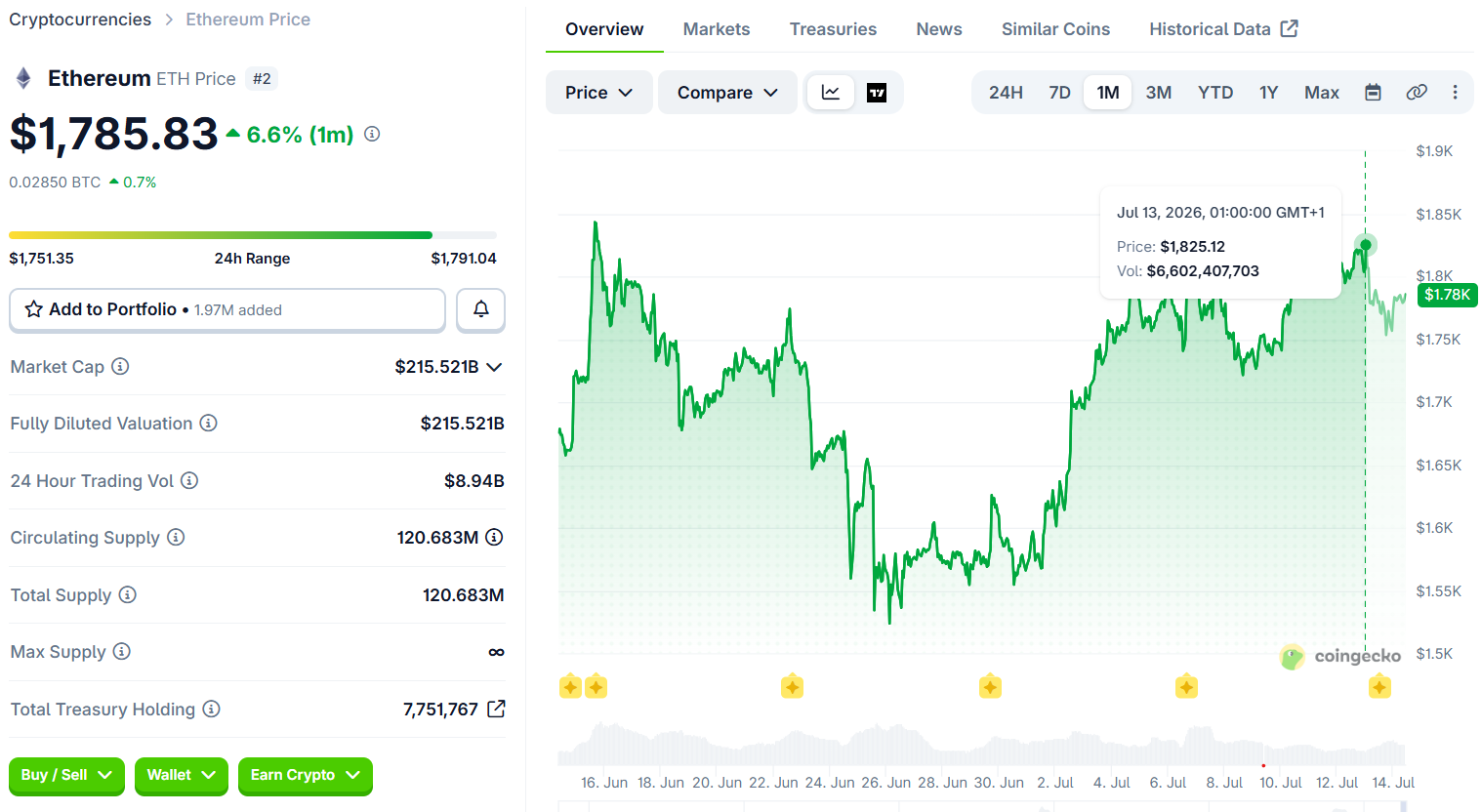
Ether price response to Robinhood Chain’s launch. Source Coingecko

And, if Robinhood’s model succeeds, it could encourage banks, brokers and asset managers to build L2s of their own, and cement Ethereum as the default blockchain for TradFi. Deutsche Bank is already in the process of building a ZK-powered Ethereum L2 called DAMA 2, focused on institutional finance.

Why Robinhood could be a turning point

Ethereum’s L2 networks use rollup technology to process transactions away from Ethereum’s main chain and periodically settle them back to the network. Robinhood Chain uses Arbitrum technology and is compatible with Ethereum’s wider ecosystem.

But what has caught the industry’s attention isn’t the technology itself, as much as who is using it.

“It’s a real milestone,” Alex Gluchowski, founder and chief executive of Matter Labs, the developer behind Ethereum L2 zkSync, told Cointelegraph.

“It shows Ethereum L2s have gone from something crypto-native teams experiment with to infrastructure a regulated, publicly listed company will run its business on.”

Rather than building a blockchain from scratch, as Stripe has opted to do with Tempo, Robinhood chose to tailor an Ethereum rollup to its own needs “for privacy, compliance and performance, while still inheriting Ethereum’s security and connecting to its liquidity,” he added.

Max Shannon, senior research analyst at Bitwise, told Cointelegraph that Robinhood Chain’s success is more significant than previous L2 deployments.

“It represents the growth of the Ethereum ecosystem, particularly among major institutions,” he said. “It also arrives at a time when Ethereum has more broadly repositioned itself toward institutions through Eth Labs and Ethereum Institutional.”

Does Robinhood Chain change the investment case for ETH?

For Shannon, Robinhood’s launch strengthens the investment case for Ethereum because it reinforces the network’s position as the leading blockchain for institutional adoption.

He said ETH has the “network characteristics” to become the reserve asset for a growing network of institutional L2s. But like many, he believes Ethereum’s tokenomics need to be improved so that increased network activity is reflected more clearly in demand for ETH.

Ethereum has been criticized frequently for its decision to lower fees for L2s as a way to spark adoption and gain network effects. Ark Invest’s Lorenzo Valente posted on July 14 that Robinhood Chain had generated $816,000 in revenue since launch, with Arbitrum taking a 10% cut, but only 0.15% of the total being paid back to Ethereum.

“If your thesis is ‘ETH is money,’ Robinhood building here is ultra bullish. More activity, more ETH collateral, more lindyness. If your thesis is ‘ETH is a revenue generating asset,’ this is the ultra-bear case.”

GrowThePie said that Valente’s figures for Eth’s share of the revenue were off by a factor of four and argued “0.6% of revenue is the correct figure.” But even the higher figure is not a meaningful driver of revenue to the L1. Robinhood Chain generated more gas fees than any other L2 in the past week, but Ethereum only saw $4,400 of that.
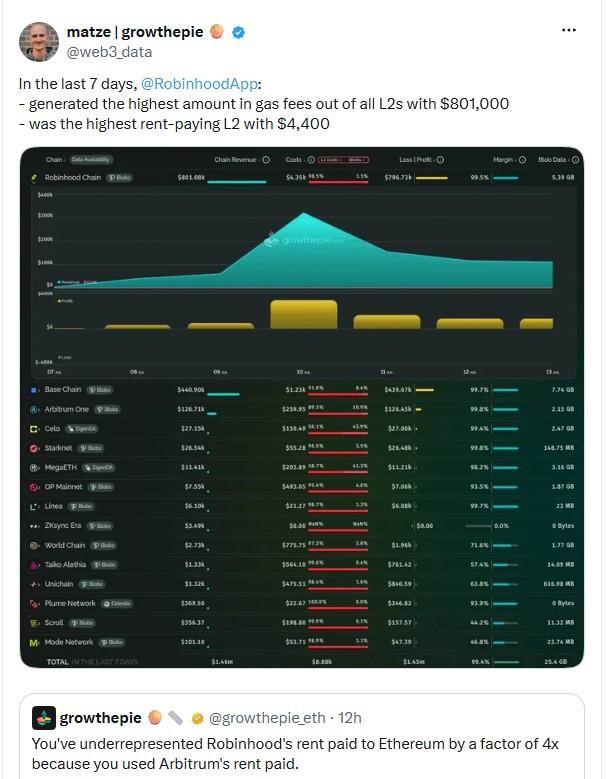
Source: Matze, GrowThePie

Gluchowski said ETH’s appreciation would not be based on fee revenue, but would likely come from becoming widely accepted money throughout the L2 ecosystems.

“People might pay fees in stablecoins or never think about gas at all,” he said. “But as more value settles through Ethereum, ETH starts to look less like a fee token and more like a base monetary asset for this system.”

Related: Robinhood says its AI agent feature will ‘soon’ be assisting crypto traders

Even ETH bears like Mike Dudas from 6th Man Ventures, have described Robinhood Chain as “the single most bullish thing I’ve seen in eth-land in years.”

But after Dudas saw Valente’s post, he added the proviso that “Eth cooked unless ‘eth is money’ takes off or the price of l1 settlement increases.”

The value accrual question remains

While Robinhood’s success may have bolstered the case for Ethereum’s scaling strategy, it has yet to settle one of the network’s biggest unanswered questions: how does growing L2 activity ultimately translate into value for ETH?

Shannon said that recent upgrades like Fusaka have improved Ethereum’s scaling capabilities, but despite transaction activity reaching record levels, demand has yet to translate into meaningfully higher fees or increased ETH burn.

“Robinhood will not solve this problem,” Shannon said, and the collective growth of L2s will likely not either... It requires a wholesale change in developer mindset and in ETH’s token economics.”

Another uncertainty is how much ETH institutional users will actually hold directly. As tokenized stocks and other RWAs increasingly trade against stablecoins, many users may rarely interact with ETH, even though it underpins the network behind the scenes.

Robinhood may have shown that a major financial institution is willing to build on Ethereum’s infrastructure, but whether that ultimately translates into stronger demand for ETH remains to be seen.

Magazine Ethereum’s much-hated staking ‘tax’ may already be obsolete

Trending Cryptos

Related Questions

QWhat is the central debate about Ethereum reignited by the launch of Robinhood Chain?

AThe debate is whether successful layer-2 networks increase demand for ETH as an asset, or if the new entrants capture all the value for themselves.

QAccording to the article, why might Robinhood Chain's launch be more significant than previous L2 deployments like Arbitrum or Base?

AIt is more significant because it was developed by a publicly listed retail brokerage with tens of millions of customers, targeting tokenized stocks and real-world assets, representing institutional adoption rather than just crypto-native experimentation.

QWhat are the two main competing theses regarding how Robinhood Chain's success impacts the investment case for ETH?

AThe two theses are: 1) 'ETH is money' - bullish, as more activity increases ETH's role as collateral and base monetary asset. 2) 'ETH is a revenue-generating asset' - bearish, as very little L2 fee revenue accrues back to the Ethereum L1.

QWhat problem does the article state that Robinhood Chain's growth will NOT solve for Ethereum?

AIt will not solve the problem of translating growing L2 transaction activity into meaningfully higher fees or increased ETH burn on the Ethereum L1, which requires a change in developer mindset and ETH's token economics.

QWhat is one potential future implication for Ethereum if Robinhood's model succeeds?

AIt could encourage other banks, brokers, and asset managers to build their own L2s, cementing Ethereum as the default blockchain for traditional finance (TradFi).

Related Reads

In Conversation with Ray Dalio: We Are Currently in an AI Bubble, with 1% of My Portfolio in Bitcoin

Ray Dalio, founder of Bridgewater Associates, warns in an interview that the current AI boom shows classic bubble characteristics, which could lead to significant economic downturns as seen in past cycles like 1929 or 2000. He explains that speculative enthusiasm, fueled by debt and overvaluation, often precedes a crash when rising rates or taxation force asset sales, causing widespread losses and recession. Dalio also outlines his "Big Cycle" theory, describing an approximate 80-year pattern where widening wealth gaps, massive government deficits, and shifting geopolitical power (like China's rise) create internal conflict and global instability. He emphasizes that we are in a late-cycle, transitional phase where traditional powers like the US and UK face decline. For personal wealth protection, Dalio advises diversification beyond cash into assets like stocks, bonds, real estate, and particularly gold, which he prefers over Bitcoin. While he holds about 1% of his portfolio in Bitcoin as a non-printable hard asset, he views gold as more secure from technological or governmental threats. Regarding AI's impact, Dalio believes it will disproportionately benefit capital owners, worsening inequality by replacing both physical and cognitive labor. He suggests that human intuition and emotional intelligence, combined with AI, will be key for future workers. On taxation, Dalio argues that wealth taxes are impractical and risk triggering asset sell-offs, reducing productive investment. He points to the UK as a cautionary example of debt, low productivity, and political strife. Geopolitically, Dalio foresees a more regionalized world, with the US showing weakness in prolonged conflicts like with Iran, akin to past imperial declines. The ideal outcome, he suggests, is coexisting powerful blocs (e.g., Americas, China-Asia Pacific) without major war.

marsbit1h ago

In Conversation with Ray Dalio: We Are Currently in an AI Bubble, with 1% of My Portfolio in Bitcoin

marsbit1h ago

Daily 7.2 Trillion KRW: Foreign Capital's Record Net Buying on Friday! Wall Street Says Headwinds for Korean Stock Fund Flows Have Subsided

South Korean stock market sees a dramatic shift in fund flows. On July 31, foreign investors made a record net purchase of approximately KRW 7.2 trillion in KOSPI stocks, marking a fundamental reversal from the persistent large-scale net outflows seen in previous months. This contributed to a significant narrowing of foreign net selling in July to KRW 9.8 trillion, down sharply from KRW 48.4 trillion in June and KRW 44.5 trillion in May. Simultaneously, domestic institutional pressure eased. South Korean pension funds and asset managers turned to a net buying position in July, purchasing KRW 1.0 trillion worth of KOSPI shares, contrasting with net sales in May and June. Market volatility is expected to be dampened by new financial regulations. Effective July 31, the Financial Services Commission tightened access for retail investors to single-stock leveraged ETFs by raising the minimum cash deposit requirement. Trading volumes for these products subsequently dropped to about 50% of their monthly average. Citigroup Research maintains its year-end KOSPI target of 10,000 points. The firm cites several supportive factors: the substantial easing of headwinds from capital outflows, a robust fundamental outlook for the semiconductor sector, historically low market valuations, strong economic fundamentals, and the potential for policy support from financial authorities if needed.

marsbit1h ago

Daily 7.2 Trillion KRW: Foreign Capital's Record Net Buying on Friday! Wall Street Says Headwinds for Korean Stock Fund Flows Have Subsided

marsbit1h ago

Thanks to Dice Rolls, Bitcoin Keys Are Stored Offline, But Not Everyone Will Do It

The article discusses using dice rolls to generate secure Bitcoin wallet seeds, providing entropy independent of potentially flawed hardware random number generators. It explains that each fair dice roll offers about 2.585 bits of entropy, with around 50 rolls needed for a standard 12-word seed phrase and 99+ recommended for higher security. This method gained attention after a vulnerability was revealed in some Coldcard hardware wallets, where a faulty firmware RNG (dating back to 2021) compromised generated keys. The analysis notes that while a dice-generated main seed was safe from this specific flaw, other Coldcard functions (like creating paper wallets, backup keys, or passwords) could still be vulnerable if they used the defective RNG. The piece argues that while dice-based entropy is technically robust, the manual process is error-prone, tedious, and unrealistic for most new users, who might make mistakes in recording or inputting rolls. It concludes that while manual entropy generation should remain an option for advanced users, the long-term goal is to develop reliable, user-friendly hardware and software that securely generates randomness without requiring specialized knowledge. Coldcard users are advised to check their firmware version and replace any secondary secrets (like paper wallet keys) created with vulnerable devices, while also considering multi-signature setups with devices from different manufacturers for added security.

cryptonews.ru7h ago

Thanks to Dice Rolls, Bitcoin Keys Are Stored Offline, But Not Everyone Will Do It

cryptonews.ru7h ago

Trading

Spot

Hot Articles

Discussions

Welcome to the HTX Community. Here, you can stay informed about the latest platform developments and gain access to professional market insights. Users' opinions on the price of S (S) are presented below.

活动图片















