Iran Opens Fire on an Oil Tanker That Paid Bitcoin Transit Fees to Scammers

marsbitPublished on 2026-04-22Last updated on 2026-04-22

Abstract

Iran announced plans to charge Bitcoin and USDT transit fees for oil tankers passing through the Strait of Hormuz. Within two weeks, scammers impersonated Iranian officials and sent fraudulent messages to stranded vessels, demanding cryptocurrency payments in exchange for safe passage. At least one tanker that paid the fake fee was fired upon by Iranian Revolutionary Guard boats when attempting to cross. Maritime risk firm MARISKS confirmed the scam exploited shipowners’ anxiety amid heightened regional tensions. Chain analysis firms TRM Labs and Chainalysis found no evidence of large-scale crypto payments actually being made to Iranian entities. Legal experts warned that even payments made to scammers—if intended for Iran—could violate international sanctions. The incident highlights how cryptocurrency’s irreversibility, often touted as a strength, becomes a critical risk in conflict-driven fraud. While Iran’s proposal initially sparked excitement in crypto circles, it ultimately created a new attack vector for deception, leaving ships trapped, fined, or even under fire.

Author: Deep Tide TechFlow

Deep Tide Introduction: Less than two weeks after Iran announced it would collect Bitcoin transit fees in the Strait of Hormuz, scammers impersonated Iranian officials and sent fake messages to stranded oil tankers demanding BTC and USDT.

At least one tanker that paid the fake transit fee was fired upon by the Iranian Revolutionary Guard Corps when attempting to pass. Chain analysis firms TRM Labs and Chainalysis both stated that no large-scale on-chain evidence of cryptocurrency payments has been found so far.
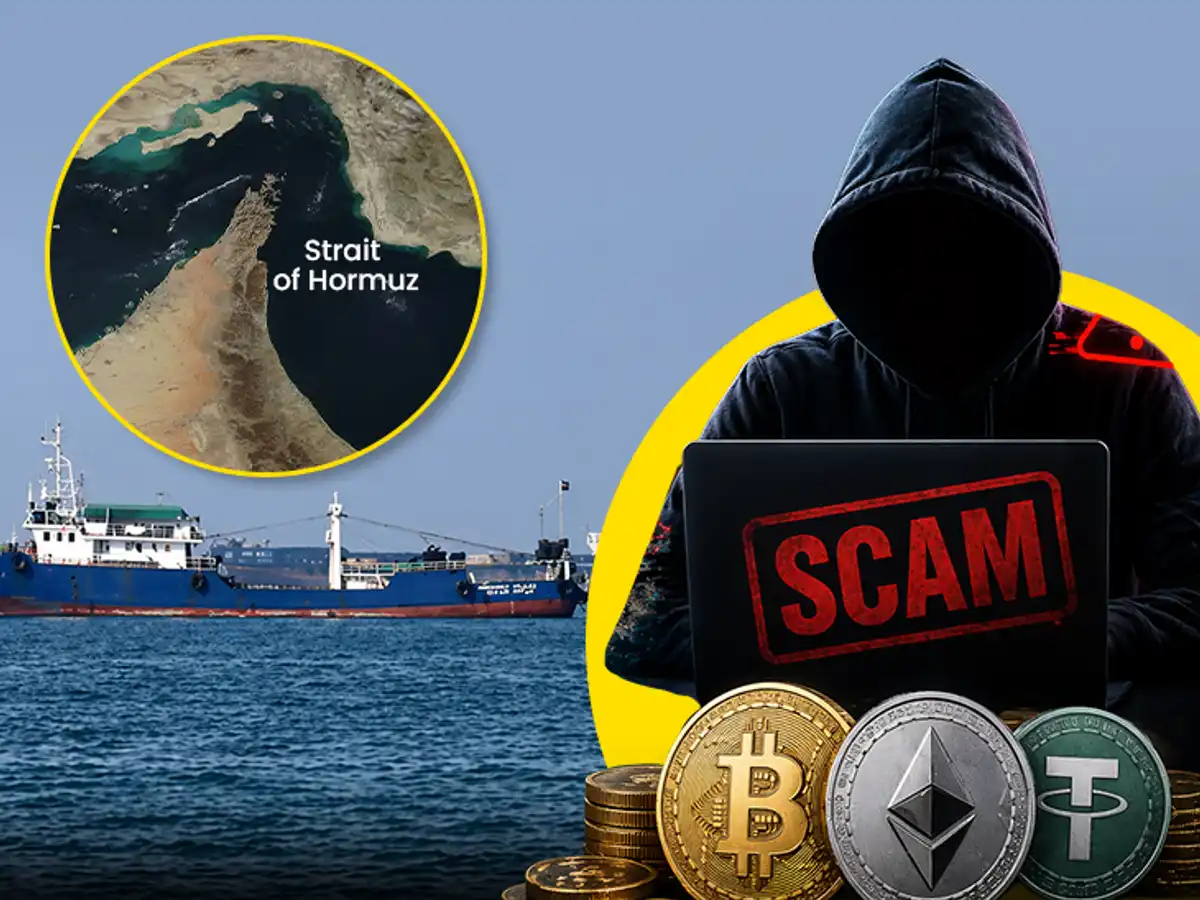
Iran announced it would collect transit fees in Bitcoin, and within two weeks, scammers turned this narrative into a weapon.

According to a Reuters report on April 21, the maritime risk management company MARISKS issued a warning: unidentified individuals are posing as Iranian authorities and sending false messages to ships stranded on the western side of the Strait of Hormuz, demanding payment of "transit fees" in BTC or USDT in exchange for safe passage. MARISKS believes that at least one of the vessels fired upon by Iranian Revolutionary Guard Corps speedboats on April 18, when Iran briefly opened the strait, was a victim of this scam.

The absurdity of the incident lies in the entire chain of causality: a sovereign state announces it will collect Bitcoin transit fees, scammers copy this rhetoric to commit fraud, shipowners believe it and pay, and then get shot at by the real Iranian military.

From "National-Level Settlement Tool" to Attack Surface for Scammers

The story begins in early April.

From March 30 to 31, the Iranian parliament passed the "Hormuz Strait Management Plan," formally writing into law the transit fee system that the Islamic Revolutionary Guard Corps had already been implementing since mid-March. According to the Financial Times, Hamid Hosseini, spokesperson for the Iran Oil, Gas, and Petrochemical Products Exporters Union, confirmed that fully loaded tankers are required to pay a fee of $1 per barrel, with payment methods including Bitcoin, USDT, or Chinese yuan. A supertanker carrying 2 million barrels of crude oil could face a single transit fee of up to $2 million.

Upon the news, Bitcoin's price jumped 5%, briefly breaking through $72,700. The crypto community quickly interpreted this as a milestone validation of Bitcoin as a "neutral settlement layer for international trade." Institutions like Bitwise even linked it to predictions of Bitcoin reaching $1 million.

But there were also many skeptics.

Sam Lyman of the Bitcoin Policy Institute pointed out in a report on April 15 that large-scale collection of Bitcoin transit fees with existing technology is "almost impossible." Ari Redbord, global policy head at TRM Labs, told Fortune magazine that on-chain data does not show transit fee payments occurring on a large scale. Chainalysis, in its analysis report, noted that on-chain activities of entities linked to Iran primarily rely on USDT on the Tron network, not Bitcoin.

Scammers don't care about these technical debates. They only need a credible narrative, and the Iranian government has already written the script for them.

Ships That Paid the Fake Fee Got Shot at for Real

According to Reuters and DL News, the wording of the scam messages highly imitates official language. The scammers required shipowners to submit ship documents, claiming they would be assessed by the "Iranian security department." After passing the assessment, payment in BTC or USDT would be required, after which the ship could "safely pass through the strait at the scheduled time."

Approximately 400 ships and about 20,000 crew members are currently stranded in the Persian Gulf. With the U.S. blockading Iranian ports and Iran repeatedly opening and closing the strait for passage, the anxiety of shipowners is understandable. The scammers precisely exploited this anxiety.

On April 18, Iran briefly opened the strait, and some ships attempted to pass. According to the UK Maritime Trade Operations (UKMTO), two Iranian Revolutionary Guard Corps speedboats opened fire on an oil tanker trying to exit the strait, forcing it to turn back. MARISKS believes this tanker had previously paid the cryptocurrency "transit fee" to scammers, thinking it had obtained passage permission.

They paid, but the money didn't go to Iran. The ship was still shot at.

Paying Scammers Could Also Violate Sanctions Laws

Even more ironically, even if shipowners realize they have been scammed, the legal risks won't disappear.

Xue Yin Peh, investigation strategy head at Chainalysis, told Decrypt that regardless of whether the recipient is actually the Iranian authorities, as long as the payer intended to pay a sanctioned regime, it could constitute a violation of OFAC, EU, and UK sanctions regulations. In other words, even if you thought you were paying Iran and the money ended up in a scammer's pocket, regulators could still pursue your "subjective intent."

Isabella Chase, head of policy for Europe, the Middle East, and Africa at TRM Labs, also warned that any wallet addresses associated with such demands should be considered "high-risk," and cryptocurrency payments do not provide any "safe harbor" in terms of sanctions compliance.

This creates a nearly unsolvable dilemma for shipowners: paying Iran violates sanctions, paying scammers might also violate sanctions, and not paying means continuing to drift in the Persian Gulf.

"Bitcoin's Irreversibility" Turns from Advantage to Flaw

The most noteworthy aspect for the crypto industry to reflect on is how Bitcoin's core characteristics performed in this scenario.

Benzinga's report highlighted the key issue: cryptocurrency payments cannot be reversed once sent. Traditional bank transfers at least offer the possibility of freezing and recovery, but once Bitcoin or USDT is transferred, the funds are lost. This feature is called "trustless settlement" in normal commercial contexts but becomes "irrecoverable loss" in the combined scenario of war and fraud.

This might be the most absurd crypto story of 2026... Iran's plan to collect transit fees in Bitcoin may never have been truly implemented, but scammers have already made money from this story, and an oil tanker got shot because of it.


Related Questions

QWhat did Iran announce regarding the Strait of Hormuz in early April, and what was the proposed payment method?

AIran announced a toll system for oil tankers passing through the Strait of Hormuz, requiring a fee of $1 per barrel of oil. The payment methods included Bitcoin, USDT, or Chinese Yuan.

QHow did scammers exploit Iran's announcement about cryptocurrency toll payments?

AScammers impersonated Iranian authorities and sent fake messages to ships stranded in the Strait of Hormuz, demanding payments in BTC or USDT as 'tolls' for safe passage, capitalizing on the anxiety of shipowners.

QWhat happened to at least one ship that paid the fake toll to scammers?

AAt least one ship that paid the fake toll was fired upon by Iranian Revolutionary Guard Corps boats when it attempted to pass through the strait during a brief opening, forcing it to turn back.

QAccording to chain analysis firms TRM Labs and Chainalysis, was there evidence of large-scale cryptocurrency toll payments to Iran?

ANo, both TRM Labs and Chainalysis stated that there was no on-chain evidence of large-scale cryptocurrency toll payments being made to Iran.

QWhat legal risk do shipowners face even if they pay scammers instead of the actual Iranian authorities?

AShipowners could still be deemed in violation of OFAC, EU, and UK sanctions laws because the intent to pay a sanctioned regime (Iran) is what matters, regardless of whether the funds actually reached Iranian authorities or scammers.

Related Reads

That Year, Elon Musk and I Talked About His "Space Dream"

"The Year I Talked to Musk About His 'Space Dream'" by Zhang Peng. On June 12, 2024, SpaceX, now incorporating X, xAI, and Starlink, completed a historic IPO, reaching a $2 trillion valuation. This piece reflects on a 2014 conversation between the author, founder of GeekPark, and Elon Musk during his first public appearance in China at the GeekPark Singularity Summit. Their discussion centered on Musk's motivations and unique mindset. Musk described himself not as a CEO but as an "engineer" driven to solve fundamental problems. He explained his work on Tesla aimed to shift the automotive industry's paradigm toward sustainable transport, while SpaceX was born from a desire to make humanity a multi-planetary species, drastically reducing space access costs through reusability. He emphasized persistence in the face of likely failure, noting that traditional entities like NASA, with abundant resources, often lacked the imperative for radical innovation that drives commercial ventures. Musk dismissed the idea of entering politics, believing change is best achieved through compelling products. The author sees the 2020 successful Crew Dragon launch as a pivotal moment, marking the maturation of commercial spaceflight and the true beginning of a scalable, industry-driven space age. He views Musk as a pioneer clearing the path for broader participation, expressing hope that affordable space travel will become a reality, fueled by commercial momentum.

marsbit3m ago

That Year, Elon Musk and I Talked About His "Space Dream"

marsbit3m ago

US Government Suddenly Halts Anthropic's Strongest Model, "Quasi-IPO Stock Price" Plunges 3.7% Overnight

U.S. Government Halts Anthropic's Top AI Models, 'Pre-IPO' Price Drops 3.7% On June 12, the U.S. government ordered Anthropic to shut down access to its two most powerful AI models, Claude Fable 5 and Claude Mythos 5, citing national security concerns. The directive, issued by the Department of Commerce, required Anthropic to block access for all foreign nationals, leading the company to disable the models globally for all users. Anthropic strongly opposed the move, arguing the government's basis was a "narrow jailbreak vulnerability" and warning that applying such a standard industry-wide would effectively halt all frontier model deployments. The news impacted Anthropic's implied valuation in speculative markets. The Anthropic perpetual contract on Hyperliquid fell approximately 3.7% to around $1,627, down from highs above $1,800 following the models' release. Unauthorized tokenized products linked to Anthropic on Solana also saw significant declines. The models, launched just days earlier on June 9, represented a major capability leap for Anthropic. Fable 5 was its first public release of a "Mythos"-tier model above its flagship Claude Opus. The shutdown creates an ironic situation for Anthropic, a company founded on "AI safety" principles, and adds uncertainty to its ongoing IPO preparations. The company is actively engaging with regulators to resolve what it calls a "misunderstanding" and restore service.

marsbit22m ago

US Government Suddenly Halts Anthropic's Strongest Model, "Quasi-IPO Stock Price" Plunges 3.7% Overnight

marsbit22m ago

SpaceX IPO Creates Trillion-Dollar Billionaire: Musk's Wealth Equals Half of Crypto Market

SpaceX's record-breaking IPO has propelled Elon Musk to become the first modern billionaire with a personal net worth exceeding $1 trillion, reaching $1.11 trillion according to Bloomberg. This staggering wealth surpasses the total market capitalization of all cryptocurrencies excluding Bitcoin and equals roughly half of the entire crypto market's value. The milestone highlights extreme wealth concentration and the significant devaluation of the altcoin market, whose total cap has nearly halved since late 2025 as capital flows into large tech stocks. SpaceX's Nasdaq debut saw its valuation hit $2.2 trillion, with shares soaring from a $135 offer price to close at $161. Its first-day trading volume of $85 billion set a new global IPO record. Musk owns 42% of the company. Despite his wealth dwarfing the altcoin sector, Musk maintains deep ties to digital assets. He personally holds Bitcoin, Ethereum, and Dogecoin, while his companies, SpaceX and Tesla, collectively hold over 30,000 Bitcoin, ranking among the top corporate BTC holders globally. His acquisition and integration of financial data tools into X (formerly Twitter) further connect his ecosystem to the markets. Ultimately, Musk's trillion-dollar status underscores the immense wealth controlled by tech founders, though this fortune remains largely tied to volatile stock prices rather than liquid assets.

Foresight News30m ago

SpaceX IPO Creates Trillion-Dollar Billionaire: Musk's Wealth Equals Half of Crypto Market

Foresight News30m ago

Hardcore First Look | Ocean Embodied Intelligence Company 'Shihang Intelligence' Secures Record-Breaking 1 Billion in Funding, Zhu Xiaohu, Temasek Place Bets

Breaking News | Ocean Embodied Intelligence company "Shihang Intelligent" secures a record-breaking 1 billion RMB (approximately 10 billion yuan) in Series A financing, with investment from Zhu Xiaohu and Temasek. Author: Qiu Xiaofen | Editor: Yuan Silai Ocean Embodied Intelligence company "Shihang Intelligent" has completed its Series A funding round, raising over 1 billion RMB. This marks the largest single funding round in the global marine robotics field to date. Investors include upstream momentum funds from chip companies "Moore Thread" and "Kunlunxin," Singapore's state-owned investment platform Vertex Growth, and listed company Dyneo, among others. Existing investors like GSR Ventures (whose founder Zhu Xiaohu has invested for the fifth time), Vertex Ventures China, Hua Ying Capital, and Long Capital also significantly increased their investments. Founder and CEO Chen Xiaobo, a 1989-born alumnus of Harbin Engineering University, is a long-time expert in underwater robotics. He received the National Defense Science and Technology Progress Award at age 28 (the youngest recipient) and led the development of China's first commercial underwater cleaning robot. The funds will be used for core technology R&D, global market expansion, and building the industry chain ecosystem to scale the application of marine robots in complex underwater scenarios. The ocean is considered one of the most challenging environments for robotics due to low light, high turbidity, complex currents, limited communication, high pressure, and corrosion. "Shihang Intelligent" focuses on developing core underlying technologies for marine robots, covering six key systems: power, control, sensing, navigation, sealing, and deployment. Its robots are capable of operating at depths from 0 to 10,000 meters with full degrees of freedom, performing complex maneuvers, autonomous navigation, and multi-robot collaboration. Applications include ship cleaning, underwater security, offshore wind power, marine ranching, and seabed inspection. The company's order value for the first half of 2026 alone has exceeded 1 billion RMB. Its "Orca Robot" is used by major shipping companies and has performed maintenance on over a thousand large vessels. In April of this year, the company launched its ocean embodied large model "Cangqiong CEORION." Unlike traditional remote-controlled or pre-programmed robots, this model integrates environmental perception, task understanding, and action generation into a single end-to-end architecture. Trained on millions of hours of commercial operation data and simulation data, it covers 12 major underwater operation scenarios. In simulations, it achieved over 90% task success rate and over 70% zero-shot adaptation capability to unseen environments. A built-in physics reasoning module reduces collision risk by 80%, enabling autonomous operation even with weak or no communication. Recently, "Shihang Intelligent" was selected as a core technology partner for Singapore's Maritime and Port Authority national hull inspection and cleaning program. These advancements indicate marine robotics is moving from pilot projects to scaled applications, with real-world operations generating valuable data to continuously improve robot capabilities. CEO Chen Xiaobo stated the company will continue investing in core marine robotics technology, the embodied intelligence model, and global application scenarios to expand into more high-risk, high-difficulty, and high-value underwater operations.

marsbit56m ago

Hardcore First Look | Ocean Embodied Intelligence Company 'Shihang Intelligence' Secures Record-Breaking 1 Billion in Funding, Zhu Xiaohu, Temasek Place Bets

marsbit56m ago

Three Months, 35 Billion Yuan: Investors Rush to Grab the OpenAI of the Physical World

Investors flock to a physical AI startup as the race for the "OpenAI of the physical world" heats up. Ji Jia Shi Jie (GigaWorld), a company dedicated to developing Artificial General Intelligence (AGI) for the physical world, has raised 3.5 billion RMB (approximately $490 million) in just three months, according to a report from investment media outlet Touzijie. The latest B2 funding round of 1 billion RMB attracted a wide range of top-tier investors, including sovereign wealth funds, industrial capital, and financial institutions. This brings the total funding for the young company, now valued over 10 billion RMB, to 3.5 billion RMB across three recent rounds. The company is led by Huang Guan, a post-90s Tsinghua University PhD with extensive experience in AI, autonomous driving, and entrepreneurship. Its core innovation is a "dual-pyramid" system comprising a five-layer data pyramid (from internet videos to real-world robot data) and a three-layer algorithm pyramid focused on world simulation, action alignment, and reinforcement learning. This system underpins its key models: the "World Action Model" (e.g., GigaBrain series for robot control) and the "World Generation Model" (e.g., GigaWorld series for simulating and understanding the physical world). Its models have reportedly achieved top rankings in global robotics benchmarks. Ji Jia Shi Jie argues that while current digital AGI excels in information processing, the next frontier is physical AGI—systems that can understand and interact with the real world. The company believes the field is approaching its "GPT-3 moment," a key inflection point in capability scaling. To achieve this, the company is pursuing a dual-market strategy. For the consumer (C) market, it launched the "SeeLight" brand and its S1 general-purpose humanoid robot, which has secured initial orders for deployment in real homes. For the business (B) market, it focuses on industrial automation with its Maker series robots, having signed agreements for large-scale deployment in factories, and its DriveDreamer world model for autonomous driving, which is already in use with over 30 automakers and tech companies. The report concludes that by bridging the gap between digital intelligence and physical action, Ji Jia Shi Jie aims to unlock a new wave of productivity, ultimately bringing physical AGI into everyday life.

marsbit1h ago

Three Months, 35 Billion Yuan: Investors Rush to Grab the OpenAI of the Physical World

marsbit1h ago

Trading

Spot
Futures

Hot Articles

How to Buy IR

Welcome to HTX.com! We've made purchasing Infrared Finance (IR) simple and convenient. Follow our step-by-step guide to embark on your crypto journey.Step 1: Create Your HTX AccountUse your email or phone number to sign up for a free account on HTX. Experience a hassle-free registration journey and unlock all features.Get My AccountStep 2: Go to Buy Crypto and Choose Your Payment MethodCredit/Debit Card: Use your Visa or Mastercard to buy Infrared Finance (IR) instantly.Balance: Use funds from your HTX account balance to trade seamlessly.Third Parties: We've added popular payment methods such as Google Pay and Apple Pay to enhance convenience.P2P: Trade directly with other users on HTX.Over-the-Counter (OTC): We offer tailor-made services and competitive exchange rates for traders.Step 3: Store Your Infrared Finance (IR)After purchasing your Infrared Finance (IR), store it in your HTX account. Alternatively, you can send it elsewhere via blockchain transfer or use it to trade other cryptocurrencies.Step 4: Trade Infrared Finance (IR)Easily trade Infrared Finance (IR) on HTX's spot market. Simply access your account, select your trading pair, execute your trades, and monitor in real-time. We offer a user-friendly experience for both beginners and seasoned traders.

3.7k Total ViewsPublished 2025.12.17Updated 2026.06.02

How to Buy IR

Discussions

Welcome to the HTX Community. Here, you can stay informed about the latest platform developments and gain access to professional market insights. Users' opinions on the price of IR (IR) are presented below.

活动图片












