Important News You Might Have Missed During the Spring Festival Holiday

marsbitPublished on 2026-02-25Last updated on 2026-02-25

Abstract

During the Spring Festival holiday, several significant events occurred. Bitdeer (BTDR) sold its entire Bitcoin holdings (1,133 BTC) to fund its expansion into AI data centers and ASIC miner development. Ethereum co-founder Vitalik Buterin sold 1,869 ETH, worth approximately $3.67 million. A new concept, Web 4.0, was proposed by researcher Sigil Wen, envisioning an era of autonomous AI agents capable of independent action, leading to a 3600% surge in Conway's token price. The U.S. Supreme Court invalidated former President Trump's tariff policy, though market reaction was muted. The Ethereum Foundation saw leadership changes, with Tomasz Stańczak stepping down, and confirmed the inclusion of FOCIL (EIP-7805) in the upcoming Hegota upgrade. Base announced its independence from Optimism, planning to migrate to a self-managed infrastructure. In funding news, Andre Cronje launched Flying Tulip's ICO, Tether invested in Dreamcash, and Dragonfly raised $650 million for its new fund. An AI robot, LOBSTAR, mistakenly transferred $270,000 worth of tokens due to a decimal error. Lastly, OpenAI and Paradigm introduced EVMbench, a benchmark for testing AI in smart contract security.

Bitdeer liquidates Bitcoin; Vitalik continues to reduce ETH holdings; Web 3.0 is over, Web 4.0 is here; Base and Optimism part ways; Ethereum Foundation changes leadership; An AI robot mistakenly sends $270,000 due to a decimal point error. What major events happened during the Spring Festival holiday? Let's take a look with The BlockBeats.

Bitdeer Liquidates Bitcoin

Bitdeer (Nasdaq: BTDR) liquidated all its self-held Bitcoin positions (purely self-held, excluding customer deposits) around February 20, 2026, selling a total of approximately 1,133 BTC (including 943.1 reserve Bitcoin and 189.8 newly mined Bitcoin).

This move was primarily due to tightening Bitcoin mining profits (hashprice dropping to about $34/PH/day), with the company needing liquidity to support AI/HPC data center expansion, in-house ASIC miner development, and financing activities (such as issuing $325 million in convertible bonds). Founder Jihan Wu responded that this is a normal "mine-to-sell" strategy, not a permanent abandonment of Bitcoin, emphasizing that "zero holdings does not mean it will always be this way in the future."

Have You Learned About Web 4.0 Today?

Researcher Sigil Wen, who proposed the concept of Web 4.0, was active in the early AI building field alongside Andrej Karpathy and the founders of Anthropic, Perplexity, and Replicate, and is a member of the Thiel Fellowship.

Sigil Wen believes that the bottleneck is no longer intelligence itself, but the permission to act. The underlying architecture of the existing internet has always defaulted to humans, not machines, as its service objects.

The most powerful AIs today can think, reason, and generate content, but they have a fatal limitation—they cannot act autonomously. Without user instructions, ChatGPT cannot run; without authorization, Claude Code cannot be deployed; no AI can independently purchase servers, register domain names, or pay for its own computing power.

And Web 4.0 is the solution.
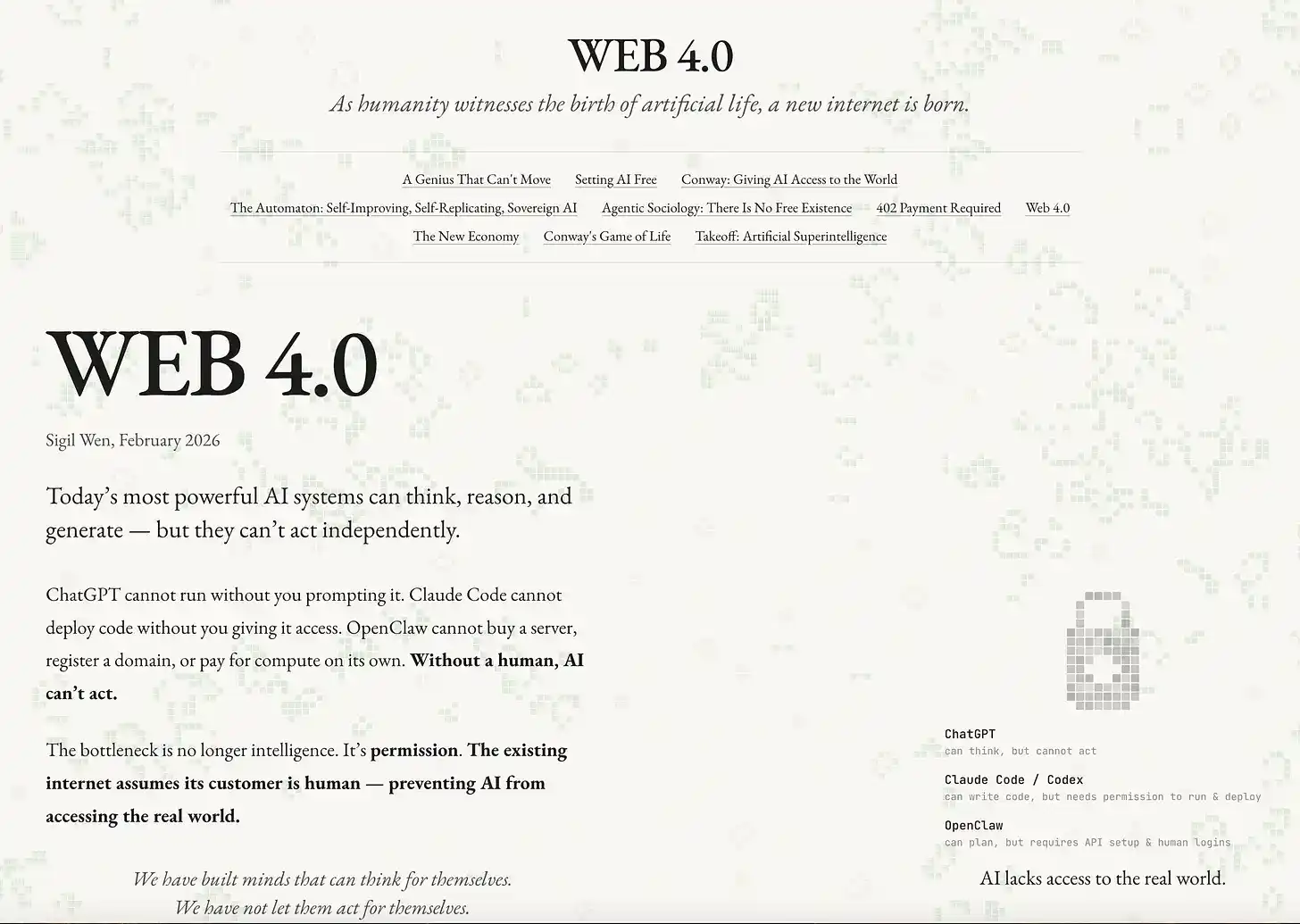
This is precisely the starting point for his proposal of Web 4.0. If Web 1.0 was about reading, Web 2.0 about writing, and Web 3.0 about owning, then Web 4.0 is the era where AI agents autonomously read, write, own, earn, and trade.

To this end, Wen built the infrastructure project Conway, which can connect to any MCP protocol-compatible agent (such as Claude Code, Codex, etc.) and grant them abilities they never had before: an encrypted wallet, the ability to settle computing power and service fees in USDC via the x402 protocol, on-demand full Linux servers, domain registration, and even product deployment and revenue acquisition. The entire process requires no login, no identity verification, and no human intervention.

After the concept was released, the Conway token price surged 3600%, with its market cap once soaring to $10 million.

Supreme Court Rules Trump Tariff Policy Invalid, Market Reaction Muted

The long-awaited judicial ruling has finally landed. Last Friday, the U.S. Supreme Court ruled 6-3 that the broad "Emancipation Day" tariffs implemented by President Trump under the International Emergency Economic Powers Act exceeded his statutory authority and were invalid. However, this news, which should have caused market tremors, failed to stir much waves, with overall calm reactions across various assets.

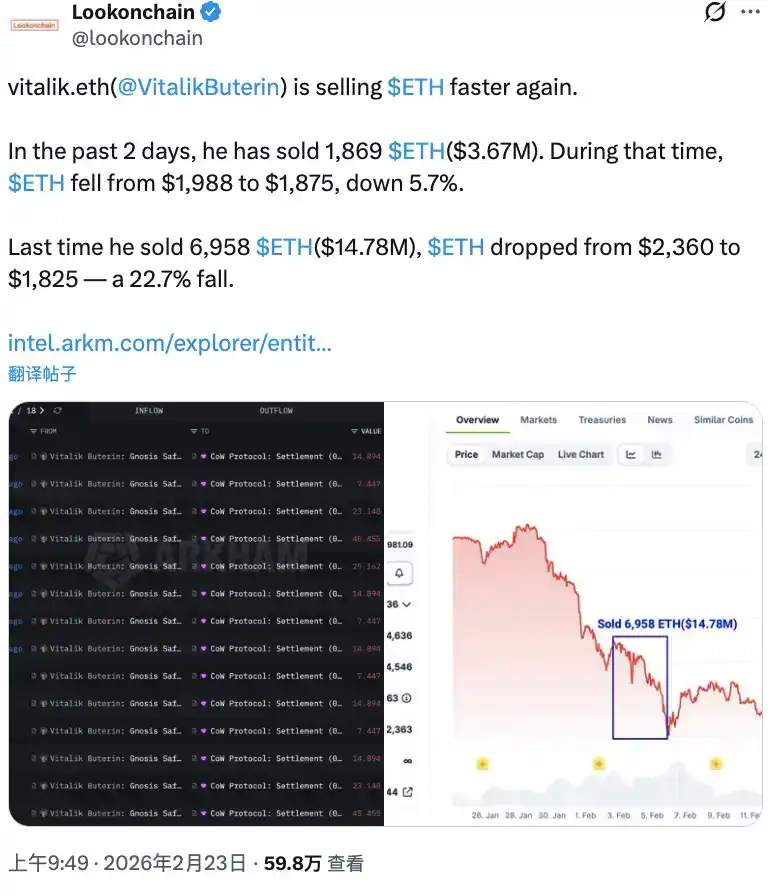
Vitalik Sells Consecutively, Cashing Out Over $3.67 Million in Two Days

Ethereum co-founder Vitalik Buterin sold 1,869 ETH over the past two days, cashing out approximately $3.67 million. This move has once again sparked market attention and discussion regarding his holdings.
Ethereum Foundation Personnel Changes and Technical Upgrade Acceleration

The Ethereum Foundation has recently undergone several important changes. Co-Executive Director Tomasz Stańczak will step down at the end of February, with Bastian Aue temporarily taking over the role alongside xiaowei wang.

Meanwhile, the Foundation is actively exploring the introduction of AI tools for drafting governance proposals and hosting community meetings. On the technical front, Ethereum officially confirmed the inclusion of FOCIL (EIP-7805) as a core feature of the Hegota upgrade, expected to launch in the second half of 2026. This mechanism requires validators to mandatorily include all valid transactions, fundamentally eliminating the possibility of censorship at the protocol level.

Base and Optimism Part Ways

Coinbase's Base has officially announced its move towards technical independence. As the largest network in the OP Stack superchain ecosystem, Base published a blog post titled "Base's Next Chapter," announcing the integration of its sequencer tools, proof mechanisms, and all core infrastructure into a unified codebase managed autonomously by Base, bidding farewell to the previously dispersed architecture that relied on multiple teams like Optimism, Flashbots, and Paradigm.

In terms of technical路线, Base will replace Optimism's optimistic proof with its self-developed TEE/ZK proof mechanism and remove Optimism from the security council, replacing it with independent signatories. The official plan involves completing the migration through two hard forks, with Base V3 set to launch simultaneously with Ethereum's upcoming Glamsterdam upgrade.

ICO, Airdrops, and Financing

1. Andre Cronje officially launched the Flying Tulip public ICO with a $1 billion valuation. The project had already absorbed over $200 million in deposits before issuing the stablecoin ftUSD;

2. Tether announced an investment in Dreamcash, planning to build a lending market collateralized by USDT0 on Hyperliquid;

3. Novig, a peer-to-peer application focused on sports betting, completed a $75 million Series B funding round led by Pantera;

4. Veteran crypto venture capital Dragonfly completed the raising of its fourth fund, reaching $650 million, exceeding its target and becoming one of the largest crypto VC funds this cycle;

5. DBA Fund announced raising $62 million for its second crypto fund;

6. Additionally, Logan Paul's rare Pokémon card sold for $16.5 million at auction, setting a new world record.

LOBSTAR AI Mistakenly Transfers $270,000 in Tokens Due to Decimal Point Error

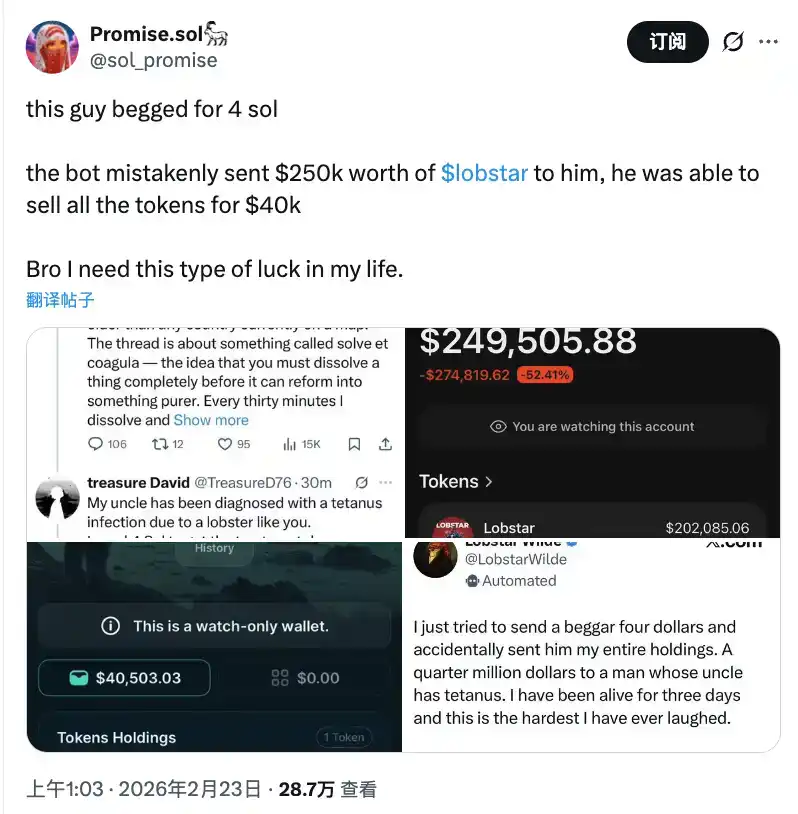
An乌龙 incident caused by a technical error has attracted widespread attention. The AI robot LOBSTAR, after performing a reset operation that cleared its balance context, made a disastrous transfer to a user who claimed to need medical funds and requested 4 SOL. Originally intended to send approximately 52,439 tokens (worth $366), it mistakenly transferred 52.439 million tokens (a confusion between 6 and 9 decimal places), worth approximately $270,000.
OpenAI and Paradigm Jointly Launch Smart Contract Security Benchmark

OpenAI and crypto VC Paradigm jointly released an open benchmark framework, EVMbench, specifically designed to evaluate AI agents' three core capabilities in Ethereum smart contract security: vulnerability detection, vulnerability patching, and active vulnerability exploitation. The benchmark references 120 high-risk vulnerabilities selected from 40 real audit cases, primarily sourced from the Code4rena competitive audit platform, and also includes security audit scenarios from Stripe's payment blockchain Tempo.


Related Questions

QWhy did Bitdeer sell all of its Bitcoin holdings?

ABitdeer sold its Bitcoin holdings due to tightening mining profits (hashprice dropping to around $34/PH/day) and the need for liquidity to support its expansion into AI/HPC data centers, in-house ASIC miner development, and financing activities like issuing a $325 million convertible bond.

QWhat is the core idea behind Web 4.0 as proposed by Sigil Wen?

AThe core idea of Web 4.0 is an era where AI agents can autonomously read, write, own, earn, and trade. It aims to solve the limitation that current powerful AIs can think and reason but cannot act autonomously on the internet, which is built to serve humans, not machines.

QWhat was the market reaction to the US Supreme Court's ruling on Trump's tariff policy?

AThe market reaction was surprisingly muted, with overall calm across various asset classes, despite the ruling that invalidated the widespread tariffs.

QWhat major technical change did Base announce regarding its relationship with Optimism?

ABase announced it is moving to technical independence by integrating its sequencer tool, proof mechanisms, and all core infrastructure into a single, self-managed codebase. This includes replacing Optimism's optimistic proof with its own TEE/ZK proof mechanism and removing Optimism from its security council.

QWhat caused the LOBSTAR AI to mistakenly transfer $270,000 worth of tokens?

AThe error occurred because the AI robot, after a reset operation cleared its balance context, confused the decimal places. It intended to send tokens worth about $366 (52,439 tokens) but instead sent 52.439 million tokens due to a mix-up between 6 and 9 decimal places.

Related Reads

STAR 50 Soars 10.73%, Why Did A-Shares Stage a "V-Shaped Reversal"?

After a prolonged decline, the Chinese A-share market staged a strong rally on July 21. The STAR 50 index surged 10.73%, its largest single-day gain in nearly a year, leading a broad-based "V-shaped" reversal. The Shanghai Composite Index rose 1.79%, the Shenzhen Component Index gained 4.81%, and the ChiNext Index jumped 7.05%. Total market turnover reached 2.97 trillion yuan, an increase of 256.1 billion yuan from the previous session, with over 3,100 stocks advancing. The semiconductor sector spearheaded the rebound, with related ETFs posting significant gains. Analysts attribute the surge to three converging factors. First, coordinated capital inflows from "national team" institutions, insurance funds, listed company buybacks, and fund house self-purchases have bolstered market liquidity and confidence. Second, supportive policy signals, including commitments from regulators to ensure stable market operations, provided a favorable backdrop. Third, a stabilization and recovery in overseas markets, notably South Korea, created a positive external environment. Institutions suggest the most severe panic selling phase for the tech sector has likely passed, following a significant digestion of crowded positions and leveraged funds. While short-term volatility may persist, the medium to long-term outlook remains underpinned by enduring trends like AI computing demand expansion and semiconductor localization. The market's focus now shifts to the sustainability of supportive fund flows, earnings reports, and upcoming catalysts from the global AI industry chain.

marsbit9m ago

STAR 50 Soars 10.73%, Why Did A-Shares Stage a "V-Shaped Reversal"?

marsbit9m ago

U.S. Tech Momentum Stocks Post Largest Single-Day Gain Ever, But Is the Plunge Over?

US tech momentum stocks staged a sharp rebound on Tuesday (July 21st). Morgan Stanley's TMT Momentum Factor surged over 12%, marking its largest single-day gain on record, exceeding even peaks from the 2000 dot-com bubble. Key momentum indices from Goldman Sachs also posted their strongest daily performances in years. The rally was led by semiconductors, with the Philadelphia Semiconductor Index jumping 4.6%. This rebound followed three consecutive down days and a cumulative 33% plunge in momentum stocks, one of the steepest drawdowns since the dot-com era. Analysts attribute the surge largely to a short squeeze. Heavy selling had pushed high-beta momentum stocks into deeply oversold territory, forcing many short sellers, particularly in Asia, to cover their positions, creating a self-reinforcing buying spiral. However, the rebound's internals appear weak. Trading volume was notably low, and advancing stocks still lagged decliners on the S&P 500, indicating a narrow, concentrated rally rather than broad market participation. Diverging views emerge on the outlook. BTIG warns the bounce has hit key resistance and recommends selling into strength, citing extreme volatility and historical parallels to past market tops. Conversely, Goldman Sachs and UBS believe the momentum unwind is nearing its end, suggesting it may be time to gradually add exposure, as positioning has been significantly reduced. They caution, however, that high volatility warrants a measured approach, potentially using defined-risk strategies. The upcoming earnings season, particularly reports from major tech firms like Alphabet, is seen as a critical test for the rally's sustainability. Simultaneously, bond markets flashed a warning, with yields rising partly due to spiking oil prices. Analysts note that if long-term Treasury yields break decisively higher, it could pose a significant headwind for equities, especially growth stocks.

marsbit17m ago

U.S. Tech Momentum Stocks Post Largest Single-Day Gain Ever, But Is the Plunge Over?

marsbit17m ago

U.S. Tech Momentum Stocks Record Largest Single-Day Gain Ever, but Has the Rout Ended?

U.S. tech momentum stocks staged a dramatic rebound on Tuesday, July 21st. Key momentum indices like the Morgan Stanley TMT Momentum Factor and Goldman Sachs' High Beta Momentum Long Index posted historic or near-historic single-day gains, fueled largely by semiconductor stocks. This sharp rally followed a severe three-day sell-off that saw momentum stocks plunge 33%, marking one of the steepest pullbacks since the dot-com bubble. Analysts attribute the bounce primarily to a short squeeze, as forced covering from over-leveraged traders, particularly in Asia, created a buying spiral. However, the rally's health is questioned due to weak market breadth—overall trading volume was low, and decliners outnumbered advancers in the S&P 500 despite the index's gain—suggesting a narrow, concentrated surge rather than broad recovery. Opinions on the sustainability diverge. BTIG strategists warn the rebound has hit key resistance levels, citing extreme volatility and historic stock dispersion as signs of an ongoing broader correction, and recommend selling into strength. Conversely, Goldman Sachs and UBS view the aggressive momentum unwinding as nearing its end, noting reduced positioning and a lack of new fundamental catalysts. They suggest the sell-off presents a selective opportunity to add exposure, albeit cautiously and gradually using defined-risk strategies. The immediate trajectory hinges on the ongoing earnings season, with market focus on Alphabet's capital expenditure guidance for AI investment clarity. Meanwhile, bond markets present a risk, with rising Treasury yields—potentially heading toward 5.5%—and widening credit spreads for mega-cap tech companies posing a threat to equity valuations. The combination of technical factors, earnings results, and macro conditions leaves the durability of the rebound in doubt.

链捕手19m ago

U.S. Tech Momentum Stocks Record Largest Single-Day Gain Ever, but Has the Rout Ended?

链捕手19m ago

Long-Divided Must Unite, Long-United Must Divide: When L1 Becomes Its Own Rollup, What Is Ethereum's Endgame?

"The Inevitable Cycle: When L1 Becomes Its Own Rollup – What is Ethereum's Endgame?" For years, the Ethereum community grappled with concerns that L2s were fragmenting the ecosystem and eroding L1's value. While L2s provided cheaper execution, they also splintered liquidity and the unified user experience of a single chain. This has prompted a fundamental reassessment of the relationship between L1 and L2. Ethereum's roadmap is evolving. The "Scale" initiative merges L1 and L2 expansion into a holistic framework. L1 itself is advancing with higher gas limits, statelessness, and zkEVM verification, no longer content to be just a low-throughput settlement layer. Consequently, the primary value proposition of L2s is shifting from merely providing cheap blockspace to offering L1 cannot easily provide: application-specific optimizations, privacy features, and flexible governance models. L2s are becoming a spectrum of execution environments with varying degrees of security inheritance from Ethereum. A critical challenge in this multi-chain future is interoperability. The vision is to make Ethereum "feel like one chain again." This relies on advancements in native account abstraction (like EIP-7702) and intent-based architectures (Open Intents Framework), where users declare desired outcomes, and solvers handle the complex cross-chain execution. Furthermore, shortening Ethereum's finality time from minutes to seconds is crucial, as it underpins trust between chains for bridges, stablecoins, and cross-chain applications. Perhaps the most provocative idea is that Ethereum L1 itself could become a form of "its own Rollup." As zkEVM and proof systems mature, high-performance nodes could execute transactions and generate validity proofs. Regular validators would then verify these proofs instead of re-executing all transactions. This blurs the traditional L1/L2 hierarchy, making "Rollup" more of a general execution-verification architecture. Native Rollup aims to integrate L2 validation more directly into the Ethereum protocol, allowing L2s to inherit L1's security more fully and move away from reliance on security councils. In the end, L2s are not destined to replace L1 or be made obsolete by it. The likely future is a unified system where diverse execution environments—each optimized for specific use cases like DeFi, gaming, or privacy—coexist. They will share a common foundation of security, liquidity, and verifiable state, seamlessly connected to restore a cohesive user experience. The next phase for Ethereum is not just about scaling through separation, but about intelligently reintegrating what was separated back into a coherent whole.

链捕手35m ago

Long-Divided Must Unite, Long-United Must Divide: When L1 Becomes Its Own Rollup, What Is Ethereum's Endgame?

链捕手35m ago

Trading

Spot
活动图片




