If the AI Bubble Is Already Bursting, Who Will Truly Survive?

marsbitPublished on 2026-06-15Last updated on 2026-06-15

Abstract

If the AI Bubble is Bursting, Who Will Remain? The debate over an AI bubble is intensifying, with figures like Ray Dalio warning of high levels and Jensen Huang seeing immense, early-stage opportunity. Both views hold truth: a speculative bubble in capital markets likely exists, mirroring the dot-com era, but the underlying technological shift is real and transformative. History shows that while bubbles burst—wiping out overvalued companies and speculative capital—they often leave behind critical physical and digital infrastructure. The dot-com bust, for instance, eliminated many firms but left the global fiber optic networks and data centers that enabled the rise of Amazon, Netflix, and cloud computing. Today's massive AI infrastructure investments (projected at trillions by 2030) in data centers, power, cooling, and GPUs may follow a similar path, creating the foundation for future applications. A key divergence from past bubbles is the "Jevons Paradox" effect in AI. As the cost of AI inference has plummeted by over 99.7% since 2023, enterprise spending on AI has skyrocketed. Cheap "tokens" have unlocked vast, previously uneconomical use cases, moving AI from simple chatbots into core business workflows—code generation, legal document review, scientific simulation, and financial analysis. The market is now in a phase of self-correction, weeding out superficial "API-wrapper" startups, but this cleansing process strengthens the ecosystem. The long-term trajectory is clear...

Source: Gelong, North City's Mr. Xu

Data support: GogoBigData

The AI bubble is becoming the most divisive consensus in the global market. Dalio says the bubble is already high, while Huang Renxun says the opportunity is just beginning; one sees overheating in the capital market, the other sees the dawn of a productivity revolution.

The real issue is not whether there is an AI bubble, but what will be left behind after it bursts. The dot-com bubble of 2000 caused the Nasdaq to plummet, companies to collapse, and wealth to evaporate, but it also left behind the infrastructure of submarine cables, broadband networks, and cloud computing, which ultimately supported Amazon, Netflix, YouTube, and the mobile internet.

Today, AI stands at a similar juncture. On one side, hundreds of billions of dollars are pouring into data centers, electricity, liquid cooling, optical modules, and GPUs; on the other side, there is a huge gap yet to be filled by application revenues. A bubble clearly exists, but the underlying productive forces are not inflated. When token costs plummet and intelligence begins to be called upon like water and electricity, AI will no longer be just a chatting tool, but will enter real workflows in code, healthcare, finance, law, manufacturing, and scientific research. The market will wash away shell companies and PPT entrepreneurs, but it will not reverse the direction of AI+. The bubble will burst, but the industry will remain. Enjoy:

Recently, the market has experienced sharp fluctuations, and theories of an "AI bubble" are rampant.

  • Ray Dalio, founder of Bridgewater Associates, says: There is a bubble in the AI market, and it is "relatively high."

  • NVIDIA CEO Jensen Huang says: There is a huge opportunity in AI, and the demand for computing power is just beginning to explode.

Who should we believe?

They are both correct.

Is there a bubble in the AI industry? Absolutely.

However, bubbles in the tech sector are often the only tribute society can pay to disruptive advanced productive forces. They are not merely a derogatory term.

In the long run, this is an inevitable phenomenon at the dawn of advanced productive forces.

Many liken the current situation to the dot-com bubble of 2000, feeling deeply concerned. The dot-com bubble indeed caused the Nasdaq to plummet nearly 78%, evaporating over 5 trillion dollars in wealth.

But twenty years later, what industry can operate without the internet? Today, the value of the internet industry far exceeds that of the bubble era.

At least superficially, the AI bubble resembles that. The bubble in the capital market cannot stop nearly every sector in society from actively being empowered by AI.

AI+ is the inevitable trend. Just as all industries today cannot do without the internet, all industries in the future will not be able to do without AI.

01 The "IQ Tax" That Innovation Must Pay

In that era when companies could go public and raise money just by having .com in their name, the Nasdaq surged nearly 600% between 1995 and 2000. Then followed a two-and-a-half-year financial storm.

Iconic names of that time, like the software company MicroStrategy, plunged 62% in a single day due to accounting scandals and exaggerated claims; Pets.com (online dog food seller), Webvan (the pioneer of fresh food e-commerce) simply went bust... In the panic, almost everyone blamed the internet as a scam.

However, the physical infrastructure precipitated by the over-expenditure of speculative capital often nourishes the super giants of the next era at extremely low costs. The bubble burst not because of the internet technology itself, but because the physical construction speed of infrastructure could not keep pace with the market's rhythm.

For example, the global undersea cables and dense wavelength division multiplexing networks laid by those once-prominent telecom companies (like WorldCom, Global Crossing), which bankrupted them with heavy investment, became the perfect breeding ground for the later rise of Netflix, Zoom, and the mobile internet.

Without the frenzied and premature global investment in telecom infrastructure around 2000, the later video streaming explosion of YouTube and the cloud computing infrastructure would not have happened.

Amazon is the most typical example. Its stock price plummeted from a high of $107 in 1999 to $7 in 2001, a drop of over 90%. But it survived because its underlying business logic, "reconstructing retail with the network," aligned with the direction of advanced productive forces.

This is a classic case of Amara's Law: we tend to overestimate the effect of a new technology in the short run and underestimate its effect in the long run. In the early stages of a technological revolution, the fervor of speculative capital inevitably leads to overinvestment, forming a bubble. It's the IQ tax that innovation must pay. But when the bubble recedes, what remains will be more indestructible advanced productive forces.

02 Why Are Corporate AI Expenditures Rising Instead of Falling?

Back in 2026, the AI industry bubble appears even larger.

Just five major cloud service providers—Amazon, Google, Meta, Microsoft, and Oracle—are expected to have capital expenditures reaching $690 billion in 2026, with total AI infrastructure investment projected at $5.3 trillion by 2030. Of this, only about 25% is for GPUs; the remaining 75% is all poured into physical infrastructure: liquid cooling systems, power transmission, network switches, optical modules, and land.

On the revenue side, the combined total revenue in 2026 for all leading pure AI companies like OpenAI, Anthropic, Cohere, Mistral, Perplexity is projected not to exceed $40 billion.

The foundational layer invests nearly $700 billion, while the application layer recovers tens of billions. This severe asymmetry—isn't that a bubble?

Such a conclusion cannot be drawn so simply and crudely. One critical point must not be overlooked:

  • In March 2023, when OpenAI released GPT-4, the mixed cost per million tokens of input was about $30.

  • By April 2025, with model architecture optimization and inference computing power improvements, the price per million tokens for models of comparable intelligence plummeted to $0.1–$0.15.

According to Stanford University's "AI Index Report" and TokenCost data: AI inference costs have fallen by over 99.7% in the past two years.

Following traditional linear thinking, if costs plummet, corporate AI spending should decrease. But the reality is that corporate AI cloud spending tripled between 2024 and 2025.

Why?

Because when the marginal cost of "intelligence" approaches zero, AI is no longer just a simple text summarizer or chatting companion; it has entered a new era of agents and multi-modal enhanced retrieval. Enterprises are starting to let AI agents automatically run thousands of cycles of tasks—writing code, scanning millions of legal contracts, simulating biological experiments.

Cheap tokens have unlocked a massive volume of long-tail demands that were previously not commercially viable due to cost constraints.

Comparing NVIDIA in 2026 to Cisco, the networking hardware titan of 2000, also reveals this trend. Their ecosystem positions are remarkably similar, but their underlying financial health is worlds apart.
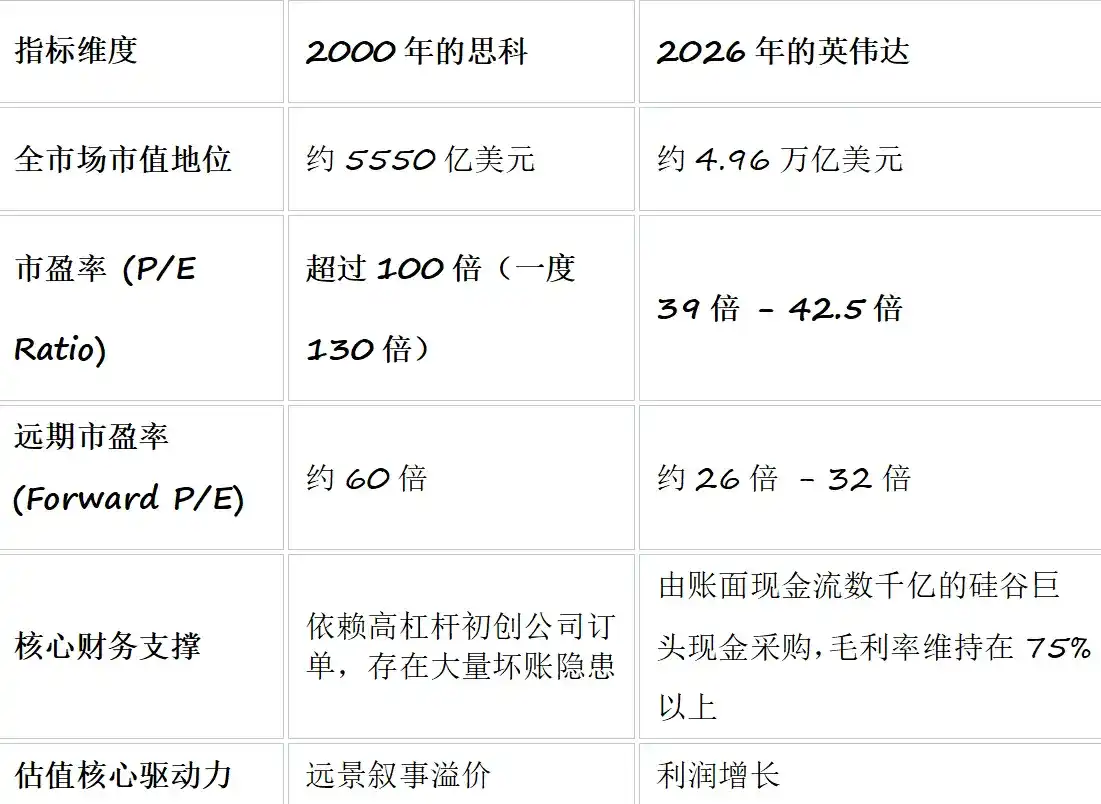
(Hardcore Financial Comparison of NVIDIA and Cisco)

This precisely confirms the economic principle of the "Jevons Paradox": technological progress improves energy use efficiency, but instead of reducing energy consumption, it leads to greater demand due to lower costs.

Even after last year's so-called "DeepSeek moment," the market quickly sobered up in the following months: the more optimized the algorithms, the lower the threshold for enterprises to adopt AI, and ultimately, the total computing power consumption rises exponentially instead.

It is precisely for this reason that AI has the potential to gradually embed itself into almost all old industries. Just as all industries embraced Internet+ over the past two decades. From SaaS software to biomedicine, to advanced manufacturing robots driven by embodied intelligence, by 2026, almost every industry is embracing AI+. No one discusses "whether we should use AI," but instead worries: "Is our data properly cleaned? Do we have enough API call quotas? Is the RAG architecture optimal?"

Currently, there is indeed a bubble in the AI industry. But for enterprises, if you don't embrace the bubble, you will be crushed by the times. This has been proven over the past two decades of the internet era.

03 The Market's Deep Evolution: From Infrastructure to Application

Currently, we are undoubtedly at a critical node in the technology life cycle: just before the "Trough of Disillusionment" on Gartner's Hype Cycle, or at the turning point described by the theory of "Technological Revolutions and Financial Capital."

The AI bubble is already bursting, though many haven't realized it. In the past, any upstart could write a few dozen pages of PPT, wrap a layer of OpenAI's API, and secure funding. Now, as the tide recedes, these companies with no moat and only concepts are dying en masse.

This is the market purifying itself, a manifestation of the bubble bursting. But this is only the surface. The deep logic of the market is undergoing three profound evolutions:

First, value transfer from CapEx to OpEx

Currently, money is being made by those selling shovels—NVIDIA, TSMC, and companies selling optical modules and server liquid cooling equipment are reaping most of the benefits. However, as computing power gradually becomes "infrastructure-ized," like water and electricity, the real excess profits will gradually shift to the application layer. These are the AI-native enterprises that can use extremely low-cost tokens to genuinely solve pain points in vertical industries and reshape business processes (OpEx optimization).

Second, valuation multiple compression and earnings digestion

The high valuations assigned to AI infrastructure do not necessarily imply an impending crash. In many cases, the rapid growth in corporate earnings can digest the high valuations over time, trading "time for space." As long as the revenue growth rate of cloud computing giants keeps pace with the depreciation rate of their capital expenditures, this game of hot potato can evolve into an unprecedented industrial upgrade.

  • For example, leading global automakers and chip giants, by introducing end-to-end AI twin technology, have shortened the cycle from R&D to mass production of new products by 35% and improved overall equipment effectiveness by 18%.

  • In the financial industry, by 2026, quantitative trading, risk control, and credit assessment are already fully dominated by multi-modal Agents. AI not only processes macro expectations at microsecond-level timestamps but is deeply involved in every micro-level asset pricing.

  • In industries highly reliant on senior professional knowledge, such as law, healthcare, and auditing, AI has already completed its transformation from a "junior assistant" to a "partner-level expert."

Among the over 1 billion active users of ChatGPT, Gemini, and Claude, a significant portion uses them as substitutes for daily high-intensity intellectual labor. This includes you and me. All of the above are real things happening, visible to everyone.

04 Conclusion

Looking back at the magnificent history of technology, the "creative destruction" proposed by Schumpeter is always at play.

The capital market is always impatient, hoping that $1 invested today will yield $10 tomorrow. When nearly $700 billion in infrastructure investment cannot be fully transformed into application-layer profits in the short term, the market is bound to face a brutal reshuffle. It will eliminate speculative shell companies that rely solely on flashy PPTs, leaving behind those with genuine technological depth and practical implementation scenarios.

After this reshuffle, those cheap yet vast computing centers and highly optimized model algorithms will serve thousands of industries at extremely low prices.

After 2000, humanity ushered in a digital era where no industry could do without the internet. Today, we are also irreversibly moving towards an intelligent golden age where all industries will be governed and empowered by AI.

Amidst the clamor of the bubble, the underlying productive potential carries not a single drop of moisture.


Related Questions

QWhat is the core argument of the article regarding the AI bubble compared to the dot-com bubble?

AThe core argument is that the existence of an AI bubble is similar to the dot-com bubble, serving as a necessary 'tribute' to a disruptive new technology. While it leads to market overvaluation and will burst, the underlying physical infrastructure and technological progress (like plummeting token costs) built during the bubble will persist. This will enable AI to become ubiquitous across all industries, much like the internet did post-2000, leaving behind a transformative, durable foundation of productivity.

QWhy does the article claim that enterprise AI spending is rising even as AI inference costs fall dramatically?

AThe article cites the 'Jevons Paradox' from economics: a drastic reduction in the cost of a resource (in this case, AI 'intelligence' per token) does not reduce overall consumption but instead unlocks vast new, previously uncommercializable long-tail demands. With token costs nearing zero, companies are deploying AI for complex, iterative tasks like running thousands of automated code-writing, legal contract analysis, or scientific simulation jobs, leading to a massive increase in total AI cloud spending.

QAccording to the article, what is the primary difference between the financial health of Nvidia in 2026 and Cisco in 2000, despite their similar ecosystem positions?

AThe article implies that while both companies held dominant positions as hardware suppliers during their respective technological booms (networking for Cisco, AI compute for Nvidia), Nvidia's underlying financial health is portrayed as more robust. The article does not provide specific comparative financials but suggests the context is different because the AI infrastructure build-out is fueling tangible, widespread enterprise adoption and productivity gains across sectors, whereas the dot-com bubble involved more speculative investment without immediate, broad-based application revenue.

QWhat are the two key 'deep market evolutions' the article predicts will occur as the AI bubble matures?

AThe two key evolutions are: 1) A value shift from Capital Expenditure (CapEx) to Operational Expenditure (OpEx). Profit will migrate from infrastructure 'shovel sellers' (like GPU manufacturers) to AI-native application companies that use cheap tokens to solve vertical industry problems and optimize business processes. 2) Valuation compression and earnings digestion. High valuations for infrastructure will be gradually absorbed ('time for space') by the rapid growth of corporate profits as AI integration boosts efficiency and revenue in sectors like manufacturing, finance, and law.

QWhat does the article conclude will 'truly remain' after the AI bubble bursts?

AThe article concludes that after the bubble bursts and speculative, shell companies are washed away, what will truly remain is the massive, now-cheap computational infrastructure and highly optimized AI models. These will serve as a pervasive utility, enabling AI to be deeply integrated into and transform every industry—code, medicine, finance, law, manufacturing, and research—ushering in a 'smart era' where AI is as indispensable as the internet is today. The underlying productive potential is solid.

Related Reads

2029 Finale Prediction: When Cryptocurrency Completely "Vanishes", Who Can Remain in This Financial Upheaval?

By 2029, the crypto industry will have transformed into a largely invisible but foundational layer for traditional finance. This timeline outlines the key shifts from now until then. By mid-2026, the most sought-after assets on-chain will not be traditional tokens, but synthetic perpetual contracts for private, high-growth companies (like SpaceX, OpenAI). These become primary price discovery tools, highlighting the market's craving for real-world asset value. Most altcoins enter a sustained bear market as their fundamental lack of asset-backed value is exposed. In late 2026, the "AI + Crypto" narrative largely fades as AI giants prove they don't need crypto infrastructure, except for prediction markets betting on model performance. Simultaneously, a quiet but significant wave of tokenization for institutional assets (money market funds, private credit) begins. The industry splits into a noisy speculative economy and a silent institutional one. Throughout 2027, major public blockchain foundations pivot decisively to serve institutional clients, building compliance toolkits and sales teams. However, key sectors hit growth ceilings: private perpetual contracts are legally restricted from public promotion, stable币 growth is capped by looming political uncertainty, and tokenization projects remain cautious. In 2028, following a U.S. election assumed to maintain a regulatory (not prohibitive) stance, a pivotal change occurs. After a major liquidation crisis exposes the flaws of synthetic contracts lacking a real-asset anchor, new regulations allow the *public solicitation* of private security sales (secondary market shares) to accredited investors. This creates a legitimate, direct on-ramp for retail capital into previously illiquid private equity. By 2029, the resulting bull market is driven by trading in real, innovative company shares (biotech, robotics, AI labs), not speculative tokens. "Crypto" as a distinct asset class recedes; it becomes the mundane, unseen plumbing for this new global private markets infrastructure. Tokens that survive are those capturing real cash flows from this infrastructure. Speculation persists but is marginalized. The core questions posed at the start are answered: token value is tied to legally enforceable claims on real assets, frontier tech adoption happens via private market channels, and crypto's absorption into traditional finance is marked by its becoming boring and invisible. The key validation for this entire thesis is whether, by late 2028, a legal pathway exists for ordinary accredited investors to access private assets directly.

marsbit28m ago

2029 Finale Prediction: When Cryptocurrency Completely "Vanishes", Who Can Remain in This Financial Upheaval?

marsbit28m ago

After the U.S. Banned Fable 5, Zhipu's Stock Soared 47%

On June 15, Chinese AI company Zhipu's stock surged up to 47.6% in Hong Kong, closing with a 32.82% gain. This sharp rise followed two key industry events. On June 12, Anthropic was compelled by a U.S. government export control order to suspend global access to its latest flagship models, Claude Fable 5 and Claude Mythos 5, impacting developers and businesses reliant on them. The next day, Zhipu announced it was opening access to its new open-source flagship model, GLM-5.2, for all Coding Plan users, with API and model weights (under the MIT license) to follow. The Anthropic incident highlighted a critical shift in the AI industry: beyond raw capability, the stability, continuous accessibility, and control over AI models are becoming equally vital, especially as AI integrates deeper into business workflows. Zhipu's move, emphasizing that "frontier intelligence should not belong to a few nor be subject to arbitrary revocation," positioned its open, accessible model as an alternative. GLM-5.2 focuses on "Long Horizon Tasks" with a 1M context window, aiming for consistency in complex, extended projects. Market analysts suggest this event exposes the risk of dependency on closed-source models subject to single jurisdiction policies, potentially accelerating a shift toward domestic base models and localized deployments. The investment response indicates a new valuation metric is emerging—prioritizing which companies can provide AI capabilities that are not only advanced but also reliably and sustainably accessible.

marsbit29m ago

After the U.S. Banned Fable 5, Zhipu's Stock Soared 47%

marsbit29m ago

PANews Column Registration and Article Submission Guide

"PANews Column Registration and Submission Guide" provides instructions for users to register as columnists and publish articles on the PANews platform. Key application requirements are emphasized: content should focus on in-depth analysis within Crypto, Web3, blockchain, data, and viewpoints. Content primarily for brand/product introductions will not be approved, and heavily AI-generated content will be rejected. Promotional (PR/soft) content is directed to the business channel. **Registration Process:** * **Web:** Go to the official website footer, click "Apply for Column," and register with a phone number or email (login via verification code, no password). Fill in the column name, description, upload an avatar, and submit links to previously published work. * **Mobile:** Navigate to "My" -> "Contribute & Create" and complete the form. **Article Submission Tutorial:** 1. Log in to the PANews website. 2. Access the "Creator Center" from your personal homepage. 3. Use the editor to create and publish articles. **Video Upload:** The platform supports embedding videos from third-party sites (e.g., Bilibili). Copy the embed code from the source video, use the editor's "Insert/Edit media" button, paste the code under the "Embed" tab, and adjust the display size (recommended: width 100%, height 560px). **PANews Skills (AI Agent Tool):** PANews offers an official AI Agent skill set called PANews Skills, enabling AI tools to query platform content, track trends, and publish column articles directly. It includes three main skills: 1. `panews`: For tracking daily must-read lists, popular articles, and funding news. 2. `panews-creator`: For managing columns, publishing articles, and uploading images. 3. `panews-web-viewer`: For parsing PANews webpages into Markdown. These skills are compatible with various AI Agent tools (OpenClaw, Cursor, Claude Code, ChatGPT, Gemini, etc.). To use the `panews-creator` skill, users must obtain a specific authentication value from the PANews website after logging into their columnist account.

marsbit40m ago

PANews Column Registration and Article Submission Guide

marsbit40m ago

I Built Myself an Investment Workbench Using AI

For the past two weeks, I've been immersed in Vibe Coding—using AI to write code from natural language descriptions. This process has enabled me to quickly build functional tools that address long-standing personal ideas. Previously, I had many concepts but found execution too cumbersome. Key ideas included a unified dashboard for assets across US stocks, Crypto, HK stocks, and A-shares; a real-time alert system for price movements; an investment map visualizing sector relationships; and a tool to correlate prediction market bets with news and market data. Traditional development hurdles meant these often remained unrealized. Using AI (Codex, Claude Code, and DeepSeek API), I built four initial tools: 1. A **Cross-Market Asset Dashboard** showing total assets, daily P&L, and holdings by market, with added features for alerts and sector mapping. It's deployed locally for privacy. 2. A **Prediction Market (PM) Monitor** tracking bets on events (e.g., company valuations) and correlating probability shifts with news and market movements. I categorize bets by conviction to filter noise. 3. A **Simple Operations Backend** for managing my writing workflow (topics, progress, publishing). It's cloud-deployed for mobile access. 4. A **One-Click Formatting Tool** that automates converting drafts into various platform-specific formats, saving manual effort. While these tools are basic, they represent a significant shift: AI lowers the barrier to creating personalized systems. I believe individual investors can now feasibly build core systems for: * **Asset Observation** (tracking holdings and changes) * **Signal Monitoring** (watching for key market shifts) * **Sector Mapping** (understanding network relationships within a sector) * **Performance Review** (documenting rationale and outcomes) The power of Vibe Coding is its fast feedback loop. Ideas can be implemented, tested, and iterated on rapidly, turning "want-to-do" into "done." This marks the start of my new phase, where I'll share investment thoughts, tool tests, on-chain operations, and educational Web3 content.

marsbit56m ago

I Built Myself an Investment Workbench Using AI

marsbit56m ago

Trading

Spot
Futures

Hot Articles

Discussions

Welcome to the HTX Community. Here, you can stay informed about the latest platform developments and gain access to professional market insights. Users' opinions on the price of AI (AI) are presented below.

活动图片