Hyperliquid governance vote aims to permanently sideline $1B Assistance Fund

cointelegraphPublished on 2025-12-17Last updated on 2025-12-17

Abstract

The Hyper Foundation has proposed a validator vote to formally recognize approximately $1 billion worth of HYPE tokens held in the protocol’s Assistance Fund as permanently inaccessible. These tokens, accumulated through automated conversion of trading fees, are stored in a system address designed without retrieval mechanisms. A "Yes" vote would classify these tokens as burned, excluding them from circulating and total supply calculations. This move aims to clarify HYPE’s true supply amid growing institutional interest, as the protocol has generated around $874 million in fees year-to-date, with 99% routed to the Assistance Fund for token repurchases. The proposal does not reduce existing supply but formalizes the treatment of fee-derived tokens. Hyperliquid remains a major perpetual DEX, with over $205 billion in trading volume in the last 30 days.

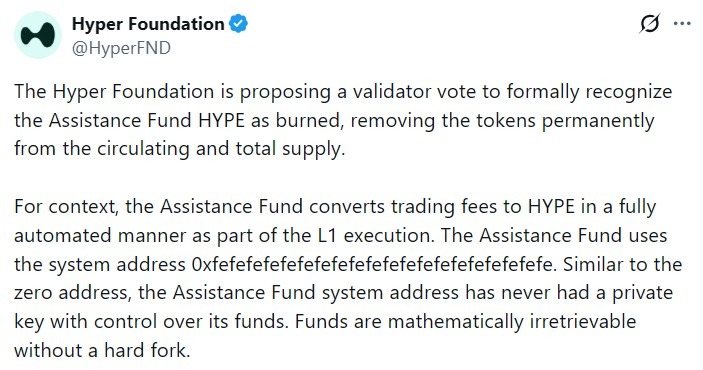
The Hyper Foundation proposed a validator vote to formally recognize HYPE tokens held in the Hyperliquid protocol’s Assistance Fund system address as permanently inaccessible, excluding them from the asset’s circulating and total supply.

According to the Foundation, the Assistance Fund is a protocol-level mechanism embedded in the layer-1 network’s execution. It automatically converts trading fees into HYPE tokens and routes them to a designated system address. At the time of writing, the wallet contains about $1 billion in tokens.

The system address was designed without control mechanisms, making the funds irretrievable without a hard fork. “By voting ‘Yes,’ validators agree to treat the Assistance Fund HYPE as burned,” Hyper Foundation wrote.

Native Markets, the issuer of the Hyperliquid-native stablecoin USDH, reminded users that 50% of the stablecoin’s reserve yield is routed to the Assistance Fund and converted into HYPE tokens. “Should this validator vote pass, these contributions will then be formally recognized as burned,” the company wrote.
Source: Hyper Foundation

Clarifying supply amid institutional interest

While the proposal uses the term “burned,” it does not reduce the existing supply. Instead, it formalizes how the fee-derived tokens are treated for governance purposes, reducing ambiguity around Hyper’s effective supply.

The distinction has become more relevant as Hyperliquid’s fee-driven model has been attracting institutional attention.

In a research note covering Hyperliquid-focused digital asset treasuries (DATs), financial services firm Cantor Fitzgerald framed Hyperliquid as a protocol that returns nearly all of its fee revenue to tokenholders through automated repurchases.

Cantor estimated that Hyperliquid generated approximately $874 million in fees year-to-date (YTD) as of 2025. The company said 99% of protocol fees are routed through the Assistance Fund mechanism to repurchase HYPE.

The firm characterized the repurchases as a contributor to a declining circulating supply. However, the Hyper Foundation’s proposal drew a clear line by recognizing that the Assistance Fund balances were never intended to be spendable or recoverable.

The vote aims to align supply metrics with protocol design, rather than creating scarcity retroactively.

Related: 1.75M Hyperliquid tokens unlocked today, but was the price impacted?

Hyperliquid volume and HYPE DAT holdings

Hyperliquid remains one of the top contenders in the perpetual decentralized exchange (DEX) space. In the last 30 days, DefiLlama data shows that the protocol recorded over $205 billion in perpetuals trading volume, making it the third-largest perps DEX in the time frame.

Furthermore, a growing ecosystem of DAT companies has emerged around HYPE. According to Cantor, Hyperion DeFi (HYPD) holds about $46 million in HYPE tokens in its treasury, while Hyperliquid Strategies (PURR) holds about $340 million.

Magazine: Ethereum’s Fusaka fork explained for dummies: What the hell is PeerDAS?

Related Reads

Yang Ge Gary: Agent Economy and AI Sub-Microeconomics

"Agent Economy and AI Submicroeconomics" by Gary Yang discusses the evolution of AI Agent economies, written from Singapore in June 2026. The author observes a significant "civilizational generational gap" in AI development, particularly highlighted by events in Silicon Valley. The article identifies a current bottleneck in the transition from Human-to-Agent (H2A) economies to true Agent-to-Agent (A2A) ecosystems. While AI Payment protocols are rapidly emerging, many implementations remain non-AI-native, focusing on traditional human decision-making models rather than leveraging autonomous Agent decision-making. A core thesis is the inevitable formation of an **Agent Economy**, defined as a system where autonomous AI Agents create, exchange, and capitalize value independently. This requires new infrastructure: **AI Protocols**, which are the foundational rules and standards for Agent interaction. The piece explores the relationship and current gap between AI Protocols and Crypto Protocols, suggesting political and regulatory factors from traditional finance are temporarily constraining development. However, a future fusion into a mature Digital Protocol system is deemed inevitable based on first principles. The author introduces **AI Agent Submicroeconomics**, contrasting it with human economics. Key differences include higher transaction frequency, lower value per transaction, efficiency-driven (not emotion-driven) decisions, task-oriented (not consumption-oriented) behavior, and near-zero organizational and communication costs. A biological analogy is drawn, comparing an Agent to a cell, its LLM to a nucleus, and its protocol stack to a cell membrane. The rise of **AIFi** (AI Finance) is presented as a natural consequence, where value originates from AI-native activities and is subsequently tokenized and financialized. This contrasts with DeFi/TradFi, where finance is the source of value. The concept of a **Financial Chip (FinChip)**—an autonomous AI Agent integrated with a crypto smart contract—is highlighted as key infrastructure for this new economy. The conclusion emphasizes that **AI-Native** thinking represents a paradigm shift distinct from "Internet+" upgrades. It requires reasoning from first principles, focusing on energy-value shortest paths and maximum efficiency, which presents a steep learning curve and significant challenge for all participants in this rapidly evolving field.

marsbit24m ago

Yang Ge Gary: Agent Economy and AI Sub-Microeconomics

marsbit24m ago

ViaBTC CEO Haipo Yang: Looking Back at the Decade, Re-understanding the Value of Crypto

In "A Decade in Retrospect: Re-evaluating the Value of Crypto," ViaBTC & CoinEx CEO Haipo Yang reflects on the cryptocurrency industry's evolution since founding ViaBTC in 2016. Initially a niche interest, Crypto has fundamentally transformed key financial infrastructures like market making, trading, settlement, and issuance through open protocols, as seen with Uniswap and GMX, and enabled efficient cross-border transfers via stablecoins. While acknowledging speculation's role in fueling innovation and liquidity, Yang warns it often overshadows real demand. He distinguishes between blockchain (a trust-minimizing technology), Web3 (an application model requiring genuine utility), and Crypto assets. The latter's value derives from block space as a commodity (e.g., gas fees) and "sovereign liquidity premium" (e.g., Bitcoin's censorship resistance), with most tokens lacking such dual support. Looking ahead, Yang argues the next decade's focus should shift from "open participation" to "sustainable participation," emphasizing reliable infrastructure. He predicts consolidation towards networks with strong security and liquidity (like Bitcoin and Ethereum), and sees DeFi becoming a specialized tool rather than a mass replacement for traditional finance. Crypto will integrate into traditional finance (e.g., via Bitcoin ETFs) but may sacrifice some decentralization for mainstream adoption. Real future demand may come from AI agents and machine economies needing permissionless settlement. Ultimately, Yang believes Crypto's enduring value lies not in hype or replacing everything, but in verifiably reducing trust costs, increasing efficiency, and providing stable, transparent services across market cycles.

marsbit24m ago

ViaBTC CEO Haipo Yang: Looking Back at the Decade, Re-understanding the Value of Crypto

marsbit24m ago

Trading

Spot
Futures

Hot Articles

How to Buy SFP

Welcome to HTX.com! We've made purchasing SafePal (SFP) simple and convenient. Follow our step-by-step guide to embark on your crypto journey.Step 1: Create Your HTX AccountUse your email or phone number to sign up for a free account on HTX. Experience a hassle-free registration journey and unlock all features.Get My AccountStep 2: Go to Buy Crypto and Choose Your Payment MethodCredit/Debit Card: Use your Visa or Mastercard to buy SafePal (SFP) instantly.Balance: Use funds from your HTX account balance to trade seamlessly.Third Parties: We've added popular payment methods such as Google Pay and Apple Pay to enhance convenience.P2P: Trade directly with other users on HTX.Over-the-Counter (OTC): We offer tailor-made services and competitive exchange rates for traders.Step 3: Store Your SafePal (SFP)After purchasing your SafePal (SFP), store it in your HTX account. Alternatively, you can send it elsewhere via blockchain transfer or use it to trade other cryptocurrencies.Step 4: Trade SafePal (SFP)Easily trade SafePal (SFP) on HTX's spot market. Simply access your account, select your trading pair, execute your trades, and monitor in real-time. We offer a user-friendly experience for both beginners and seasoned traders.

689 Total ViewsPublished 2026.05.22Updated 2026.06.02

How to Buy SFP

How to Buy CTR

Welcome to HTX.com! We've made purchasing Citrea (CTR) simple and convenient. Follow our step-by-step guide to embark on your crypto journey.Step 1: Create Your HTX AccountUse your email or phone number to sign up for a free account on HTX. Experience a hassle-free registration journey and unlock all features.Get My AccountStep 2: Go to Buy Crypto and Choose Your Payment MethodCredit/Debit Card: Use your Visa or Mastercard to buy Citrea (CTR) instantly.Balance: Use funds from your HTX account balance to trade seamlessly.Third Parties: We've added popular payment methods such as Google Pay and Apple Pay to enhance convenience.P2P: Trade directly with other users on HTX.Over-the-Counter (OTC): We offer tailor-made services and competitive exchange rates for traders.Step 3: Store Your Citrea (CTR)After purchasing your Citrea (CTR), store it in your HTX account. Alternatively, you can send it elsewhere via blockchain transfer or use it to trade other cryptocurrencies.Step 4: Trade Citrea (CTR)Easily trade Citrea (CTR) on HTX's spot market. Simply access your account, select your trading pair, execute your trades, and monitor in real-time. We offer a user-friendly experience for both beginners and seasoned traders.

565 Total ViewsPublished 2026.05.25Updated 2026.06.02

How to Buy CTR

What is USOIL

USOILUSDT Perpetual Contract is the trading symbol for West Texas Intermediate (WTI) Crude Oil priced in US dollars, representing 1 barrel of crude oil.

574 Total ViewsPublished 2026.05.25Updated 2026.05.25

What is USOIL

Discussions

Welcome to the HTX Community. Here, you can stay informed about the latest platform developments and gain access to professional market insights. Users' opinions on the price of A (A) are presented below.

活动图片