Hyperliquid: Can $100mln revenue from third-party apps fuel HYPE’s rally?

ambcryptoPublished on 2026-03-24Last updated on 2026-03-24

Abstract

Hyperliquid is gaining significant traction, driven by two key factors: trading of non-crypto assets (HIP-3) like oil and gold, which accounted for 40% of daily volumes in March, and integrations with third-party platforms such as Phantom and MetaMask via builder codes. Together, these now generate $100 million in annual revenue, representing 19% of Hyperliquid's total revenue share. Builder codes alone contribute 10% of total trading volumes. This growth has positively impacted HYPE, the platform's native token, as a significant portion of revenue is used for token buybacks, creating buying pressure. In Q1 2026, a surge in perp volumes and revenues led to a substantial price appreciation from $20 to $43. Although the price has retraced below $40, bullish whale activity suggests support around the $35-$50 range, with potential for a move toward $50 if the positive trend continues.

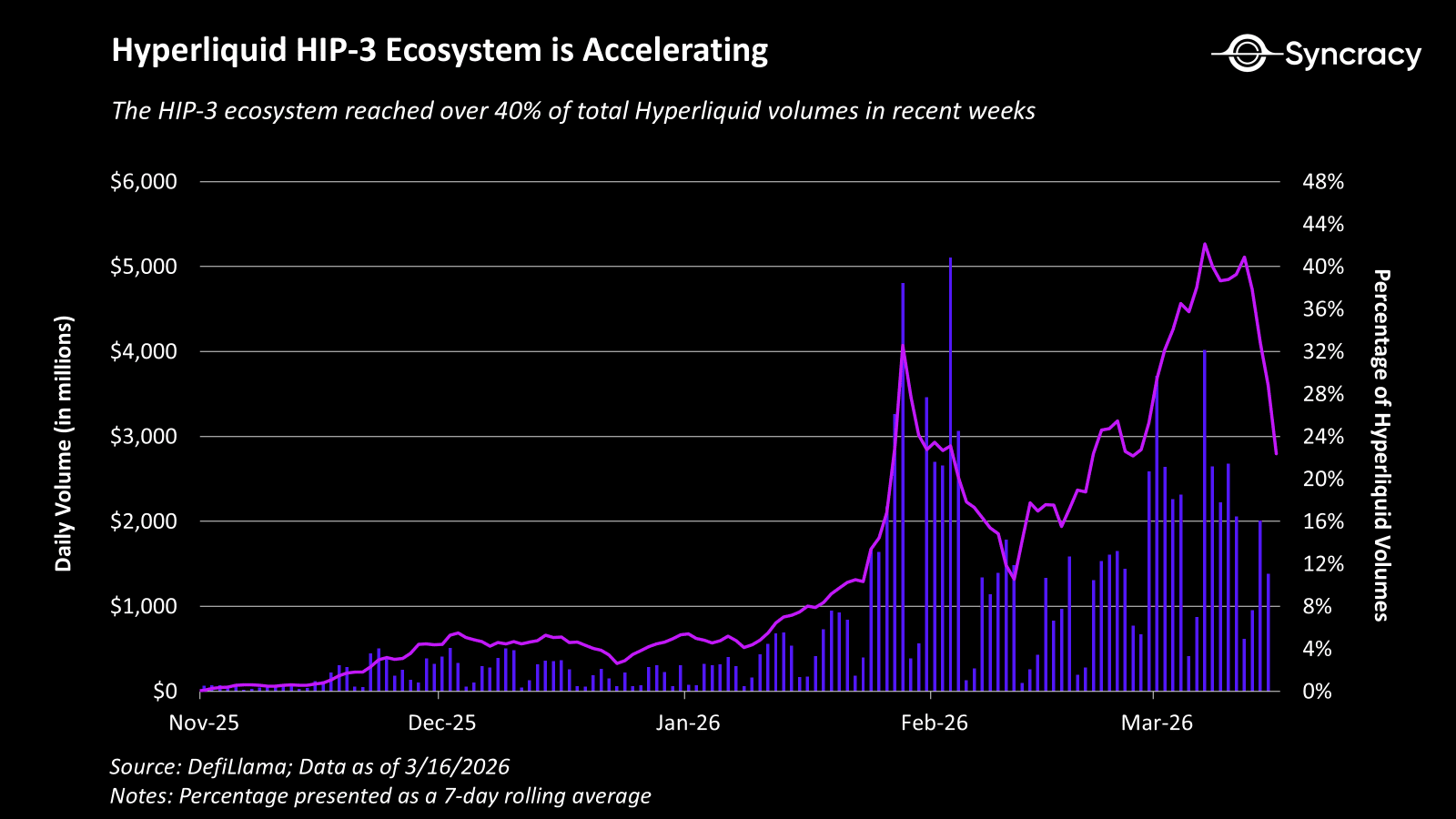
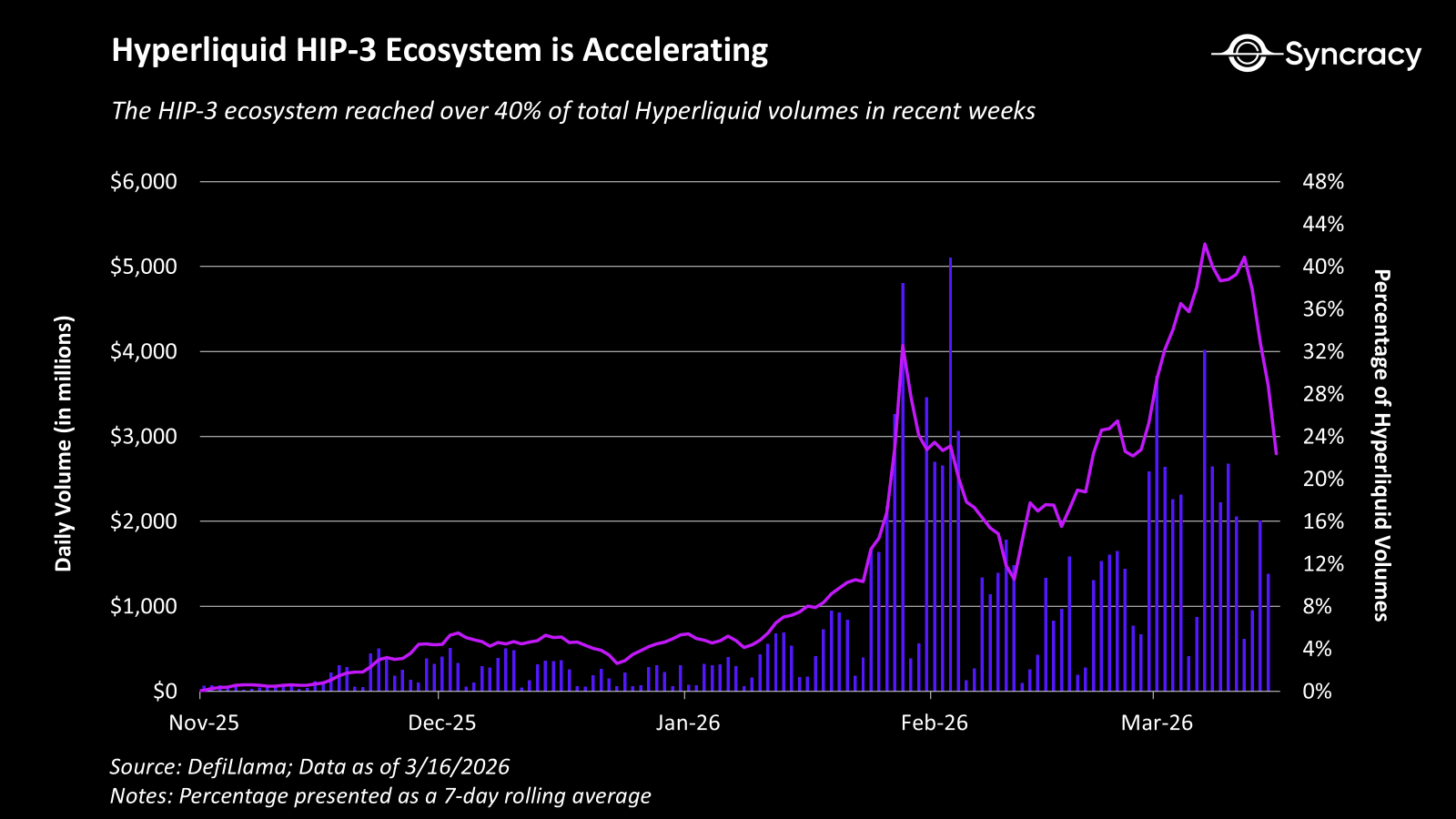
Hyperliquid has been hitting headlines lately, thanks to the growing interest in non-crypto assets (HIP-3) such as oil, gold, and silver trading on the platform.

In March alone, HIP-3 volumes accounted for 40% of total Hyperliquid daily volumes as the West Asia crisis dragged on.

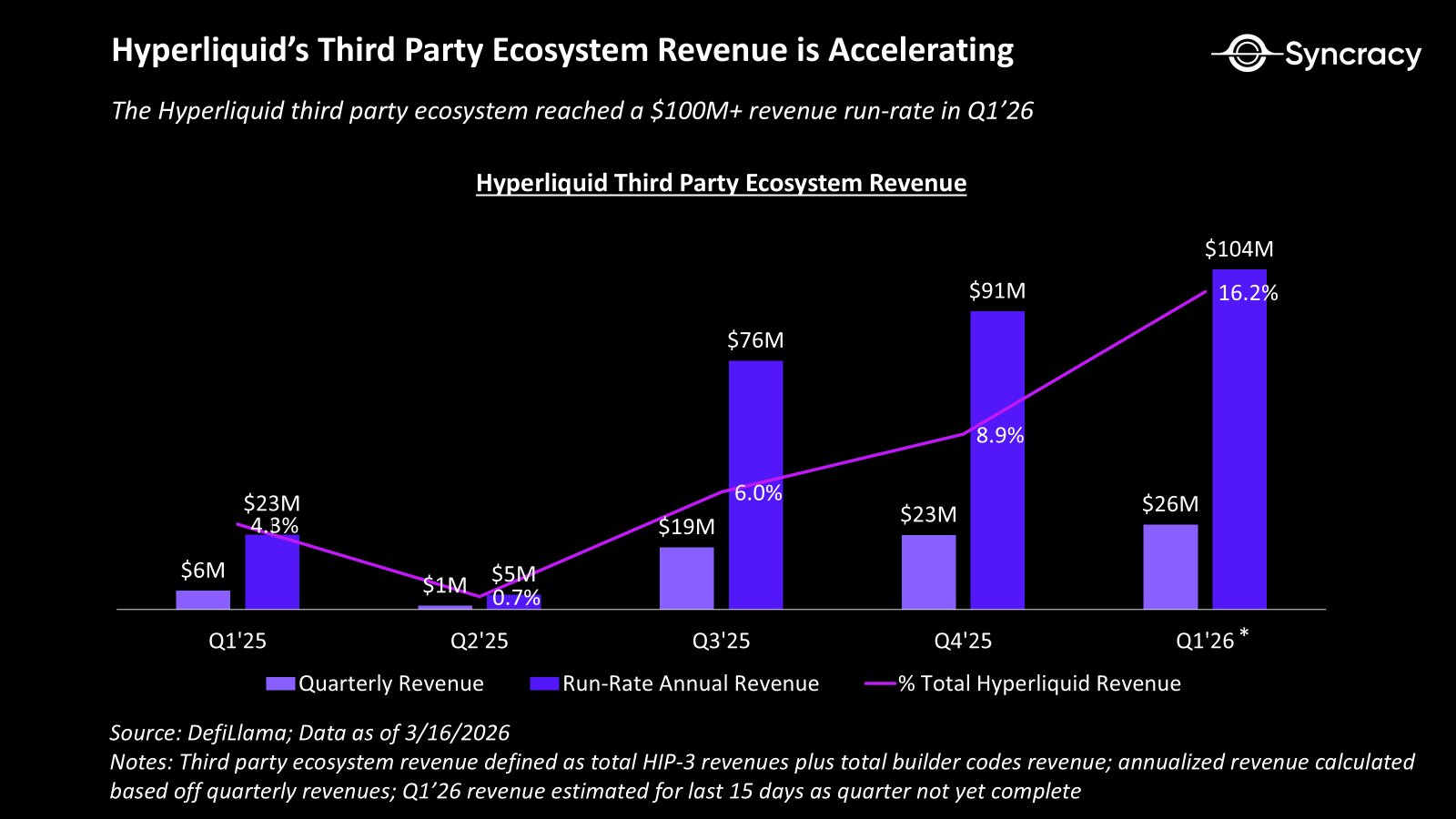
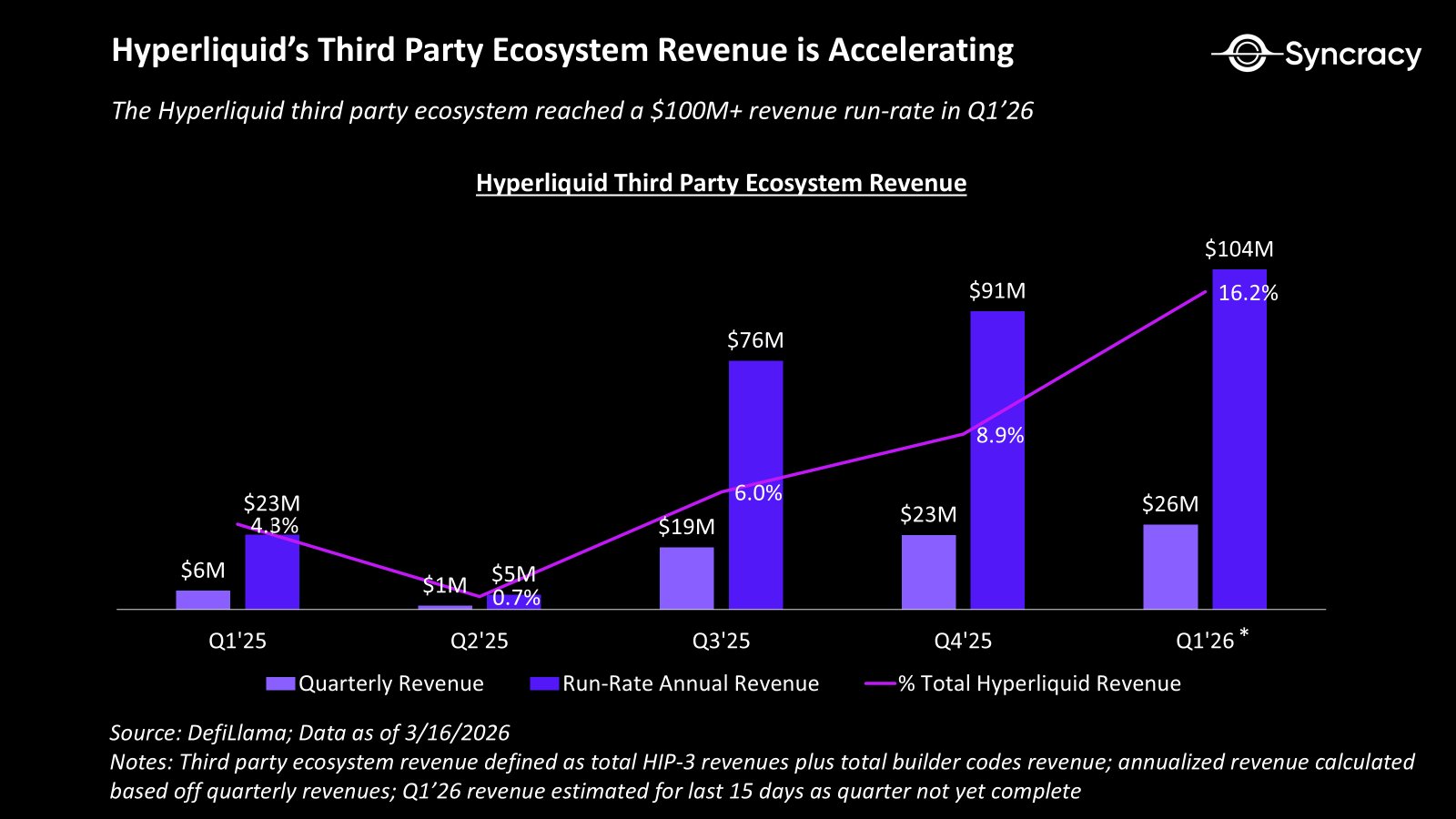
Below the surface, however, HIP-3 isn’t the only growth driver. Builder codes or integration with other platforms, such as Phantom and MetaMask wallets, has also seen incredible adoption.
Source: Syncracy Capital

Collectively, HIP-3 and builder codes (third-party ecosystem) now generate $100 million annual revenue for Hyperliquid – About 19% of total revenue share.

In terms of trading volumes alone, builder codes account for 10% of total volumes, primarily from mobile interfaces.

These are platforms like Phantom, which have plugged Hyperliquid under the hood to empower their perp offerings. For every trade made via these integrations, a fee-sharing model applies between Hyperliquid and the builder.
Source: Syncracy Capital (Builder codes vs HIP-3 revenues)

According to Ryan Watkins, co-founder of crypto VC firm Syncracy Capital, the two factors were ‘accelerating adoption’ for Hyperliquid.

Impact on HYPE?

Now, how does this monster adoption impact HYPE value or tokenholders? Well, since most of the revenue goes toward the token buyback program, buying pressure may trigger HYPE appreciation, especially in a positive macro environment.

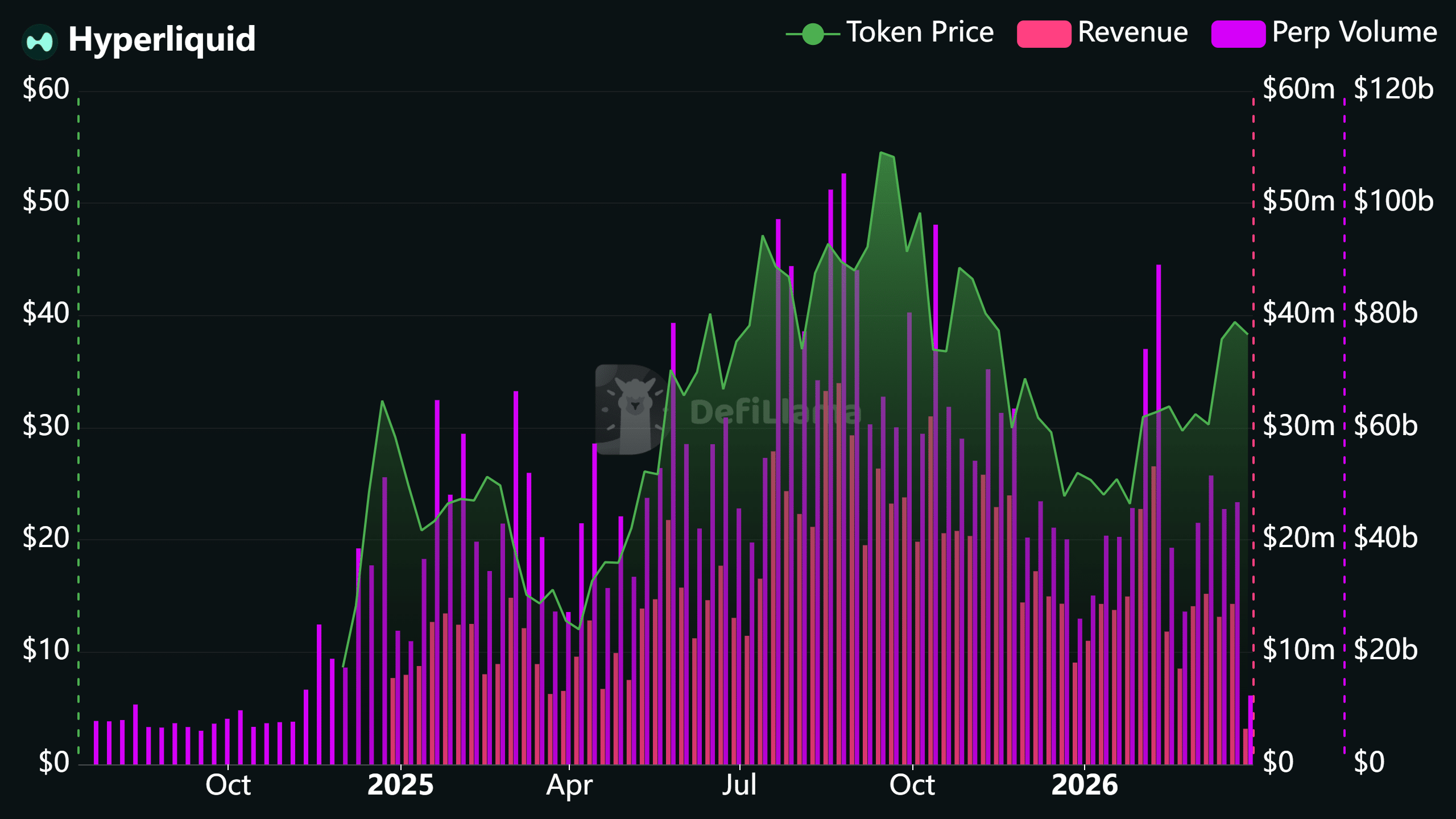
In fact, this is exactly what happened in Q1 2026. As perp volumes doubled from $40B to nearly $90B, weekly revenues doubled too from less than $9M to over $22M.

This made HYPE retracement to stabilize around $20, setting up a breakout to $38- Marking a whopping 86% run. After a cool-off to $25, the second phase lifted HYPE to $43, a massive 71% upswing.
Source: DeFiLlama

In other words, under positive market sentiment, the strong adoption is a flywheel for HYPE and tokenholders.

What’s next for HYPE price?

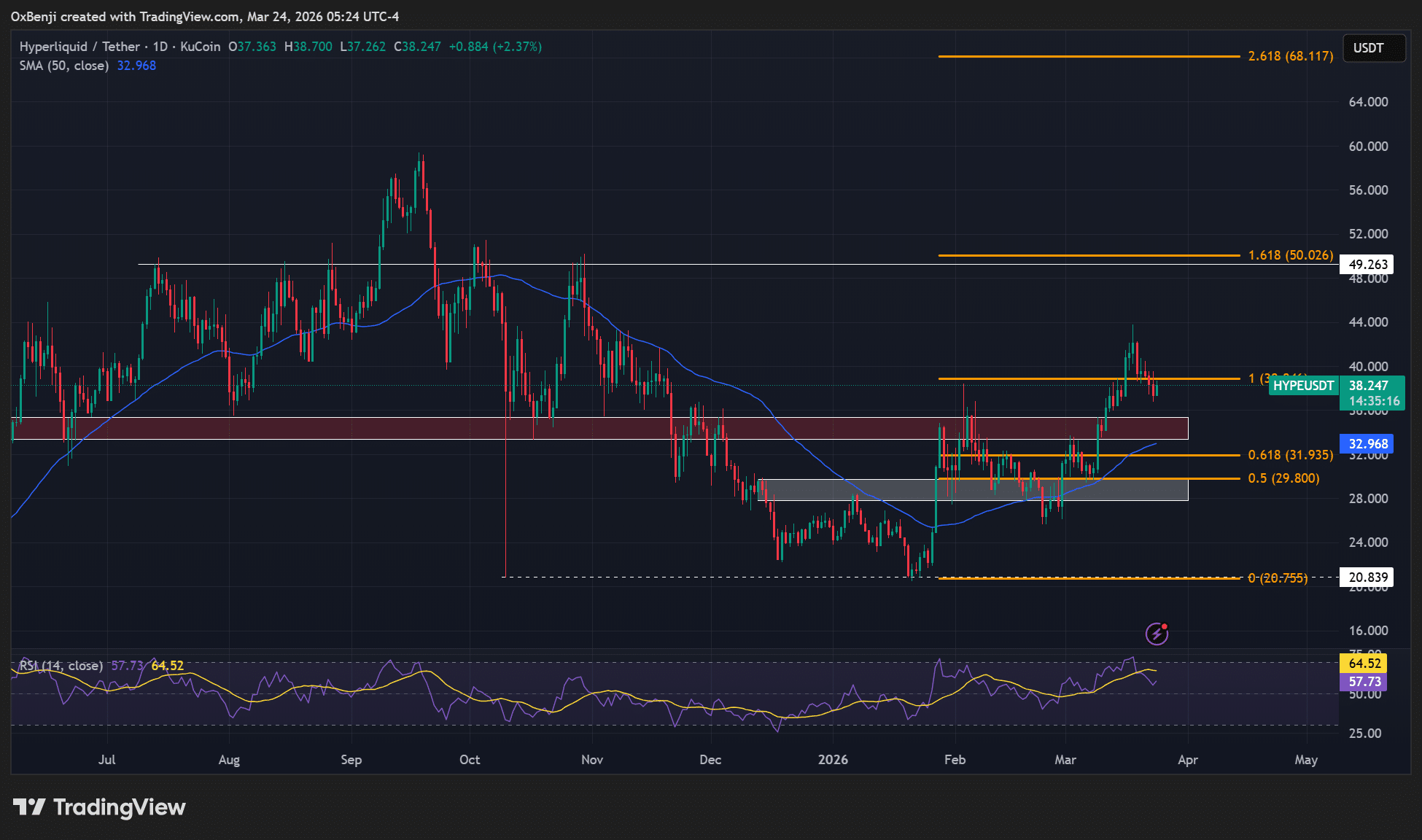
At the time of writing, HYPE had retraced part of its recent gains and traded below $40. But some whales kept bidding as the price retraced, underscoring that some players remained bullish on the altcoin.

Even so, HYPE was back in its H2 2025 price range of $35-50, and defending the range lows could increase the odds of hitting $50.
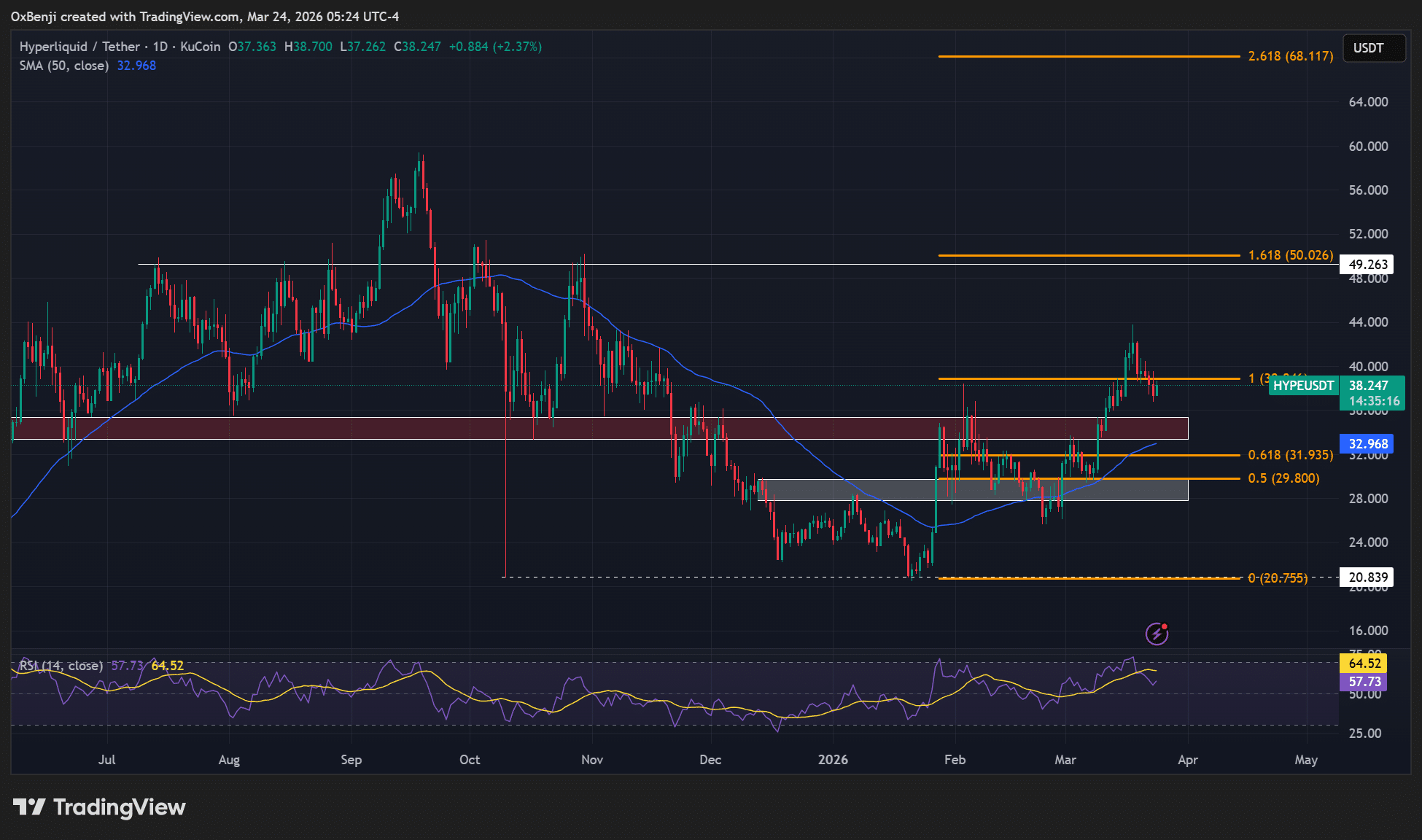
Source: HYPE/USDT, TradingView

Final Summary

  • Non-crypto assets and integration with other platforms now generate $100M annual revenue to Hyperliquid
  • The massive adoption has been net positive for HYPE, and bulls may defend the $35-$50 price range if the trend continues.


Trending Cryptos

Related Questions

QWhat are the two main growth drivers for Hyperliquid mentioned in the article?

AThe two main growth drivers are HIP-3 (non-crypto assets like oil, gold, and silver trading) and builder codes (integration with third-party platforms like Phantom and MetaMask wallets).

QHow much annual revenue do HIP-3 and builder codes collectively generate for Hyperliquid, and what percentage of the total revenue share is this?

AHIP-3 and builder codes collectively generate $100 million in annual revenue, which accounts for about 19% of Hyperliquid's total revenue share.

QAccording to the article, how does the revenue from third-party apps impact the HYPE token?

AMost of the revenue is used for a token buyback program, which creates buying pressure and can lead to HYPE token appreciation, especially in a positive macro environment.

QWhat was the price range for HYPE in H2 2025, as stated in the article?

AThe price range for HYPE in H2 2025 was $35 to $50.

QWho is Ryan Watkins and what did he say about Hyperliquid's growth factors?

ARyan Watkins is the co-founder of crypto VC firm Syncracy Capital. He stated that HIP-3 and builder codes were 'accelerating adoption' for Hyperliquid.

Related Reads

Bank of America Quietly Positions: Could $6 Trillion in Bank Deposits Flow into Stablecoins?

Bank of America has quietly made leadership appointments to accelerate its digital asset strategy, sparking discussion about a potential large-scale migration of bank deposits to stablecoins. Reports highlighted the bank naming Sonali Theisen, Kevin Milsom, and Adam Dixon to lead its global digital asset and AI platform, focusing on stablecoins, tokenized deposits, custody, and crypto settlement. This move revived a claim that $6 trillion in bank deposits could flow into stablecoins, a figure originally cited by Bank of America's CEO Brian Moynihan in January. However, he conditioned this shift on stablecoins being allowed to pay interest—a feature not permitted under the current GENIUS Act. The legislation's final rules are delayed, pushing its effective date to January 2027. Major banks are not waiting. JPMorgan and Citigroup are already piloting tokenized deposit services, and a consortium including Bank of America is building a shared tokenized deposit network targeting a 2027 launch. While some, like Pacemakers.io's Alessandro Hatami, remain skeptical of rapid bank collaboration, data shows significant institutional adoption. Stablecoin settlement volume hit $33 trillion in 2025, and analysts project the market could surpass $1 trillion by 2026. Despite a recent dip in crypto prices and stablecoin supply, the institutional push for real-world use cases continues. The race is on for January 2027, when the GENIUS Act takes effect, potentially reshaping the competition between traditional finance and digital assets.

Foresight News2m ago

Bank of America Quietly Positions: Could $6 Trillion in Bank Deposits Flow into Stablecoins?

Foresight News2m ago

US Treasury Secretary Bement Claims: The US Will Soon Control 80% of Global Computing Power

U.S. Treasury Secretary Ben Sent proclaimed that America is poised to control 80% of the world's computing power, positioning compute dominance as a core pillar of U.S. economic strategy. Speaking on the Mike Rowe show, he stated the U.S. currently holds 50-60% of global compute share, with expectations to reach 80% soon. He framed this as a strategic competition the U.S. "cannot afford to lose," warning that a rival's lead would grant "unacceptable" strategic leverage, while asserting a current one-year AI lead. This high-level policy endorsement is seen as a direct boost for AI infrastructure investment, benefiting chipmakers like NVIDIA and cloud providers' capex cycles. Sent positioned AI compute, semiconductors, and quantum computing as three pillars of national economic strength and security. He defended AI's societal impact, citing historical tech shifts, and argued AI empowers small businesses without causing net job loss so far. He highlighted government efforts to deepen public-private AI cybersecurity cooperation. For investors, the statement signals sustained U.S. policy support for AI infrastructure. However, analysts urge caution, noting "compute share" lacks a standard public metric; the 80% figure is a forecast, not audited data. They recommend focusing on tangible indicators like physical capacity expansion and power infrastructure, with future semiconductor and cloud reports providing key verification data.

marsbit14m ago

US Treasury Secretary Bement Claims: The US Will Soon Control 80% of Global Computing Power

marsbit14m ago

Trading

Spot

Hot Articles

How to Buy HYPE

Welcome to HTX.com! We've made purchasing Hyperliquid (HYPE) simple and convenient. Follow our step-by-step guide to embark on your crypto journey.Step 1: Create Your HTX AccountUse your email or phone number to sign up for a free account on HTX. Experience a hassle-free registration journey and unlock all features.Get My AccountStep 2: Go to Buy Crypto and Choose Your Payment MethodCredit/Debit Card: Use your Visa or Mastercard to buy Hyperliquid (HYPE) instantly.Balance: Use funds from your HTX account balance to trade seamlessly.Third Parties: We've added popular payment methods such as Google Pay and Apple Pay to enhance convenience.P2P: Trade directly with other users on HTX.Over-the-Counter (OTC): We offer tailor-made services and competitive exchange rates for traders.Step 3: Store Your Hyperliquid (HYPE)After purchasing your Hyperliquid (HYPE), store it in your HTX account. Alternatively, you can send it elsewhere via blockchain transfer or use it to trade other cryptocurrencies.Step 4: Trade Hyperliquid (HYPE)Easily trade Hyperliquid (HYPE) on HTX's spot market. Simply access your account, select your trading pair, execute your trades, and monitor in real-time. We offer a user-friendly experience for both beginners and seasoned traders.

4.5k Total ViewsPublished 2024.03.29Updated 2026.06.02

How to Buy HYPE

Discussions

Welcome to the HTX Community. Here, you can stay informed about the latest platform developments and gain access to professional market insights. Users' opinions on the price of HYPE (HYPE) are presented below.

活动图片