How to Earn $300,000 a Year by Counting Musk's Tweets?

比推Published on 2026-02-21Last updated on 2026-02-21

Abstract

An anonymous trader known as "noovd" has reportedly earned over $345,000 in profit since July 2024 by accurately predicting the number of tweets Elon Musk would post each week on the prediction market Polymarket. The user placed 1,281 bets, with the largest single win exceeding $136,000. Noovd’s strategy focused exclusively on betting "Yes" on narrow, often undervalued tweet-count ranges (e.g., 260–279 or 420–439 tweets per week), which were typically priced as low as 2–24 cents due to market underestimation. Using a proprietary quantitative model trained on Musk’s tweet data since 2022, noovd identified mispriced probabilities—often realizing 8–20x expected value advantages. Key to the model’s success was incorporating variables like day-of-week patterns, real-world events (e.g., SpaceX launches, Tesla earnings), and mid-week recalculations to narrow the probable outcome range. The trader’s high-conviction, concentrated bets—often risking thousands per position—allowed for outsized returns, such as a 4,311% gain on a $1,569 bet. Noovd’s edge stemmed from deep data analysis, disciplined execution, and exploiting persistent market inefficiencies. The case illustrates how specialized expertise in a narrow domain can yield significant returns, emphasizing data over intuition in prediction markets.

Author: Ma He, Foresight News

Original Title: He Made $300,000 by Counting Musk's Tweets


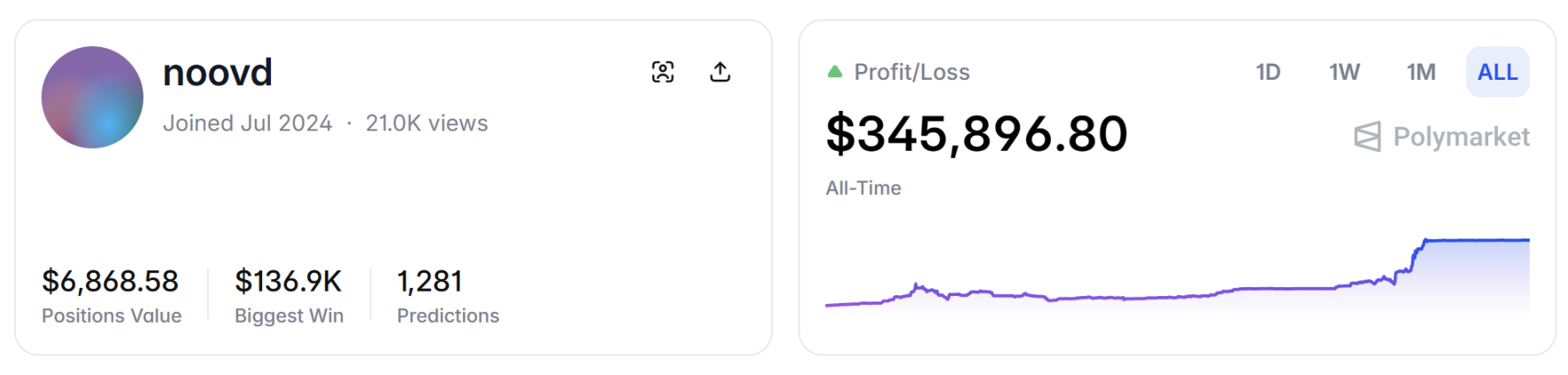
Polymarket is home to many top-tier, profit-savvy minds. A player with the nickname noovd (0x063aeee10fbfd55b6def10da28e87a601e7deb4b) has earned hundreds of thousands in profits simply by predicting the number of tweets from the world's wealthiest man, Elon Musk.

According to the official homepage, he only joined in July 2024 but has already netted $345,000. This player has made 1,281 predictions, with the single largest win being $136,000, and currently holds positions worth $6,877.

Looking at his profit curve, it was almost flat for the first few months, but starting from late 2025, it suddenly shot up with several near-vertical spikes, each surge originating from the same source: interval bets on how many tweets Elon Musk would post per week.
As the world's richest billionaire, Musk certainly has no incentive to manipulate the market.

He doesn't guess NBA scores or bet on various political events; he sticks to this one track. Looking at his settled records, the top eight profits all come from betting "Yes" on "Will Musk post between X and Y tweets this week?"

Polymarket breaks down Musk's weekly tweet count into over a dozen mutually exclusive intervals, each spanning about 20 tweets—200-219, 220-239......420-439, and even extreme intervals like 850-874. Retail investors, faced with so many choices, often pick something in the middle, buying a little at 35-50 cents for psychological comfort. What about the edge intervals? Their prices often drop to 2-24 cents, even when the actual probability is clearly 15-30%.
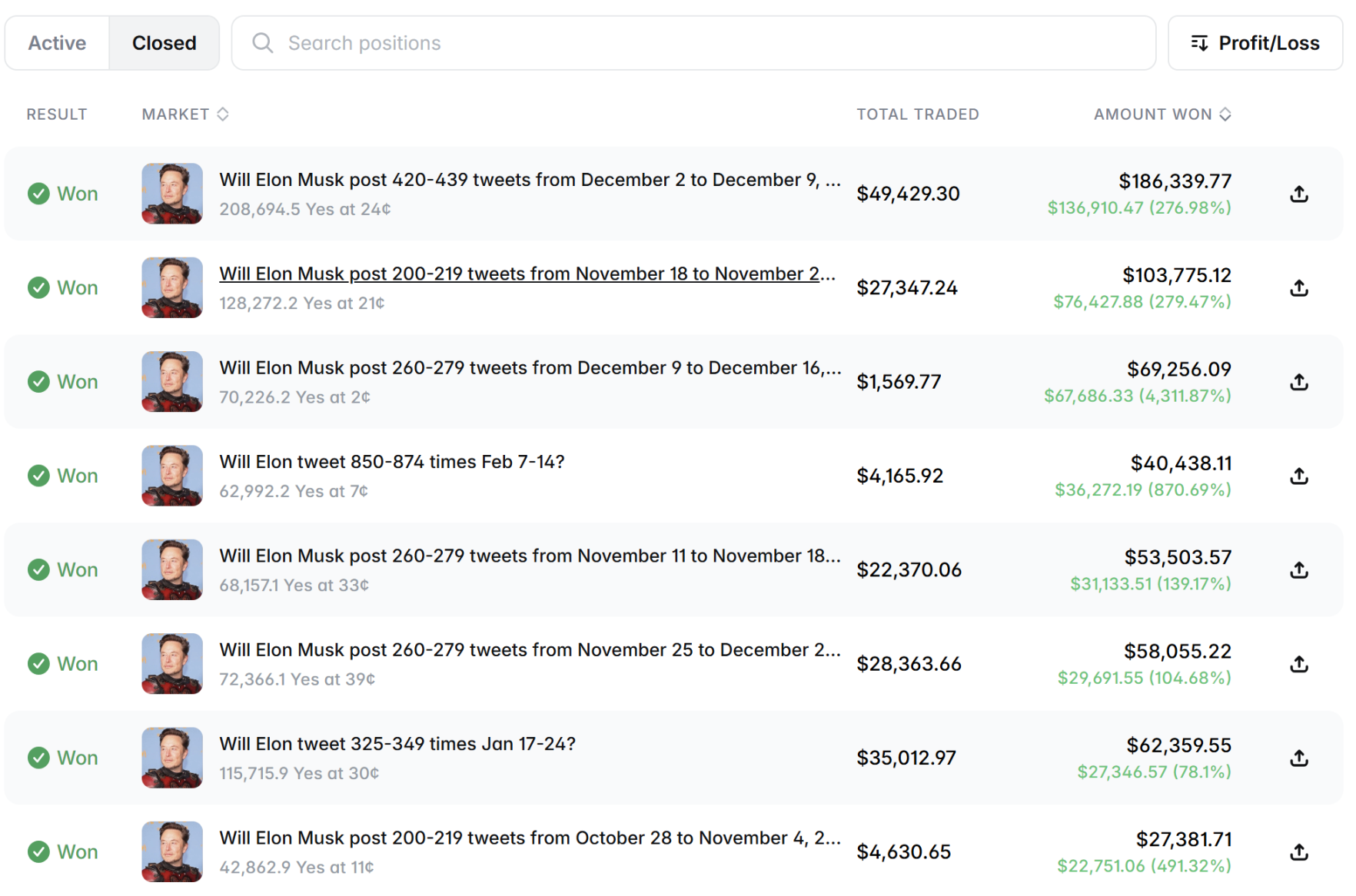
noovd feasts on these undervalued bargains. He only buys "Yes," never "No," never sells early, and never diversifies or hedges. When he places a bet, his positions range from $4,000 to $30,000, with an average entry price between 2-39 cents. Once his model confirms, he goes all in and waits for Sunday's settlement. His brilliance lies in having a real-time rhythm model that others don't see. He doesn't rely on hunches like "Musk will probably post more this week"; instead, he feeds his model with daily tweet data since 2022, updating it daily.

Musk's posting habits from Monday to Friday, the weekend lulls, the weight of catalysts like Starlink launches, Tesla earnings, DOGE news, and xAI new features—all are quantified. By Wednesday or Thursday, he can already precisely calculate how many tweets are needed each remaining day to land exactly within a specific 20-tweet interval.

While the market is still guessing blindly with historical averages, he has compressed the error margin to within ±10-15 tweets. If he detects that a 2-cent interval has an actual probability of 18-25%, he goes heavy. The single-bet expected value advantage often reaches 8-20x. One big win can wipe out dozens of small losses and then some.
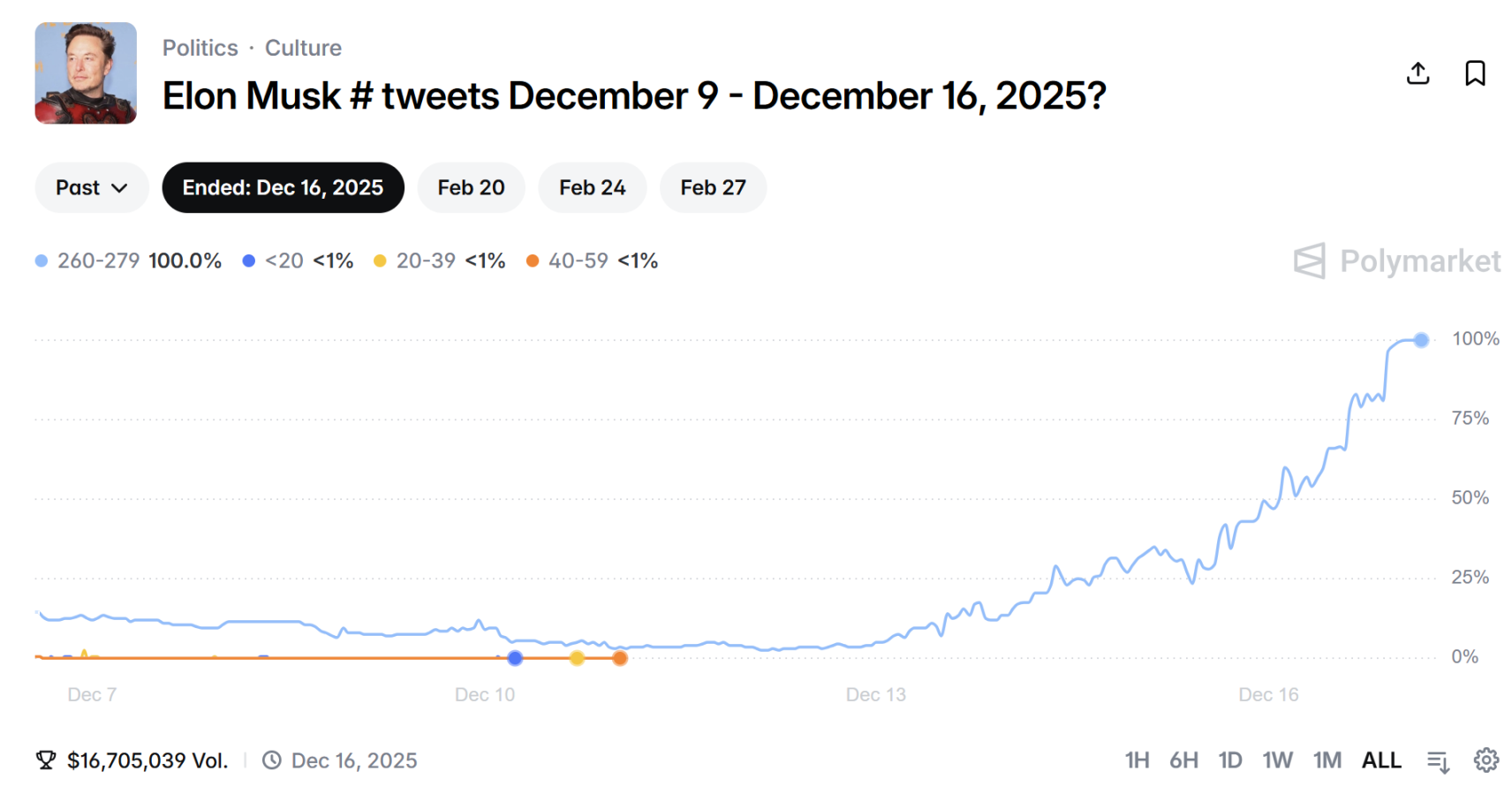
Take the prediction for December 9-16, 2025, for example. By Wednesday night, Musk had already posted 130+ tweets, leaving four days where he needed 32-35 tweets per day to precisely hit the 260-279 interval. That week had no explosive news, but discussions about xAI and Tesla were ongoing. The market, however, priced this interval extremely low because everyone thought "either it'll be平淡 180-220, or it'll shoot straight to 400+".

noovd's model might have captured some pattern of Musk's "sporadic activity." The player bought in at an average price of 2¢, investing about $1,569, and ultimately profited $67,686.33—a return of 4,311.87%.

He entered when the odds were extremely skewed, using minimal cost to lock in this narrow profit interval. This is a typical "deep out-of-the-money options" strategy, betting on the long-tail opportunities of probability distributions.

While the previous case already boasts an astonishing 43x return, the next case became his most profitable bet.
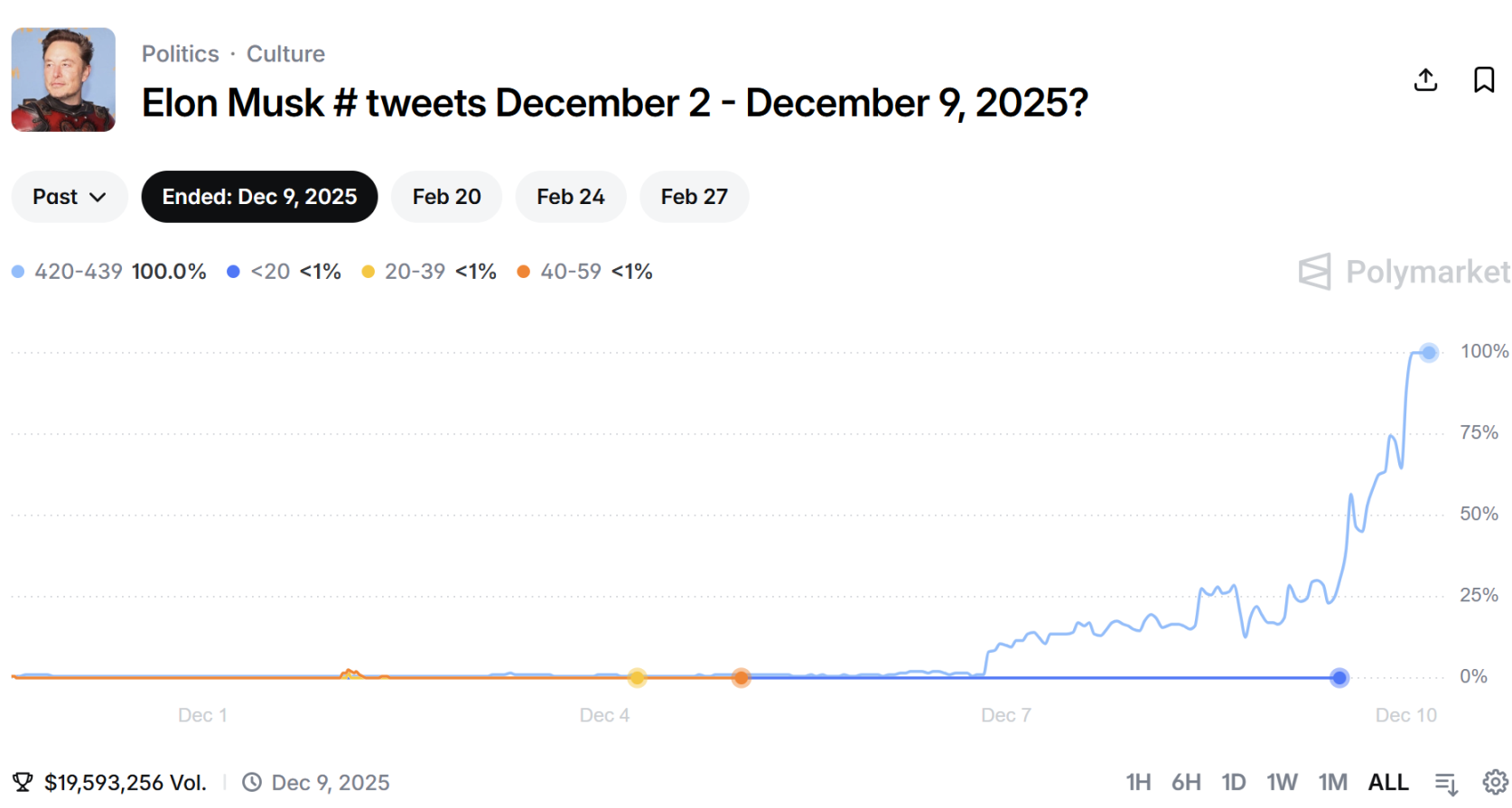
December 2-9: Will Musk post 420-439 tweets?

He bought at an average price of 24¢, heavily with $49,429, and finally profited over $130,000.

At that time, Musk's tweet count had already surged to 180+ by Tuesday. For the remaining days, he needed to maintain 65-70 tweets per day to firmly nail the 420-439 interval. That week had election aftermath and product pre-hype. The market priced it at 24 cents, but he saw that others were spreading their positions across the 400-419, 420-439, and 440-459 intervals, while the most likely landing spot was the middle one. He directly scooped up all 208,694 shares at a cost of $49k, settled for $186k—another near 3x return. Just these two December trades combined for over $255,000. The other thousand or so bets were mostly small tests or辅助 intervals in the same赛道, essentially keeping the machine oiled.

Why can this strategy keep making money, and why is it almost impossible to replicate?

First, the information barrier is too high. You need to scrape his timeline daily, preferably have a complete historical dataset, and write your own Poisson distribution model that refreshes every 6-12 hours. Ordinary people either can't scrape the data or can't be bothered to tune the parameters. The psychological hurdle is immense. Intervals priced at 2 cents or 7 cents look like throwing money away. Anyone who hasn't endured 100 weeks of drawdowns or witnessed 100 settlements firsthand would never dare to go heavy. When you look at his settled loss screenshots, you might breathe a sigh of relief—this player isn't a 100% win-rate god either.
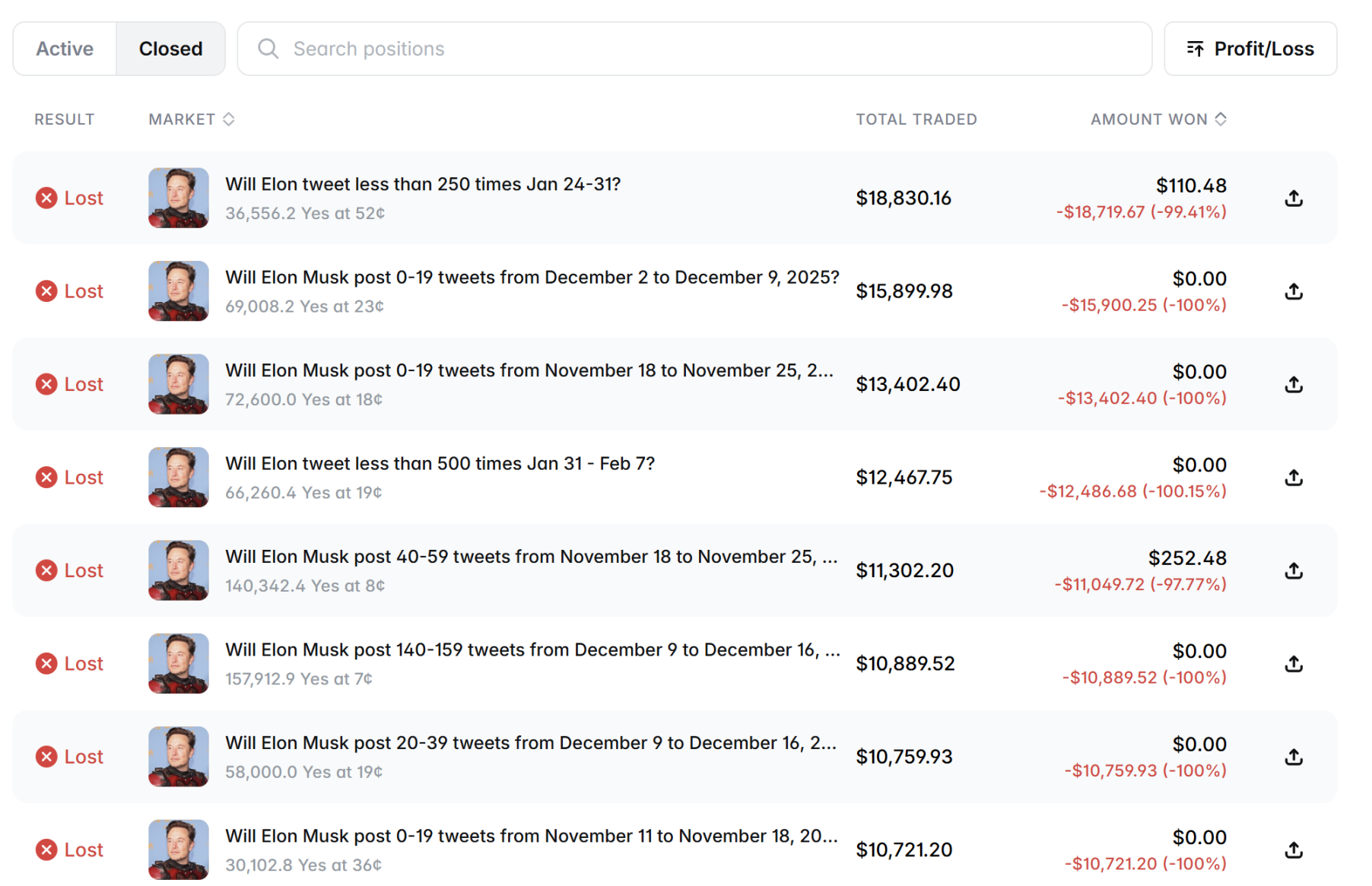
Second, it requires extreme execution. Only go big when the advantage is greater than 10x, treat small losses as tuition, and let big wins compound. Most critically, market inefficiencies persist.

From noovd, what ordinary people can truly learn is to stop fantasizing about conquering all markets. First, find an extremely narrow, repeatable signal and study it thoroughly. Depth always beats breadth, as long as your edge is real. Abandon feelings entirely; speak with numbers and data. Making spreadsheets, scraping data, and running regressions are ten thousand times more reliable than relying on "a feeling that Musk will go crazy this week."

2 cents with a 20% real probability is far better than 50 cents with only a 5% edge. Most people do the exact opposite. In a casino where everyone shouts about 100x returns, the quietest and fiercest wealth was made by someone who could count tweets better than anyone else.

Now, new intervals for predicting Musk's weekly tweet count are still opening regularly. The only question is, very few can turn it into their own money printer.


Twitter:https://twitter.com/BitpushNewsCN

Bitpush TG Discussion Group:https://t.me/BitPushCommunity

Bitpush TG Subscription: https://t.me/bitpush

Original link:https://www.bitpush.news/articles/7613530

Trending Cryptos

Related Questions

QHow did the user noovd make over $300,000 on Polymarket?

ABy accurately predicting the number of tweets Elon Musk would post each week, using a sophisticated data model to identify undervalued betting intervals.

QWhat specific strategy did noovd use to profit from Musk's tweet predictions?

AHe focused on buying 'Yes' shares in undervalued, narrow tweet count intervals (e.g., 420-439 tweets) with high probability but low market prices, often at 2-39 cents, and held until结算.

QWhat was noovd's most profitable single bet, and how much did he earn from it?

AHis most profitable bet was on December 2-9, predicting Musk would tweet 420-439 times. He invested $49,429 at an average price of 24 cents and profited over $130,000.

QWhy is noovd's approach difficult for others to replicate?

AIt requires high technical skills, including scraping Musk's historical tweet data, building a real-time Poisson distribution model, and executing large bets on low-probability intervals with psychological discipline.

QWhat key lesson can be learned from noovd's success on Polymarket?

AFocus on a narrow, repeatable opportunity, use data-driven models instead of intuition, and capitalize on market inefficiencies where probability is mispriced, rather than broadly betting on multiple events.

Related Reads

Must-Watch Events Next Week|CLARITY Act Could Face Senate Vote; SpaceX, Circle to Report Earnings (8.3-8.9)

**Summary: Key Events and Developments to Watch (August 3-9)** The upcoming week is marked by significant financial disclosures, key legislative deadlines, and notable product updates. **Major Financial Events:** Several companies are scheduled to release their Q2 2026 earnings. American Bitcoin (ABTC) will report on August 3, followed by SpaceX and Hut 8 Mining Corp. on August 4, and Circle on August 5. Notably, a significant portion of SpaceX shares (up to 12% of total shares) will be unlocked on August 6 following their earnings release. **Key Legislative Deadline:** The U.S. Senate faces an August 7 deadline to secure 60 votes for the CLARITY Act, a bipartisan bill aiming to establish a federal regulatory framework for cryptocurrencies. The Senate may hold a full vote on the bill during the week. **Economic Data:** The U.S. July Non-Farm Payrolls report will be released on August 7, providing crucial labor market data. **Technology & Product Updates:** * **Shutdowns:** DeFi portfolio tracker Zapper and wallet app Ctrl Wallet will cease operations on August 3. * **Upgrades:** LayerZero will deprecate its v1 relayers on August 3. XRP Ledger's new version 3.3.0, featuring five new functions, is expected next week. * **AI:** Elon Musk announced that the advanced Grok 4.6 AI model is set for release around August 7. * **Bitcoin:** The BIP-110 forced signaling for a potential Bitcoin network change is scheduled to begin around August 8. **Other Notable Events:** Chinese robotics firm Unitree Tech has set its preliminary price inquiry for its IPO for August 5. South Korean exchange Upbit will delist AQT and AERGO tokens on August 3.

marsbit30m ago

Must-Watch Events Next Week|CLARITY Act Could Face Senate Vote; SpaceX, Circle to Report Earnings (8.3-8.9)

marsbit30m ago

Stocks Are Plummeting More Sharply Than Cryptocurrencies. Where Has the Money Gone?

Stock Markets Plunge Deeper Than Cryptocurrencies: Where Did the Money Go? In late July, Seoul's Kospi index triggered circuit breakers for two consecutive days, plummeting over 40% from its June high. The collapse was led by heavyweight stocks like SK Hynix, whose record profits still disappointed investors, and devastating leveraged ETFs, with one major product losing over 83% of its value. This signaled a global, forced deleveraging targeting the most crowded trades. Interestingly, while stocks exhibited extreme volatility akin to crypto markets, Bitcoin rose nearly 15% in July after a prior steep drop. Analysis shows the money fleeing equities did not flow into Bitcoin. Instead, Bitcoin had already absorbed its sell-off in May-June, when U.S. spot Bitcoin ETFs saw historic outflows. The true safe-haven beneficiary was gold, whose price rose over 20% year-on-year, highlighting a decoupling between Bitcoin and gold as "digital gold." The sell-off was a targeted unwinding of leveraged positions in tech and semiconductors, accelerated by broker-dealer risk management and shifts in the AI narrative, including new competition from Chinese memory chipmakers. The retreat path was clear: from high-valuation tech stocks to cash and U.S. Treasuries, then to gold. For Bitcoin to attract sustained institutional inflows, conditions like eased global liquidity pressure, a "soft-landing" Fed rate cut, and U.S. regulatory clarity via legislation like the stalled CLARITY Act are needed. Currently, Bitcoin is not a safe haven but an already-cleared asset. Its low correlation with tech stocks, however, makes it a potential diversification play for institutional portfolios once the storm passes. The money isn't here yet, but the positioning is underway.

marsbit30m ago

Stocks Are Plummeting More Sharply Than Cryptocurrencies. Where Has the Money Gone?

marsbit30m ago

In Conversation with Ray Dalio: We Are Currently in an AI Bubble, with 1% of My Portfolio in Bitcoin

Ray Dalio, founder of Bridgewater Associates, warns in an interview that the current AI boom shows classic bubble characteristics, which could lead to significant economic downturns as seen in past cycles like 1929 or 2000. He explains that speculative enthusiasm, fueled by debt and overvaluation, often precedes a crash when rising rates or taxation force asset sales, causing widespread losses and recession. Dalio also outlines his "Big Cycle" theory, describing an approximate 80-year pattern where widening wealth gaps, massive government deficits, and shifting geopolitical power (like China's rise) create internal conflict and global instability. He emphasizes that we are in a late-cycle, transitional phase where traditional powers like the US and UK face decline. For personal wealth protection, Dalio advises diversification beyond cash into assets like stocks, bonds, real estate, and particularly gold, which he prefers over Bitcoin. While he holds about 1% of his portfolio in Bitcoin as a non-printable hard asset, he views gold as more secure from technological or governmental threats. Regarding AI's impact, Dalio believes it will disproportionately benefit capital owners, worsening inequality by replacing both physical and cognitive labor. He suggests that human intuition and emotional intelligence, combined with AI, will be key for future workers. On taxation, Dalio argues that wealth taxes are impractical and risk triggering asset sell-offs, reducing productive investment. He points to the UK as a cautionary example of debt, low productivity, and political strife. Geopolitically, Dalio foresees a more regionalized world, with the US showing weakness in prolonged conflicts like with Iran, akin to past imperial declines. The ideal outcome, he suggests, is coexisting powerful blocs (e.g., Americas, China-Asia Pacific) without major war.

marsbit4h ago

In Conversation with Ray Dalio: We Are Currently in an AI Bubble, with 1% of My Portfolio in Bitcoin

marsbit4h ago

Daily 7.2 Trillion KRW: Foreign Capital's Record Net Buying on Friday! Wall Street Says Headwinds for Korean Stock Fund Flows Have Subsided

South Korean stock market sees a dramatic shift in fund flows. On July 31, foreign investors made a record net purchase of approximately KRW 7.2 trillion in KOSPI stocks, marking a fundamental reversal from the persistent large-scale net outflows seen in previous months. This contributed to a significant narrowing of foreign net selling in July to KRW 9.8 trillion, down sharply from KRW 48.4 trillion in June and KRW 44.5 trillion in May. Simultaneously, domestic institutional pressure eased. South Korean pension funds and asset managers turned to a net buying position in July, purchasing KRW 1.0 trillion worth of KOSPI shares, contrasting with net sales in May and June. Market volatility is expected to be dampened by new financial regulations. Effective July 31, the Financial Services Commission tightened access for retail investors to single-stock leveraged ETFs by raising the minimum cash deposit requirement. Trading volumes for these products subsequently dropped to about 50% of their monthly average. Citigroup Research maintains its year-end KOSPI target of 10,000 points. The firm cites several supportive factors: the substantial easing of headwinds from capital outflows, a robust fundamental outlook for the semiconductor sector, historically low market valuations, strong economic fundamentals, and the potential for policy support from financial authorities if needed.

marsbit4h ago

Daily 7.2 Trillion KRW: Foreign Capital's Record Net Buying on Friday! Wall Street Says Headwinds for Korean Stock Fund Flows Have Subsided

marsbit4h ago

Trading

Spot

Hot Articles

Discussions

Welcome to the HTX Community. Here, you can stay informed about the latest platform developments and gain access to professional market insights. Users' opinions on the price of S (S) are presented below.

活动图片















