How to Deal with Trump? Here's the 'Deal-Maker's Playbook'

marsbitPublished on 2026-03-11Last updated on 2026-03-11

Abstract

The Kobeissi Letter outlines a consistent 10-step "conflict playbook" used by former President Trump in geopolitical and trade disputes, from Iran to tariffs. It begins with verbal pressure and strategic posturing, often followed by "Friday night surprise" actions to allow market digestion. Markets initially bet on quick deals, but Trump’s "forever war" rhetoric reverses optimism, forcing repricing. A conditional de-escalation signal (like Trump’s recent Iran comments) emerges when structural market stress (oil >$90, stocks down 5%) or political costs mount. Eventually, deals are struck, triggering violent market reversals due to defensive positioning. Three scenarios are projected for the next 2-4 weeks, all pointing to an eventual agreement—Trump’s conflicts consistently end with deals, not prolonged war.

Every conflict involving Trump follows the same script.

According to Xinhua News Agency, Trump spoke about the Iran conflict in Miami on the 9th: he believes the conflict will end "soon," but "not" this week. This statement sounds ambiguous, but if you've been tracking his approach to handling geopolitical conflicts, you'll recognize it as a familiar signal—negotiation terms are quietly taking shape.

This is precisely the seventh step described by The Kobeissi Letter—the emergence of conditional de-escalation signals. After the market has already begun seriously pricing in a "longer fight," conditional cooling rhetoric appears—not a retreat, but a test of whether the opponent and the market can withstand the next stage of escalation.

In a report dated March 3, The Kobeissi Letter, an independent U.S. macro market research newsletter, systematically reviewed every geopolitical and trade conflict involving Trump since his inauguration in January 2025, from tariff wars, the arrest of Venezuela's Maduro, and Greenland negotiations, to the current Iran conflict. The negotiation logic Trump follows in handling these conflicts is highly consistent.

This research compiles a complete 10-step "conflict script" for Trump's approach to conflicts: from verbal pressure and posturing, to a preference for making key moves on Friday nights, to the spread of risk premiums across stocks, bonds, and commodities, and finally ending with a "deal" that triggers violent market repricing. For the next 2 to 4 weeks, the institution outlines three scenarios, with the outcome likely still being an agreement—but before that, the market may have to endure another round of pain.

Step One to Step Three: From Verbal Pressure to the "Friday Night Surprise"

Trump's conflicts often don't start with the first missile or the first tariff notice, but with linguistic pressure to "make a deal."

The Kobeissi Letter defines the starting point of Trump's conflict mode as verbal pressure. Taking the Iran conflict as an example, the first strike on Iranian nuclear facilities occurred on February 28, but as early as two months prior, Trump had repeatedly posted on Truth Social that "a massive fleet is heading towards Iran" and continuously urged Iran to "make a deal."
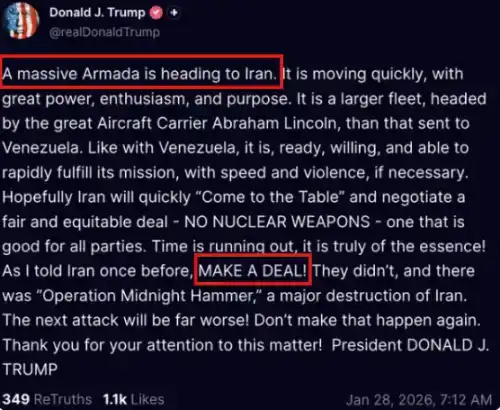
The institution points out that this pattern was equally clear in the Venezuela and EU tariff events: Trump announced the closure of Venezuelan airspace more than a month before taking action against Venezuela; before imposing tariffs on the EU, he continuously threatened Denmark and claimed it was "time" to acquire Greenland.

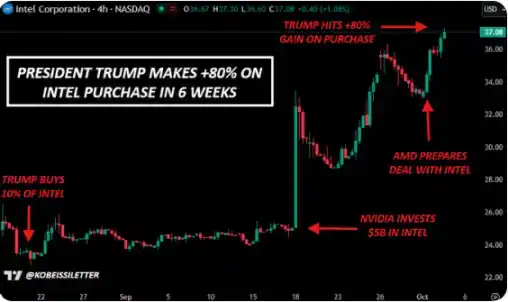
The second step is strategic posturing and demonstration of strength, including visible preparatory actions like military deployments and public ally coordination, aimed at enhancing credibility without triggering full-scale conflict. The institution cites Trump's meeting with Intel CEO Lip-Bu Tan in August 2025 as an example—prior to this, Trump had publicly demanded his "immediate resignation," after which both sides reached an agreement for a 10% government stake. This investment recorded over 80% paper gains in less than two months.
The third step is the signature "Friday Night Surprise." The Kobeissi Letter's statistics show that Trump's major actions are highly concentrated from Friday night to early Saturday morning, including: the June 21 U.S.-Israel joint airstrike on Iranian nuclear facilities, the September 1 strike on drug boats in the Caribbean, the October 10 threat of 100% tariffs on China, the November 29 closure of Venezuelan airspace, the December 25 military action in Nigeria, and the February 28 airstrike on Iran.

Why always act on Friday night? The report suggests that if major news breaks during trading hours, liquidity dries up instantly, algorithmic programs amplify volatility, and intraday panic intensifies. Announcing on Friday evening gives investors, institutions, and governments the entire weekend to digest the information.

More importantly, Trump is highly sensitive to severe market volatility—he needs a time window to observe market reactions and leave room for possible negotiations. According to this script, after acting on Friday night, Trump often begins hinting at the possibility of a "deal" before the Sunday futures market opens. In the case of Iran, that signal did not come.

Step Four to Step Six: How the Market Gets "Educated"

After the third step, the research divides the market's typical reaction into three layers:

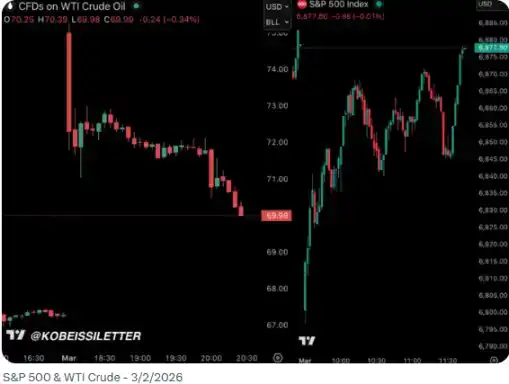
Step Four: The shock occurs, but the market initially bets on a "quick deal." The report describes a common path: severe volatility occurs during the Sunday night session (18:00 EST), but by the time the Monday cash market opens, some of the moves are "reversed," as investors assume Trump loves deals and the conflict won't drag on. The research cites the March 2 movement as an example: WTI crude oil erased about 70% of its gains at one point, and the S&P 500 even turned green, but these moves were subsequently reversed, with oil hitting new highs and stocks hitting new lows.
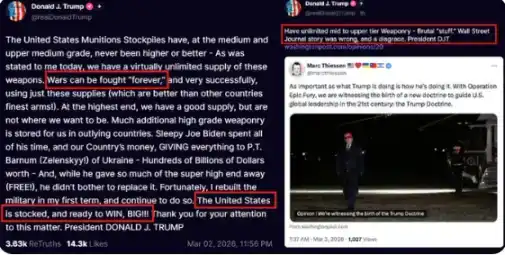
Step Five: Trump uses rhetoric like "we can fight forever" to burst the market's optimism. After investors buy the dip, the market is often hit with a counter-punch. On March 2, Trump publicly stated that "the war can go on forever" and that the U.S. has "unlimited mid-to-high-end weapons." The Kobeissi Letter believes this "forever" type of statement is more of a negotiation tactic, showing the bearable upper limit, but does not equate to a genuine desire for a prolonged war.
Step Six: The market begins formally pricing in a "longer duration." As of the report's writing on March 3, Brent crude oil prices broke above $85/barrel for the first time in nearly two years; the Dow Jones Index fell over 1100 points in a single day; stocks fell to weekly lows, and defensive capital outflows accelerated. This stage marks a structural shift in market psychology—"The first dip is bought because investors expect an agreement is coming; the second dip is bought because investors believe the escalation is temporary; the third dip is when positions begin to change structurally."

Step Seven to Step Eight: De-escalation Signals and the Market Feedback Loop

Step Seven is the emergence of conditional de-escalation signals, which corresponds to the stage of Trump's latest statement on the 9th. The Kobeissi Letter emphasizes that the time window between Step Six and Step Seven is "highly uncertain"—in the early 2025 tariff war, this transition took months, ultimately catalyzed by a rapid surge in U.S. Treasury yields before tariffs were "paused" on April 9.

The institution points out that the historical catalysts prompting Trump to back down have either been the target actively seeking to "make a deal" or a structural break in the market. On the Iran issue, this catalyst would be the collapse of the Iranian government or some event with structural implications for the U.S. and global economy.
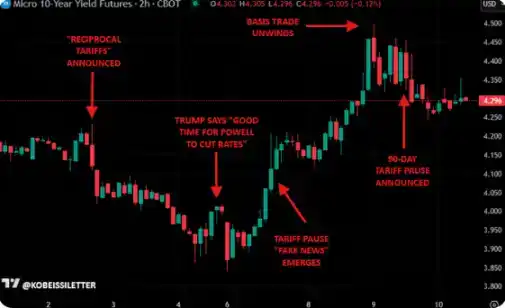
Step Eight is the feedback loop between the market and politics. The financial market itself has become part of the negotiation environment, as oil prices, stock markets, and inflation expectations in turn influence the political narrative.

Trump has three policy priorities: being a "peace president," suppressing inflation, and lowering U.S. gasoline prices. From this, it follows that: rising oil prices, if prolonged, directly conflict with his goals, especially in a critical midterm election year.

According to JPMorgan estimates, a blockade of the Strait of Hormuz could push oil prices to $120-$130/barrel and cause U.S. CPI inflation to soar to around 5%. Based on this, the institution set three key monitoring thresholds: Brent crude sustaining above $90/barrel, a stock market decline of 5% or more, and a gasoline price increase of over 10%. "When these thresholds are breached, the probability of negotiation-related headlines appearing increases significantly."
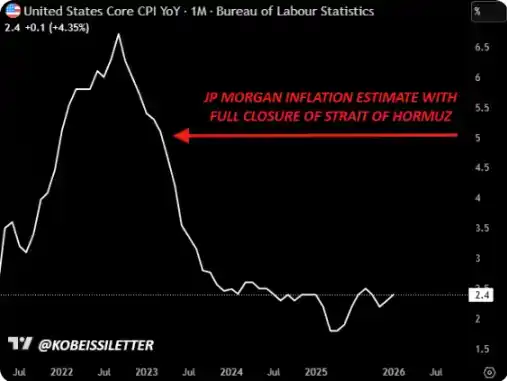
Step Nine to Step Ten: Agreement Reached and Violent Repricing

Step Nine is agreement reached and narrative framing. The Kobeissi Letter points out that every major confrontation within Trump's framework ultimately ends with a narrative of "maximum pressure in exchange for concessions," whether it's trade deals with China, the EU, India, corporate negotiations with Intel or in the rare earths sector, or the multiple conflicts Trump helped end in 2025.

On the Iran issue, the institution believes that if the Iranian government does not collapse, the final agreement might involve a ceasefire linked to nuclear issues, a regional security arrangement with enforcement mechanisms, or a sanctions adjustment plan conditional on compliance benchmarks. "The specific architecture is far less important than the timing and narrative framework."

Step Ten is violent market repricing and declaration of political victory. The Kobeissi Letter emphasizes that market repricing after an agreement is announced is often sudden rather than gradual, because investors are generally in defensive positions by then—energy exposure is high, equity risk has been compressed, and volatility remains elevated due to latent uncertainty.

Once uncertainty dissipates abruptly, these positions are rapidly unwound. The institution cites historical cases from April, August, October 2025 and January 2026, noting that each time tariffs were paused or a framework agreement was announced, stocks surged sharply, while oil prices plummeted rapidly as expectations for the reopening of shipping channels were established.

Three Paths for the Next 2-4 Weeks: "The Deal Will Be Back on the Table"

The Kobeissi Letter outlines three scenarios for the next two to four weeks.

Scenario One: Escalation briefly intensifies, oil prices rise, stocks fall, then negotiation language suddenly appears, and the market reverses sharply due to overly defensive positioning.

Scenario Two: The conflict continues in a controlled but sustained manner, oil prices remain high without sharp spikes, stocks wait for clarity amid high volatility, and an agreement is reached under sustained pressure later this month.

Scenario Three: Regional escalation expands significantly, including substantial disruption to shipping channels or direct involvement by more state actors. Oil prices would move towards triple digits, and global risk assets face deeper repricing. Given historical precedent and the current critical midterm election year, the probability of the third scenario is low, but not impossible.

Regardless of the path, the common bet of this handbook is clear: Trump does not like "forever wars"; he is better at pushing escalation to a sufficient leverage point, then writing the ending as a "deal." The Kobeissi Letter concludes: "Don't forget, in the 13 months since Trump took office, every conflict he has been involved in has ended with a deal. Trump is a dealmaker. Follow the pattern, and you will be rewarded."


Trending Cryptos

Related Questions

QWhat are the first three steps in Trump's conflict playbook according to The Kobeissi Letter?

AThe first three steps are: 1) Verbal pressure, starting with language pushing the other side to 'make a deal'. 2) Strategic posturing and demonstration of force, including military deployments and public ally coordination to build credibility. 3) The signature 'Friday night surprise', where major actions are concentrated from Friday night to Saturday morning.

QWhy does Trump prefer to make major announcements on Friday nights?

AAnnouncing major actions on Friday night gives investors, institutions, and governments the entire weekend to digest the information, preventing instant liquidity drying up and panic amplification by algorithms during trading hours. It also provides a time window for Trump to observe market reactions and leave room for potential negotiations.

QWhat is the significance of Step 7 (Conditional De-escalation Signal) in the conflict playbook?

AStep 7 signifies the appearance of conditional de-escalation rhetoric. It is a signal that negotiation terms are quietly taking shape, indicating a tentative cooling of rhetoric—not a retreat—but a test to see if the opponent and the market can withstand the next phase of escalation.

QWhat three market thresholds does The Kobeissi Letter identify as key catalysts for triggering negotiations?

AThe three key market thresholds are: 1) Brent crude oil sustaining above $90 per barrel. 2) The stock market falling by 5% or more. 3) Gasoline prices rising by more than 10%. When these thresholds are hit, the probability of negotiation-related headlines increases significantly.

QWhat is the common outcome of every major confrontation Trump has been involved in since his inauguration, according to the report?

AAccording to The Kobeissi Letter, every major confrontation Trump has been involved in since his inauguration nearly 13 months prior has ended with a deal being made. He is characterized as a dealmaker who uses escalation to gain enough leverage to ultimately frame the outcome as a 'transaction'.

Related Reads

Two Legends Lost in Three Days: Is Google's AI Talent Dam Cracking?

In three days, Google lost two AI legends. On June 18, Noam Shazeer, co-author of the seminal "Attention is All You Need" paper and Gemini co-lead, left for OpenAI. Just 48 hours later, John Jumper, 2024 Nobel laureate and AlphaFold lead, departed DeepMind for Anthropic. This follows Andrej Karpathy joining Anthropic in May. These moves highlight a structural trend: top AI talent is concentrating at mission-driven, pre-IPO firms like OpenAI and Anthropic, while Google becomes a primary source. The exodus stems from a core mission mismatch. Google's ad-centric model often subordinates AI research to product and revenue goals, creating friction for pioneers like Shazeer, who returned in 2024 only to leave again. In contrast, OpenAI and Anthropic offer singular focus on pushing AI boundaries, whether towards AGI or safety-aligned models, which deeply appeals to top researchers like Jumper. Financial incentives amplify the pull. With both OpenAI and Anthropic nearing IPO, employees stand to gain immensely from equity, an upside Google's mature stock cannot match. Furthermore, the 2023 merger of Google Brain and DeepMind, intended to consolidate strength, has instead created cultural tension and slowed the path from research to product, as evidenced by Gemini's pace. This talent redistribution is reshaping the AI landscape. While Google retains vast data and compute resources, its true crisis is the quiet, continuous loss of the people who define the field's future. The real moat in AI is not infrastructure, but the concentration of brilliant minds—a battle Google is currently losing.

marsbit35m ago

Two Legends Lost in Three Days: Is Google's AI Talent Dam Cracking?

marsbit35m ago

Behind the AI Report Card, Lies a Chinese 'Exam Setter'

Beyond the familiar performance charts like MMLU-Pro and MMMU, which major AI models strive to ace, stands a key "examiner": Chinese-Canadian researcher Wenhu Chen. An assistant professor at the University of Waterloo and founder of TIGERLab, Chen addresses the crucial need for more rigorous AI evaluation. As models like GPT-4 began scoring near-perfect results on older benchmarks like MMLU, it became difficult to distinguish their true capabilities. In response, Chen introduced MMLU-Pro in 2024, featuring harder, more reasoning-focused questions with more answer choices, successfully reintroducing meaningful performance gaps. His work extends to multi-modal evaluation with MMMU and its enhanced version, MMMU-Pro. These benchmarks test a model's ability to understand and reason with complex information from images, charts, and text across diverse academic subjects, exposing the significant challenges even top models face in genuine comprehension. Chen's background in complex QA, table reasoning, and his experience at Google DeepMind on projects like Gemini inform his approach. He understands that effective benchmarks must anticipate how models might "cheat" by memorizing data or avoiding visual analysis. His lab also actively researches video understanding and generation models (e.g., UniVideo, Vamba), ensuring his evaluation work is grounded in practical model-building challenges. Now at Meta's Super Intelligence Lab, Chen continues his focus on multi-modal data and evaluation, representing the deep yet often unseen contributions of Chinese talent in shaping the fundamental tools of the AI industry.

marsbit46m ago

Behind the AI Report Card, Lies a Chinese 'Exam Setter'

marsbit46m ago

Alliance Co-founder's Letter to Entrepreneurs: Written at the Moment Cursor Sold for $600 Billion

Alliance Co-founder's Letter to Entrepreneurs: On Cursor's $60 Billion Sale Many aspiring founders see massive exits like Cursor's $60B sale and wonder why they can't achieve the same, often concluding opportunities are exhausted. But great companies aren't built in obvious, crowded spaces. Cursor, like Stripe, Figma, and Shopify before it, started with a non-consensus belief about the future. Before ChatGPT, they believed AI would transform knowledge work. They focused on a genuinely exciting domain, became their own customer, and obsessed over power users. Their journey involved years of "glass-chewing" effort before the market was ready. The pattern is consistent: identify a long-term technological shift, find a missed entry point, and execute for years before the trend becomes obvious. First-generation products (PayPal, Adobe, Amazon) prove a market exists. Second-generation winners (Stripe, Figma, Shopify) rebuild that market around new insights, technology, or changing customer behaviors. Founders must identify their phase in the cycle. Early entrants like Coinbase or Cursor focus on making new technology usable for power users. Later entrants find the "yin" to the established "yang"—the blind spots incumbents miss as they grow distant from individual users. The key is deep market immersion. Use every product in your space. Talk to users. Build an audience. Stop looking for ideas and start *seeing* them everywhere. Then, choose one. The idea must offer a 10x improvement or solve a "hair-on-fire" pain point—something severe enough that users are already crafting workarounds. When building, avoid feature bloat. Ask: why would someone switch? Great startups rarely force new behaviors; they improve familiar workflows with drastically lower friction (e.g., Cursor forked VS Code instead of creating a new editor). Distribution is the underestimated moat. Before product-market fit, achieve distribution-market fit. How do customers discover new tools? Founders like those at Airbnb, Stripe, and Cursor did unscalable, manual work to recruit early users. The final, unteachable ingredient is resilience. Cursor built for years pre-market, faced rejection, and persisted. So did Airbnb, Nvidia, and Rain (which launched post-FTX collapse). The lesson isn't that these founders were smarter, but that they stayed in the game long enough for their insights to compound. Framework: Spot technological cycles. Cultivate unique insight. Obsess over your market. Talk to customers. Find a hair-on-fire problem. Build the simplest wedge. Win your distribution channel. Above all, don't quit when it gets hard. Most people won't do these things consistently. The few who do build the next generation of great companies. Go build.

marsbit50m ago

Alliance Co-founder's Letter to Entrepreneurs: Written at the Moment Cursor Sold for $600 Billion

marsbit50m ago

Weekly Editor's Picks (0613-0619)

Weekly Editor's Picks (0613-0619): Market Insights & Analysis This weekly digest curates in-depth analysis often lost in the information flow, focusing on key insights across macro trends, investment, and technology. **Macro & Geopolitics:** With the Strait of Hormuz reopening and military conflict shifting to negotiation, markets are pivoting from "war shock" to "supply restoration." Trades include shorting crude risk premiums, longing airlines/tourism, Asian energy importers, and bond duration, while shorting inflation expectations. LNG, fertilizer, and chemical chains are also being repriced. **Investment & VC:** Ray Dalio advises against betting on concentrated AI giants dominating indices, advocating for diversified portfolios of high-quality, low-correlation assets instead. Analysis covers the 4-year crypto cycle, predicting the core surviving product by 2029 will be asset trading markets. Current BTC metrics suggest a potential bottoming zone, presenting a patient accumulation window. SpaceX's high-profile IPO at a $2.1T valuation faces scrutiny over fundamentals, with key watchpoints being its likely inclusion in the Nasdaq index and Q2 earnings. Concerns are raised about potential "gamma squeeze" and systemic risks if its narrative-driven valuation gets amplified by passive index funds. Robinhood (HOOD) is noted for breaking its high correlation with crypto, bolstered by its stock trading and new underwriting business. **Web3 & AI:** A warning highlights ~$1.8T in off-balance-sheet AI infrastructure commitments (purchase commitments, leases) as a potential systemic risk if AI monetization lags. AI models are being used for World Cup predictions, adding a new layer for betting markets. A cost breakdown of a $20 AI subscription reveals the supply chain from model companies to cloud, GPUs, and power. **Prediction Markets:** The emergence of prediction market "concept stocks" is noted, with Robinhood developing its own platform, Rothera, signaling a shift from market competition to a "channel war" for user access. **CeFi & DeFi:** The SpaceX IPO tested perpetual contract mechanisms for pre-IPO assets, highlighting challenges in handling corporate actions like stock splits on-chain. The de-pegging of STRC (Strategy's preferred share) to ~$89 reflects market concerns over MicroStrategy's capital structure and BTC-backed leverage model. BlackRock's covered-call Bitcoin ETF (BITA) offers yield but caps upside, appealing to yield-seeking institutions. **Ethereum:** An opinion piece argues Ethereum's core strength is its vast developer community and composability, solidifying its role as the default operating system for the financial internet. **Weekly Hot Topics:** Include the US-Iran deal reopening the Strait of Hormuz, Fed's hawkish hold, Anthropic restricting model access, SpaceX acquiring Cursor, and a humorous stock surge for "Liuliumei" due to its "LLM" ticker.

marsbit55m ago

Weekly Editor's Picks (0613-0619)

marsbit55m ago

Alliance's Co-Founder's Letter to Entrepreneurs: Written on the Occasion of Cursor's $60 Billion Sale

In this letter to entrepreneurs, Alliance reflects on the success of Cursor's $60 billion sale to Elon Musk, using it as a case study to counter the misconception that opportunities in crowded fields like AI or crypto are exhausted. The piece argues that great companies like Cursor, Stripe, Figma, and Shopify are not built by geniuses with perfect ideas, but by founders who start with a non-consensus belief about the future and build for years before that future becomes obvious to everyone. They identify long-term shifts, find overlooked entry points, and execute relentlessly. The framework for success involves: 1. **Identifying your place in the technology cycle**: Early-stage opportunities focus on making new tech usable for power users (e.g., Coinbase, Cursor). Later-stage opportunities involve finding the "yin" to an existing "yang"—the blind spots of first-generation players (e.g., Stripe vs. PayPal, Figma vs. Adobe). 2. **Cultivating unique insights**: Immerse yourself deeply in the market. Use every product, talk to users, and build an audience. Insights will emerge naturally from deep engagement. 3. **Finding a "hair-on-fire" problem**: Look for a 10x improvement or a severe, urgent pain point. The strongest signal is people already building clumsy workarounds. 4. **Building a focused MVP**: Don't just add features because you can. Ask why users would abandon their current tool for yours. The best startups rarely force new behaviors; they improve familiar workflows with drastically lower friction. 5. **Winning a distribution channel**: Distribution is often the moat. Before product-market fit, achieve channel-market fit. Find where your customers are and build an engine to reach them, even through unscalable, manual efforts initially. 6. **Persistence**: The final, unteachable ingredient is resilience. Success stories like Cursor, Airbnb, and Nvidia involved years of grinding, rejection, and perseverance when the path forward seemed unclear. The conclusion is that there is no secret. Most people fail to consistently execute these steps over the long term. The few who do build the companies that define the next era. The world is yours to create.

链捕手1h ago

Alliance's Co-Founder's Letter to Entrepreneurs: Written on the Occasion of Cursor's $60 Billion Sale

链捕手1h ago

Trading

Spot
Futures

Hot Articles

Discussions

Welcome to the HTX Community. Here, you can stay informed about the latest platform developments and gain access to professional market insights. Users' opinions on the price of S (S) are presented below.

活动图片