Hoskinson Reaffirms Cardano Focus After IO Treasury Proposals Pass

bitcoinistPublished on 2026-05-26Last updated on 2026-05-26

Abstract

Cardano's community treasury vote has ratified the "Developer Experience Initiative" proposed by Input Output (IO), securing funding for a six-month project to improve developer tooling and onboarding. The proposal passed with 67.90% approval, marking a governance win for founder Charles Hoskinson. He framed the vote as a critical response to developer complaints about fragmented tools and documentation, and a test of Cardano's post-Voltaire governance system, which he declared "real" and functional. The result coincided with Hoskinson publicly reaffirming his "100%" focus on Cardano and its privacy-focused sidechain, Midnight, following news of the closure of a separate personal healthcare venture. He emphasized the importance of ecosystem coordination among key organizations and committed to increased visibility for Cardano and Midnight at upcoming industry events. The broader funding round delivered a mixed outcome, with several other IO proposals failing to pass, indicating the community's selective support for core development work over other infrastructure and ecosystem spending requests.

Cardano’s IO-backed Developer Experience Initiative has been ratified after a closely watched treasury vote, giving Charles Hoskinson a fresh governance win at the same time he is publicly trying to re-center his attention on ADA and Midnight.

The proposal, a treasury withdrawal request tied to developer tooling and onboarding, was listed by AdaStat as ratified and approved, with 67.90% Yes support against 32.10% No. The vote involved roughly ₳3.72 billion in Yes stake and ₳1.76 billion in No stake, according to the tracker. The governance action had been submitted on April 22, 2026, and expired on May 24, 2026, in Epoch 633, according to Gov.tools.

IO Secures Crucial Cardano Funding

The result matters because the vote had become more than a routine funding request. Hours before the deadline, Hoskinson wrote that the proposal was “just 0.5% away” from passing and framed the measure as a response to persistent complaints from developers: fragmented tooling, scattered documentation, weak onboarding and a steep learning curve.

IO’s own description of the initiative presents it as a six-month, 3.6 million ada push to make Cardano easier to build on, including a one-command project setup, audit-ready smart contract templates, a unified developer portal and support for community tooling. Hoskinson had repeatedly warned that IO may need to wind down parts of its research operation if the proposal did not secure approval.

IO has argued that the developer base remains a structural weakness. In a May 18 post outlining the proposal, Robertino Martinez wrote that it has “around 17x fewer developers than Ethereum,” with the gap continuing to widen while Cardano’s developer numbers remain largely flat. The same post said fragmented documentation, unmaintained tools and the absence of a clear onboarding path were causing builders to arrive in “a disjointed and scattered ecosystem.”

Hoskinson used the vote’s closing stretch to cast the governance process as evidence that the network’s post-Voltaire system is functioning, even when outcomes are contested. “Cardano is alive. The community is engaged. And that matters more than any single vote,” he wrote. “But this process has shown me something important: Cardano’s governance is real. You are not passive holders. You are owners.”

Hoskinson Confirms Cardano Focus

The post also moved beyond the single proposal. Hoskinson said the process had reinforced the importance of the so-called Pentad — IOG, EMURGO, the Cardano Foundation, the Midnight Foundation and Intersect — as a coordination layer for the ecosystem. He invited those organizations to “sit down and have a real conversation about the future of governance” and how to formalize that coordination going forward.

The timing was notable. Two days earlier, Cowboy State Daily reported that Hoskinson Health & Wellness Clinic in Gillette, Wyoming, would close on July 31, ending an ambitious rural healthcare project backed by Hoskinson. The publication described the clinic as part of a roughly $250 million effort to build what had been billed as the “Mayo Clinic of the West,” and cited clinic leadership as saying the organization was “no longer financially sustainable.”

That background gave Hoskinson’s post a sharper edge. He did not mention the clinic closure directly in the Cardano governance statement, but he addressed questions about his focus. “I am 100% focused on Cardano and Midnight. Always have been. Let me prove it,” he wrote.

He also said he would attend the Cardano Summit in Singapore and appear on stage, while personally committing to partially top up Cardano and Midnight’s Token2049 sponsorship to Title level. “Being on that main stage is where Cardano and Midnight need to be heard,” Hoskinson said.

Cardano Funding Round Delivers Mixed Result

The broader treasury round showed that Cardano’s new governance system is willing to split the ticket. Several IO-led proposals passed, including the Developer Experience Initiative, Cardano Upgrades, the Consensus Initiative and Cardano High Assurance Technical Collaboration.

But others did not. IO’s maintenance proposal with Ensurable Systems and its Plutus proposal with VacuumLabs both expired just short of the 67% DRep threshold, while the L2 Scalability Initiative with Midgard Labs, Blockfrost’s indexing proposal and Pogun’s Bitcoin DeFi funding request failed by wider margins.

That makes the result harder to frame as a simple endorsement or rejection of IO. DReps backed some core protocol and developer-experience work while withholding approval from other infrastructure, maintenance and ecosystem-spending requests.

At press time, ADA traded at $0.2446.
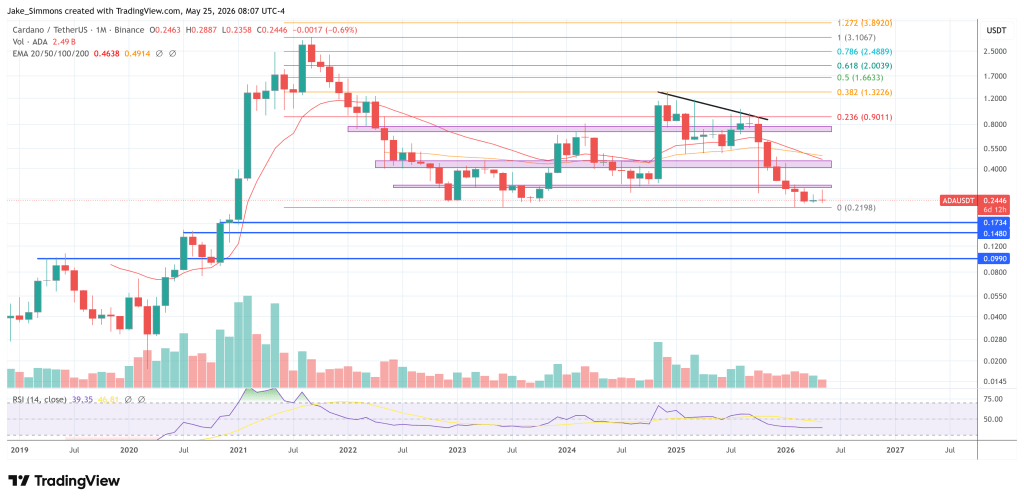
ADA remains below key resistance, 1-month chart | Source: ADAUSDT on TradingView.com

Related Questions

QWhat was the main purpose of the IO-backed Developer Experience Initiative proposal that passed in the Cardano treasury vote?

AThe main purpose of the proposal was to improve Cardano's developer experience over six months with a 3.6 million ada budget. It aimed to address issues like fragmented tooling, scattered documentation, weak onboarding, and a steep learning curve by creating a one-command project setup, audit-ready smart contract templates, a unified developer portal, and supporting community tooling.

QHow did Charles Hoskinson frame the importance of the governance vote, regardless of its outcome?

AHoskinson framed the governance process itself as evidence that Cardano's post-Voltaire governance system is functioning correctly. He stated that it showed the community is engaged and that Cardano's governance is real, emphasizing that token holders are active owners, not just passive participants.

QWhat personal commitment did Charles Hoskinson make regarding Cardano and Midnight's presence at Token2049?

ACharles Hoskinson personally committed to partially top up Cardano and Midnight's sponsorship for Token2049 to the Title level. He also stated he would attend the Cardano Summit in Singapore and appear on stage, emphasizing that being on the main stage is where these projects need to be heard.

QBesides the Developer Experience Initiative, what does the article indicate about the results of other proposals in the same funding round?

AThe broader treasury round delivered mixed results. While several IO-led proposals like Cardano Upgrades and the Consensus Initiative passed, others failed or expired. These included IO's maintenance proposal with Ensurable Systems, its Plutus proposal with VacuumLabs, the L2 Scalability Initiative with Midgard Labs, Blockfrost's indexing proposal, and Pogun's Bitcoin DeFi funding request. This indicates DReps selectively supported core protocol work but rejected other infrastructure and spending requests.

QWhat context regarding Charles Hoskinson's other ventures was provided in the article, and how did he respond to it?

AThe article noted that two days before his governance post, it was reported that the Hoskinson Health & Wellness Clinic in Wyoming would close, ending a major rural healthcare project he backed. In his Cardano statement, Hoskinson did not mention the closure directly but addressed questions about his focus by declaring, "I am 100% focused on Cardano and Midnight. Always have been. Let me prove it."

Related Reads

To Those Ordinary People Who Haven't Invested in AI: You Think You're Late, You're Just Lacking Your Own Worldview

**Summary:** The article argues that ordinary investors feeling FOMO over missing the AI investment boom lack not timing, but their own independent worldview. Most people chase "what to buy" based on others' opinions (FOMO, envy) rather than fundamental analysis. This leads to costly mistakes: not knowing when to exit winning trades or cut losses on losing ones. The core solution is to develop a personal, long-term (5-10 year) worldview about societal shifts and technological bottlenecks. For most, building this from scratch (Path A) is too demanding. A practical alternative (Path B) is to follow the **capital expenditures (capex)** and strategic investments of visionary leaders, as their money reveals true conviction more reliably than their words. Five key figures to track for different AI perspectives are highlighted: Jensen Huang (NVIDIA, infrastructure), Elon Musk (Tesla/SpaceX/xAI, capex signals), Sam Altman (OpenAI, commercialization, but beware hype), Dario Amodei (Anthropic, technical/safety focus), and Liang Wenfeng (DeepSeek, efficiency/anti-consensus view). The article details how to read capex signals from hyperscalers' financial reports, NVIDIA's revenue breakdown, and strategic investments. It maps the complete AI产业链 (supply chain) from raw materials/energy to models/applications, explaining value flow and inter-dependencies (e.g., how a model release triggers demand across chips, memory, and optics). Finally, it provides an action plan: secure personal finances first, allocate a limited portfolio percentage (max 25%) to the theme, prefer broad ETFs (like QQQ), use dollar-cost averaging over 6-12 months, and write down strict investment rules beforehand to combat emotional errors during market volatility. The conclusion is that a stable, personally-held worldview enables disciplined, long-term investment far more than chasing short-term trends.

marsbit43m ago

To Those Ordinary People Who Haven't Invested in AI: You Think You're Late, You're Just Lacking Your Own Worldview

marsbit43m ago

Microsoft Halts Vibe Coding: "Burning Tokens" Is Now More Expensive Than Employees

Microsoft has halted the widespread internal use of Claude Code, withdrawing licenses from most employees by the end of its fiscal year, June 30, 2026. This reversal comes just six months after actively promoting the AI coding tool to boost productivity via "vibe coding"—where developers describe intent in natural language and let the LLM generate code. The core issue isn't the tool's effectiveness; internal reports suggest employees preferred Claude Code over Microsoft's own Copilot CLI. The problem is financial: the "copilot mode" adds a variable, consumption-based token cost on top of existing employee salaries without a proportional revenue increase. As usage grew, the token bills became unsustainable, leading to what sources describe as a cost-structure failure. Similar overruns have been reported at other firms like Uber. The article contrasts this with the approach of AI-native startups, exemplified by Y Combinator's philosophy. Here, high token consumption is strategic—it replaces, rather than supplements, human labor. Startups operate with tiny teams where AI agents handle work previously done by many, making the high token bill financially viable as it offsets much larger personnel costs. The conclusion is that "vibe coding" isn't dead, but its economics fail within traditional corporate structures that treat AI as a productivity add-on for existing staff. Success requires a foundational shift to an AI-native organization, where processes are built to be "legible to AI," and the company's core knowledge and assets reside in documented, AI-accessible systems rather than solely in employees' minds. The future divide will be between companies that merely add AI tools and those that redesign their organizations around them.

marsbit1h ago

Microsoft Halts Vibe Coding: "Burning Tokens" Is Now More Expensive Than Employees

marsbit1h ago

Metrics Ventures Market Watch: The Brewing Storm

In the past month, the market has been actively trading contrasting expectations, balancing global supply chain disruptions fueling re-inflation against both actual and anticipated (Walsh) interest rate hikes. This volatility has impacted commodities and most equities, though tech has temporarily benefited from concentrated short-term liquidity. Fundamentally, as previously analyzed regarding the Strait of Hormuz situation, the US faces deep-seated balance sheet issues beyond what any single Fed chair can resolve. Hypotheses around a figure like Walsh could only materialize if AI fundamentally reshapes production relations. Until then, most non-AI-leading nations (effectively all except the US and China) risk fiscal and monetary policy collapse, rendering the identity of the Fed chair ultimately irrelevant. For crypto assets, there is currently no clear role in these dominant narratives. The market remains strongly capped by the 200-day moving average. While trends may shift from "anything but AI" to "anything but mines," this phase is dominated by the silicon vs. carbon (AI vs. traditional) dichotomy, leaving little room for crypto—though its time will come. **Market Overview & Commentary** The crypto market lacks significant catalysts beyond hype, plagued by low volume and scarce innovation, with clear technical resistance. Currently, crypto struggles for attention as global focus lies elsewhere. Assets like gold, oil, and grains are more direct hedges against supply-chain-driven inflation/stagflation. Bitcoin needs more time for capitulation and consolidation; this reset is expected to last until at least Q4 2026. Looking ahead, three factors will likely drive future market volatility: 1. Whether Walsh repeats the patterns of predecessors like Bassant or Musk, shifting stance into a new policy cycle. 2. The market underestimates the severity of global supply chain damage and the prolonged time needed for repair, which will eventually lead to recognition of acute resource shortages and price swings. 3. AI non-beneficiary, high-inflation nations (e.g., UK, Japan) will face severe fiscal and monetary crises. Rapid AI-driven displacement could trigger a collapse of existing credit and welfare systems. Ultimately, the market may realize that an AI bubble burst could spark contagious sovereign credit crises. The monetary and fiscal responses to such a scenario could serve as the ultimate catalyst for Bitcoin's next major bull run.

marsbit2h ago

Metrics Ventures Market Watch: The Brewing Storm

marsbit2h ago

Trading

Spot
Futures

Hot Articles

Discussions

Welcome to the HTX Community. Here, you can stay informed about the latest platform developments and gain access to professional market insights. Users' opinions on the price of S (S) are presented below.

活动图片