HIP-3 Perpetual Futures Arbitrage in Action: SK Hynix ADR Premium Trading Opportunity

Foresight NewsPublished on 2026-07-20Last updated on 2026-07-20

Abstract

HIP-3 Perpetual Futures Arbitrage in Practice: The SK Hynix ADR Premium Trade Following its Nasdaq listing, a significant price gap emerged between SK Hynix's ADR (SKHY) and its underlying share (SKHX). During this period, the HIP-3 builder TradeXYZ launched perpetual futures markets for both on Hyperliquid. The divergent funding rates between these two markets offer a clear case study on the capabilities and limitations of stock perpetuals. The premium, which soared to 51% on July 14th, was primarily driven by closed arbitrage channels. The new ADR issuance did not involve depositing existing shares, and conversion between the underlying share and the ADR is not permitted until after July 29th. With strong US institutional demand facing constrained supply, the price gap widened. On Hyperliquid, the funding rates for SKHX and SKHY moved in opposite directions, revealing traders executing a pairs trade to bet on the premium narrowing—buying SKHX (underlying) and shorting SKHY (ADR). This highlights key insights: 1. **Ability to bypass traditional market friction:** The trade can be executed with USDC on a single platform, avoiding complexities like currency conversion, foreign accounts, and ADR borrowing. 2. **Missing tools to separate funding costs:** The trade inherently carries the cost of funding rate payments/receipts, as perpetuals reflect but do not force convergence between the two underlying indices. Instruments to hedge this variable cost are not yet available f...


Written by:Eren,Four Pillars

Compiled by:AididiaoJP,Foresight News


After the ADR listing on Nasdaq, the price gap between the ADR (SKHY) and the underlying shares (SKHX) widened significantly. During this period, TradeXYZ, a HIP-3 builder on Hyperliquid, launched perpetual futures markets for both. The funding rates of these two markets clearly demonstrate what stock perpetual futures actually provide, what the market still lacks, how they interact with the underlying spot markets, and where they attract the strongest demand.


Note: ADR (American Depositary Receipt) is a certificate issued by a U.S. bank representing shares of a foreign company, facilitating trading in U.S. dollars for American investors on markets like Nasdaq. ADR (SKHY) is the ticker for SK hynix's ADR listed on Nasdaq, with each SKHY representing 1/10th of an underlying share (SKHX); the underlying shares (SKHX) are the original shares/traded product in the Korean domestic market. After listing, due to strong U.S. investor demand, liquidity differences, and limited arbitrage channels, the price gap between SKHY and the underlying shares expanded noticeably.


1. SK Hynix ADR Premium and Thwarted Arbitrage


On July 9, SK hynix sold 177.9 million American Depositary Receipts (ADRs) at $149 each, raising $26.5 billion. This is the largest ADR issuance ever by a foreign company, surpassing Alibaba's $21.8 billion record in 2014. The order book was oversubscribed over 7 times, with Nasdaq opening at $170 on July 10.


Subsequently, the price gap between the ADR (SKHY) and the underlying shares (SKHX) widened dramatically. The premium timeline is as follows:


  • July 13: The ADR premium relative to the issue price, around 3%, expanded to 25.6%, while the underlying shares plunged 15.4%. The KOSPI index also fell over 8% intraday, triggering a circuit breaker, but the ADR only declined 9.3%.
  • July 14: The ADR surged 27%, closing at $193.92, with its premium over the underlying shares skyrocketing to 51%.
  • July 15: The previously surging ADR fell 9%, closing at $176.46, while the underlying shares rebounded 8.8%. The ADR premium over the underlying shares narrowed from 51% to 30.7%.


The cause of the premium is the closed arbitrage channel. In an efficient market, institutions would buy the cheaper underlying shares, convert them into ADRs, and sell the ADRs to increase supply and eliminate the spread.


However, this channel is currently not open. These ADRs were not created by depositing existing shares; instead, they were created by issuing 17.79 million new shares to the depositary bank (Citibank). These underlying shares are scheduled for additional listing on the Korean Exchange on July 29. The Korea Securities Depository stated that applications for interconversion between underlying shares and ADRs will only be possible after that date.


Furthermore, the issued ADRs account for less than 3% of SK hynix's total shares. Strong U.S. institutional demand encountered inelastic supply, causing the spread to widen.


2. HIP-3 Funding Rates Reveal the Current Stage of Stock Perpetual Futures
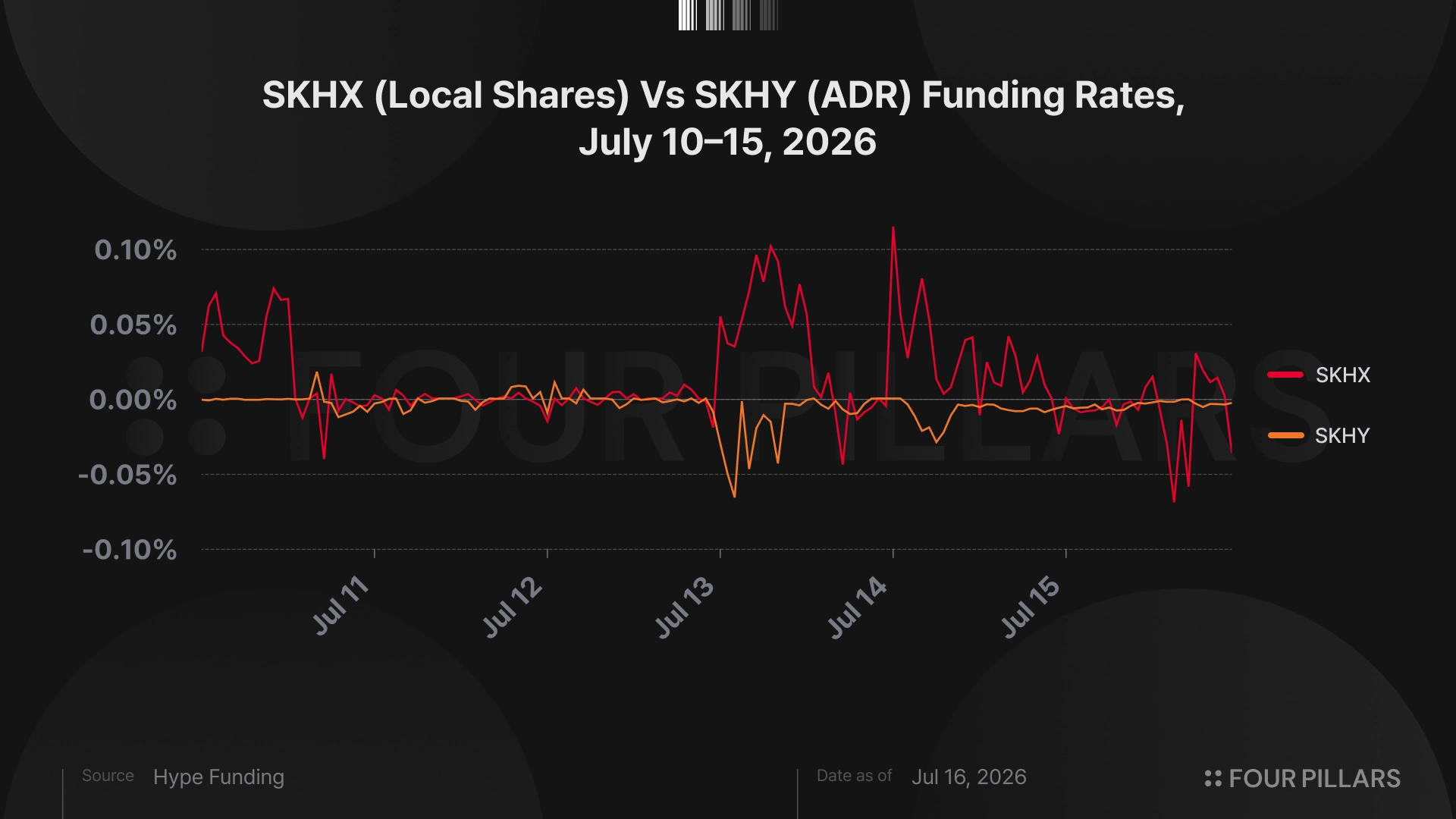


During the same period, TradeXYZ, a HIP-3 builder on Hyperliquid, launched perpetual futures markets for both. SKHX, tracking the underlying shares, has been operational for some time, while SKHY, tracking the ADR, went live the day before listing as a pre-IPO contract, transitioning to a standard contract upon Nasdaq trading commencement.


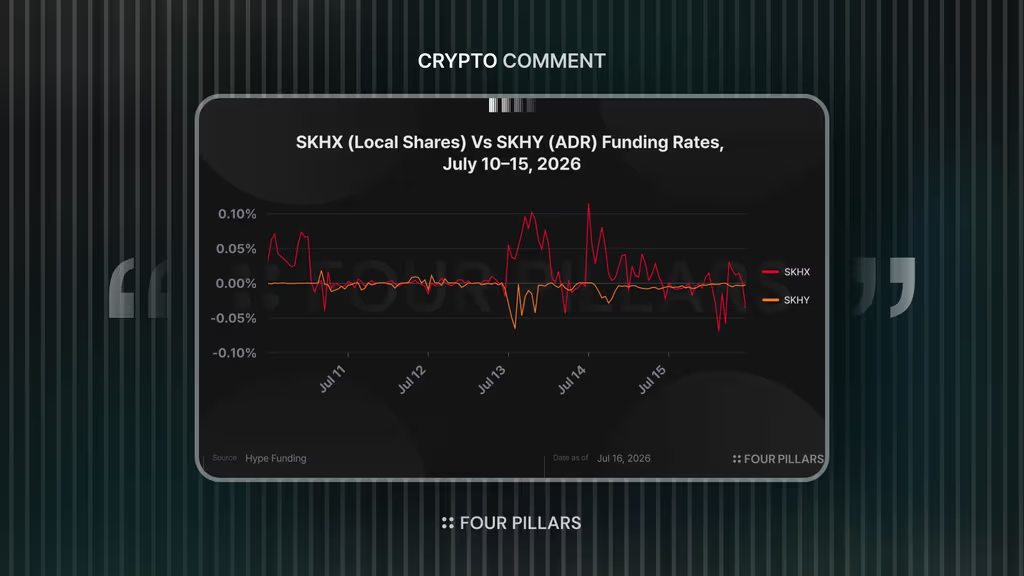
As the gap between underlying shares and ADRs widened, the funding rates of the two markets diverged in opposite directions. On the 13th, while the underlying shares plummeted, the SKHX funding rate jumped to +0.10% per hour, while SKHY's rate dropped to -0.065%.


A positive funding rate means longs pay shorts, a negative rate means the opposite. This indicates longs simultaneously rushing to the underlying share side, and shorts rushing to the ADR side. This combination points to a single position – a trade betting on premium convergence executed on Hyperliquid.


This event validates several hypotheses about stock perpetual futures through a single case study. It directly demonstrates what stock perpetual futures actually provide, what the current market lacks, their relationship with the underlying market, and which markets give them the strongest demand:


  • Ability to Express Views Bypassing Spot Market Frictions: Betting on premium convergence requires buying underlying shares and shorting ADRs. In the spot market, this requires Korean Won funds, foreign investor accounts, settlement infrastructure, and ADR borrowing availability. With perpetual futures, it can be achieved by simply trading two contracts on a single platform using USDC as collateral.
  • Lack of Instruments to Separate Funding Rate Exposure: The current structure of the two-sided bet is not ideal. Even if the premium persists, the hourly funding rate accumulates, eroding collateral. In spot arbitrage, once underlying shares are converted to ADRs, the spread is immediately locked in as realized profit, but perpetual futures lack this forced convergence mechanism. SKHX converges to the underlying share index, SKHY converges to the ADR index; neither can close the gap between the two indices. Perpetual futures reflect the spread in the underlying markets but do not resolve it. Even with correct direction, delayed convergence can allow accumulating holding costs to erode returns. Ultimately, it is a structure that simultaneously carries both the "premium will converge" view and its holding cost.
  • A separate market is needed to trade the funding rate itself and decouple the two. For example, Pendle's Boros tokenizes funding rates into YU (Yield Units), splitting them into fixed and variable components. A position paying funding rates, like an SKHX long, could hedge the cost by buying the floating-rate receiving YU on Boros. This allows hedging variable costs into fixed costs. The cost itself doesn't disappear, but future expenses can be locked in at entry, enabling position sizing management. However, Boros currently supports only major assets like BTC and ETH, not yet HIP-3 stock perpetual futures. Therefore, trading this spread currently means bearing the volatility of funding costs.
  • Perpetual Futures as a Leading Indicator: TradeXYZ's SKHY pre-IPO market pointed to $164 three hours before Nasdaq open, $169.80 one hour before, $169.92 one minute before, with the actual opening price being $170. The SKHX market also trades during KRX night and weekend closures, with Korean traders using its price as a leading indicator for the next day's open. Perpetual futures are no longer confined to their derivative role of tracking underlying assets; they become price discovery venues when the original markets are closed.
  • Market Value Inversely Proportional to Underlying Asset Accessibility: These are two futures contracts linked to the same company, but SKHY's funding rate stayed near zero most of the time except during periods like the sharp spread widening on the 13th. The reason is that physical ADRs exist on Nasdaq, and from the 14th, U.S. options are also listed, allowing arbitrageurs to capture the basis. In contrast, SKHX lacks hedging tools, making the funding rate the sole mechanism to clear the market. Consequently, it has become the single largest contract, dominating 33% of total HIP-3 volume and 50% of stock perpetual futures volume. Launching perpetual futures for highly liquid large-cap U.S. stocks is like rebuilding what already exists. The more restricted the access, the higher the value of the perpetual futures contract.


A key future date to watch is July 29. When the underlying shares are additionally listed on the Korean Exchange and applications for interconversion between underlying shares and ADRs open, the blocked arbitrage channel will partially reopen.


However, asymmetry persists even after the channel opens. Redeeming ADRs into underlying shares has no limit, but converting underlying shares into ADRs is only possible within the issuance cap, and compressing the premium requires the latter.


Because of this, it remains uncertain whether the premium will sharply converge, but even if it does, Hyperliquid remains the only place where this spread can be traded.


Related Questions

QWhat caused the significant price premium of SK hynix's ADR (SKHY) over its underlying share (SKHX) after its Nasdaq listing?

AThe significant premium was primarily caused by a closed arbitrage channel. The ADRs were created by issuing new shares to the depositary bank (Citibank) rather than depositing existing shares. Mutual conversion between the underlying shares and ADRs will not be possible until after the additional listing of those underlying shares on the Korean Exchange on July 29th. This, combined with strong US institutional demand and the ADRs representing less than 3% of SK hynix's total shares, led to a supply-demand imbalance and a widening price gap.

QHow did the funding rates for the SKHX and SKHY perpetual futures on Hyperliquid diverge during the price gap expansion, and what did this indicate?

AWhen the price gap expanded on July 13th, the funding rate for SKHX (tracking the underlying share) jumped to +0.10% per hour, while the rate for SKHY (tracking the ADR) fell to -0.065% per hour. This indicated that long positions were flooding into the SKHX side (paying funding) and short positions were flooding into the SKHY side (receiving funding). This combination pointed to a single, unified trade on Hyperliquid: a bet that the premium would narrow by going long SKHX and short SKHY.

QWhat key limitation of perpetual futures in trading the SKHY-SKHX premium does the article highlight, and what potential solution is mentioned?

AThe article highlights the absence of a mechanism to separate the funding cost from the directional trade. Perpetual futures reflect the underlying market's price gap but do not force its convergence. Traders betting on premium convergence must bear the variable and accumulating funding costs, which can erode profits. The mentioned potential solution is a market like Pendle's Boros, which tokenizes funding rates into Yield Units (YU), allowing traders to hedge variable funding costs by locking them in as a fixed cost at trade inception. However, such instruments are not yet available for HIP-3 stock perpetuals like SKHX/SKHY.

QAccording to the article, why is the SKHX perpetual futures contract disproportionately valuable on Hyperliquid compared to the SKHY contract?

AThe SKHX contract is disproportionately valuable because the underlying Korean share lacks direct hedging tools for most traders. The funding rate becomes the sole mechanism to clear the market for price discovery and risk transfer. In contrast, the physical ADR for SKHY trades on Nasdaq, and US-listed options became available, providing alternative avenues for arbitrage and hedging. The value of a perpetual futures contract is inversely related to the accessibility of its underlying asset; the more受阻 (impeded) the access, the higher the contract's utility and demand.

QWhat is the significance of the date July 29th mentioned in the article, and will it completely resolve the ADR premium arbitrage?

AJuly 29th is when the new underlying shares created for the ADR issuance will be additionally listed on the Korean Exchange, and applications for mutual conversion between the underlying shares (SKHX) and ADRs (SKHY) may open. This will partially unblock the previously closed arbitrage channel. However, it will not completely resolve the arbitrage due to an inherent asymmetry: while redeeming ADRs for underlying shares is unrestricted, converting underlying shares into new ADRs is limited by the ADR issuance cap. Compressing the premium requires the latter (creating new ADRs), so uncertainty about a rapid premium narrowing remains even after this date.

Related Reads

9.42 Million Retail Investors Compete for Changxin Technology, Who Got Allotted?

Evergreen Technology's IPO subscription results are now available. On July 20, the domestic memory chip giant announced the offline preliminary allotment results and online lottery results for its IPO. A total of approximately 9.43 million retail investors participated in the online subscription, generating 770,000 winning lots with a final winning rate of about 0.4714%, setting a record for new shares on the STAR Market. After triggering a clawback mechanism from institutional to retail investors, the online retail allocation was significantly increased to 3.851 billion shares. Simultaneously, 285 institutional investors participated in the offline subscription, ultimately receiving 2.173 billion shares at an allotment rate of approximately 0.1756%. Leading insurers and public funds were among the major recipients. Notably, Liang Wenfeng, founder of the major AI model company DeepSeek, through his quantitative investment firms Ningbo Huanfang Quantitative and Zhejiang Jiuzhang Asset, secured the largest share among private funds, with a total allotment worth approximately 175 million yuan. Estimates suggest potential profits could reach 730 million yuan if Evergreen Technology's market capitalization reaches 3 trillion yuan post-listing. The company is expected to list on July 27 and could become the highest-valued tech stock on the A-share market, with various brokerages providing valuations ranging from 1 trillion to over 4 trillion yuan. However, recent significant corrections in global tech stocks may impact its post-listing performance. (Character count: 1,196)

marsbit6m ago

9.42 Million Retail Investors Compete for Changxin Technology, Who Got Allotted?

marsbit6m ago

L2 'Recalibration': When L1 Becomes Its Own Rollup, What Is Ethereum's Endgame?

The article discusses the evolving relationship between Ethereum's Layer 1 (L1) and Layer 2 (L2) solutions, moving beyond the initial "L2 for scaling" model. As Ethereum L1 itself scales (increasing Gas Limit, statelessness, zkEVM), the unique value proposition of L2s shifts from merely providing cheap execution to offering differentiated features like application-specific optimization, privacy, and flexible governance. The piece explores three key themes: 1. **L2's New Role:** L2s are transitioning from a pure scaling technology to a spectrum of execution environments with varying degrees of security inheritance from Ethereum L1. 2. **Interoperability as State Trust:** Solving L2 fragmentation is less about cross-chain bridges and more about enabling faster, trust-minimized state verification between environments. This involves initiatives like faster L1 finality, intent-based architectures (Open Intents Framework), and native account abstraction. 3. **Blurring Layers:** With the potential integration of zk-proofs into L1 validation (making L1 akin to its own "Rollup") and the concept of "Native Rollups," the rigid boundary between L1 and L2 may fade. The future could be a unified system with multiple execution domains (for DeFi, gaming, privacy, etc.) sharing a common security, settlement, and state framework. In conclusion, Ethereum's goal is not to abandon L2s or re-centralize everything on L1, but to re-integrate the fragmented user experience—liquidity, accounts, applications—while preserving the scaling benefits of a multi-environment ecosystem. The endgame is a cohesive "one chain" feeling for users, powered by diverse but securely interconnected execution layers.

marsbit47m ago

L2 'Recalibration': When L1 Becomes Its Own Rollup, What Is Ethereum's Endgame?

marsbit47m ago

Trading

Spot
活动图片