Here’s why Uniswap is betting on execution over higher LP incentives

ambcryptoPublished on 2026-07-10Last updated on 2026-07-10

Abstract

Uniswap is shifting its strategy from high liquidity provider (LP) incentives to prioritizing better trade execution. The proposal to cut V4 LP fees by up to 33% marks a departure from its previous model. The protocol aims to attract volume through lower trading costs, tighter spreads, and improved capital efficiency, betting this will offset reduced LP rewards. While this carries the risk of LPs moving capital to competitors, Uniswap is strengthening its execution capabilities, such as via the Sky’s LitePSM integration for zero-slippage stablecoin swaps. Ultimately, its success hinges on whether increased trading activity and superior execution can compensate for lower incentives and maintain its market leadership against rival DEXs.

Competition among decentralized exchanges is increasingly forcing protocols to rethink the incentives that originally fueled DeFi’s rapid expansion. In fact, Uniswap [UNI] has become the latest to test that transition after proposing a reduction of up to 33% in V4 liquidity provider fee incentives.

More importantly, Uniswap’s TVL stood at $3.02 billion while its monthly volume hovered near $36 billion at press time. This hinted at strong market leadership, despite intensifying competition from rival decentralized exchanges.
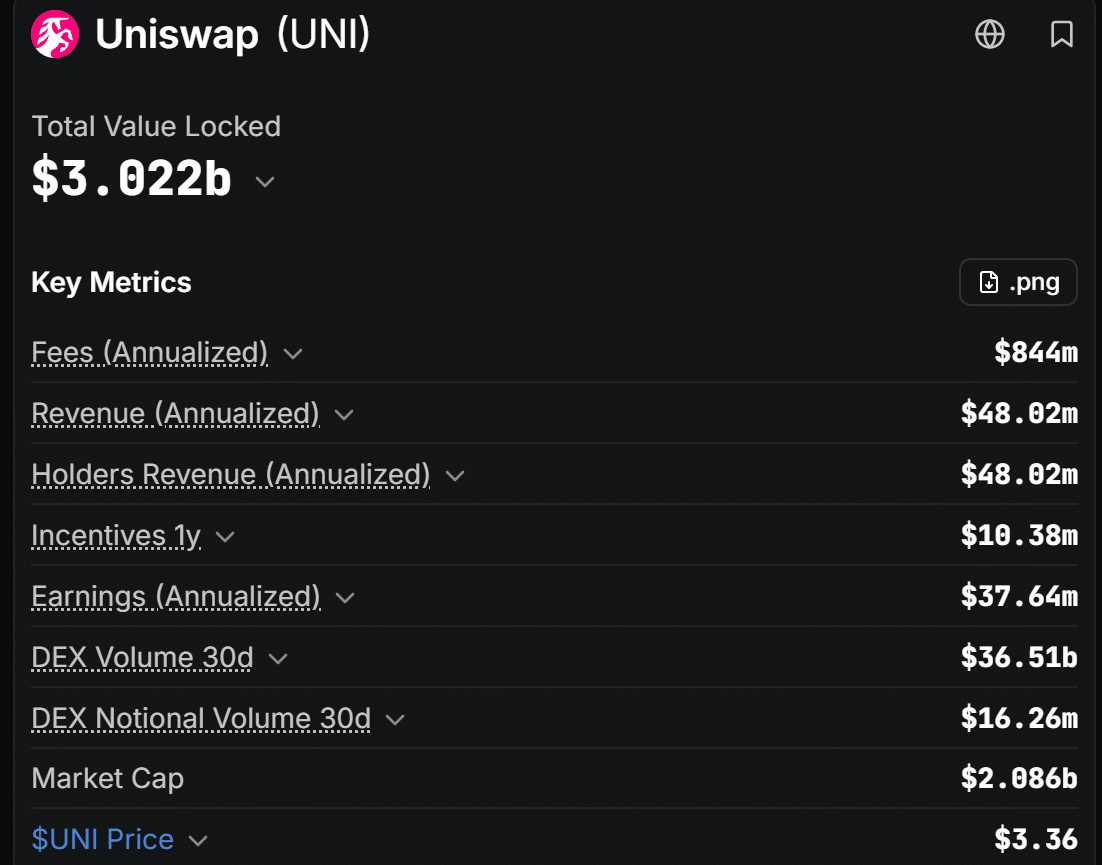
Source: DeFILlama

The proposal marks a clear departure from previous models. The V3 model used much higher percentages of each trade to incentivize early liquidity providers to quickly capitalize on its platform.

Instead, the protocol believes that a lower cost of trading, tighter spreads, and better capital usage will result in a sufficient increase in volume to offset reduced LP returns.
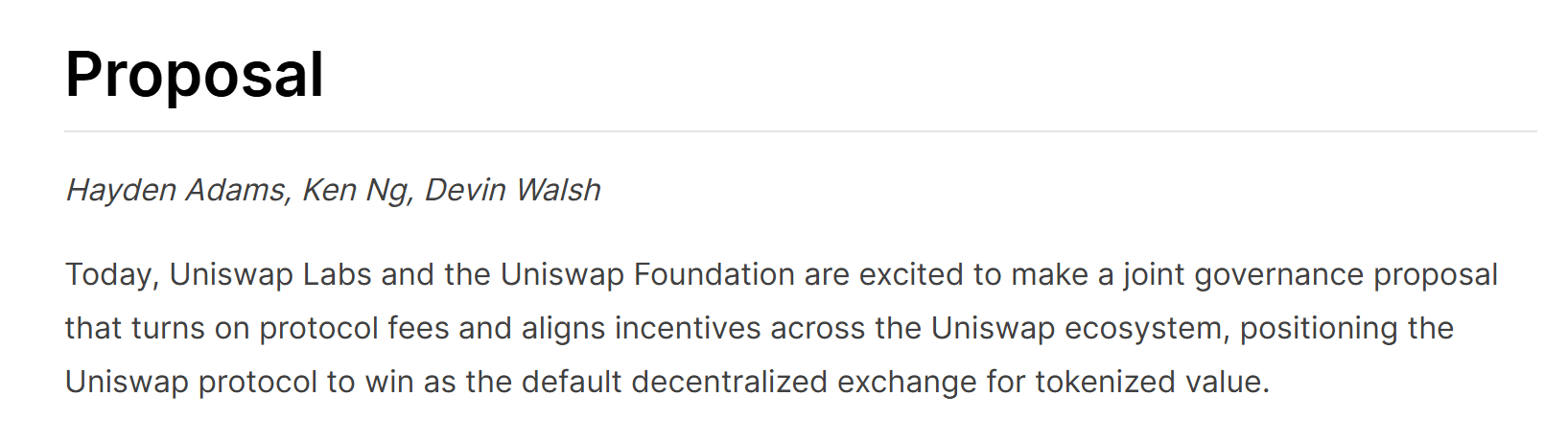
Source: Gov. Uniswap

That calculation carries meaningful risk. This, because liquidity providers can easily move capital to competing protocols offering stronger yields. If trading activity rises fast enough, the new model could strengthen Uniswap’s long-term competitiveness.

And yet, weakening LP participation may pressure liquidity depth and reshape incentive structures across the wider DeFi ecosystem.

Uniswap strengthens stablecoin liquidity

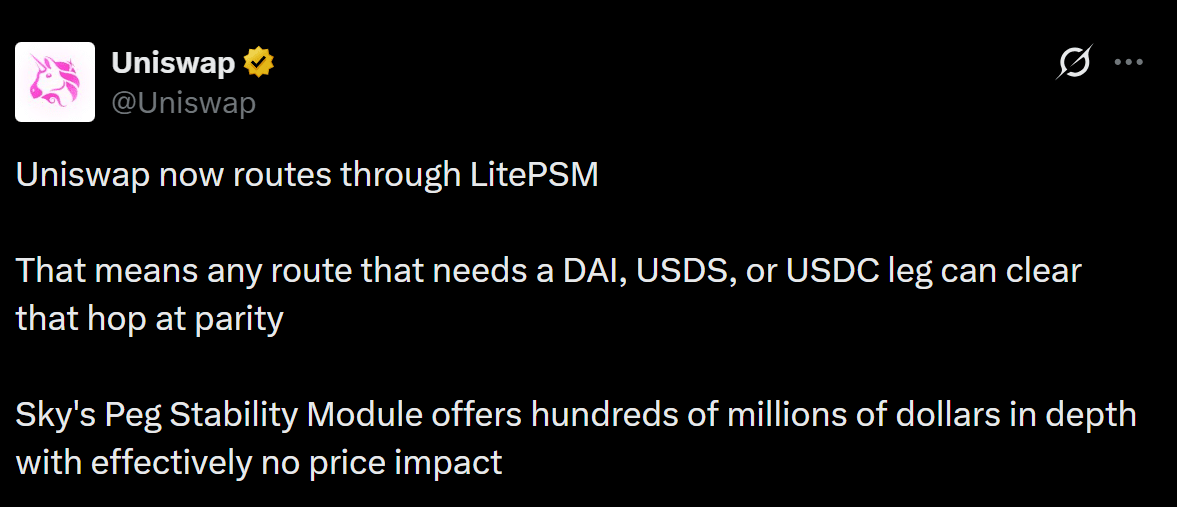
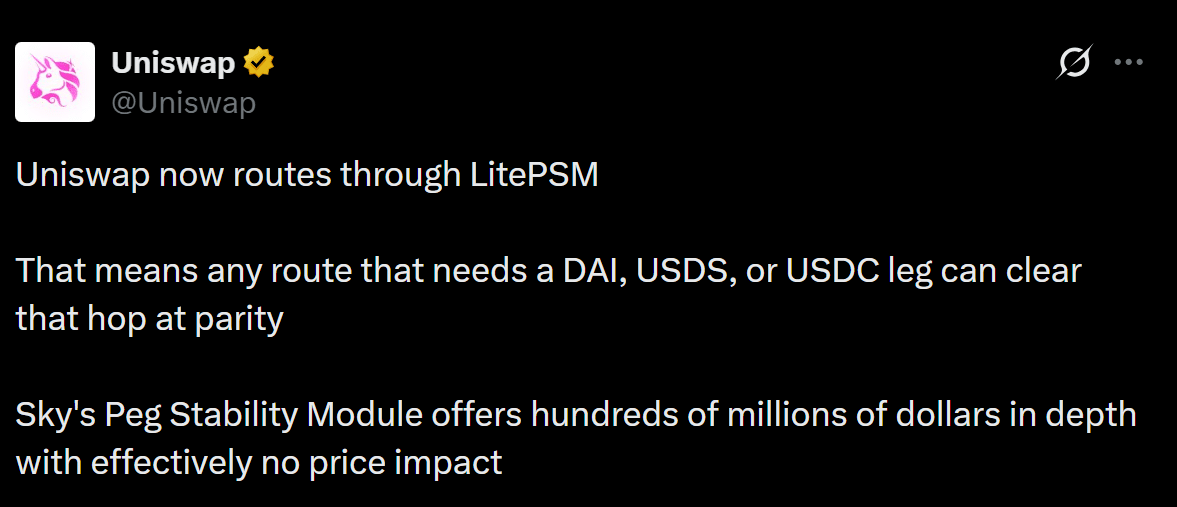
That strategy is already taking shape through Uniswap’s integration of Sky’s LitePSM.

Rather than relying solely on liquidity provider rewards, the peg stability module enables zero-slippage routing between USDS, DAI, and USDC. The integration deepens liquidity, reduces execution costs, and allows larger trades to settle with minimal price impact.
Source: Uniswap on X

Also, it enhances Sky’s FX Layer by converting parity-based stablecoin routing into operational infrastructure. While these enhancements improve competitive positioning for Uniswap, infrastructure alone may not be sufficient to generate greater trading volumes.

However, lasting success will ultimately depend on whether lower execution friction attracts enough users and volume to offset reduced liquidity provider incentives.

Still, the real test for Uniswap now lies in market adoption rather than protocol design. Success will depend on whether stronger execution and higher trading volumes offset lower liquidity provider rewards.

If traders embrace the model, Uniswap could reinforce its leadership. Otherwise, rival DEXs may attract liquidity through more competitive incentives instead.


Final Summary

  • Uniswap [UNI] has proposed prioritizing execution over higher liquidity incentives.
  • Uniswap’s success now depends on trading volume, not liquidity incentives alone.

Trending Cryptos

Related Questions

QWhat is the main change Uniswap is proposing regarding liquidity provider incentives in V4?

AUniswap is proposing a reduction of up to 33% in liquidity provider fee incentives for V4, shifting its focus from high LP rewards to better execution, lower trading costs, and improved capital efficiency.

QWhat are the potential risks associated with Uniswap's new model of reducing LP incentives?

AThe main risk is that liquidity providers might move their capital to competing protocols offering stronger yields, which could pressure Uniswap's liquidity depth and impact its market position if trading volume does not increase sufficiently to compensate.

QHow does the integration of Sky's LitePSM module benefit Uniswap, according to the article?

AThe integration of Sky's LitePSM enables zero-slippage routing between stablecoins like USDS, DAI, and USDC. This deepens liquidity, reduces execution costs, and allows larger trades with minimal price impact, strengthening Uniswap's stablecoin liquidity infrastructure.

QWhat does the article suggest is the key factor for Uniswap's long-term success with this new strategy?

AThe article suggests that Uniswap's long-term success depends on whether lower execution friction can attract enough users and trading volume to offset the reduced liquidity provider incentives. Ultimately, market adoption will be the real test.

QDespite the proposal to lower LP incentives, what current metrics indicate Uniswap's strong market position?

AAt the time of writing, Uniswap's Total Value Locked (TVL) stood at $3.02 billion and its monthly trading volume was near $36 billion, indicating strong market leadership despite increasing competition from other decentralized exchanges.

Related Reads

Thanks to Dice Rolls, Bitcoin Keys Are Stored Offline, But Not Everyone Will Do It

The article discusses using dice rolls to generate secure Bitcoin wallet seeds, providing entropy independent of potentially flawed hardware random number generators. It explains that each fair dice roll offers about 2.585 bits of entropy, with around 50 rolls needed for a standard 12-word seed phrase and 99+ recommended for higher security. This method gained attention after a vulnerability was revealed in some Coldcard hardware wallets, where a faulty firmware RNG (dating back to 2021) compromised generated keys. The analysis notes that while a dice-generated main seed was safe from this specific flaw, other Coldcard functions (like creating paper wallets, backup keys, or passwords) could still be vulnerable if they used the defective RNG. The piece argues that while dice-based entropy is technically robust, the manual process is error-prone, tedious, and unrealistic for most new users, who might make mistakes in recording or inputting rolls. It concludes that while manual entropy generation should remain an option for advanced users, the long-term goal is to develop reliable, user-friendly hardware and software that securely generates randomness without requiring specialized knowledge. Coldcard users are advised to check their firmware version and replace any secondary secrets (like paper wallet keys) created with vulnerable devices, while also considering multi-signature setups with devices from different manufacturers for added security.

cryptonews.ru4h ago

Thanks to Dice Rolls, Bitcoin Keys Are Stored Offline, But Not Everyone Will Do It

cryptonews.ru4h ago

Trading

Spot

Hot Articles

Discussions

Welcome to the HTX Community. Here, you can stay informed about the latest platform developments and gain access to professional market insights. Users' opinions on the price of S (S) are presented below.

活动图片















