Here’s How High Bitcoin Price Would Be At Gold’s ATH Market Cap

bitcoinistPublished on 2025-12-24Last updated on 2025-12-24

Abstract

Gold has reached unprecedented price levels, breaking above $4,525 per ounce and setting a new all-time high in 2025, pushing its total market capitalization to an estimated $31.1 trillion. In contrast, Bitcoin's market cap stands at $1.736 trillion, having decreased by roughly $100 billion since the start of the year, with its price struggling around the mid-$80,000s. If Bitcoin were to match gold’s peak market cap, each BTC would need to reach approximately $1.55 million, based on a circulating supply of 19.96 million coins. While such a scenario would require massive capital inflows, prominent Bitcoin advocates like Michael Saylor believe BTC could surpass gold in market value within the next decade. Despite a challenging 2025 for Bitcoin and crypto, 2026 may serve as a recovery period to rebuild confidence gradually.

Gold has reached unprecedented price levels at the end of 2025, breaking above $4,525 per ounce and setting fresh all-time highs as Bitcoin price continues to struggle. That surge has pushed gold’s total market capitalization to levels that dwarf the value of the world’s largest cryptocurrency. This difference between gold, the established safe-haven asset and Bitcoin, a growing digital store of value, invites a provocative question: if BTC’s total valuation equaled gold’s peak market cap, what price would BTC have to reach?

Gold’s Massive Surge In 2025

Gold’s rally in 2025 captured global attention as prices climbed past $4,500 per ounce for the first time, setting a new record that reflects more than just short-term speculation. Gold’s strength this year is not just about price per ounce. In market-cap terms, gold has added about $12 trillion in value since the start of 2025 alone. That single-year increase in gold’s market capitalization is around seven times larger than the entire Bitcoin market cap.

This recent all-time high price has helped boost gold’s total market capitalization to an estimated $31.1 trillion, based on the total value of above-ground gold stocks multiplied by the elevated price per ounce. Bitcoin’s market capitalization currently stands at $1.736 trillion, based on a circulating supply of just under 20 million BTC. Unlike gold, BTC’S total valuation has not increased this year. Instead, it has shrunk by roughly $100 billion since January 1, with its price now struggling in the mid-$80,000s.
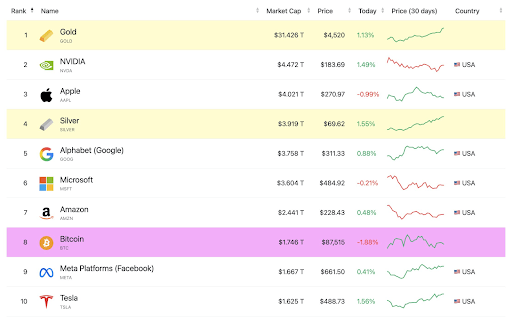
Market Cap Of Gold And Bitcoin. Source: Companiemarketcap.com

Put simply, Bitcoin is only a small slice of gold’s valuation. At today’s levels, gold’s $31 trillion market cap means that Bitcoin fits into gold roughly 18 times over. This ratio is a good reference point for Bitcoin’s long-term growth potential, given its reputation as a digital version of gold.

How High Bitcoin Price Would Be At Gold’s ATH Market Cap

If Bitcoin were to match gold’s $31 trillion market capitalization, the corresponding price per BTC would be considerably higher than current levels. Using a circulating supply of about 19.96 million BTC, BTC would need to push to approximately $1.55 million per coin to reach parity with gold’s current all-time-high market cap.

The amount of capital inflow needed for BTC to reach this price level is massive and unprecedented. Still, many Bitcoin maximalists believe this scenario is not unrealistic over an extended timeframe.

Michael Saylor, one of Bitcoin’s most vocal advocates, has proposed that BTC will eventually surpass gold in total market value within the next 10 years. In a November interview, Saylor said he has “no doubt” that BTC will become a larger asset class than gold by 2035.

It is obvious that 2025 is about to be a red year for Bitcoin and the entire crypto market. However, 2026 could play out as a recovery and normalization year. Recovery in this context does not imply explosive upside, but a period where bearish price action is worked off and confidence in BTC is rebuilt gradually.

BTC bulls lose momentum | Source: BTCUSD on Tradingview.com

Related Questions

QWhat is the estimated market capitalization of gold at its all-time high price of $4,525 per ounce?

AThe estimated market capitalization of gold at its all-time high is $31.1 trillion.

QWhat would the price of one Bitcoin be if its market cap equaled gold's peak market cap of $31 trillion?

AIf Bitcoin's market cap reached $31 trillion, the price per BTC would be approximately $1.55 million.

QHow does Bitcoin's current market cap compare to the value gold has added in 2025 alone?

AThe $12 trillion increase in gold's market cap in 2025 alone is about seven times larger than Bitcoin's entire current market cap of $1.736 trillion.

QAccording to Michael Saylor, when does he believe Bitcoin will surpass gold in total market value?

AMichael Saylor believes Bitcoin will become a larger asset class than gold by 2035.

QWhat is the current sentiment for Bitcoin's price performance in 2025 and the outlook for 2026, as described in the article?

A2025 is described as a 'red year' for Bitcoin, while 2026 is seen as a potential recovery and normalization year, though not necessarily with explosive upside.

Related Reads

AI "Transfer Station" Earning Millions Monthly? Five Questions Uncover the Truth of Token Arbitrage

The article "AI 'Transfer Station' Earns Millions Monthly? Five Questions Uncover the Truth of Token Arbitrage" explores the emerging business of API token transfer stations, which profit from global AI service price disparities and access barriers. These intermediaries purchase low-cost tokens from overseas AI providers (e.g., OpenAI, Claude) through grey-market methods—such as exploiting enterprise credits, bulk accounts, or subscription benefits—and resell them to Chinese users at a markup. Key drivers include the high cost of using top AI models (e.g., Claude Code costs ~$5 per million tokens), the performance gap between domestic and foreign models, and mismatches between subscription and API pricing. However, the practice carries significant risks: upstream token sources may be unstable or illegal; user data passing through intermediaries can be harvested or injected with hidden prompts; and models might be downgraded without disclosure. The market is evolving, with some operators now exporting cheaper Chinese models (e.g., Qwen3.5 at ~$0.11 per million tokens) to overseas users, leveraging price gaps. Yet, sustainability is low due to compliance crackdowns, instability, and reputational risks. Users are advised to employ detection methods (e.g., prompt adherence tests) and avoid sensitive data usage. The authors caution that while transfer stations offer short-term arbitrage, they lack long-term reliability and security compared to official APIs.

marsbit7m ago

AI "Transfer Station" Earning Millions Monthly? Five Questions Uncover the Truth of Token Arbitrage

marsbit7m ago

The Cost of an 11.5% Annualized Return: Will MicroStrategy's STRC Face a Moment of Reckoning?

This article analyzes the potential risks associated with MicroStrategy's (MSTR) use of structured financial products like STRC to leverage its BTC exposure. While these tools have enabled impressive returns (e.g., 11.5% annualized) and fueled significant capital inflows ($13.5B outstanding), they also create substantial annual dividend obligations (~$400M). The author argues that this structure, while effective in a bull market, could become a liability if BTC price stagnates or declines. The core risk is a potential negative feedback loop: the growing dividend burden from continued STRC issuance may eventually outweigh the benefits of increased BTC holdings. To meet these obligations, MicroStrategy might need to use new issuance proceeds for dividends instead of buying more BTC, which could disappoint equity investors. If the market capitalization (mNAV) falls below the value of its BTC holdings, the company could be forced to sell BTC instead of issuing new shares, potentially triggering a panic. The author estimates a potential inflection point in 6 months, where annual dividend costs reach $3-4B. At that stage, CEO Michael Saylor might face a difficult choice: sell BTC to meet obligations or sacrifice the credibility of the preferred shares by halting dividends. The article concludes that this financial engineering, while powerful, could ultimately "backfire" on MicroStrategy if market conditions turn.

marsbit1h ago

The Cost of an 11.5% Annualized Return: Will MicroStrategy's STRC Face a Moment of Reckoning?

marsbit1h ago

Trading

Spot
Futures

Hot Articles

Discussions

Welcome to the HTX Community. Here, you can stay informed about the latest platform developments and gain access to professional market insights. Users' opinions on the price of S (S) are presented below.

活动图片