Grayscale Doubles Down On Ethereum: $44.6M Staked In Fresh ETH Allocation

bitcoinistPublished on 2026-03-19Last updated on 2026-03-19

Abstract

Ethereum is testing the $2,300 level amid mixed market sentiment, with some analysts bullish and others cautious about a potential short-term pullback. Amid this uncertainty, Grayscale has significantly increased its staking activity, recently staking 19,200 ETH ($44.6 million) and, earlier in March, 57,600 ETH ($121.6 million). This move reduces liquid supply and signals long-term confidence in Ethereum. However, despite this institutional accumulation, the market remains hesitant due to macro uncertainty and recent volatility, creating a divergence between long-term positioning and short-term trading caution.

Ethereum has reclaimed the $2,300 level, positioning itself at a critical juncture as the market prepares for a decisive move. After weeks of volatility and corrective pressure, ETH is now testing a key zone that could determine the next phase of price action. While some analysts argue that the current structure is building toward a bullish impulse, others remain cautious, warning that the recent recovery could still lead to a short-term retrace before any sustained upside.

Amid this uncertainty, on-chain data is providing additional context. According to Arkham, Grayscale continues to stake Ethereum and recently staked another 19,200 ETH, worth approximately $44.6 million, just a few hours ago. This adds to its growing position and reinforces its long-term exposure to the asset.

Staking activity from an entity like Grayscale carries structural implications. By locking ETH into staking contracts, the firm is effectively removing liquid supply from the market, reducing the amount of ETH available for immediate selling. At the same time, staking reflects a long-term conviction strategy, as assets are committed to generating yield rather than being actively traded.

For market participants, this behavior can be interpreted as a signal of institutional confidence in Ethereum’s long-term value, even as short-term price direction remains uncertain.

Grayscale Expands Staking While Market Remains Cautious

Institutional activity continues to provide a structural backdrop for Ethereum, even as price action remains uncertain. On March 13, Grayscale (Ethereum Mini Trust) staked 57,600 ETH, valued at approximately $121.6 million, marking one of its largest recent allocations into staking. This move reinforces a broader trend of institutional players increasing exposure to Ethereum through yield-generating strategies rather than maintaining liquid positions.
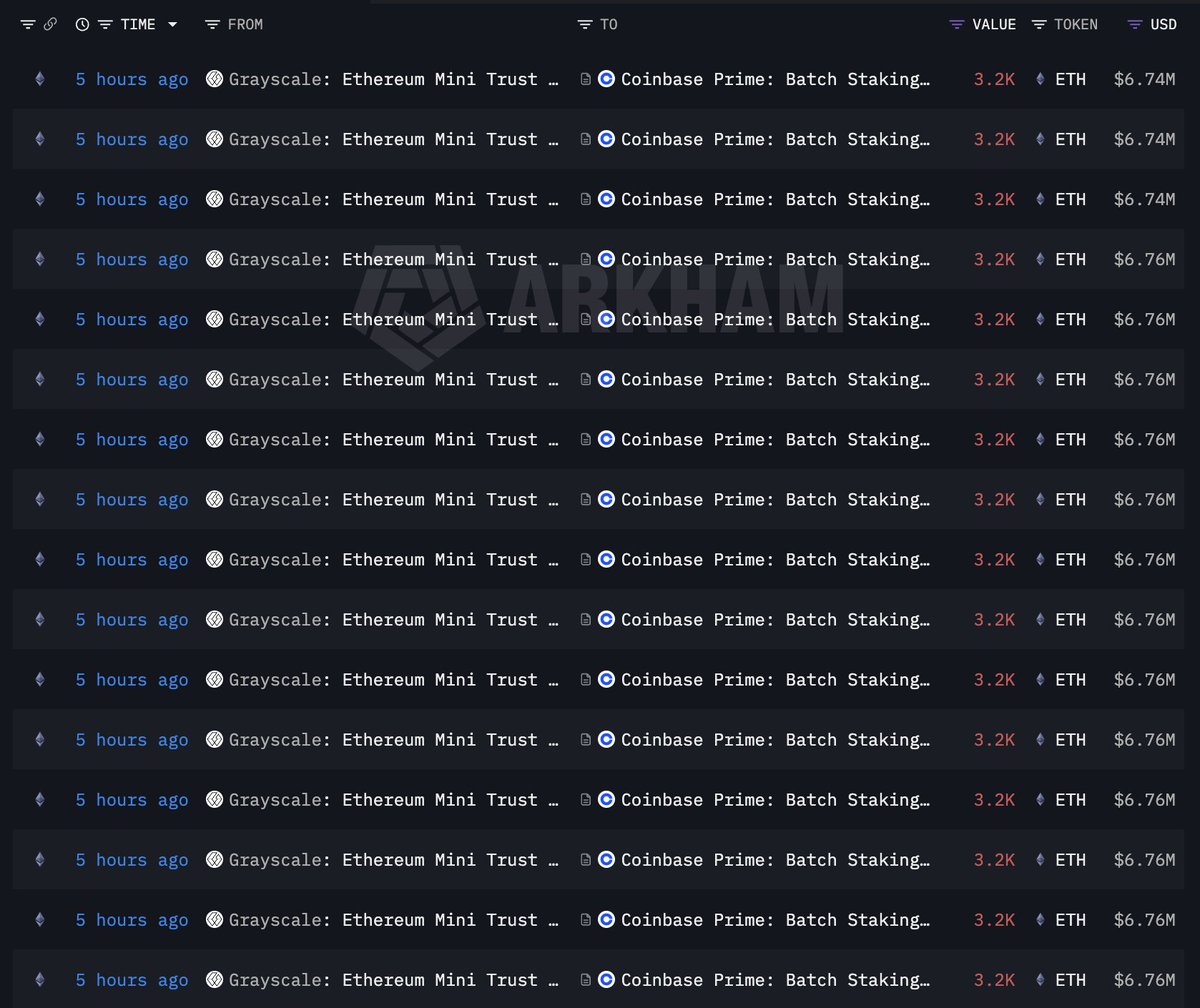
Grayscale Ethereum Mini Trust transfers | Source: Arkham

From a supply perspective, this is meaningful. Staked ETH is effectively removed from the circulating supply, reducing immediate sell-side pressure and tightening available liquidity in the spot market. In isolation, this type of behavior would typically be interpreted as supportive of price over the medium to long term.

However, the market response has been more restrained. Despite these large-scale staking inflows, Ethereum’s price action continues to reflect caution rather than conviction. The asset remains near key resistance levels, with limited follow-through after recent attempts to move higher.

This divergence suggests that while long-term capital is positioning aggressively, shorter-term participants are still hesitant. Macro uncertainty, recent volatility, and prior liquidation events continue to weigh on sentiment.

As a result, Ethereum currently presents a mixed structure: institutional accumulation on one side, and cautious, reactive trading behavior on the other.


Related Reads

The Unclear American Economy: Resilient or Cooling Down?

**U.S. Economic Outlook: Resilient or Cooling Down?** This analysis examines whether the U.S. economy is heading towards a recession. While still growing, the economy shows significant signs of strain. Key data points include Q1 2026 GDP growth of 1.6% and Q1 PCE inflation at 4.5% (annualized), more than double the Fed's target. The labor market remains resilient but is softening, with unemployment at 4.3%. Critical recession indicators present a mixed picture: the yield curve has normalized after a prolonged inversion (historically a late-cycle signal), and the Conference Board's Leading Economic Index has been declining. Current recession probability for 2026 is estimated at 19%, but rises to 41% for 2027, indicating heightened delayed risks. Major pressures are building: a wall of corporate debt refinancing at higher rates, depleted consumer savings, a contracting housing sector, and an energy price shock. The economy exhibits stagflationary characteristics—high inflation alongside slowing growth—which constrains the Federal Reserve's policy options. Historical patterns show recessions are often preceded by Fed tightening and yield curve inversions. If a recession occurs, it is expected to be mild, similar to 2001 rather than 2008. For investors, a defensive portfolio shift toward staples, healthcare, and short-term high-quality bonds may be prudent, while maintaining a long-term, diversified perspective. Key developments to monitor include upcoming GDP, employment, and inflation data, as well as policy signals from the new Fed Chair.

marsbit8m ago

The Unclear American Economy: Resilient or Cooling Down?

marsbit8m ago

The Most Advanced Large Models Are Now Subject to Export Controls Like Enriched Uranium

In an unprecedented move mirroring the control of enriched uranium, the US Commerce Department has imposed an export control ban on Anthropic's advanced AI models, Fable 5 and Mythos 5, forcing their global shutdown. This marks the first time a purely digital entity—a set of neural network weights—has been subjected to such hardware-like strategic export restrictions, based not on physical scarcity but on its concentrated "capability density." The article draws a direct parallel to the historical control of nuclear technology, arguing that just as uranium ore becomes a controlled substance only when enriched to a critical threshold, AI capabilities become subject to regulation when compressed into a single, potent, and easily accessible interface. This "enriched AI" is seen as crossing a threshold where its aggregated power poses a potential threat. The author predicts three major consequences over the next decade. First, capability auditing will become institutionalized, with governments setting compliance checklists and thresholds for model power, triggering automatic export controls. Second, jurisdictional boundaries will blur as US export controls extend their reach globally, governing any user of American AI services regardless of location, forcing non-US entities to reconsider their AI supply chain dependencies. Third, a technological bifurcation will occur, splitting the AI landscape into a restricted, high-risk track of advanced US proprietary models and a more reliable track of open-source or locally developed alternatives, where guaranteed access may outweigh raw performance. The core crisis exposed is the lack of a legal property rights framework for AI "intelligence." While companies invest heavily in integrating these models into their production systems, legally they only purchase a service that can be revoked at any time, leaving them with no recourse for their sunk investments. The conclusion warns of a permanently fractured digital world where the most capable models may not be the most usable, and clear, unassailable ownership of technology will become paramount.

marsbit21m ago

The Most Advanced Large Models Are Now Subject to Export Controls Like Enriched Uranium

marsbit21m ago

Trading

Spot
Futures

Hot Articles

Discussions

Welcome to the HTX Community. Here, you can stay informed about the latest platform developments and gain access to professional market insights. Users' opinions on the price of ETH (ETH) are presented below.

活动图片














