Author: Rita
Nvidia's Q2 earnings once again surpassed market expectations.
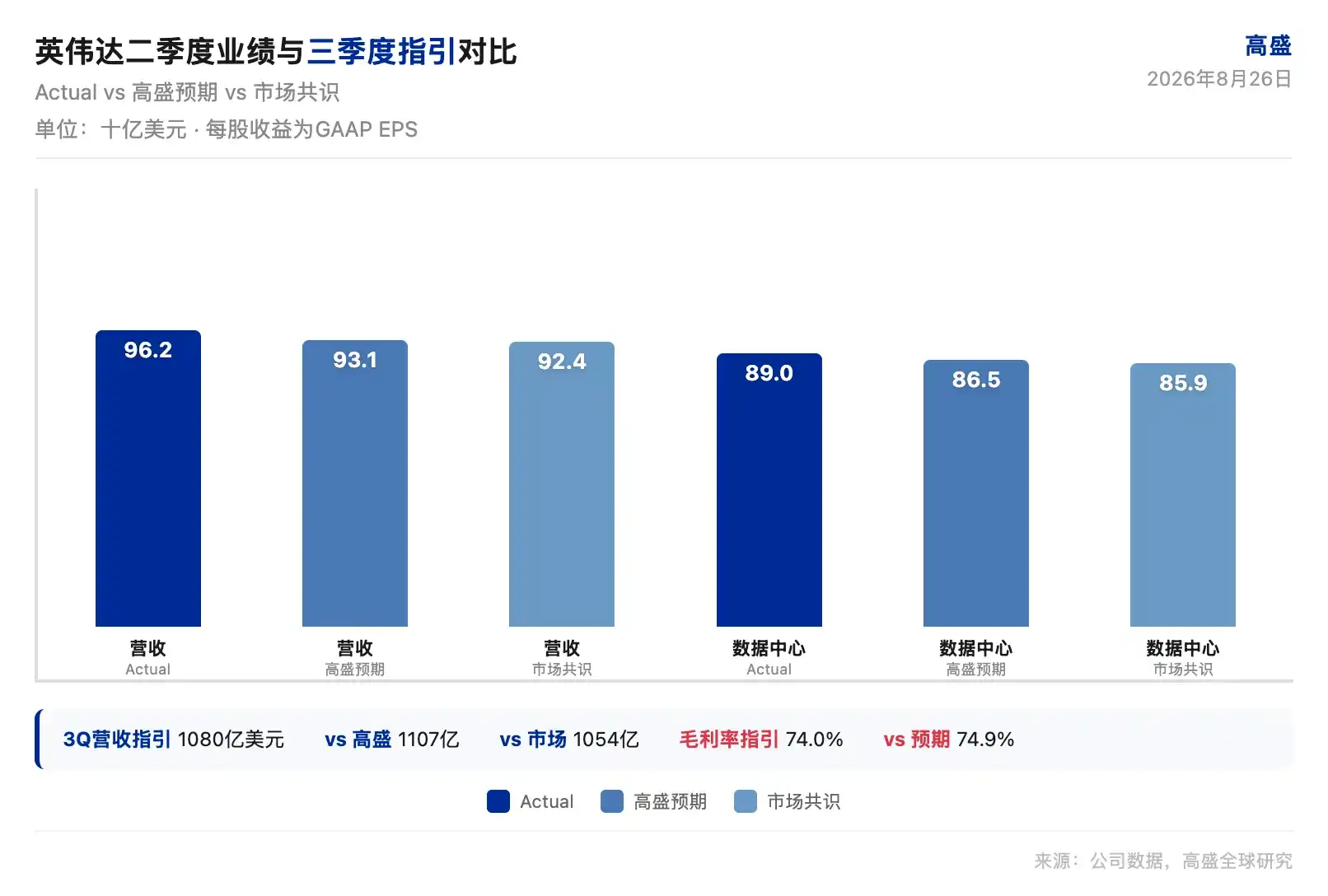
On August 26, Goldman Sachs released a flash report noting that Nvidia's Q2 revenue was $96.2 billion, with data center revenue at $89.0 billion, both exceeding Goldman Sachs and market expectations; the midpoint of Q3 revenue guidance is $108.0 billion, higher than market expectations but slightly below Goldman Sachs' forecast. Goldman Sachs maintains a Buy rating with a target price of $285, representing approximately 34% upside from the current price. Goldman Sachs expects the stock to trade within a range post-earnings, as optimistic expectations were already largely priced in following capex increases by hyperscalers.
Earnings Exceed Expectations, But Limited Surprises
All key Q2 metrics exceeded expectations. Revenue of $96.2 billion was 3.4% above Goldman Sachs' estimate and 4.2% above market consensus. Data center revenue of $89.0 billion was 2.9% and 3.6% higher, respectively. EPS of $2.22 was 4.9% and 6.1% higher, respectively. Gross margin of 75.0% was in line with expectations.
Behind the numbers, some subtle signals emerge. Inventory increased 22% quarter-on-quarter to $31.6 billion, with inventory days outstanding rising from 116 to 120 days; accounts receivable grew 55% quarter-on-quarter to $63.1 billion, with receivable days outstanding increasing from 46 to 60 days. Rapid accumulation of inventory and receivables typically indicates marginal easing in supply chain tightness or a slowdown in customer payment cycles.
Q3 guidance is also strong. The revenue guidance midpoint of $108.0 billion implies 14% sequential growth and approximately 90% year-on-year growth, higher than the market consensus of $105.4 billion but slightly below Goldman Sachs' expectation of $110.7 billion. Gross margin guidance of 74% is below Goldman Sachs' and market expectations of 74.9%. Goldman Sachs calculates an implied EPS of approximately $2.43, below its own estimate but above market expectations.
Slightly Lower Gross Margin Guidance; Three Key Topics for the Conference Call
Gross margin is the marginal negative signal from this report. Q3 gross margin guidance is about 90 basis points below market expectations and lower than Q2's 75.0%.
Pressure on gross margin may stem from product mix changes. The new Blackwell architecture GPUs likely have higher initial ramp-up costs, and new capacity investments also bring depreciation pressure. Historically, temporary gross margin pressure during new product introductions is normal; the key is whether the subsequent ramp-up pace meets expectations.
Goldman Sachs believes three issues in the earnings call are more important than the results themselves. Nvidia previously set a target for cumulative data center revenue of $1 trillion; investors want to know if there is room to raise this number. The structure and financial implications of the company's announced $500 billion partner financing platform have not been fully disclosed. With Q3 gross margin guidance signaling marginal pressure, the gross margin trend for the second half of 2026 and 2027 will be key for valuation.
Valuation and Market Expectations
Goldman Sachs' $285 target price is based on a 30x multiple applied to a normalized EPS of $9.50, implying 34% upside from the current price. The implied valuation multiple is not aggressive; Nvidia's data center revenue is still growing at triple-digit rates, and 30x is below its historical valuation average.
Market expectations are already high. Recent concentrated capex increases by hyperscalers have led to optimistic expectations for AI chip demand being largely reflected in the stock price. Goldman Sachs' mention of "range-bound trading" core meaning is: meeting expectations alone is not enough to drive a breakout in the stock price; new incremental information is needed to drive the next phase of valuation re-rating.
Implications for the Supply Chain
Goldman Sachs believes the Q3 guidance confirms the AI spending environment remains robust. For the digital semiconductor sector covered by Goldman Sachs, this signal is most positive, including Broadcom, AMD, Marvell, Arm, and Intel.
Nvidia's strong guidance implies that the expansion of AI infrastructure remains on an upward trajectory, providing demand visibility for the entire AI chip supply chain. Broadcom in custom computing chips, Marvell in connectivity chips, and AMD's competitive stance in the GPU market will all benefit from continued AI capex expansion. For Intel, as a potential beneficiary of foundry capacity, Nvidia's capacity needs could also provide incremental orders for its manufacturing business.
Nvidia's short-term earnings are not the issue; the issue is that market expectations have already run ahead. When earnings numbers fail to provide new positive surprises, the next phase of stock price momentum must be mined from the conference call. Whether Jensen Huang can articulate a sufficiently attractive incremental narrative during the Q&A session will determine Nvidia's stock direction post-earnings.

Disclaimer
This article is Tide Research's compilation and interpretation of a third-party brokerage research report (Goldman Sachs, August 26, 2026), combined with public market information. The ratings, target prices, earnings forecasts, and related judgments cited are the views of that brokerage's analysts, representing only the stance of their institution. They do not represent Tide Research's views and do not constitute any investment advice.
The market carries risks, and decisions should be made independently. This article should not be used as a basis for trading any securities.