GateToken (GT) Destroys 2,163,900 Tokens in Q4 2025, Building a More Robust Token Economic Structure Through Ecosystem Expansion

marsbitPublished on 2026-01-08Last updated on 2026-01-08

Abstract

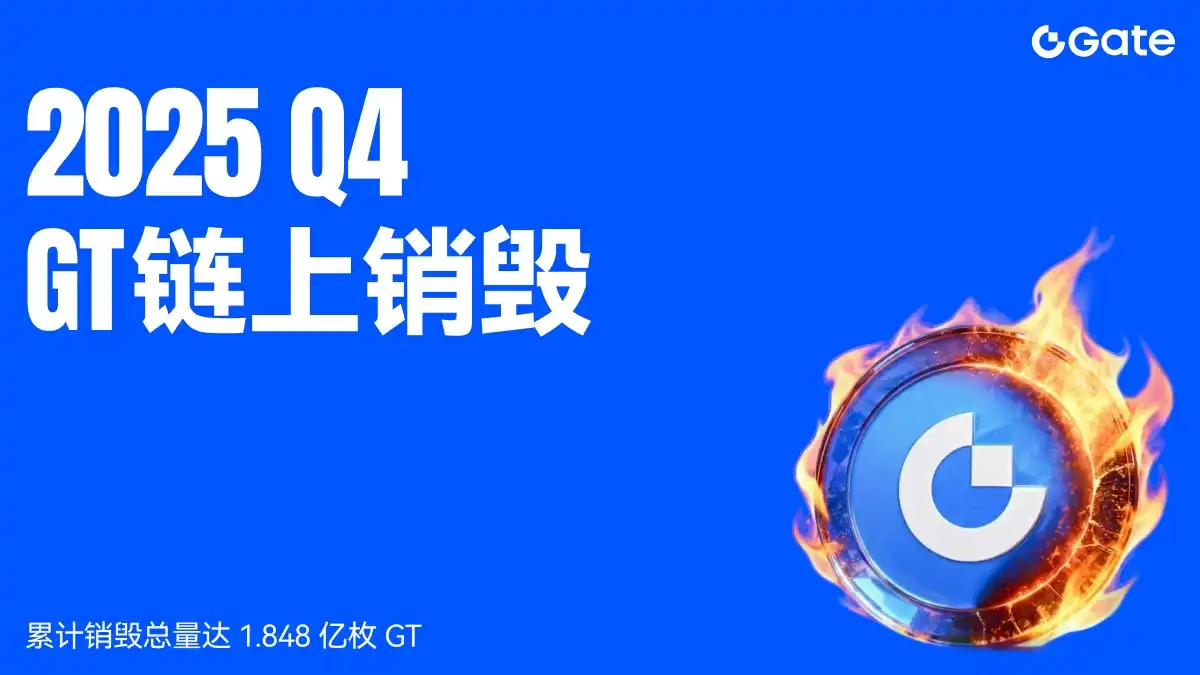
GateToken (GT) completed its Q4 2025 on-chain token destruction, permanently removing 2,163,900 GT tokens, valued at over $26.92 million. The total number of GT destroyed to date has reached 184,819,426, with a cumulative value exceeding $1.901 billion. As the native utility and gas token of GateChain, GT supports the network’s transfer system and transaction execution. Since the mainnet launch in 2019, GT’s total supply has decreased by approximately 61.61% from its original 300 million tokens due to its ongoing destruction mechanism. With the expansion of Gate’s Layer and Web3 ecosystem—including products like Gate Perp DEX, Gate Fun, Meme Go, and Gate Swap—GT is increasingly integrated as the essential gas token across all on-chain activities. Its usage and consumption continue to grow alongside ecosystem development. Gate remains committed to its deflationary tokenomics, reinforcing GT’s scarcity and value through sustained and compliant destruction. This approach aligns token economics with real on-chain demand and supports long-term ecosystem growth. As part of its All in Web3 strategy, Gate continues to enhance decentralized infrastructure and expand application scenarios, aiming to deliver a secure, efficient, and diverse Web3 experience.

According to the official announcement, the on-chain destruction of GateToken (GT) for Q4 2025 has been officially completed. A total of 2,163,900.48229 GT tokens were transferred to the burn address, with a destruction value exceeding $26.92 million. To date, GT has cumulatively destroyed 184,819,426 tokens, with a cumulative destruction value exceeding $1.901 billion (calculated at the current price).

On-chain transaction details can be viewed at: https://etherscan.io/tx/0x03773d485c05dc26a541f5d74e15097d02e010dea34c5cc4f6d3a127ac0126ce

GT (GateToken) is the core platform token of Gate and the native asset of GateChain. As the Utility Token and Gas Fee payment token on GateChain, GT supports the underlying transfer system of GateChain. Since the launch of the GateChain mainnet in 2019, GT has consistently implemented a continuous destruction mechanism, reducing the total token supply by approximately 61.61% from the initial 300 million tokens.

As Gate Layer and its Web3 ecosystem products enter a phase of stable operation and scaled development, GT's foundational role within the entire Gate ecosystem is continuously being solidified. Centered around core applications such as Gate Perp DEX, Gate Fun, Meme Go, and Gate Swap, Gate has progressively built a comprehensive Web3 application system covering trading, issuance, liquidity, and on-chain interactions, with on-chain activity and genuine usage demand continuously being released. As the sole Gas token of Gate Layer, GT is deeply integrated into key aspects such as network operation, transaction execution, and application interaction. Its on-chain consumption and usage scenarios continue to grow alongside ecosystem expansion.

Gate remains steadfast in executing the GT destruction plan, steadily advancing the deflationary process in compliance with laws and regulations. Through a long-term, stable, and sustainable destruction mechanism, Gate continuously strengthens GT's scarcity attributes and value foundation, creating a tighter positive feedback loop between the token economic model and genuine on-chain usage demand and ecosystem growth.

Simultaneously, Gate persists in advancing its All in Web3 strategy, continuously deepening underlying infrastructure construction, expanding decentralized trading and diverse on-chain application scenarios to provide users with a safer, more efficient, and richer Web3 experience. Through the synergistic advancement of the deflationary mechanism and ecosystem construction, Gate, as a long-term builder, is promoting the evolution of Web3 infrastructure towards a more mature and sustainable development path.

About Gate

Founded in 2013 by Dr. Han, its founder and CEO, Gate is one of the world's leading cryptocurrency trading platforms. The platform serves over 47 million users and supports trading for over 4,200 crypto assets. As an industry benchmark, Gate was the first to achieve 100% Proof of Reserves, and its ecosystem encompasses diverse services including Gate Wallet and Gate Ventures.

To learn more, please visit: Website | X | Telegram | LinkedIn | Instagram | YouTube

Disclaimer:

This content does not constitute any offer, solicitation, or recommendation. You should always seek independent professional advice before making any investment decision. Please note that Gate may restrict or prohibit all or part of its services from restricted regions. Please read the User Agreement for more information at: https://www.gate.com/zh/user-agreement.


Trending Cryptos

Related Questions

QHow many GT tokens were burned in Q4 2025 and what was their approximate USD value?

AIn Q4 2025, 2,163,900.48229 GT tokens were burned, with a value exceeding $26.92 million.

QWhat is the total number of GT tokens that have been burned to date and their total value?

AA total of 184,819,426 GT tokens have been burned, with a cumulative value exceeding $1.901 billion at current prices.

QWhat is the primary function of GT (GateToken) within the GateChain ecosystem?

AGT is the native asset and gas fee payment token of GateChain, supporting its underlying transfer system and serving as its core platform token.

QBy what percentage has the total token supply of GT been reduced since its inception?

AThe total token supply of GT has been reduced by approximately 61.61% from its initial amount of 300 million tokens.

QWhat is the name of Gate's overarching strategic vision mentioned in the article?

AThe overarching strategic vision mentioned is the 'All in Web3' strategy.

Related Reads

BIT Research: Liquidity is Disappearing, Will Bitcoin Replay the Bottoming Pattern of 2022?

The crypto market is currently in an adjustment phase driven by policy expectations and liquidity shifts. Despite a brief rebound fueled by geopolitical easing and SpaceX's strong IPO performance, unexpectedly hawkish signals from new Fed Chair Kevin Warsh have removed anticipated easing support. Concurrently, stablecoin liquidity is shrinking, with insufficient new capital inflows, pushing the market into a typically quiet summer period. Pricing lacks catalysts for a sustained rally. Daily trading volume has significantly contracted, stablecoin growth has slowed markedly, and the supportive effect of Strategy's (formerly MicroStrategy) STRC preferred stock-financed Bitcoin purchases is fading. Amid policy uncertainty, seasonal weakness, and liquidity contraction, Bitcoin faces near-term downward pressure. Warsh's hawkish pivot and refusal to provide a clear policy outlook have increased risk premiums, historically unfavorable for Bitcoin. Technically, the trend remains bearish below $73,700, with $62,446 as critical support. A break below could accelerate declines, though a prolonged consolidation phase, similar to 2022's bottoming process, is possible. Liquidity is a core constraint. Current daily volume is around $500 billion, roughly 25% of the peak during the July-Oct 2025 rally. The 12-month growth rates for USDT and USDC have fallen to ~20%, with 6-month growth near zero, indicating weak new inflows. Bitcoin ETF and Strategy-driven inflows have also weakened, with a 30-day rolling net outflow. With inflation at 4.2% above the Fed's target, combined hawkish policy, seasonal factors, and liquidity shortages challenge Bitcoin's ability to hold above $60,000. However, this adjustment phase may be forming a cyclical low this summer, potentially setting the stage for the next bull cycle.

marsbit17m ago

BIT Research: Liquidity is Disappearing, Will Bitcoin Replay the Bottoming Pattern of 2022?

marsbit17m ago

Who Makes the Best Use of Claude Code? The Answer Might Not Be Programmers

Claude Code Usage Report Summary (Based on ~400k sessions) Core Finding: In agentic programming with Claude Code, a clear division of labor has emerged: humans primarily decide *what* to build (planning decisions), while Claude decides *how* to build it (execution decisions). Key Insights: 1. **Effectiveness is not limited to programmers.** In code-generation tasks, success rates for users in non-technical fields (law, finance, management, research) are nearing those of software engineers. What matters most is the user's domain expertise and understanding of the problem to be solved. 2. **Domain expertise drives success and efficiency.** Sessions where users exhibited "expert" proficiency in the task's domain saw verified success rates double compared to "novice" sessions. Experts also delegated more work per instruction, with Claude executing more actions and producing more output. 3. **AI is amplifying, not replacing, domain knowledge.** Claude Code lowers the *implementation* barrier, not the *judgment* barrier. The value of knowing the "what" and "why" is increasing relative to just knowing the "how" to code. 4. **Usage is evolving.** Over a 7-month period (Oct '25 - Apr '26), the share of sessions for debugging halved, while use for software operations, data analysis, and non-code writing roughly doubled. The estimated economic value of typical tasks increased by ~25%. Conclusion: The data suggests coding agents are making programming background less critical for completing technical tasks. However, they reward and amplify deep domain understanding. The ability to successfully direct an AI agent stems more from mastery of a specific field than from coding skill itself. The primary gains come from being competent in a domain; deep specialization adds only marginal additional advantage. This may signal a shift where software creation becomes integrated into various professions.

marsbit52m ago

Who Makes the Best Use of Claude Code? The Answer Might Not Be Programmers

marsbit52m ago

Trading

Spot
Futures

Hot Articles

How to Buy GT

Welcome to HTX.com! We've made purchasing Gatechain (GT) simple and convenient. Follow our step-by-step guide to embark on your crypto journey.Step 1: Create Your HTX AccountUse your email or phone number to sign up for a free account on HTX. Experience a hassle-free registration journey and unlock all features.Get My AccountStep 2: Go to Buy Crypto and Choose Your Payment MethodCredit/Debit Card: Use your Visa or Mastercard to buy Gatechain (GT) instantly.Balance: Use funds from your HTX account balance to trade seamlessly.Third Parties: We've added popular payment methods such as Google Pay and Apple Pay to enhance convenience.P2P: Trade directly with other users on HTX.Over-the-Counter (OTC): We offer tailor-made services and competitive exchange rates for traders.Step 3: Store Your Gatechain (GT)After purchasing your Gatechain (GT), store it in your HTX account. Alternatively, you can send it elsewhere via blockchain transfer or use it to trade other cryptocurrencies.Step 4: Trade Gatechain (GT)Easily trade Gatechain (GT) on HTX's spot market. Simply access your account, select your trading pair, execute your trades, and monitor in real-time. We offer a user-friendly experience for both beginners and seasoned traders.

1.7k Total ViewsPublished 2024.03.29Updated 2026.06.02

How to Buy GT

Discussions

Welcome to the HTX Community. Here, you can stay informed about the latest platform developments and gain access to professional market insights. Users' opinions on the price of GT (GT) are presented below.

活动图片