Garlinghouse Says 67M US Crypto Owners Show Industry Has Gone Mainstream

bitcoinistPublished on 2026-08-21Last updated on 2026-08-21

Abstract

Ripple CEO Brad Garlinghouse cites a new survey estimating that 67 million Americans, roughly 25% of U.S. adults, own cryptocurrency. He argues this signals the industry's move from a niche interest into the financial mainstream. The figure, from the National Cryptocurrency Association and Harris Poll's 2026 report, is based on a survey of 10,000 respondents rather than a verified registry, but still indicates significant adoption. Garlinghouse uses the data to support the argument that crypto now has a substantial user base, influencing both commercial strategies and political policy. The growing ownership implies crypto can no longer be ignored by lawmakers, shifting the debate from whether people will adopt crypto to how they will use it. The report acknowledges survey estimates require careful interpretation but underscores crypto's expanding role in everyday finance.

Ripple CEO Brad Garlinghouse has pointed to a new ownership estimate showing 67 million Americans hold cryptocurrency, arguing that the industry is no longer fringe.

The figure comes from the National Cryptocurrency Association and The Harris Poll’s 2026 State of Crypto Holders Report. The survey estimates that roughly 25% of US adults own crypto, based on a sample of 10,000 respondents.

That is a major claim, but the scope matters.

The 67 million figure is an estimate, not a registry count. There is no nationwide wallet database proving exactly how many Americans own crypto. Still, a large survey showing one in four adults holding crypto is a strong sign that digital assets have moved beyond early adopters.

TL;DR

  • Brad Garlinghouse cited a report estimating 67 million US crypto owners.
  • The figure represents roughly 25% of US adults.
  • The number is survey-based, not a globally verified ownership registry.

Why The 67M Figure Matters

Crypto adoption has always been difficult to measure.

Wallets are pseudonymous. One user can have many wallets. Exchange accounts do not always equal active ownership. Some people hold tiny balances. Others hold through ETFs or custodians.

That is why survey data is imperfect but still useful.

A large consumer survey can show whether crypto has entered mainstream financial behavior. If roughly a quarter of US adults say they own crypto, then the industry is no longer limited to traders, developers, and early believers.

That is Garlinghouse’s point.

Ripple’s Mainstream Argument

Garlinghouse has long argued that crypto needs to move from speculation into real utility.

A large ownership figure supports the political and commercial case that digital assets are now part of everyday financial life. That matters for policy because lawmakers may treat crypto differently if they believe tens of millions of voters hold it.

It also matters for companies.

Banks, fintechs, payment providers, exchanges, and asset managers pay attention when user adoption crosses mainstream thresholds.

For Ripple, the argument supports a broader message: crypto is not a niche sector waiting for permission to exist. It already has a large user base.

Surveys Need Careful Framing

The caution is that survey estimates are not exact counts.

A 10,000-person sample can be robust, but it still depends on methodology, wording, demographics, and respondent honesty. Crypto ownership can also mean different things to different people. Someone with $20 of Bitcoin on an app may answer the same way as someone with a large self-custodied portfolio.

That does not invalidate the result.

It simply means the number should be described as an estimate.

The phrase “67 million Americans own crypto” is powerful, but readers should understand how the estimate was produced.

Crypto’s Political Weight Is Growing

The bigger implication is political.

If crypto ownership is anywhere near 25% of US adults, digital asset policy is no longer a fringe regulatory topic. It affects a large potential voter group, a growing investor base, and a meaningful part of financial-market participation.

That may explain why market-structure bills, ETF approvals, custody rules, and enforcement policy now receive more attention in Washington.

Politicians may not agree on crypto, but they can no longer ignore it.

The Adoption Debate Is Changing

The early crypto adoption debate was about whether anyone outside a small technical community would care.

That debate is over.

The new debate is about what people actually use crypto for: saving, speculation, payments, remittances, stablecoins, DeFi, NFTs, tokenized assets, ETFs, or simply portfolio exposure.

Ownership alone does not prove deep usage. But it does show familiarity and access.

Garlinghouse’s point is that crypto has entered the mainstream conversation. The 67 million figure gives that argument a headline number.

The next test is whether ownership turns into durable utility.

This article is based on the National Cryptocurrency Association and Harris Poll 2026 State of Crypto Holders Report.

This article was written by the News Desk and edited by Samuel Rae.

This report is based on information released in disclosures at primary source documentation.

Related Questions

QWhat is the estimated number of Americans who own cryptocurrency, according to the report cited by Brad Garlinghouse?

AThe report estimates that 67 million Americans own cryptocurrency, representing roughly 25% of US adults.

QWhat is the source of the 67 million crypto owner estimate mentioned in the article?

AThe figure comes from the National Cryptocurrency Association and The Harris Poll's 2026 State of Crypto Holders Report, which was based on a survey of 10,000 respondents.

QWhy does Brad Garlinghouse believe the 67 million figure is significant for the crypto industry?

AGarlinghouse argues that a large ownership figure supports the political and commercial case that crypto is mainstream, moving beyond speculation into real utility, and that politicians and companies can no longer ignore an industry with tens of millions of potential voters and users.

QWhat caution does the article mention regarding the 67 million crypto owner estimate?

AThe article cautions that the figure is a survey-based estimate, not an exact registry count. Survey results can depend on methodology, wording, and respondent honesty, and the definition of 'ownership' can vary among respondents.

QAccording to the article, how has the core debate around cryptocurrency adoption changed?

AThe early debate about whether anyone outside a small technical community would care is over. The new debate is about what people actually use crypto for, such as saving, payments, DeFi, or portfolio exposure, moving from mere ownership to durable utility.

Related Reads

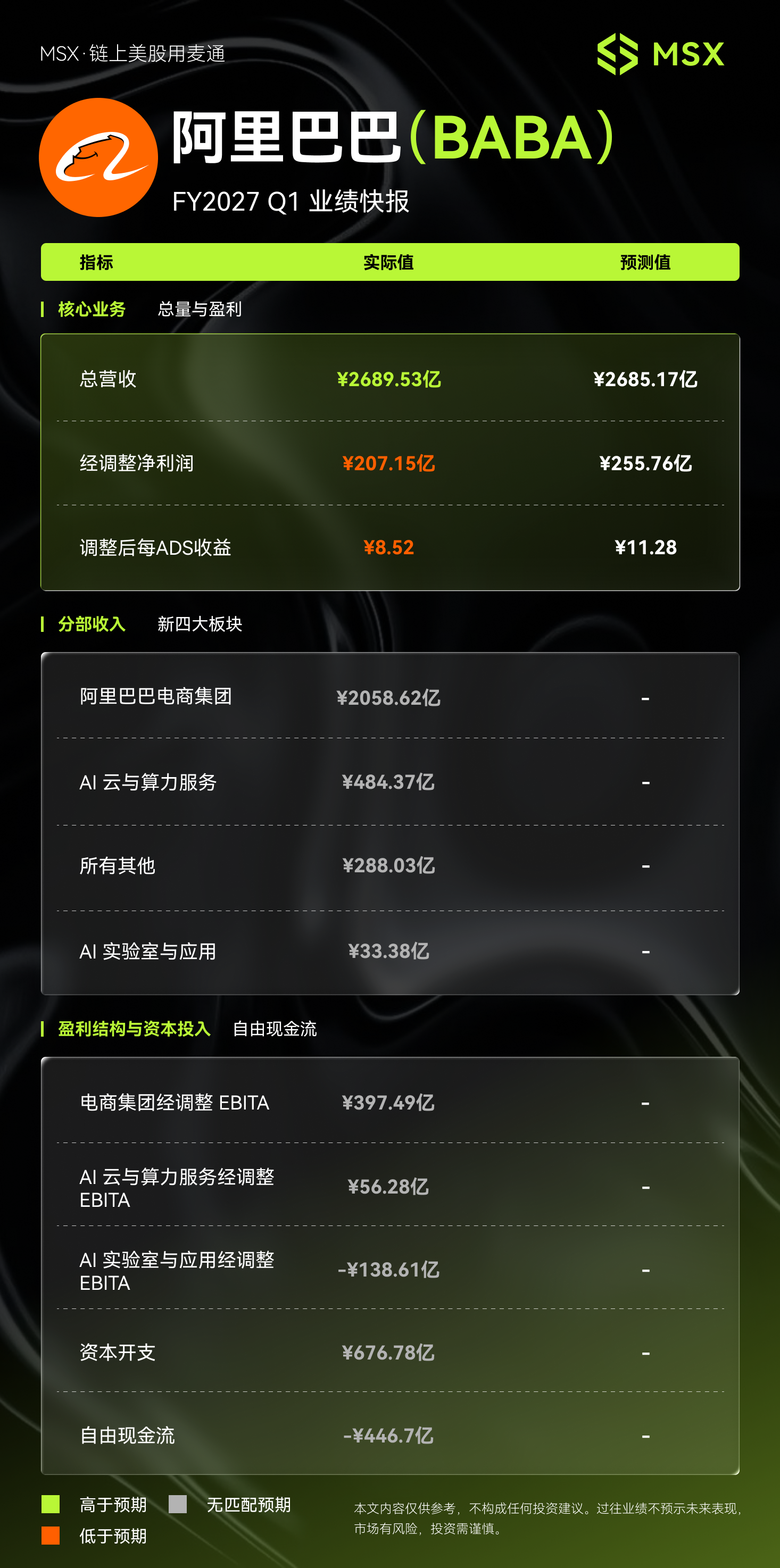
MSX US Stock Daily Observation: Alibaba FY2027 Q1 Earnings: AI Cloud Revenue Growth Hits Record High, AI Cloud Achieves Profitable Closed Loop

**MSX Daily US Stock Watch: Alibaba FY2027 Q1 Earnings – AI Cloud Revenue Hits Record Growth, Achieves Profitability Milestone** Alibaba's Q1 FY2027 revenue slightly exceeded expectations at 268.9B yuan (+9% YoY). However, adjusted net profit of 20.7B yuan (-38% YoY) and adjusted EPS missed consensus significantly. This shortfall was primarily driven by increased AI investments and two one-time items: a 5.5B euro provision for an EU Digital Services Act fine and 4.46B yuan in goodwill impairment. The restructured business segments showed clear divergence. The standout performer was the AI Cloud & Computing Services unit, with revenue surging 45% YoY to 48.44B yuan. Crucially, its adjusted EBITA jumped 133% YoY to 5.63B yuan, with margins expanding to 12%, signaling a profitable commercial loop for AI infrastructure. Within the Commerce Group, revenue growth was mixed: China Local Services (instant retail) grew 45% to 53.3B yuan, largely offsetting an 8% decline in Traditional China Commerce (110.9B yuan). International commerce revenue fell 1%. Despite this, the Commerce Group's adjusted EBITA dipped only 1% YoY to 39.75B yuan. A key area to watch is cash flow. Capital expenditures soared 75% YoY to 67.68B yuan, turning free cash flow to a net outflow of 44.67B yuan. However, operating cash flow remained positive and grew 11% YoY to 22.95B yuan, indicating the cash burn is a strategic choice for AI capacity build-out rather than operational weakness. In summary, while headline profits were pressured by heavy AI spending and one-off charges, the core takeaway is the emerging profitability of the AI Cloud business. The success of Alibaba's current investment cycle hinges on whether the profit improvement in AI Cloud can outpace the depreciation costs of its massive computing infrastructure expansion.

Odaily星球日报11m ago

MSX US Stock Daily Observation: Alibaba FY2027 Q1 Earnings: AI Cloud Revenue Growth Hits Record High, AI Cloud Achieves Profitable Closed Loop

Odaily星球日报11m ago

Trading

Spot
活动图片