Fundstrat’s circulating 2026 crypto outlook warns of pullback, contrasting Tom Lee

cointelegraphPublished on 2025-12-20Last updated on 2025-12-20

Abstract

A reportedly internal 2026 crypto outlook from Fundstrat Global Advisors warns of a potential "meaningful drawdown" in the first half of 2026, setting downside targets for major cryptocurrencies. The document, attributed to the firm's head of digital asset strategy Sean Farrell, suggests Bitcoin (BTC) could fall to $60,000–$65,000, Ether (ETH) to $1,800–$2,000, and Solana (SOL) to $50–$75, viewing these levels as potential buying opportunities later in the year. This contrasts with recent public comments from Fundstrat's head of research Tom Lee, who called ETH "grossly undervalued" at around $3,000 and suggested it could reach up to $60,000 based on historical ratios. The report's authenticity has not been confirmed by Fundstrat or Cointelegraph.

A circulating report attributed to Fundstrat Global Advisors has outlined a bearish outlook for cryptocurrencies that appears to clash with Tom Lee’s recent public comments.

According to screenshots shared on X, the document, which appears to be Fundstrat’s internal 2026 crypto strategy guidance, warns of a “meaningful drawdown” in the first half of 2026. The report sets downside targets of Bitcoin (BTC) falling to $60,000–$65,000, Ether (ETH) dropping to $1,800–$2,000, and Solana (SOL) declining to $50–$75 before potentially presenting buying opportunities later in the year.

The material has not been publicly released by Fundstrat, and its authenticity has not been independently confirmed by Cointelegraph at the time of publication. However, multiple crypto-focused accounts, including Wu Blockchain, claim the document was distributed to internal clients.

Lee is a managing partner and the head of research at Fundstrat. The circulating 2026 crypto outline has been apparently written by Sean Farrell, head of digital asset strategy at the firm.
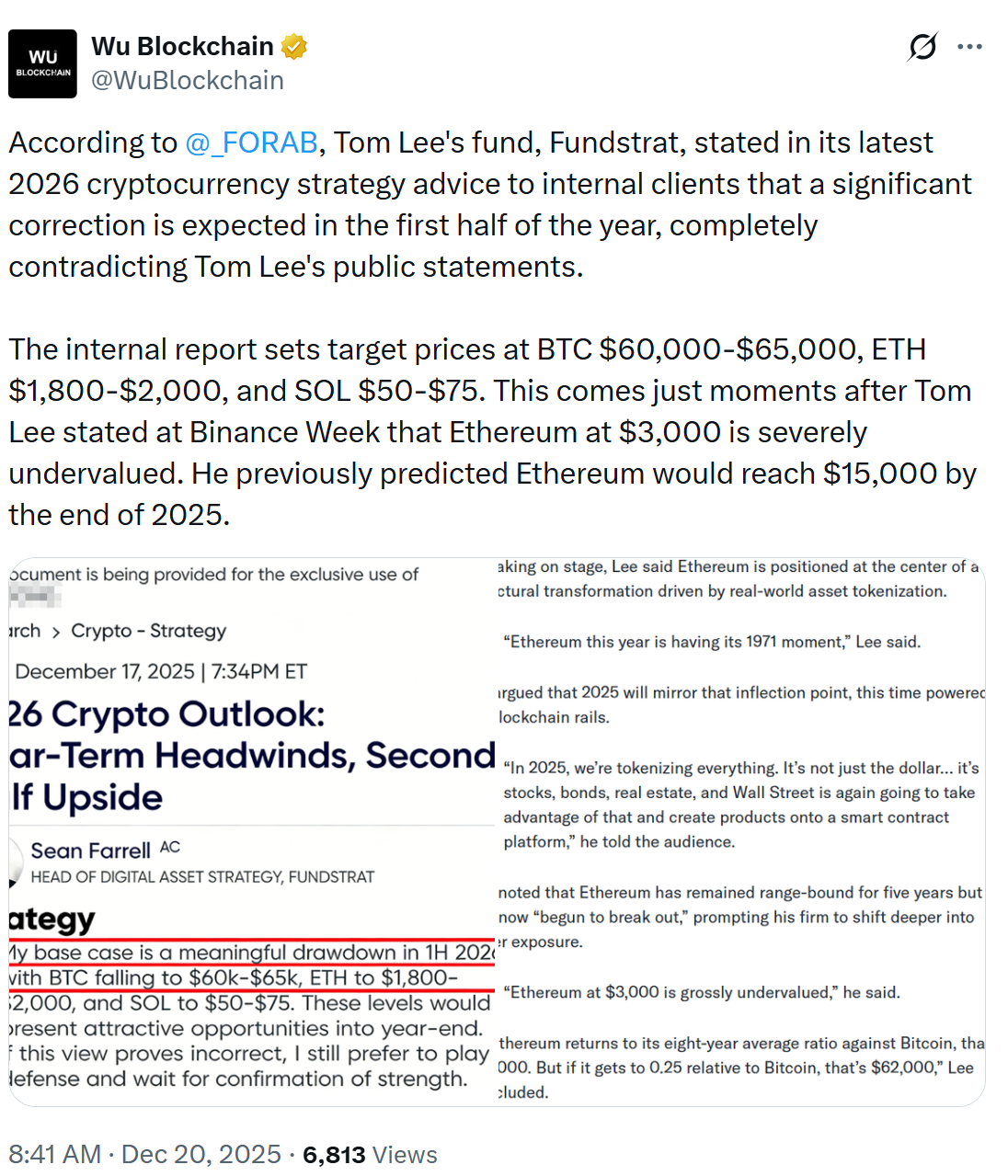
Fundstrat’s 2026 crypto outlook. Source: Wu Blockchain

Related: Ether down 42% from all-time high: Where will ETH price bottom?

Tom Lee calls ETH “grossly undervalued”

The circulating outlook stands in contrast to statements Lee made on stage at Binance Blockchain Week in Dubai earlier this month. Speaking publicly, Lee said Bitcoin could reach $250,000 within months and called Ether at around $3,000 “grossly undervalued.”

Lee argued that if Ether were to return to its eight-year average ratio against Bitcoin, its price could approach $12,000. A revisit of 2021 relative levels would imply prices near $22,000, while an ETH/BTC ratio of 0.25 would suggest valuations north of $60,000, according to Lee’s presentation.

In November, Lee also claimed Ether is starting on the same path that saw Bitcoin’s price multiply over 100 times since 2017. “We believe ETH is embarking on that same Supercycle,” he said.

Cointelegraph reached out to Fundstrat for comment, but had not received a response at the time of publication.

Related: Ethereum could get faster in January with gas limit rise to 80M

BitMine ramps up Ether buying

As Cointelegraph reported, Lee’s BitMine has continued to aggressively accumulate Ether despite a weakening market backdrop.

In a Dec. 8 disclosure, the company said it held nearly 3.9 million ETH as of Dec. 7, after adding more than 138,000 ETH in a single week. The firm claimed its holdings now represent over 3.2% of Ether’s total supply.

Magazine: 2026 is the year of pragmatic privacy in crypto — Canton, Zcash and more

Trending Cryptos

Related Questions

QWhat is the bearish outlook for cryptocurrencies in the first half of 2026, according to the circulating Fundstrat report?

AThe report warns of a 'meaningful drawdown' with downside targets of Bitcoin falling to $60,000–$65,000, Ether dropping to $1,800–$2,000, and Solana declining to $50–$75.

QHow does the circulating Fundstrat report contrast with Tom Lee's recent public comments on cryptocurrency valuations?

AWhile the report predicts a significant price pullback, Tom Lee publicly stated that Bitcoin could reach $250,000 within months and called Ether 'grossly undervalued' at around $3,000, suggesting it could potentially reach prices as high as $12,000 to $60,000.

QWho is identified as the author of the circulating 2026 crypto outlook document from Fundstrat?

AThe document was apparently written by Sean Farrell, the head of digital asset strategy at Fundstrat.

QWhat evidence is provided in the article to suggest that the Fundstrat document is authentic, even though it hasn't been publicly released?

AThe article states that multiple crypto-focused accounts, including Wu Blockchain, claim the document was distributed to Fundstrat's internal clients, and screenshots of it were shared on social media platform X.

QWhat action has Tom Lee's company, BitMine, taken regarding Ether accumulation according to the article?

ABitMine has continued to aggressively accumulate Ether, adding more than 138,000 ETH in a single week and holding nearly 3.9 million ETH as of Dec. 7, which represents over 3.2% of Ether's total supply.

Related Reads

Founder of Baixing.com: The Notion That Large Language Models Will Devour Everything, I Believe Half of It

Founder of Baixing.com: I Only Half-Believe the Saying “Large Language Models Will Devour Everything” Author: Wang Jianshuo, Founder of Baixing.com Many proclaim that large models are everything, but the author is skeptical. He argues that such sweeping claims often stem from a limited understanding of the future. Drawing parallels to past technologies like electricity and the internet—which were predicted to “devour everything” but didn’t—he suggests that large language models (LLMs) are better seen as a foundational base. Like electricity, this base is essential for modern development, but its real value emerges only when applied to specific scenarios through various “machines” or “tools” (e.g., Claude Code for programming, Claude Design for design). The author acknowledges that LLMs may indeed replace many existing software systems built on rigid rules, workflows, and forms (e.g., CRMs, SaaS tools), as these are precisely what LLMs excel at processing. However, he emphasizes that beyond software, elements like customer data, execution capabilities (e.g., booking a flight), trust, and physical-world interactions will not be “devoured.” Instead, he foresees that after streamlining existing software, LLMs will open up a larger space for innovative, next-generation applications. These new tools will likely feature fluid interfaces and rely less on fixed rules, unleashing greater creativity. The author cautions against short-sightedness, recalling how in 2004 many believed internet giants like Sina, Sohu, and NetEase would monopolize the market—only to be proven wrong by subsequent disruptions. In conclusion, while LLMs are a crucial foundation and a current focal point, the true mainstream of this wave lies in the diverse applications built atop them to solve concrete problems. The phrase “devour everything” is imprecise; the real opportunity lies in identifying and leveraging the areas where LLMs do bring transformative change.

marsbit1h ago

Founder of Baixing.com: The Notion That Large Language Models Will Devour Everything, I Believe Half of It

marsbit1h ago

Founder of Baixing.com: I Only Half Believe in the Notion that Large Language Models Devour Everything

The founder of Baixing Wang states that while large language models (LLMs) are an extremely important foundational technology—akin to electricity or the internet—he only "half believes" the notion that they will "consume everything." He argues that LLMs provide a base layer of intelligence, but real-world value and transformation come from integrating this intelligence into specific applications and devices designed for particular scenarios—like how electricity powers various appliances from washing machines to TVs. He agrees LLMs will likely consume or replace a significant portion of existing rule-based, workflow-driven software (e.g., many SaaS systems, CRMs), as these are precisely what LLMs excel at handling. However, numerous other elements—such as customer data, execution capabilities (e.g., booking a flight), trust, and physical-world interactions—will not be consumed. Wang emphasizes that after LLMs absorb certain software layers, they will open up a much larger space for innovation: new types of "streaming" software with less rigid interfaces, where fixed rules are managed by AI. This next wave of applications built on top of the stable LLM foundation is where the true mainstream opportunity lies. He cautions against the short-sightedness of declaring any technology as all-consuming, drawing parallels to past premature predictions about internet giants monopolizing the web. The key is to find opportunities within the areas LLMs do transform.

链捕手1h ago

Founder of Baixing.com: I Only Half Believe in the Notion that Large Language Models Devour Everything

链捕手1h ago

Trading

Spot

Hot Articles

Discussions

Welcome to the HTX Community. Here, you can stay informed about the latest platform developments and gain access to professional market insights. Users' opinions on the price of S (S) are presented below.

活动图片