Written by: Eric, Foresight News
The perpetual contract space is undergoing a quiet revolution.
Over the past two years, Perp DEX has evolved from a fringe experiment into a force to be reckoned with in the derivatives market. In 2025, the total trading volume of Perp DEX reached $7.9 trillion, approaching 10% of the total volume on centralized exchanges. However, amidst this clamor, a fundamental limitation persisted: almost all platforms were trapped in the cage of crypto-native assets, trading mainly Bitcoin, Ethereum, and a handful of altcoins, with collateral almost uniformly being stablecoins.
Meanwhile, the real-world asset (RWA) tokenization sector is rising at a staggering pace, growing from a proof-of-concept in 2023 to a market size now exceeding $30 billion. In this sector, Ondo Finance has established an indisputable leading position: its tokenized equities platform, Ondo Global Markets, commands nearly 70% market share, about 2.5 times that of the runner-up.
Starting this year, precious metals, commodities, and stocks began to be included in DEX trading lists. But the trend we're familiar with has been Perp DEXs listing tokenized RWA assets.
When the absolute leader in the RWA sector decides to enter the Perp DEX arena, things get interesting. The launch of Ondo Perps signifies that the perpetual contract space finally has a player that genuinely starts from traditional financial assets, deeply integrating institutional-grade asset issuance capabilities with crypto-native trading infrastructure. This may mark a turning point in the evolution of Perp DEX from a pure crypto derivatives tool to a truly global asset trading infrastructure.
"Going Against the Grain"
In 2021, former Goldman Sachs employees Nathan Allman and Pinku Surana founded Ondo, initially positioning it as a DeFi structured products protocol. From late 2022 to early 2023, the team keenly observed that the DeFi internal loop model would eventually hit a ceiling, and the bridge connecting traditional finance with the on-chain world represented the next real opportunity. They decisively pivoted to the RWA sector, launching the tokenized U.S. Treasury fund OUSG, followed by USDY for non-U.S. retail investors. These products precisely addressed the market's biggest pain point at the time: the massive capital in the crypto world desperately needed low-risk, high-yield on-chain destinations, while the Fed's aggressive rate hikes made U.S. Treasuries the most attractive choice.
Sadly, in late May, Nathan Allman, Ondo's founder and CEO and a key proponent of the RWA tokenization space, passed away unexpectedly. Long-time President Ian De Bode will succeed him as CEO. Ondo stated that Ian De Bode has been responsible for company strategy, product, and daily operations for over two years, and his appointment as CEO has the full support of the management team.
Ondo's execution is impressive. In March 2024, when BlackRock launched its tokenized money market fund BUIDL, Ondo swiftly moved OUSG's primary holdings to BUIDL, leveraging the credit endorsement of the world's largest asset manager while maintaining its independence in distribution channels. By 2025, Ondo's TVL exceeded $2.5 billion, with the USDY product alone surpassing $1 billion, becoming the world's largest tokenized Treasury product for retail investors.
The launch of Ondo Global Markets expanded the company's footprint from fixed income to equities. This platform, launched in September 2025, offered trading in over 260 tokenized U.S. stocks and ETFs. From Apple and Nvidia to S&P 500 index ETFs, it covered hot sectors like AI, biotech, defense, and energy. The data—TVL surpassing $1 billion in under eight months and cumulative trading volume exceeding $18 billion—represents a phenomenal growth curve in the history of any financial product. By comparison, stablecoins didn't show such a steep adoption curve in their early stages.
More importantly, Ondo is not just a crypto project operating in a gray area. It obtained regulatory approval in Liechtenstein covering 30 European countries, confidentially filed a registration statement with the U.S. Securities and Exchange Commission (SEC), and partnered with traditional financial giants like JPMorgan Chase and Mastercard to complete the first cross-border tokenized Treasury redemption test. When established asset managers like Franklin Templeton chose to tokenize their ETF products via Ondo's platform, Ondo's hub status in the RWA space became self-evident.
This year, both exchanges and DEXs are racing to list tokenized RWA assets. Hyperliquid saw trading volume for assets like gold, silver, and crude oil spike over a weekend during the U.S.-Iran conflict, leading to two Bloomberg reports in one week. The trend is obvious, but everyone seems focused on how exchanges can capture trading of RWA tokenized assets, forgetting the potential for projects specializing in RWA tokenization themselves to launch exchanges.
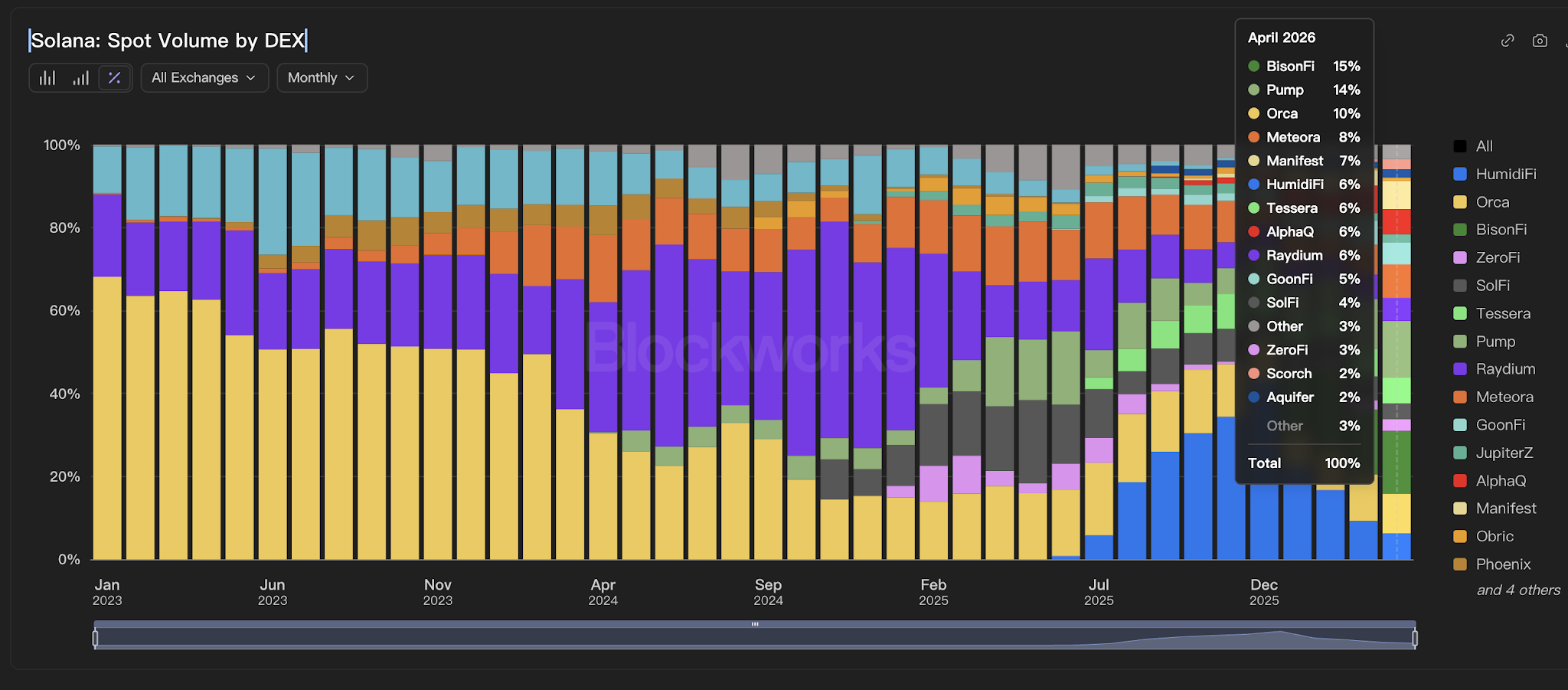
This is similar to the situation before pump.fun launched its DEX, when DEXs on Solana were fiercely competing for the meme token trading market. Thirteen months after pump.fun launched PumpSwap, its market share by trading volume had risen to second place, nearly tied for first, while once-dominant Raydium's share had shrunk to just 5%.
"Wall Street 2.0"
The core positioning of Ondo Perps is very clear: it is a perpetual futures platform focused on tokenized stocks, indices, and commodities, combining institutional-grade financial infrastructure with a permissionless, globally accessible trading platform interface. In simpler terms, it is a platform that genuinely brings Wall Street assets into the DeFi perpetual contract arena.
The first and most obvious advantage of this positioning lies in the richness of the asset side. Ondo Perps can directly list assets that Ondo has already tokenized on its Perp DEX for trading. For a trader looking to flexibly use leverage in global asset allocation, this difference in choice space is transformative.
Currently, Ondo Perps is open to all users. Let's look at some of its highlights:
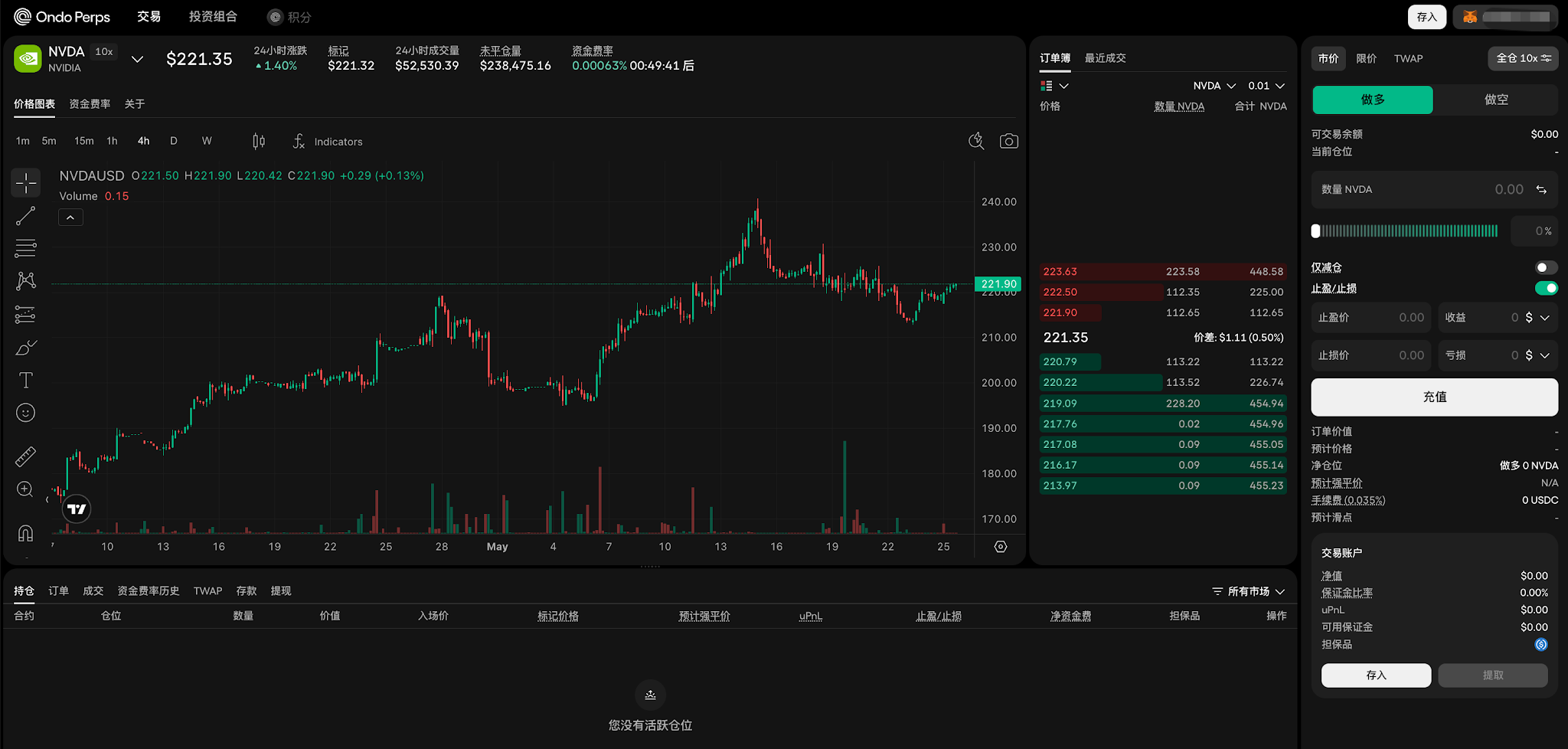
Ondo Perps, as a Perp DEX, has all the basic functionalities, which won't be detailed here. Currently, the maximum leverage supported by Ondo Perps is 20x, with most U.S. stock contracts capped at 10x, and commodities, indices, etc., at 20x.
Currently, Ondo Perps supports 24/7 trading across 24 perpetual contract markets, including:
16 U.S. Stocks: SPCX, MU, NVDA, TSLA, AAPL, MSFT, GOOGL, AMZN, META, NFLX, AMD, INTC, ORCL, PLTR, COIN, HOOD, MSTR, CRCL;
3 Commodities: XAU (Gold), XAG (Silver), WTI (Crude Oil);
2 Indices: US 500, US 100;
1 ETF: Roundhill Memory ETF (DRAM).
In practical use, the author noted two characteristics: first, users do not directly trade using their own wallets; they need to transfer USDC from Ethereum to a designated Ondo address to trade; second, Ondo Perps operates on a cross-margin mode, meaning positions (long/short) across different assets share the same margin pool.
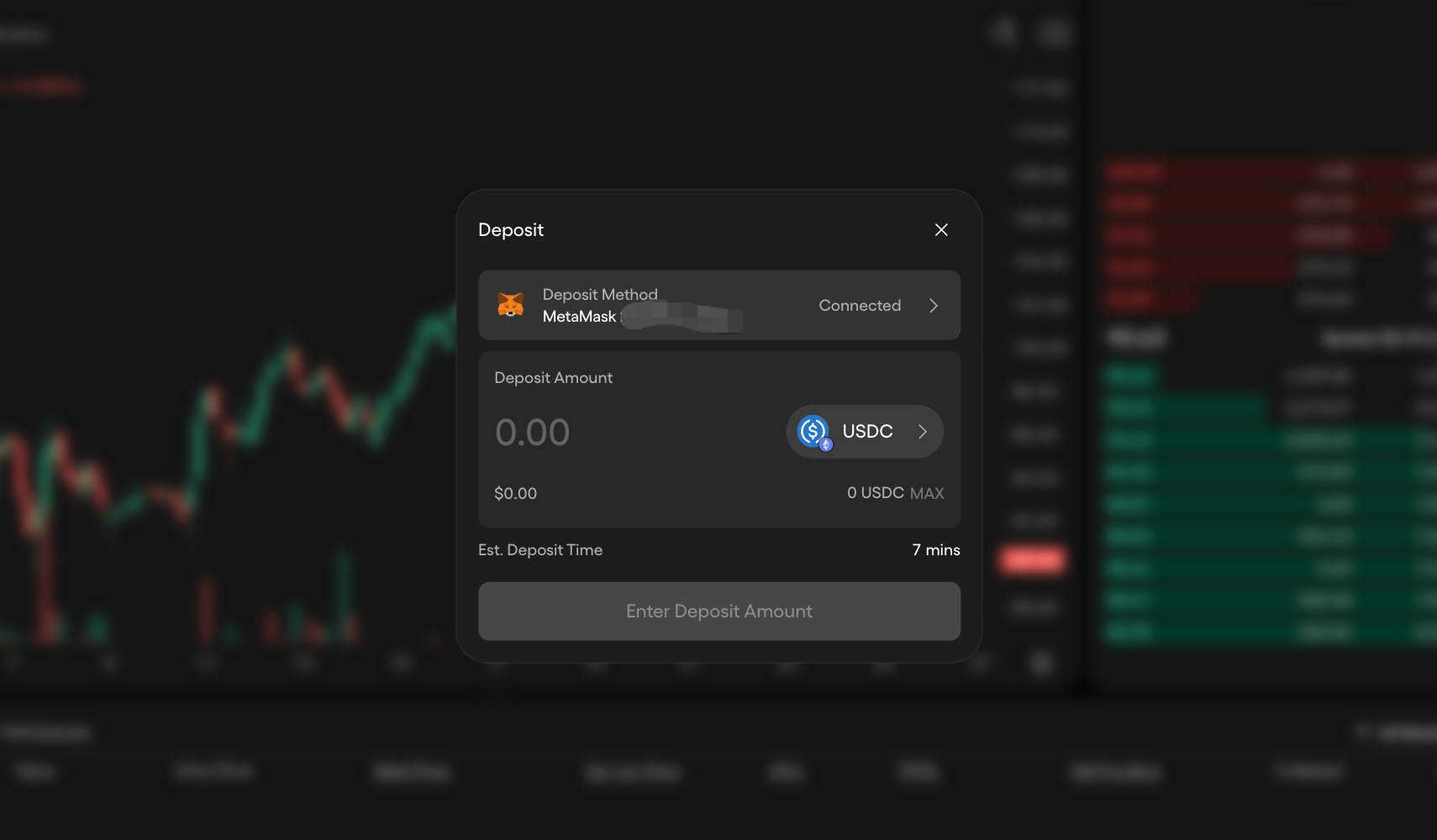
These designs correspond to longer-term plans. According to provided materials, Ondo Perps will eventually adopt a multi-asset collateral system, supporting not only stablecoins but also Ondo-issued U.S. stock and Treasury tokens as margin to open positions. This allows users to hedge, for example, without selling their investment portfolios.
From a financial engineering perspective, multi-asset collateral is not just an added feature; it fundamentally restructures the system's risk calculation logic. Ondo Perps is closer to the Portfolio Margin concept in traditional finance, treating the entire asset portfolio as a unified risk pool. This means natural hedging relationships between different assets can be automatically recognized by the system. For instance, if you hold both a tokenized SPY long position and an S&P 500 perpetual contract short, the system can identify this hedge and reduce margin requirements accordingly. While average users might not grasp its value, it genuinely serves complex quantitative strategies and basis traders.
Regarding liquidity, Ondo Perps does not build liquidity pools from scratch on-chain. Instead, through the issuance and redemption mechanism of tokenized stocks, it directly connects the on-chain market to traditional exchanges. This means price discovery and liquidity depth can inherit from the multi-trillion-dollar traditional markets like NASDAQ and NYSE, rather than relying on limited on-chain pools.
It can be said that Ondo Perps' design not only meets the basic needs of ordinary investors but also fully considers the requirements of professional traders and institutional investors. Additionally, Ondo Perps claims to be "the fastest permissionless perpetuals trading platform," with order routing, margin updates, and liquidations all processed in real-time while maintaining decentralized security guarantees.
The balance between decentralization and user experience, along with the design of routing contract trades directly to traditional financial exchanges, necessitates that Ondo aggregates funds, processes order routing, trading, and settlements off-chain, and allocates funds on-chain.
More Than Just Trading
A flagship trading platform was the missing piece for Ondo. The Perp DEX is actually a crucial piece in the financialization closed-loop of RWAs.
Let's return to the full picture of Ondo's business. On one hand, Ondo Global Markets is responsible for issuing tokenized assets, converting traditional securities like stocks, ETFs, and Treasuries into tokens that can flow freely on the blockchain. These tokenized assets inherently possess two properties: they represent price exposure to the underlying financial assets, and they can be composably used in DeFi protocols like any ERC-20 token. But the problem is, if tokenized assets can only be "held," their value is far from fully realized.
On the other hand, with the relaxation of tokenization regulations in the U.S., platforms currently partnering with Ondo and using its tokenized assets could choose to defect or issue their own tokenized products at any time. If the end-user traders are not retained, even a high market share is just building a bridge for others.
The emergence of Ondo Perps injects productivity into these tokenized assets. When a tokenized Apple stock can not only be held passively but also used as margin to open leveraged positions, execute complex basis arbitrage strategies, or hedge portfolio risks, its financial attributes are fully activated. This transition from "yield asset" to "credit foundation" is a necessary path for the entire RWA sector to move from early adoption to mainstream financial infrastructure.
Looking further, what Ondo is building is actually a unified ecosystem spanning spot and derivatives, connecting traditional finance with the on-chain world. Tokenized stocks are issued on Ondo Global Markets, previously cross-chained via Ondo Bridge to ecosystems like Hyperliquid's HyperEVM, and now can be traded directly on its own Ondo Perps. Once this network effect forms, it will be extremely difficult for competitors to replicate, as a better trading interface alone cannot replace a complete ecosystem deeply embedded in a multi-chain RWA infrastructure.
In fact, this vision is already materializing. Ondo has partnered with Chainlink to provide institutional-grade price oracles for its tokenized stocks, enabling these assets to be used as collateral in DeFi lending markets for the first time. Integration with lending protocols like Euler is underway, allowing traders to borrow funds without selling their holdings. This "holdings as capital" experience is the core value of prime brokerage in traditional finance, now being brought on-chain by Ondo.
The Era of New Infrastructure
Viewed from a broader perspective, the launch of Ondo Perps is the product of the convergence of two historic trends: one is the inevitable process of RWA tokenization moving from a fringe experiment to mainstream financial infrastructure, and the other is the natural evolution of Perp DEX from a pure crypto derivatives tool to a full-asset-class trading platform. Ondo happens to stand at the intersection of these two trends: it is the largest issuer in the RWA sector, with the deepest institutional financial partnerships and the broadest global regulatory layout.
For traders, Ondo Perps represents a new possibility: a platform where you can use Nvidia stock as margin to trade S&P 500 perpetual contracts on a Sunday night, while enjoying institutional-grade liquidity and execution speed. This experience simply doesn't exist in traditional finance and is unavailable in existing DeFi. It belongs to the new world that is accelerating towards us: the boundaries between traditional finance and crypto-native infrastructure are blurring, and assets themselves become pure financial building blocks that can be combined in any way, at any time, anywhere.
This is perhaps the true significance of Ondo Perps. It's not just a new perpetual contract exchange; in Ondo's own words, it is a "next-generation" platform "bringing traditional financial assets into on-chain trading infrastructure."