Highlights of This Issue
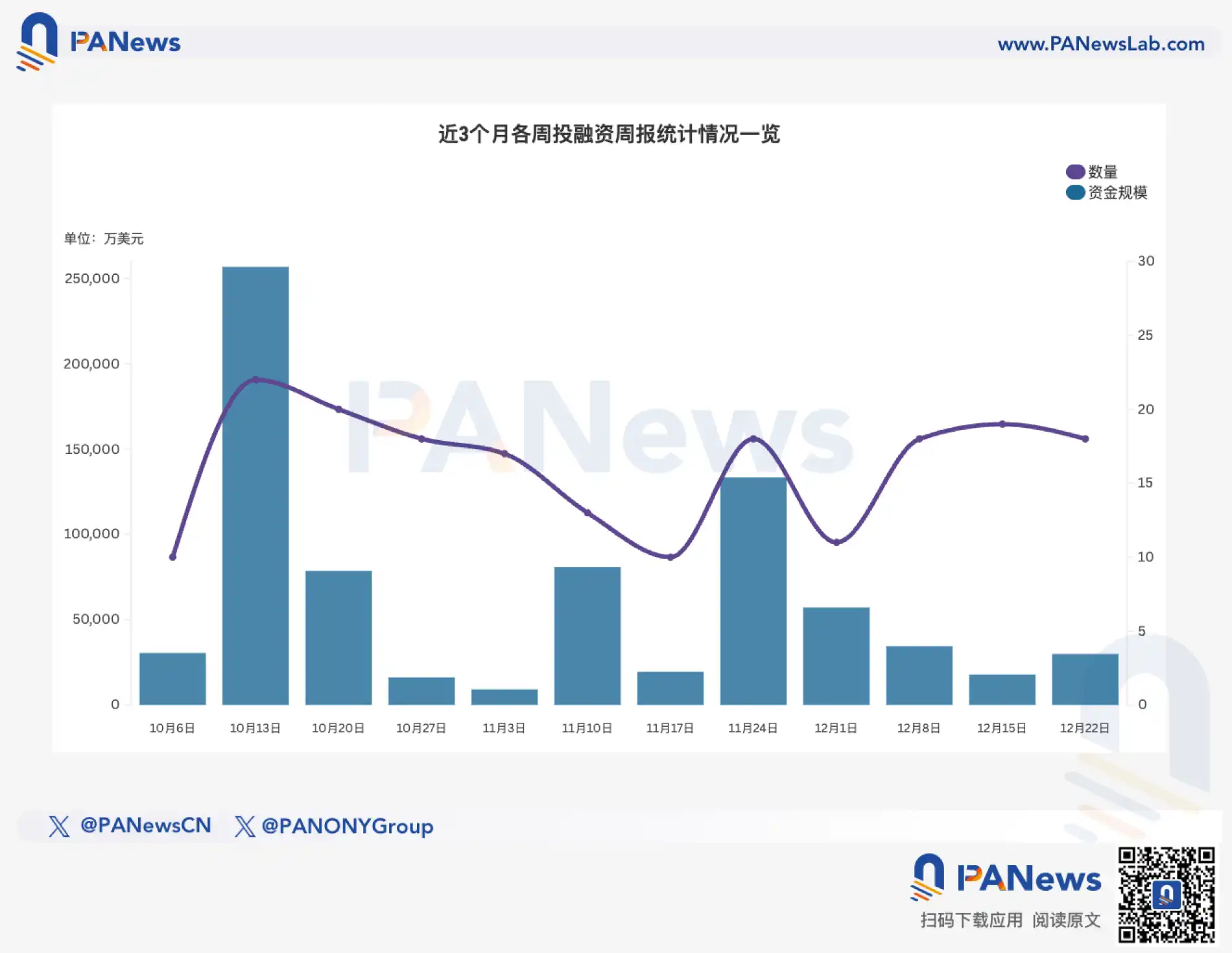
According to incomplete statistics from PANews, there were 18 investment and financing events in the global blockchain sector last week (12.15-12.21), with a total funding scale exceeding $299 million. The overview is as follows:
- DeFi announced 3 investment and financing events, among which ETHGas completed a $12 million seed round led by Polychain Capital;
- The Web3+AI track announced 1 investment and financing event, with TestMachine completing a $6.5 million funding round led by BlockChange Ventures and others;
- Infrastructure & Tools announced 4 investment and financing events, among which the Hong Kong stablecoin payment platform RedotPay completed a $107 million Series B funding round led by Goodwater Capital;
- The Centralized Finance sector announced 6 investment and financing events, among which Swedish investment company Hilbert Group (HILB) acquired high-frequency trading platform Enigma Nordic for $32 million;
- The DePIN track announced 2 investment and financing events, among which the Solana-based DePIN project Fuse Energy announced the completion of a $70 million Series B funding round;
- The Prediction Market sector announced 2 investment and financing events, among which the Solana ecosystem prediction market worm.wtf announced the completion of a $4.5 million Pre-Seed funding round
DeFi
ETHGas Completes $12 Million Seed Round Led by Polychain Capital
ETHGas completed a $12 million seed round led by Polychain Capital and launched Ethereum's first block space futures market, attracting approximately $800 million in non-cash liquidity commitments from validators and block builders. The platform allows for the pre-trading of execution rights for up to 64 blocks, aiming to enhance yield and stabilize Gas costs. ETHGas charges a 5% fee on transactions and is progressively advancing Ethereum's "real-time execution" architecture.
Harbor Completes $4.2 Million Strategic Round Led by Susquehanna Crypto and Triton Capital
Michael Oved, founder of AirSwap, announced the public release and launch of Harbor, a new-generation decentralized trading platform co-founded with Pluto, a former THORChain core engineer. Harbor focuses on native asset cross-chain trading, positioning itself as a high-performance, chain-agnostic DeFi liquidity infrastructure, dedicated to providing professional-grade matching and scalability for wallets and applications. The project has completed a $4.2 million strategic funding round led by Susquehanna Crypto and Triton Capital, with supporters also including market makers such as Auros, Kronos, and Selini.
Frontera Labs, Developer of Strata Protocol, Completes $3 Million Seed Round
Frontera Labs, the development team behind the DeFi structured yield protocol Strata, has completed a $3 million seed round led by Maven 11, with participation from Lightspeed Faction and others. Strata achieves more granular risk exposure and capital efficiency by layering on-chain yields into Senior and Junior assets. The protocol launched in October 2025, based on USDe, and its Total Value Locked (TVL) has now exceeded $210 million. The new funds will be used for protocol expansion and multi-asset support.
AI
TestMachine Completes $6.5 Million Funding to Advance AI-Powered On-Chain Security Platform
TestMachine has completed a $6.5 million funding round, planning to accelerate the global expansion of its AI security platform, Predator. This round was led by BlockChange Ventures, New Form Capital, Decasonic, and Delphi Digital, with participation from Baboon, UDHC, Auros Global, Generative Ventures, Contango Digital, and Santiago Santos. Predator is now integrated into Coinbase's CEX and DEX for real-time monitoring of risks associated with over a million tokens. The company claims the system accurately identified all $12 million rug pull cases in a sample set of 11,000 tokens.
Infrastructure & Tools
Stablecoin Payment Platform RedotPay Completes $107 Million Series B Funding Led by Goodwater Capital
Hong Kong-based stablecoin payment platform RedotPay has completed a $107 million Series B funding round led by Goodwater Capital, with participation from Pantera Capital, Circle Ventures, Blockchain Capital, and existing investor HSG, among others. The funds will be used for product iteration, expansion of compliance licenses, and strategic mergers and acquisitions. RedotPay's annualized payment volume exceeds $10 billion, with annual revenue over $150 million. Its users span over 100 global markets, registrations have surpassed 6 million, and the platform remains profitable.
Lightning Network-Based Stablecoin Payment Company Speed Completes $8 Million Funding Round Led by Tether
Tether has led an $8 million funding round for payment infrastructure company Speed, with participation from ego death capital. Speed (Speed1) builds a settlement network based on the Bitcoin Lightning Network and the stablecoin USDT. It processes approximately $1.5 billion in annual payment volume, serves a combined total of 1.2 million users and merchants, and offers instant BTC/USDT settlement and enterprise-grade routing.
Nodu Completes $1.45 Million Funding to Build European Version of "Zerohash" Stablecoin Infrastructure
London-based, Latvian-backed stablecoin infrastructure startup Nodu has announced the completion of a $1.45 million Pre-Seed funding round led by Digital Space Ventures. The aim is to provide European financial institutions with compliant access solutions for stablecoins under the MiCA regulation, creating a "European version of Zerohash/Bridge." The Nodu platform supports KYC/AML, stablecoin payments, and fiat on/off ramps. It currently covers over 100 countries and plans to further expand its global footprint and strengthen cooperation with banks and fintech institutions.
Circle to Acquire Interop Labs Team and Intellectual Property, Axelar to Remain Independently Operated
Stablecoin issuer Circle has signed an agreement to acquire the Interop Labs team and its proprietary technology, bringing the core contributors of the Axelar network into its infrastructure business. The transaction is expected to be completed in early 2026 and includes Interop Labs' personnel and proprietary intellectual property. The Axelar network, its foundation, and the AXL token will remain independent and governed by the community.
Interop Labs is the initial developer of the Axelar network. Axelar is a decentralized interoperability network supporting cross-chain message passing and asset transfers between blockchains. Circle stated that the team's technology will be integrated into Circle's Arc blockchain and Cross-Chain Transfer Protocol (CCTP). Another Axelar contributor, Common Prefix, will take over the development responsibilities previously handled by Interop Labs to ensure the continued operation of this open-source network. According to Circle, this acquisition is expected to accelerate the interoperability of assets issued on Arc, enhance multi-chain application developer tools, and support the development of Circle's products. The terms of the deal were not disclosed.
Centralized Finance
Swedish Investment Company Hilbert Group Acquires High-Frequency Trading Platform Enigma Nordic for $32 Million
Swedish investment company Hilbert Group (HILB), focused on connecting traditional and digital assets, has acquired high-frequency trading platform Enigma Nordic for $32 million. This acquisition will help Hilbert offer systematic cryptocurrency products to institutional investors and plans to integrate Enigma's platform into its hedge fund products.
The announcement stated that Enigma's proprietary platform employs data-driven market-neutral strategies, fully leveraging real-time price inefficiencies in global digital asset markets. The company's quantitative strategies have generated exceptional risk-adjusted returns, with a Sharpe ratio exceeding 3.0—a performance metric considered extremely rare among globally scalable market-neutral digital asset strategies. As of 2025, Enigma's trading volume has exceeded 50 billion Swedish Krona (approximately $5.4 billion).
Singapore Digital Trade Platform Olea Completes $30 Million Series A Funding
Singapore-based digital trade platform Olea has completed a $30 million Series A funding round. Investors include Banco Bilbao Vizcaya Argentaria (BBVA), XDC Network, theDOCK, and SC Ventures, a subsidiary of Standard Chartered Bank. The funds will be used to accelerate the deployment of AI and Web3 solutions in high-growth markets, strengthening products such as embedded finance and risk analysis. Since its establishment in 2022, the Olea platform has obtained a CMS license from the Monetary Authority of Singapore (MAS) and has provided over $3 billion in financing to more than a thousand enterprises across over 70 trade corridors.
Malaysia's Halogen Capital Completes $3.2 Million Funding to Expand Asset Tokenization Business
Malaysian licensed digital asset fund management company Halogen Capital has announced the completion of a funding round of 13.3 million Malaysian Ringgit (approximately $3.2 million). This round was led by Kenanga Investment Bank, with participation from institutions such as 500 Global. Kenanga, through its private equity division, acquired a 14.9% stake in Halogen Capital, becoming its largest institutional shareholder. Other participating institutions include 500 Global, Digital Currency Group, The Hive Southeast Asia, Jelawang Capital, and Mythos Venture Partners.
Solana Ecosystem Credit Card Project Moto Completes $1.8 Million Pre-Seed Funding
On-chain credit card project Moto has announced the completion of a $1.8 million Pre-Seed funding round led by Eterna Capital and cyber•Fund. It focuses on a native credit card solution for the Solana ecosystem. A waitlist registration is currently open. Investors also include several crypto angels and partners such as Privy and Crossmint.
EquiLend Makes Strategic Investment in Crypto Financing Platform Digital Prime
Traditional finance giant EquiLend has announced a strategic minority equity investment in crypto financing platform Digital Prime Technologies, focusing on cooperation with its institutional lending network Tokenet, and will introduce new features such as regulated stablecoin collateral. EquiLend manages over $4 trillion in lendable assets and stated that this move is to adapt to the trend of asset tokenization rather than a transformation, aiming to accelerate the convergence of traditional and digital asset markets.
Crypto Bank Anchorage Has Acquired Securitize's Wealth Management Division
Anchorage Digital, the first federally chartered crypto bank in the US, has acquired the wealth management division of tokenization company Securitize, Securitize For Advisors. The terms of the transaction were not disclosed. This move will help Anchorage expand its financial advisory services for registered investment advisors. Anchorage will absorb the Securitize For Advisors team and front-end platform.
According to the announcement, over the past year, Securitize For Advisors grew by over 4500%, with new deposits and net assets under management both reaching record highs. Securitize CEO Carlos Domingo noted that its advisor division "achieved incredible success," but this sale will allow Securitize to focus on its "core business."
DePIN
Fuse Energy Secures $70 Million Series B Funding, Valuation Reaches $5 Billion
The Solana-based DePIN project Fuse Energy has announced the completion of a $70 million Series B funding round, reaching a valuation of $5 billion. This round was led by Lowercarbon Capital and Balderton Capital.
DePIN Project DAWN Completes $13 Million Series B Funding Led by Polychain
Decentralized broadband network project DAWN has announced the completion of a $13 million Series B funding round led by Polychain Capital. The new funds will be used to accelerate DAWN's global expansion, infrastructure deployment, and the development of ecosystem partnerships. DAWN, built by the Andrena WiFi team, aims to provide scalable decentralized internet access services through blockchain technology, offering a more democratic and efficient network connection solution for global users.
Prediction Markets
Solana Ecosystem Prediction Market worm.wtf Completes $4.5 Million Pre-Seed Funding
The Solana ecosystem prediction market worm.wtf has announced the completion of a $4.5 million Pre-Seed funding round with participation from 6MV, Alliance, Solana Ventures, Borderless, Advancit Capital, and others. worm.wtf announced its launch in mid-October, with its underlying layer supported by UMA. The platform has already launched a pre-market function, a novel bonding curve mechanism designed to reward early supporters.
Space Completes $3 Million Funding with Participation from Morningstar Ventures and Others
Leveraged prediction market Space has announced the completion of a $3 million seed and strategic funding round. This round saw participation from Morningstar Ventures, Arctic Digital, and community platforms Echo, Curated, and Impossible Finance. Space plans to use these funds to build the first 10x leveraged prediction market on the Solana blockchain, aiming to make truth a tradable asset.