Frontline Insights | Web3 Lawyer Deciphers the Latest Developments in U.S. Stock Tokenization!

深潮Published on 2025-12-18Last updated on 2025-12-18

Abstract

Summary: On December 15, 2025, Nasdaq submitted a proposal to the SEC to extend U.S. stock trading hours to 23/5, sparking speculation about tokenization, though the filing did not mention it. More significantly, on December 11, the SEC issued a No-Action Letter (NAL) to DTCC, allowing its subsidiary DTC to conduct a pilot for tokenizing traditional securities under strict conditions. The NAL exempts DTC from certain procedural filing requirements but does not constitute a full regulatory endorsement. DTC's pilot involves creating tokenized representations of securities on a permissioned blockchain, allowing direct transfers between approved wallets while maintaining central oversight through its LedgerScan system. This move signals cautious regulatory openness to blockchain efficiency improvements in settlement and asset tracking, without altering the fundamental nature of securities. The development represents a step toward modernizing market infrastructure, with two parallel paths emerging: backend efficiency gains led by institutions like DTCC, and front-end user-facing innovations from brokers and trading platforms, all within evolving regulatory boundaries.

On December 15, 2025, U.S. time, Nasdaq officially submitted Form 19b-4 to the SEC, applying to extend the trading hours for U.S. stocks and exchange products to 23/5 (23 hours per day, 5 days per week).

However, Nasdaq's application for extended trading hours is not a simple extension but rather a change to two formal trading sessions:

Day Session (ET 4:00-20:00) and Night Session (ET 21:00-4:00 the next day). Trading is suspended from 20:00-21:00, and all unfilled orders are canceled uniformly during this pause.

Many readers got excited upon seeing the news, wondering if this is the U.S. preparing for 24/7 tokenized stock trading? But after carefully studying the document, Crypto Salad wants to say, don't jump to conclusions just yet, because Nasdaq stated in the document that many traditional securities trading rules and complex orders do not apply to the night session, and some functions will also be limited.

We have been paying close attention to U.S. stock tokenization; it is one of the most important targets for real-world asset tokenization, especially with the various official moves from the U.S. SEC (Securities and Exchange Commission) recently, which have been层出不穷 (emerging one after another).

This application document has sparked renewed anticipation for U.S. stock tokenization because it represents a significant step by the U.S. to align securities trading hours closer to the 24/7 nature of digital asset markets.However, upon closer look:

This Nasdaq document doesn't mention tokenization at all; it's solely about reforms to the traditional securities system.

If you want a deeper understanding of Nasdaq's move, Crypto Salad can write another article for a detailed interpretation. But today, we want to talk about the tangible news related to U.S. stock tokenization—

The SEC has formally "allowed" attempts by a major U.S. securities depository giant to provide tokenization services.

------【Dividing Line】------

On December 11, 2025, U.S. time, the SEC's Division of Trading and Markets staff issued a《No-Action Letter (NAL)》 to DTCC, which was subsequently published on the SEC website. The letter clearly states that, subject to specific conditions, the SEC will not take enforcement action against DTC for conducting tokenization services related to the securities it custodies.

At first glance, many readers felt the SEC had officially "exempted" the use of tokenization technology on U.S. stocks. But upon closer examination, the reality is quite different.

So,what exactly does this letter say? How far has the latest development in U.S. stock tokenization actually progressed? Let's start with the main character of the letter:

1. Who are DTCC and DTC?

DTCC, full name Depository Trust & Clearing Corporation, is a U.S. group company comprising different institutions responsible for custody, stock clearing, and bond clearing.

DTC, full name Depository Trust Company, is a subsidiary of DTCC and the largest securities central depository in the U.S., responsible for the centralized custody of stocks, bonds, and other securities, as well as settlement and transfer. It currently custodies and accounts for over $100 trillion in securities assets. You can think of DTC as the ledger administrator for the entire U.S. stock market.

2. What is the relationship between DTC and U.S. stock tokenization?

Remember the news in early September 2025 about Nasdaq applying to the SEC to issue stocks in tokenized form? DTC already appeared in that application.

Nasdaq stated that the only difference between tokenized stocks and traditional stocks lies in the clearing and settlement of orders at DTC.
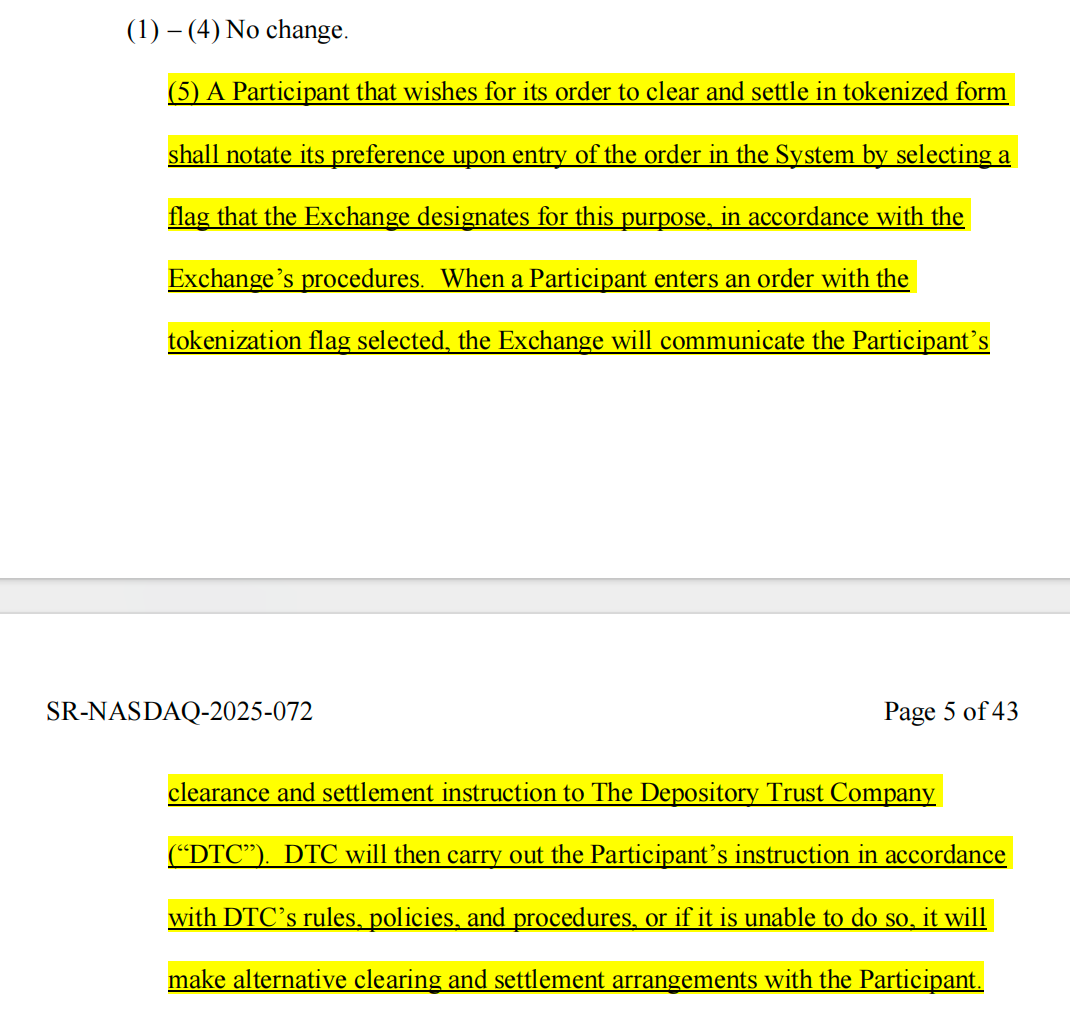
(The above image is截自 (screenshot from) Nasdaq's application proposal)

To make this easier to understand, we've drawn a flowchart. The blue part represents the changes Nasdaq applied for in its September proposal. It's clear that DTC is the key implementation and operational institution for U.S. stock tokenization.

3. What does the newly published《No-Action Letter》say?

Many people directly equate this document with the SEC approving DTC's use of blockchain for U.S. stock record-keeping, which is not entirely accurate. To understand this correctly, we must recognize a clause in the U.S. Securities Exchange Act:

Section 19(b) of the《Securities Exchange Act of 1934》 stipulates that any self-regulatory organization (including clearing agencies) must submit a rule change application to the SEC and obtain approval before changing its rules or significant business arrangements.

Nasdaq's two proposals were submitted based on this provision.

However, the rule申报 (filing) process is usually very long, potentially拖延 (delayed) for months, up to 240 days at maximum. If every single change requires application and approval, the time cost would be too high. Therefore, to ensure its securities tokenization pilot activities can proceed smoothly, DTC applied for an exemption from its obligation to fully comply with the 19b filing process during the pilot period, and the SEC granted its agreement.

In other words, the SEC has only temporarily exempted DTC from certain procedural filing obligations; it is not a substantive permission for the application of tokenization technology in the securities market.

---【Dividing Line】---

So, how will U.S. stock tokenization develop next? We need to clarify the following two questions:

(1) What pilot activities can DTC conduct without filing?

Currently, the custody and bookkeeping of U.S. stocks operate in this mode:假设 (Assuming) a broker has an account at DTC, DTC uses a centralized system to record every buy and sell order and share. This time, DTC proposed: could we provide brokers with an option to also record these stock holdings using blockchain tokens?

In practice, participants would first register a qualified, DTC-approved Registered Wallet. When a participant issues a tokenization instruction to DTC, DTC will do three things:

a) Move this portion of stocks from the original account to a general ledger pool;

b) Mint tokens on the blockchain;

c) Transfer the tokens to the participant's wallet, representing the participant's权益 (interest/rights) in these securities.

After this, these tokens can be transferred directly between these brokers without needing to go through DTC's centralized ledger for every single transfer. However, all token transfers will be monitored and recorded in real-time by DTC through an off-chain system called LedgerScan, and the records of LedgerScan will constitute DTC's official books. If a participant wishes to exit the tokenized state, they can随时 (at any time) issue a "de-tokenization" instruction to DTC, which will destroy the tokens and re-record the securities权益 (interest) back into the traditional account.

The NAL also details technical and risk control limitations, including: tokens can only be transferred between DTC-approved wallets, so DTC even has the authority to强制转移 (forcibly transfer) or destroy tokens in wallets under specific circumstances; the token system is strictly isolated from DTC's core clearing system, etc.

(2) What is the significance of this letter?

From a legal perspective, Crypto Salad must emphasize that an NAL is not equivalent to legal authorization or a rule change; it does not have universally applicable legal force and only represents the enforcement attitude of the SEC staff under given facts and assumed conditions.

The U.S. securities law system does not have a separate provision "prohibiting the use of blockchain for bookkeeping." Regulation is more concerned with whether the existing market structure, custody responsibilities, risk controls, and filing obligations are still met after adopting new technology.

Furthermore, in the U.S. securities regulatory system, letters like NAL have long been regarded as important indicators of regulatory stance, especially when the recipient is a systemically important financial institution like DTC; its symbolic significance is actually greater than the specific business itself.

------【Dividing Line】------

Judging from the disclosed content, the premise of the SEC's exemption is very clear: DTC is not directly issuing or trading securities on-chain but is creating a tokenized representation of the existing securities权益 (interests) within its custody system.

This kind of token is essentially an "interest mapping" or "ledger expression" used to improve back-office processing efficiency, not to change the legal attributes or ownership structure of the securities. The related services run on a controlled environment and a permissioned blockchain, with participants, scope of use, and technical architecture all subject to strict limitations.

Crypto Salad believes this regulatory attitude is very reasonable. On-chain assets are most susceptible to financial crimes like money laundering and illegal fundraising. Tokenization technology is new, but it must not become an accomplice to crime. Regulation needs to affirm the application potential of blockchain in securities infrastructure while坚守 (adhering to) the boundaries of the existing securities law and custody system.

4. The Latest Development Progress of U.S. Stock Tokenization

The discussion around U.S. stock tokenization has begun to shift from "is it compliant" to "how to implement it." If we拆解 (deconstruct) the current market practices, we can see at least two parallel but logically different paths forming:

· Represented by DTCC and DTC, is the official opinion-led tokenization path. Its core goal is to improve settlement, reconciliation, and asset transfer efficiency, serving mainly institutional and wholesale market participants. In this model, tokenization is almost "invisible"; for end investors, stocks remain stocks, only the backend system has undergone a technical upgrade.

· In contrast is the potential front-end role played by brokers and trading platforms. Taking Robinhood and MSX (Maiton) as examples, they have持续进行 (continuously conducted) product exploration in recent years regarding crypto assets, fractional stock trading, and extended trading hours. If U.S. stock tokenization matures regulatory-wise, such platforms naturally have the advantage of becoming user entry points. For them, tokenization does not mean重塑 (reshaping) the business model but is more likely a technical extension of the existing investment experience, such as near-real-time settlement, more flexible asset splitting, and the integration of cross-market product forms. Of course, the prerequisite for all this is the gradual clarification of the regulatory framework. This type of exploration often walks near the regulatory boundary, with risk and innovation coexisting. Its value lies not in short-term scale but in validating the next-generation securities market形态 (form). From a practical perspective, they更像是 (are more like) providing samples for institutional evolution rather than directly replacing the existing U.S. stock market.

To help everyone understand more intuitively, refer to the following comparison chart:

From a broader perspective, what U.S. stock tokenization真正试图解决 (is really trying to solve) is not "turning stocks into coins" but how to improve asset transfer efficiency, reduce operational costs, and reserve interfaces for future cross-market collaboration while maintaining legal certainty and system security. In this process, compliance, technology, and market structure will博弈 (game) in parallel for a long time, and the evolutionary path will必然 (inevitably) be gradual rather than radical.

It can be expected that U.S. stock tokenization will not fundamentally change how Wall Street operates in the short term, but it is already an important item on the U.S. financial infrastructure agenda. This interaction between the SEC and DTCC is more like a制度层面的 (institutional level) "test of the waters," delineating preliminary boundaries for subsequent broader exploration. For market participants, this is perhaps not the终点 (end point) but a真正值得持续观察的起点 (truly worthwhile starting point for持续 observation).


Trending Cryptos

Related Questions

QWhat is the significance of Nasdaq's Form 19b-4 filing regarding extended trading hours, and does it directly relate to stock tokenization?

ANasdaq's Form 19b-4 filing proposes extending trading hours to 23/5 (23 hours a day, 5 days a week) with two distinct sessions: a day session (4:00-20:00 ET) and a night session (21:00-4:00 ET), with a one-hour break. However, the filing explicitly states that it is a reform for traditional securities and does not mention tokenization. It is not a direct preparation for 24/7 tokenized stock trading, as many traditional rules and complex orders do not apply to the night session, and some functions are limited.

QWhat did the SEC's No-Action Letter (NAL) to DTCC allow regarding tokenization services?

AThe SEC's No-Action Letter to DTCC stated that, under specific conditions, the SEC would not take enforcement action against DTC (a DTCC subsidiary) for providing tokenization services related to the securities it custodies. This is not a formal authorization or rule change but a temporary exemption from certain procedural filing requirements under Section 19(b) of the Securities Exchange Act of 1934, allowing DTC to conduct a pilot program without lengthy approval processes for each change.

QHow does DTC's proposed tokenization pilot work technically?

AIn DTC's pilot, participants can register a DTC-approved wallet. Upon instruction, DTC will: a) move the specified securities to a general ledger pool, b) mint tokens on a blockchain representing the securities, and c) transfer the tokens to the participant's wallet. These tokens can then be transferred directly between approved participants without DTC's centralized ledger for each transaction, though all transfers are monitored and recorded by DTC's LedgerScan system. Participants can reverse the process by requesting 'detokenization,' where tokens are burned and securities are returned to the traditional account.

QWhat are the key limitations or controls mentioned in the NAL for DTC's tokenization services?

AThe NAL imposes strict controls: tokens can only be transferred between DTC-approved wallets, DTC has the authority to forcibly transfer or destroy tokens in specific circumstances, the token system is strictly isolated from DTC's core clearing systems, and the pilot operates on a permissioned blockchain with limited participants and scope. This ensures the tokenization is a 'mapping of权益' for efficiency without altering the legal attributes or ownership structure of the securities.

QWhat are the two main paths for stock tokenization development mentioned in the article?

AThe two paths are: 1) The DTCC/DTC-led path, which is regulator-guided and focuses on improving back-office efficiency (e.g., settlement, asset transfer) for institutional and wholesale markets, making tokenization 'invisible' to end investors. 2) The broker and trading platform path (e.g., Robinhood, MSX MaiTong), which explores front-end user experiences like fractional trading and extended hours. This path extends existing services with tokenization technology, pending regulatory clarity, and serves as a testing ground for future market structures without replacing the current stock market.

Related Reads

Solana Ecosystem Shows Signs of Recovery: On-Chain Governance Upgrade, Tokenized Stocks and Meme Coins Heat Up

Solana Ecosystem Shows Signs of Revival: Governance Upgrades, Tokenized Stocks, and Memecoins Heat Up While the broader crypto market faces a downturn, Solana has shown relative strength with its price rising nearly 15% recently. This resilience is attributed to warming ecosystem activity, particularly in tokenized stocks and memecoins, coupled with a major upgrade to its on-chain governance. In the Real World Assets (RWA) sector, Solana now leads all public chains in both the number of unique holder wallets and the quantity of RWA assets. Its tokenized stock weekly trading volume has surged to a record $1.42 billion, capturing about 96% of the market share, largely driven by the Backpack exchange. Simultaneously, the Solana memecoin sector has reignited, fueled by the rapid ascent of the ANSEM token following endorsements from a prominent crypto influencer. This has boosted activity across platforms like Pump.fun and increased fee revenue for several Solana-based exchanges. A key development is the launch of Solana Governance Proposals (SGP), a new on-chain mechanism. It allows validators with at least 100,000 SOL delegated to submit proposals for community vote, enhancing decentralized decision-making. SGP will operate alongside the existing technical proposal process (SIMD), focusing on broader ecosystem governance. Despite these positive signals in specific areas, overall on-chain activity and transaction volumes still lag behind previous bull market peaks, indicating the recovery remains partial rather than ecosystem-wide.

marsbit18m ago

Solana Ecosystem Shows Signs of Recovery: On-Chain Governance Upgrade, Tokenized Stocks and Meme Coins Heat Up

marsbit18m ago

While Semiconductor Stocks Plunge, Anthropic Plans to Develop a 2nm Chip

Anthropic, the AI company behind Claude, is exploring the development of its own custom AI chip, according to a report from The Information. The company is in early discussions with Samsung Electronics to manufacture the chip using Samsung's most advanced 2-nanometer process and packaging technology. While the project is still in preliminary stages, including defining chip specifications, and could be abandoned, it marks a strategic step for Anthropic. The move comes as the company seeks greater control over its computing costs and hardware optimization, particularly for inference tasks to run its models more efficiently and cheaply. Samsung's potential involvement follows its participation as a strategic investor in Anthropic's recent $65 billion funding round. For Samsung, partnering with a major AI lab represents a significant opportunity for its foundry business to compete with market leader TSMC in advanced semiconductor manufacturing. Anthropic's CEO, Dario Amodei, has previously highlighted the immense financial challenge of securing enough computing power for anticipated growth, making cost-effective inference a critical focus. The company would join other tech giants like Google, Amazon, Microsoft, Meta, and OpenAI in pursuing custom AI silicon. However, analysts note this trend creates deeper interdependencies rather than independence, as US AI labs become more tightly woven into Asian semiconductor supply chains. Despite this move, Anthropic remains heavily reliant on a multi-cloud, multi-vendor strategy for its immediate computing needs. It has secured massive, long-term commitments for capacity from Amazon Web Services (Trainium chips), Google (TPUs), and even leased a large GPU cluster from xAI. For now, Nvidia continues to dominate the AI chip market, with its share reportedly growing to 74%.

链捕手20m ago

While Semiconductor Stocks Plunge, Anthropic Plans to Develop a 2nm Chip

链捕手20m ago

Korean Companies Following Strategy in Accumulating Cryptocurrency: From Bull Market to Delisting?

Title: Korean DAT Companies Following "Strategy" Bitcoin Hoarding Model Face Delisting Amid Bear Market Summary: Several Korean KOSDAQ-listed companies, known as Digital Asset Trusts (DATs), are at risk of being delisted due to a combination of stricter regulatory thresholds and a downturn in crypto markets. These firms, inspired by models like Strategy and Japan's Metaplanet, raised capital to buy Bitcoin, relying on a cycle of rising crypto prices to boost their stock value. However, recent reforms in Korea have raised the minimum market capitalization required to stay listed from 150 billion won to 200 billion won (approx. $1.3M), with a further increase to 300 billion won set for next January. The new rules also close loopholes like reverse stock splits used to artificially inflate share prices. The situation is exacerbated by a significant drop in Bitcoin's price from its 2025 peak and a weak KOSDAQ market. While the main KOSPI index has surged nearly 95% year-to-date, KOSDAQ has fallen about 10%, draining liquidity from smaller companies. Many DATs now hover near or below the new market cap thresholds and must also book substantial valuation losses on their Bitcoin holdings. Analysts suggest that without a sustained recovery in both crypto prices and broader market interest in KOSDAQ stocks, these companies have limited options to avoid delisting, marking a precarious moment for Korea's crypto-linked public companies.

marsbit29m ago

Korean Companies Following Strategy in Accumulating Cryptocurrency: From Bull Market to Delisting?

marsbit29m ago

Korean Companies That Learned to Hoard Coins from MicroStrategy: From Bull Market to Delisting?

South Korean companies that adopted the “Digital Asset Treasury” (DAT) strategy—issuing shares to buy and hold Bitcoin, inspired by MicroStrategy—now face delisting risks on the KOSDAQ market. New regulations effective July 1, 2026, tightened listing maintenance rules, notably raising the minimum market capitalization threshold from 150 billion KRW to 200 billion KRW (about $1.3 million), with a further increase to 300 billion KRW scheduled for January 2027. Companies failing to meet both the share price and market cap requirements for specified periods risk being designated for delisting, with fewer options for financial engineering like stock splits to artificially boost prices. The downturn in cryptocurrency prices has severely impacted these firms. Bitcoin, which peaked above $120,000 in mid-2025, has fallen below $60,000, forcing DAT companies to report large valuation losses. Compounding this, the KOSDAQ index has dropped about 10% year-to-date, while the main KOSPI index surged nearly 95%, diverting investor interest away from smaller-cap stocks. Examples like BitPlanet (holding 300 BTC) and Parataxis Ethereum currently hover just above the new market cap limits, but face heightened scrutiny and potential delisting starting in 2027. Industry analysts warn that the combination of weak crypto markets, a struggling KOSDAQ, and stricter regulations creates a significant survival challenge for these companies, highlighting the risks of business models overly reliant on volatile digital asset prices.

链捕手34m ago

Korean Companies That Learned to Hoard Coins from MicroStrategy: From Bull Market to Delisting?

链捕手34m ago

Trading

Spot

Hot Articles

Discussions

Welcome to the HTX Community. Here, you can stay informed about the latest platform developments and gain access to professional market insights. Users' opinions on the price of S (S) are presented below.

活动图片