From Exchanges to Hotels: USDT is Penetrating Real-World Consumption Scenes

比推Published on 2025-12-26Last updated on 2025-12-26

Abstract

Trip.com, the overseas version of Chinese travel giant Ctrip, has begun accepting stablecoin payments in USDT and USDC for global users. A real-world test in Vietnam confirmed the functionality, allowing a hotel booking to be completed in under 10 minutes using USDT. Notably, payments with USDT offered significant savings, with flight bookings being approximately 18% cheaper and hotel bookings around 2.35% cheaper compared to traditional payment methods. The service, powered by Singapore-based licensed payment gateway Triple-A, supports multiple blockchains including Ethereum, Tron, and Solana. A key privacy benefit was noted: booking a hotel with USDT required only a name and email, minimizing personal data collection. This development is particularly significant for the vast global population without access to international credit cards. The article contextualizes this move within a broader trend of major corporations, from PayPal and Ant Group to automakers like BYD and Toyota, adopting stablecoins. This shift is often driven by practical necessity in countries experiencing severe local currency devaluation, where stablecoins like USDT have become a critical tool for maintaining financial stability and facilitating cross-border commerce.

Original Author: Joe Zhou, Foresight News

Original Title: Save 18% on Hotel Bookings with USDT, Trip.com's Overseas Version Strongly Promotes Stablecoin Payments


Trip.com, the overseas version of Ctrip, is quietly entering the stablecoin payment track.

On December 25, 2025, Foresight News learned that Trip.com, the overseas version of Ctrip, has launched a stablecoin payment function for global users, currently supporting two USD stablecoins: USDT and USDC. Two sources close to Trip confirmed this information to Foresight News.

After downloading and logging into Trip.com in Vietnam, the author successfully completed a hotel reservation in Nha Trang, Vietnam, using USDT payment in less than 10 minutes.

More notably, after checking the prices of several local hotels, it was found that the price of some hotels on the Trip.com App when paying with USDT was even lower than using the Ctrip official website or traditional payment methods.

Trip.com Overseas Version Already Supports USDT/USDC

On December 24, 2025, the author booked a hotel in Nha Trang, Vietnam, using USDT on the Trip.com overseas version APP, and on December 25, purchased a plane ticket from Nha Trang to Ho Chi Minh City with USDT, both showing successful payment. The author has now successfully checked into the hotel.

The author found that the flight ticket purchased with USDT on Trip.com saved approximately 18% of the cost compared to the ticket purchased on Ctrip. The hotel booked with USDT saved 2.35% of the cost.
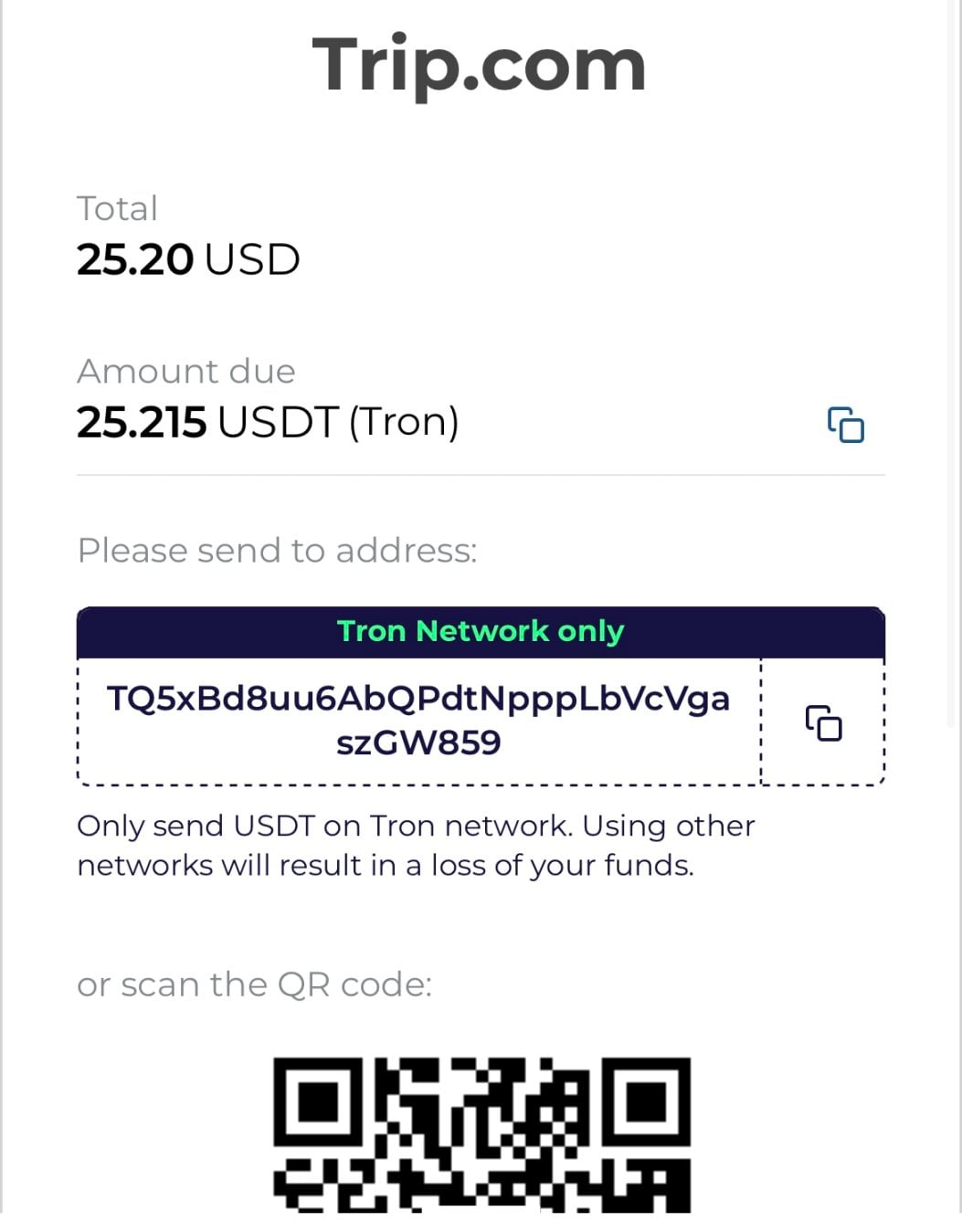
Trip has enabled USDT and USDC payments

Currently, Trip.com's crypto payments support multiple public chains including Ethereum, Tron, Polygon, Solana, Arbitrum One, and TON.

During the actual payment process, the author noticed the presence of another payment company, Triple-A. This company provides crypto payment-related services to Trip.com. Public information shows that Triple-A is a licensed crypto payment institution headquartered in Singapore, mainly providing payment gateway and settlement services for cryptocurrencies and stablecoins.

Furthermore, the author learned that Triple-A is also cooperating with Singapore's internet giant Grab as a technical partner for the crypto payment channel, enabling GrabPay users to directly use crypto assets to top up their wallet balance within the Grab app.

Additionally, the author noticed a detail:

When booking a hotel on Trip.com using USDT, there is no need to fill in detailed personal information; only a name and email are required to complete the order. This means that when using USDT for payment in hotel scenarios, the platform can hardly obtain the user's complete privacy information. Of course, if purchasing a flight ticket, information such as nationality, passport number, and phone number are still required—this is a compliance requirement of the aviation industry itself.

Privacy and data security have become major social issues.

Just this month, the Ctrip Group encountered a relatively significant "public trust incident." In December, Ctrip Group and the Cambodia National Tourism Administration signed a marketing cooperation agreement in Shanghai. After the news was announced, it sparked concerns among some users about local security, telecom fraud risks, and personal information security. A large number of screenshots of uninstalling the Ctrip App appeared on social media.

In many overseas regions, users are far more sensitive to privacy and information security than in the domestic market. This may also be an important practical background for Trip.com's promotion of stablecoin payments.

For travelers around the world without international credit cards, stablecoin payment is a new path. According to public information, the number of people globally who own credit cards is approximately 125 million to 130 million, and the number of people with international credit cards is even lower, which also means that over 80% of the global population cannot smoothly use the international credit card system.

Credit cards are not merely "payment tools" but an entry point to the credit system; however, most people globally are not within this system. In many countries and regions, such as Southeast Asia, Latin America, Africa, and India, many people cannot be incorporated into the credit system. This also prevents them from having credit cards.

Stablecoin payments are providing these people with a global payment path that bypasses the credit system.

Of course, the practical problems of stablecoins still exist: transaction fees remain relatively high and unstable.

During the actual payment process, the author found significant differences in fees between different wallets. When paying to Trip.com's USDT收款码 (receiving QR code) via Binance, a fee of 1 USDT was required, with a minimum transfer threshold of 10 USDT; whereas when using Bitget Wallet, the first transaction showed a fee of 0, the second showed a fee of 2.39 USDT, and no minimum transfer amount was set. The differences may be related to the public chain used (Tron) and its fee mechanism.

Why Are Giants Entering the Stablecoin Space One After Another?

Ctrip Group is not the first company to enter the stablecoin track.

Previously, several global internet and payment giants have clearly布局 (laid out plans for) stablecoins, including Ant Group, JD.com, Paypal, Stripe, Meta (Facebook), Grab, and TADA.

Several banking giants have also publicly stated their entry into the stablecoin field, for example, Bank of America and Morgan Stanley.

Some实体制造业企业 (physical manufacturing companies) are also接入 (integrating) stablecoin payments. Public reports show that some dealers of BYD (Build Your Dreams) in Bolivia already support USDT payments; manufacturing companies like Toyota and Yamaha also accept stablecoin settlements in overseas markets. Tether CEO Paolo Ardoino has publicly confirmed this.

Advertisement for cooperation between BYD dealers and USDT

Internet giants,实体制造业巨头 (physical manufacturing giants), banking giants are all布局 (laying out plans for) stablecoins... Their use cases for stablecoins vary.

An obvious trend is that payment giants like PayPal and Ant Group are no longer satisfied with仅仅作为 (merely being) the payment entry for stablecoins but hope to directly become the issuers of stablecoins. PayPal has already launched PYUSD; Ant Group is also promoting the application for a Hong Kong dollar stablecoin license. The boundary between payment institutions and currency issuance is being reshaped.

For实体制造业企业 (physical manufacturing enterprises) like BYD and Toyota, there is no ideological judgment about stablecoins or crypto payments, only one practical question: which method are users more willing to pay with.

Fiat Currency Continues to Depreciate, Stablecoins Become the "Practical Solution"

In Bolivia, the official fiat currency, the Boliviano (BOB), depreciated against the US dollar by 65%–137% from the end of 2024 to mid-2025. It can be said that Bolivia's fiat currency depreciates every day.

In this environment, any company expanding overseas cannot long bear the exchange losses brought by settlement in the local currency. USDT has gradually become the de facto payment tool locally.

And Bolivia is not an isolated case but a phenomenon simultaneously上演 (playing out) in multiple countries around the world.

The author visited Iran, Turkey, Egypt, and other countries this year and found that the cumulative depreciation of these economies' national currencies against the US dollar over the past three years generally exceeded 80%; stretched over a five-year周期 (cycle), the currencies of Iran, Turkey, and Egypt have all depreciated by more than 200% against the US dollar.

Currency depreciation is evolving from a "local risk" in a few countries to a broader, more structural global phenomenon.
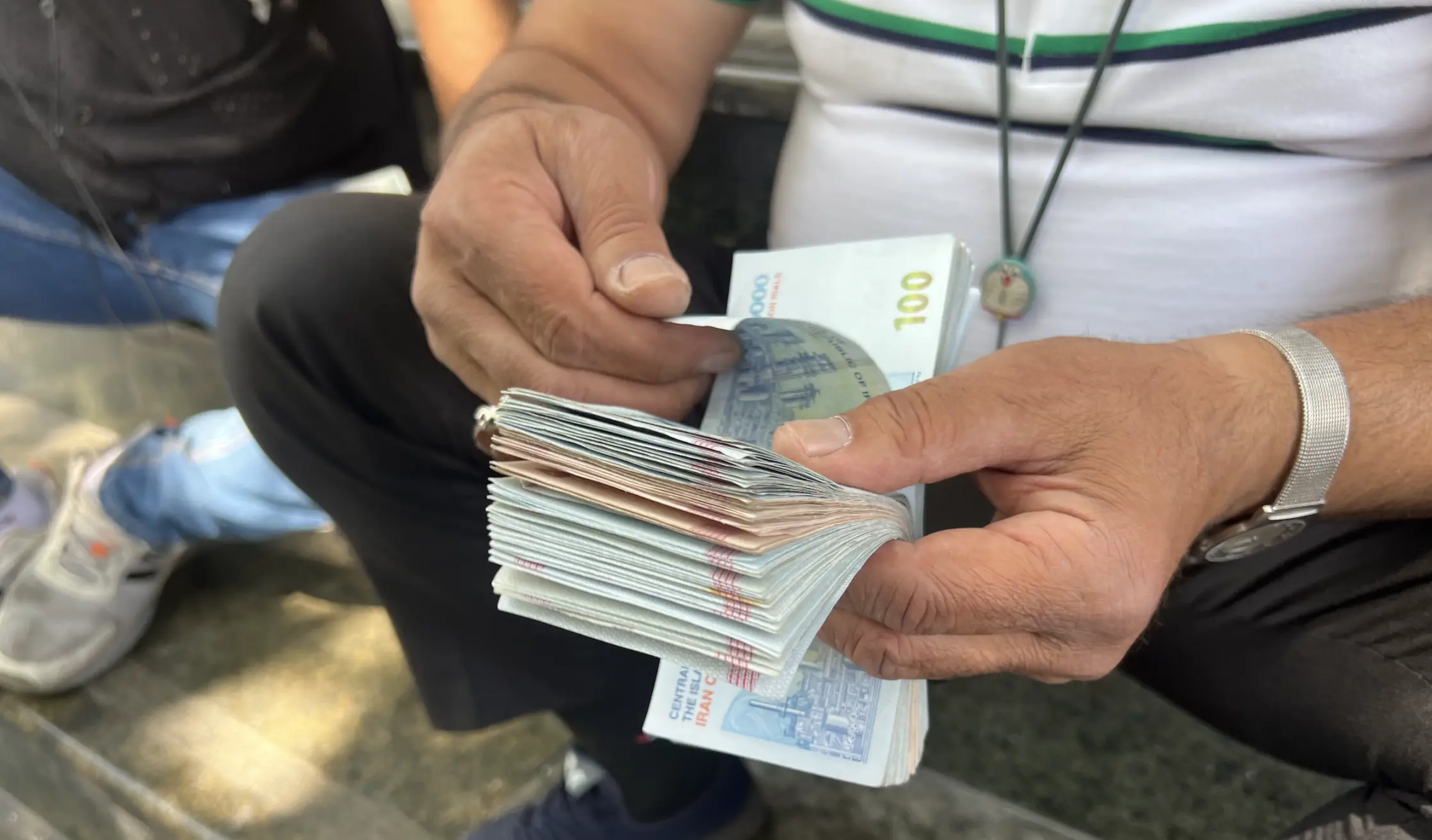
At the black market in Tehran, Iran's capital, the author is witnessing a currency transaction

More残酷的是 (cruelly), in the aforementioned countries (the countries mentioned above), the speed of local currency depreciation has long far exceeded the income growth rate of ordinary people. In real transactions, monetary disorder is directly changing people's payment methods.

This is precisely why consumer internet platforms like Trip.com Overseas Version and Grab; payment giants like PayPal and Ant Group; and physical manufacturing companies like BYD and Toyota have begun to尝试引入 (try to introduce) USDT and other stablecoins in different markets.

The world is partially collapsing, with some regions率先失衡 (becoming unbalanced first).

When the existing financial system can no longer perform the functions of stability, settlement, and trust, a new economic system is pushed to the forefront by reality.

The new economic system is not designed but is "forced" out by reality where the old system fails. The spread of stablecoins is not because they are ideal enough, but because in some places, they are already the least bad choice available.


Twitter:https://twitter.com/BitpushNewsCN

Bitpush TG Discussion Group:https://t.me/BitPushCommunity

Bitpush TG Subscription: https://t.me/bitpush

Original Article Link:https://www.bitpush.news/articles/7598412

Related Questions

QWhat is the main development announced regarding Trip.com and stablecoins?

ATrip.com, the overseas version of Ctrip, has globally launched a stablecoin payment feature, supporting both USDT and USDC for hotel and flight purchases.

QWhich payment processing company is mentioned as providing crypto payment services for Trip.com?

ATriple-A, a licensed crypto payment institution based in Singapore, is the payment company providing crypto payment gateway and settlement services for Trip.com.

QWhat practical benefit did the author experience when using USDT to book a flight on Trip.com?

AThe author saved approximately 18% on a flight ticket purchased with USDT on Trip.com compared to the price when using traditional payment methods on the Ctrip website.

QAccording to the article, what is a major global issue that is driving the adoption of stablecoins like USDT?

ARapid and severe devaluation of national currencies in many countries (e.g., Bolivia, Iran, Turkey, Egypt) is making stablecoins a more reliable payment and store of value, as they are pegged to the US dollar.

QBesides Trip.com, name two other types of major companies that are adopting or exploring stablecoin payments.

APayment giants like PayPal and Ant Group, as well as manufacturing companies like BYD and Toyota, are adopting or exploring stablecoin payments in various markets.

Related Reads

Six Years Later, UNI Finally Welcomes Its Own "Buyback Bull"

After years of debate, Uniswap's UNI token has finally entered a 'buyback bull' phase following the long-awaited activation of its fee-switch mechanism. The UNIfication proposal, executed in December 2025, redirected a portion of protocol fees from select pools and Unichain sequencer revenue into a treasury (TokenJar) dedicated to buying back and permanently burning UNI. Initial market reaction was muted due to modest early burn rates. A significant shift occurred in July 2026 with the launch of Robinhood Chain. Uniswap's immediate deployment there skyrocketed trading volume, making it a top fee-generator. Subsequently, governance votes extended the fee mechanism to v4 pools and Robinhood Chain, causing protocol revenue to nearly triple. Daily funds directed to UNI burns rose sharply, with Robinhood Chain contributing over half. This transitioned UNI's narrative from a governance token to a cash-flow asset backed by a perpetual automatic buyer. UNI's price, which had languished around $2.30 in early June, nearly doubled to approach $4.60 by late July. Analysts credit this to the tangible cash flow from fees rather than mere speculation. Unlike many newer projects where buybacks are offset by large investor unlocks, UNI's six-year history has resulted in a widely distributed and relatively clean supply, allowing the buyback pressure to effectively impact the secondary market. The key test will be whether trading activity, particularly on Robinhood Chain, sustains after its initial gas subsidies expire.

marsbit2m ago

Six Years Later, UNI Finally Welcomes Its Own "Buyback Bull"

marsbit2m ago

Only 153 Venture Capital Firms Invested in July: Is the Crypto VC Industry Experiencing a 'Mass Extinction'?

In July 2026, only 153 unique venture capital firms participated in disclosed crypto funding rounds, marking the lowest monthly count since November 2020. This figure represents an 87% decline from the peak of 1,177 firms in 2022. Overall, the first seven months of 2026 saw crypto projects raise approximately $11.78 billion across 481 rounds. This crypto VC contraction contrasts sharply with the broader venture capital landscape, where global VC investment reached a record $560.4 billion in H1 2026, heavily fueled by major AI company financings. This shift in capital allocation has drawn funds away from the crypto sector. Within crypto, funding is highly concentrated. Trading platforms, prediction markets, and payment sectors absorbed 53% of the total capital. While early-stage deals remain frequent, the largest sums flow to a few late-stage rounds and mergers & acquisitions, which surged to $7.23 billion in Q2 2026. The market is consolidating around top funds like a16z crypto and Dragonfly, which successfully raised new multi-billion dollar funds, while many smaller firms have retreated. Analysts describe this as a "great extinction" for crypto VCs, where capital is becoming more selective, favoring proven business models and assets over early-stage speculation. This raises the bar for project quality, funding efficiency, and viable exit paths.

marsbit23m ago

Only 153 Venture Capital Firms Invested in July: Is the Crypto VC Industry Experiencing a 'Mass Extinction'?

marsbit23m ago

Strategy's Loss in the Second Quarter Reaches $8.22 Billion Amid Bitcoin Decline

Strategy, the largest corporate holder of Bitcoin, reported a net loss of $8.22 billion for the second quarter. This loss was primarily driven by an $8.32 billion unrealized loss on its Bitcoin holdings due to a decline in the asset's price during the period. Despite these paper losses, the company increased its Bitcoin holdings to 843,775 BTC, a 25% growth since the start of the year. As part of a new monetization strategy, Strategy sold approximately $218.4 million worth of Bitcoin, mainly to fund dividends for preferred shareholders, with $216 million of that sold after Q2 ended. The company also built a $3.75 billion cash reserve, which it claims is sufficient to cover over two years of dividend and interest payments, aiming to insulate itself from Bitcoin's volatility while meeting obligations. Following the earnings release, Strategy's stock (MSTR) rose 4.7% in regular trading but corrected slightly after-hours. This pattern reflects how the company's accounting results are heavily tied to Bitcoin's price swings, even as its long-term strategy remains unchanged. The report indicates that Strategy is maintaining its core strategy of accumulating Bitcoin while building a financial buffer. This quarterly loss follows a recognizable pattern, with the company posting significant unrealized losses in previous quarters (e.g., $12.4 billion in Q4 2025 and ~$12.5 billion in Q1 2026) due to fair-value accounting. A key technical shift is its new monetization program, which introduces periodic selling pressure on the market, transitioning Strategy from a pure accumulator to a participant that occasionally adds supply. A critical question remains: how long can the cash reserve cover dividend obligations if a Bitcoin price downturn persists beyond two years?

cryptonews.ru43m ago

Strategy's Loss in the Second Quarter Reaches $8.22 Billion Amid Bitcoin Decline

cryptonews.ru43m ago

Will Terrorist Durov Ban Russian Officials?

Telegram founder Pavel Durov publicly reacted to being labeled a "terrorist" by Russian authorities, stating the designation came after he refused demands for mass surveillance and censorship on the platform. In a Telegram post, he highlighted that this status formally bans him from "publishing information online." Durov concluded with a statement widely circulated: Russian officials "clearly don't understand who can ban whom on the internet." This remark suggests Durov could potentially restrict official Russian government and officials' channels on Telegram, which continue to operate on the platform despite its formal blocking in Russia. The situation parallels previous, slow-moving state directives, like switching officials to domestic cars, contrasted with the current push to migrate all government communication to the Russian-made messenger MAX by 2030. However, reports indicate many officials still use Telegram via workarounds, fearing surveillance on MAX, while alternatives like BiP and KakaoTalk recently became inaccessible in Russia without a VPN. Durov has not specified any immediate actions against state channels. His statement is an initial response, with further developments depending on the authorities' reaction. The dynamic differs from 2020 when Russian regulators lifted a block on Telegram; now, Durov implies control from within the platform itself over the official accounts that persisted through that earlier blockade.

cryptonews.ru43m ago

Will Terrorist Durov Ban Russian Officials?

cryptonews.ru43m ago

Trading

Spot
活动图片